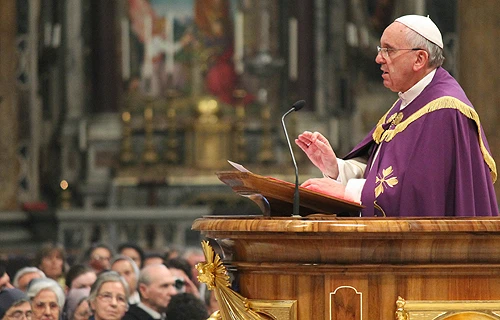
 Pope Francis preaches during a penance service at St. Peter’s Basilica, March 28, 2014. / Lauren Cater/CNA.
Zamboanga City, Philippines, Aug 26, 2021 / 18:00 pm (CNA).
A Philippines bishop has announced 40 days of fasting and penitence as a way to share in the sufferings of others and heal from the spiritual damage of the coronavirus pandemic. Such penitence and self-reflection, he said, will help the faithful “encounter Christ in the fullness of his generosity and love especially amidst this ongoing pandemic crisis.”
“The pandemic has revealed that we are not only vulnerable to this biological threat of COVID-19, but also to the contagion of hopelessness, depression, selfishness, the abuse of power, the lack of transparency and accountability, and the preoccupation to personal privileges to the detriment of those who continuously suffer,” Auxiliary Bishop Moises M. Cuevas of Zamboanga said in an Aug. 24 pastoral letter “Not by Bread Alone.”
Cuevas is serving as the apostolic administrator of the Archdiocese of Zamboanga, on the southern Philippines island of Mindanao, while the sitting archbishop Romulo de la Cruz recovers from a stroke.
He has declared Forty Days of Fasting and Penitence, to begin Oct. 13 and to end on Nov. 21, Christ the King Sunday. Observing these days would be actions “in solidarity with those who suffer readily the effects of the pandemic,” he said. Such a practice aims “to evoke the fasting and time of preparation of Christ in the wilderness.”
To help prepare the Catholic faithful in the months before these forty days, parishes should hold a catechesis in the months before, he said.
“Parishes shall readily make available the Sacrament of Reconciliation for those who wish to engage in a spiritual and moral renewal in this period,” said the bishop.
“I make an appeal to each of you to receive upon your hearts Christ as the word of life, provider and shepherd of us all,” he said. “It is Christ who remains faithful to us in his truth, compassion, and wisdom amidst this ongoing pandemic crisis in the city and elsewhere.”
Cuevas’ pastoral letter reflected on the coronavirus epidemic in light of Christ’s temptation in the desert, where the devil asked him to turn stones into bread.
“The desert experience has subjected Jesus to an extreme examination of his identity, reducing the trappings of his divinity and exaltedness,” said the bishop. “The pandemic crisis has also subjected us to an examination of the threshold of our charity, whether it would remain consistent or altogether fall apart. Jesus refused to change the stones into bread in the desert, even when tempted to do so, telling the tempter that man cannot indeed live on mere bread alone even amidst one’s desolation.”
“Through this crisis, Jesus shares with us what it means to be hungry, isolated, vulnerable,” the bishop said. “As in Christ’s temptation, the devil too presents attractive alternatives to our Christian mission and purpose: the lure of power, invulnerability, and influence to easily bring our notions of God’s Kingdom upon this mortal world – to save humanity from its self-destructive tendencies by choosing the most convenient and gainful promise of domination over a great many.”
The threat of the COVID-19 epidemic continues to “derail” the normalcy of daily life and puts at risk the most vulnerable, said the bishop.
“As a community we are still traversing on the verge of the unknown and most uncertain, while we precariously hold on to our emotional stability and the assurance that we are not left helpless in these present circumstances,” he said.
Close to 1 million people live in Zamboanga City.
The Philippines has had about 1.9 million reported cases and 32,700 deaths, according to Reuters. New infections reported average about 15,000 per day, and less than 15% of the country’s population has been fully vaccinated.
According to Cuevas, Zamboanga City is “greatly blessed” to have people who live “not by bread alone” but seek “the ‘eternal food’ of selfless service and witnessing to the call of communion and solidarity with those who can be left behind and struggle most amidst this crisis.” He specifically mentioned doctors, nurses, essential workers, volunteers, clergy and men and women religious, as well as parents, elders and family members who seek to stabilize their communities and their households.
“They understood that no one is saved alone,” said the bishop, citing Pope Francis’ December 2020 apostolic letter on St. Joseph, Patris Corde.
He stressed the need for true charity, not a false charity that is “manipulated as an affection or sentiment,” or is not “an authentic encounter or engagement with the other.” This is the kind of false charity that attempts to “live on bread alone.”
“As a Church, we encounter Christ as the life-giving word from the Eternal Father and the Bread that gives life in the sacrament of the Holy Eucharist,” said the bishop. “But the encounter must begin with our personal journey in confronting ourselves to what makes us cling to our raw instincts for personal survival and selfish gain.”
“Whenever we refuse to come out of ourselves, comfortable in the cocoons of our own satisfaction and privilege, Christ cannot come to us—and we cannot come to one another,” he added. “Our vicious obsession for self-preservation gives us this illusion of contentment and achievement that effectively cuts us off from the rest of struggling, barely-surviving humanity. Only in our willful and sustained encounter with Jesus can we realize what it means to share our lives and give the best of ourselves for others in a similar manner to His willful self-giving for humankind.”
He called anyone who had sinned against charity and justice to repent and make reparation:
“to those who have obsessively consumed and hoarded bread for themselves, those who have taken more than what they can collect, I say to them: return that which is stolen, remit that which needs accounting, in the name of charity and justice.”
He also sought the intercession of the Virgin Mary, Our Lady of the Pillar, saying her first encounter with God’s word “led her to wholeheartedly embrace her vocation as the Mother of the Redeemer and of the redeemed as well.”
“In our personal encounter with Christ in his word, who also shepherds and provides for us during this pandemic, we imitate and honor Mary’s humility and openness to charity and service for others,” he said. He cited Mary’s words from the Gospel of Luke: “Let it be done unto me according to your word.”

[…]


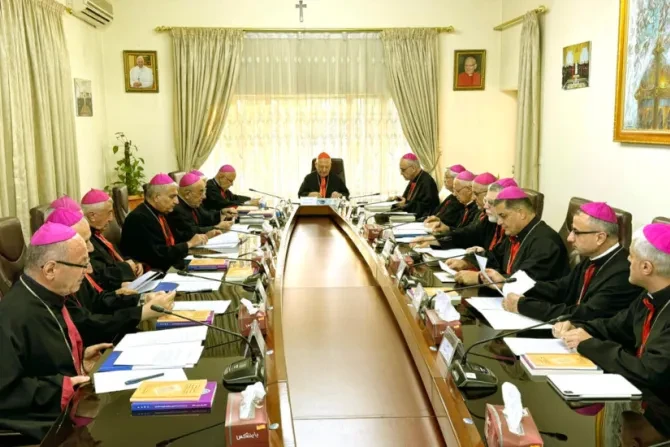



Clarity from the Chaldean Church. Where can I sign up?
Why might the inventive blessing of same-sex couples–as “couples”–remind us of the Crowdstrike “blue-screen” computer security meltdown?
Millions of computers were paralyzed by a system upgrade and a glitch that went sideways. As with COVID or the China virus, it’s almost as if a computer “virus” species-jumped from the backroom labs of the computer world! And, coincidentally, just as in June (gay pride month!) when personal computers were infected with an intrusive rainbow screenshot from puppet-master Microsoft boasting of its gay agenda dating back to 1989.
Do we see a pattern here?
The language of anti-binary unilateralism cross-dresses itself and spreads into many idioms. Something like the 1980s when AIDS jumped from the male homosexual population and penetrated the general population, surely through bisexuals. And then, the 1990s when anti-binary and broadened alphabetical tribalism began crowding out complementary human sexuality and the natural family (as Pope Paul VI also warned of contraceptive culture). And, now, infecting the ubiquitous internet world—with unilateral, amorphous and very front-to-back software homogeneity from the personal desktop to the near-infinite cloud. Just a penetrating click away—self-cancelling computer security plus equally ubiquitous and subliminal rainbow-flag propaganda!
In all domains, flat-universe entropy obsolescing “viva la difference”?
In yet another system upgrade and glitch—in the verbiage of Fiducia Supplicans (“couples”)—to what degree do we have a “blue-screen” gradualist obsolescence of moral theology and Humanae Vitae?