


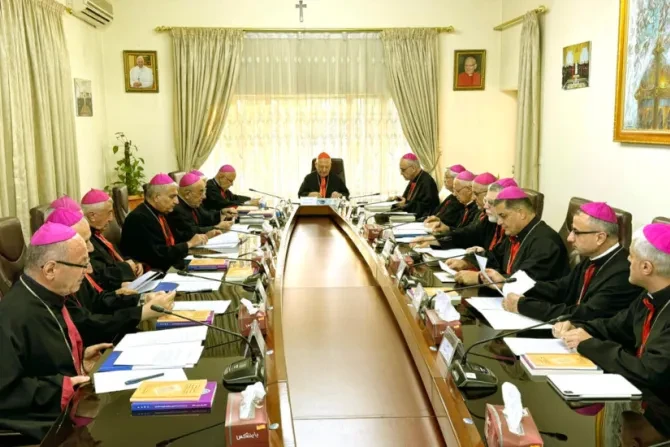
Baghdad, Iraq, Jul 25, 2024 / 16:30 pm (CNA).
The bishops of the Chaldean Synod on July 16 issued a statement declaring their position on the blessing of same-sex unions as well as the necessity of protecting children from sexual abuse.
The synod emphasized “the necessity of protecting children from sexual harassment and raising awareness among priests about its dangers,” stressing the importance of priests participating in child protection programs and obtaining certification from the local ecclesiastical authority.
The statement also clarified the position of the Chaldean Church — both in Iraq and worldwide — “regarding the union of two people of the same sex.” The synod asserted that the Chaldean Church does not recognize same-sex unions as marriage, as the legitimate and correct form of marriage for them is one that unites one man and one woman to form a family.

The statement concluded by firmly rejecting the blessing of same-sex unions in order “to preserve the sanctity of marriage” as one of the seven sacraments of the Church.
The Vatican previously issued directives allowing Catholic priests to bless same-sex couples. These directives were framed as an expression of pastoral closeness without condoning sexual relations between people of the same sex.
These directives sparked controversy, prompting the Vatican to issue a subsequent clarification, especially after the misunderstanding led the Coptic Church to suspend dialogue with the Latin Church.

The clarification stated that the nonliturgical form of the blessing is not a marriage, nor is it an endorsement or approval of same-sex relationships, but “merely a response from the pastor to two people seeking God’s help.”
This article was first published by ACI Mena, CNA’s Arabic-language news partner. It has been translated and adapted by CNA.
If you value the news and views Catholic World Report provides, please consider donating to support our efforts. Your contribution will help us continue to make CWR available to all readers worldwide for free, without a subscription. Thank you for your generosity!
Click here for more information on donating to CWR. Click here to sign up for our newsletter.


Clarity from the Chaldean Church. Where can I sign up?
Why might the inventive blessing of same-sex couples–as “couples”–remind us of the Crowdstrike “blue-screen” computer security meltdown?
Millions of computers were paralyzed by a system upgrade and a glitch that went sideways. As with COVID or the China virus, it’s almost as if a computer “virus” species-jumped from the backroom labs of the computer world! And, coincidentally, just as in June (gay pride month!) when personal computers were infected with an intrusive rainbow screenshot from puppet-master Microsoft boasting of its gay agenda dating back to 1989.
Do we see a pattern here?
The language of anti-binary unilateralism cross-dresses itself and spreads into many idioms. Something like the 1980s when AIDS jumped from the male homosexual population and penetrated the general population, surely through bisexuals. And then, the 1990s when anti-binary and broadened alphabetical tribalism began crowding out complementary human sexuality and the natural family (as Pope Paul VI also warned of contraceptive culture). And, now, infecting the ubiquitous internet world—with unilateral, amorphous and very front-to-back software homogeneity from the personal desktop to the near-infinite cloud. Just a penetrating click away—self-cancelling computer security plus equally ubiquitous and subliminal rainbow-flag propaganda!
In all domains, flat-universe entropy obsolescing “viva la difference”?
In yet another system upgrade and glitch—in the verbiage of Fiducia Supplicans (“couples”)—to what degree do we have a “blue-screen” gradualist obsolescence of moral theology and Humanae Vitae?