The Knights of Columbus film “In Solidarity with Ukraine” will have a six-week run on ABC-affiliated stations starting Feb. 26. / YouTube/Knights of Columbus Supreme Council
Boston, Mass., Feb 25, 2023 / 05:00 am (CNA).
Husbands have been separated from their wives; children separated from their parents, and thousands of civilians have been killed since Russia invaded Ukraine a year ago.
In the trailer for the Knights of Columbus’ new film, “In Solidarity with Ukraine,” Natalia Lvivska of Gostomel, one of the millions of displaced Ukrainians, said: “We were even afraid to leave the house. The road was also dangerous and scary. It’s not a movie. It’s reality.”
The documentary premieres on Feb. 26 and will run for six weeks on ABC-affiliated stations across the country.
The interview with Lvivska is one of many personal stories that the Knights of Columbus will be presenting in their new documentary about the humanitarian crisis in the war-torn nation, which its director says tells a story of “charity, solidarity, and prayer.”
“It’s the greatest refugee crisis since the Second World War,” David Naglieri, the film’s director, told CNA Friday.
Almost 18 million Ukrainians are in “dire need” of humanitarian aid, while 14 million have been displaced from their homes, according to the United Nations.
Water shortages have resulted from the disastrous conditions and electric outages spanning the nation, something that the Knights’ leader, Supreme Knight Patrick Kelly, experienced in his visit to Ukraine in December.
“Things are more difficult now in Ukraine than they were nine months ago,” Kelly told CNA in a December interview following his visit. “And we need to stay the course and continue to help them.”
The 60-minute documentary was shot over the past year, following the Knights of Columbus’ charity work in Ukraine and Poland, including Ukrainian cities such as Lviv and Kyiv, the country’s capital.
In addition to interviews with many Knights of Columbus in both Poland and Ukraine, the film features interviews with Supreme Knight Kelly; Archbishop Borys Gudziak, the archeparch of the Ukrainian Catholic Archeparchy of Philadelphia; Ukrainian Catholic Major Archbishop Sviatoslav Shevchuk; and Archbishop Mieczysław Mokrzycki of Lviv, Ukraine.
But not all interviewed are clergy or household names, Naglieri said.
The film highlights the stories of Ukrainian refugees, including a displaced couple forced to flee the country, a Polish couple who took refugees into their own home, and a family who had adopted two special-needs Ukrainian children before the war and got involved with gathering and transporting medical supplies from their local community to Ukraine.
The film also features an interview with Alexander and Danylo Fedoryka, two American brothers whose parents immigrated from Ukraine and have a Washington, D.C.-based band called Scythian, which one outlet calls a “high-energy Celtic folk-rock band.”
The brothers, who are members of the Knights of Columbus, were “heartbroken” when the war broke out and wanted to help. They began directing their fans to the Knights’ Ukraine Solidarity Fund, which fundraised for food and supplies for Ukrainian refugees.
To date, the Ukraine Solidarity Fund has raised over $20 million.
Naglieri said the biggest challenges in filming the documentary were finding a videography crew willing to work in a war-torn nation as well as working for long stretches of time.
While communicating over the phone with one of their cameramen in Kyiv, Naglieri said he would hear bombs and sirens in the distance.
“This is a real humanitarian crisis, and I think by broadcasting the images of the suffering that people are enduring, we hope to educate viewers in the United States and educate them about the need to support those who have lost everything during this war, and also to advocate and pray for peace,” he said.
The trailer can be seen below.
If you value the news and views Catholic World Report provides, please consider donating to support our efforts. Your contribution will help us continue to make CWR available to all readers worldwide for free, without a subscription. Thank you for your generosity!
Click here for more information on donating to CWR. Click here to sign up for our newsletter.
Thousands of pro-life advocates gathered outside the U.S. Supreme Court in Washington, D.C., on Dec. 1, 2021, in conjunction with oral arguments in the Dobbs v. Jackson Women’s Health Organization abortion case. / Katie Yoder/CNA
Washington D.C., Dec 2, 2021 / 08:04 am (CNA).
Anna Del Duca and daughter, Frances, woke up at 5 a.m. Wednesday morning to brave the 30-degree weather outside the U.S. Supreme Court in Washington, D.C. They arrived hours before oral arguments began in the highly-anticipated abortion case, Dobbs v. Jackson Women’s Health Organization.
The case, which involves a Mississippi law restricting most abortions after 15 weeks, challenges two landmark decisions: Roe v. Wade, the 1973 ruling that legalized abortion nationwide, and Planned Parenthood v. Casey, which upheld Roe in 1992.
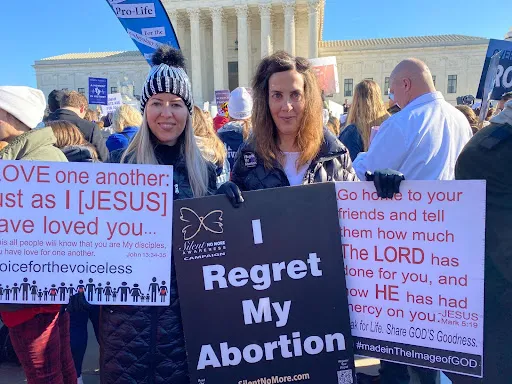
“We’re looking forward to the end of Roe versus Wade in our country,” Anna, who drove from Pittsburgh Tuesday night, told CNA. In her hands, she held a sign reading, “I regret my abortion.”
Anna Del Duca (right) and her daughter, Frances, traveled from Pittsburgh to attend a pro-life rally outside the U.S. Supreme Court on Dec. 1, 2021, in conjunction with oral arguments for the Dobbs v. Jackson Women’s Health Organization abortion case. Katie Yoder/CNA
“I would like to use my testimony to be a blessing to others,” she said, so that “others will choose life or those who have regretted abortion or had an abortion would turn to Jesus.”
Anna remembered having an abortion when she was just 19. Today, she and her daughter run a group called Restorers of Streets to Dwell In Pittsburgh that offers help to women seeking healing after abortion.
Anna and Frances were among thousands of Americans who rallied outside the Supreme Court before, during, and after the oral arguments. To accommodate them, law enforcement closed the street in front of the court. Capitol police also placed fencing in the space in front of the building in an attempt to physically separate rallies held by abortion supporters and pro-lifers.
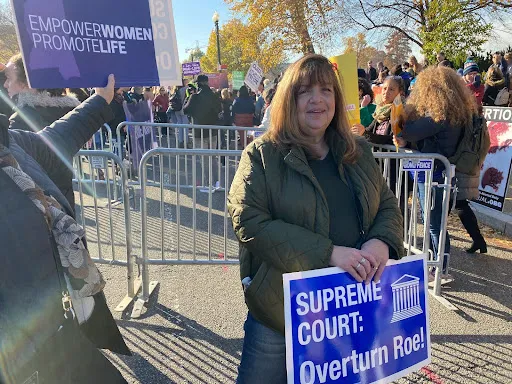
At 21-weeks pregnant, pro-life speaker Alison Centofante emceed the pro-life rally, called, “Empower Women Promote Life.” The event featured a slew of pro-life women of diverse backgrounds and numerous politicians.
“It’s funny, there were so many diverse speakers today that the only unifying thread was that we want to protect preborn children,” Centofante told CNA. They included Democrats, Republicans, Christians, Catholics, agnostics, atheists, women who chose life, and women who regretted their abortions, she said.
She recognized women there, including Aimee Murphy, as people who are not the typical “cookie cutter pro-lifer.”
Aimee Murphy, 32, founder of pro-life group Rehumanize International, arrived at the Supreme Court around 6:30 a.m. She drove from Pittsburgh the night before. Her sign read, “Queer Latina feminist rape survivor against abortion.”“At Rehumanize International, we oppose all forms of aggressive violence,” she told CNA. “Even as a secular and non-partisan organization, we understand that abortion is the most urgent cause that we must stand against in our modern day and age because it takes on average over 800,000 lives a year.”
She also had a personal reason for attending.
“When I was 16 years old, I was raped and my rapist then threatened to kill me if I didn’t have an abortion,” she revealed.
“It was when he threatened me that I felt finally a solidarity with unborn children and I understood then that, yeah, the science told me that a life begins at conception, but that I couldn’t be like my abusive ex and pass on the violence and oppression of abortion to another human being — that all that I would be doing in having an abortion would be telling my child, ‘You are an inconvenience to me and to my future, therefore I’m going to kill you,’ which is exactly the same thing that my rapist was telling me when he threatened to kill me.”
On the other side of the police fence, the Center for Reproductive Rights and the National Abortion Access Coalition and NARAL Pro-Choice America participated in another rally. Yellow balloons printed with the words “BANS OFF OUR BODIES” escaped into the sky. Several pro-choice demonstrators declined to speak with CNA.
Voices clashed in the air as people, the majority of whom were women, spoke into their respective microphones at both rallies. Abortion supporters stressed bodily autonomy, while pro-lifers recognized the humanity of the unborn child. Chants arose from both sides at different points, from “Whose choice? My choice!” to “Hey hey, ho ho, Roe v. Wade has got to go!”
At 10 a.m., the pro-life crowd sudddenly went silent as the oral arguments began and the rally paused temporarily as live audio played through speakers.
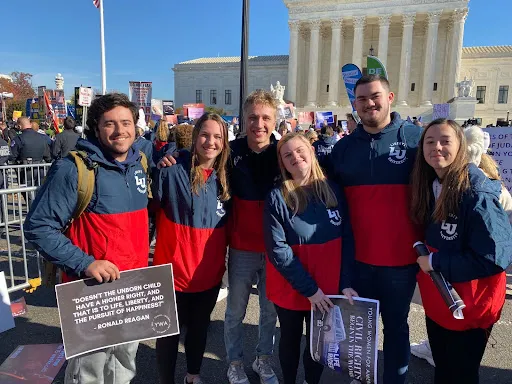
Hundreds of students from Liberty University in Lynchburg, Virginia, traveled to Washington, D.C. for a pro-life rally outside the U.S. Supreme Court on Dec. 1, 2021, in conjunction with oral arguments in the Dobbs v. Jackson Women’s Health Organization abortion case. Katie Yoder/CNA
During the oral arguments, students from Liberty University knelt in prayer. One student estimated that more than a thousand students from the school made the more than 3-hour trip from Lynchburg, Virginia.
“Talking about our faith is one thing, but actually acting upon it is another,” he said. “We have to be the hands and feet of Jesus Christ. So to me this is part of doing that.”
Sister Mary Karen, who has been with the Sisters of Life for 21 years, also stressed the importance of prayer. She drove from New York earlier that morning because, she said, she felt drawn to attend. She came, she said, to pray for the country and promote the dignity of a human person.
“Our culture is post-abortive,” she explained. “So many people have suffered and the loss of human life is so detrimental, just not knowing that we have value and are precious and sacred.”
Theresa Bonopartis, of Harrison, New York, was among the pro-life demonstrators outside the U.S. Supreme Court on Dec. 1, 2021. She runs a nonprofit group called Entering Canaan that ministers to women and others wounded by abortion. Katie Yoder/CNA
She stood next to Theresa Bonopartis, who traveled from Harrison, New York, and ministers to women and others wounded by abortion.
“I’ve been fighting abortion for 30 years at least,” she told CNA.
Her ministry, called Entering Canaan, began with the Sisters of Life and is observing its 25th anniversary this year. It provides retreats for women, men, and even siblings of aborted babies.
Abortion is personal for Bonopartis, who said she had a coerced abortion when she was just 17.
“I was kicked out of the house by my father and then coerced into getting an abortion,” she said. “Pretty much cut me off from everything, and that’s something people don’t really talk about … they make it try to seem like it’s a woman’s right, it’s a free choice. It’s all this other stuff, but many women are coerced in one way or another.”
She guessed that she was 14 or 15 weeks pregnant at the time.
“I saw my son. I had a saline abortion, so I saw him, which I always considered a blessing because it never allowed me to deny what abortion was,” she said. Afterward, she said she struggled with self-esteem issues, hating herself, guilt, shame, and more. Then, she found healing.
“I know what that pain is like, I know what that experience is like, and you know that you can get past it,” she said. “You just want to be able to give that message to other people, that they’re able to heal.”
Residents of Mississippi, where the Dobbs v. Jackson case originated, also attended.
Marion, who declined to provide her last name, drove from Mississippi to stand outside the Supreme Court. She said she was in her early 20s when Roe v. Wade was decided in 1973.
“At the time, of course, I could care less,” she said. Since then, she had a change of heart.
“We were the generation that allowed it,” she said, “and so we are the generation who will help close that door and reverse it.”
Marion, who declined to provide her last name, was among those who attended a pro-life rally outside the U.S. Supreme Court on Dec. 1, 2021, from Mississippi, where the Dobbs v. Jackson Women’s Health Organization abortion case originated. Katie Yoder/CNA
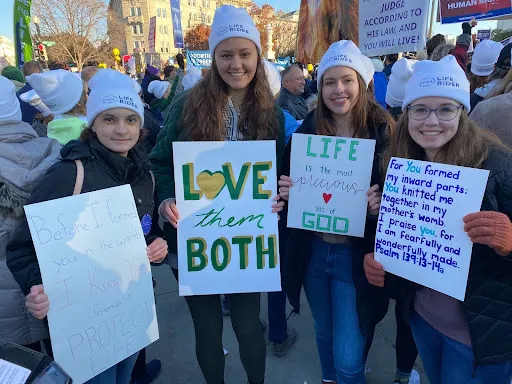
The crowd at the pro-life rally included all ages, from those who had witnessed Roe to bundled-up babies, children running around, and college students holding up homemade signs.
One group of young friends traveled across the country to stand outside the Supreme Court. They cited their faith and family as reasons for attending.
Mathilde Steenepoorte, 19, from Green Bay, Wisconsin, identified herself as “very pro-life” in large part because of her younger brother with Down syndrome. She said she was saddened by the abortion rates of unborn babies dianosed with Down syndrome.
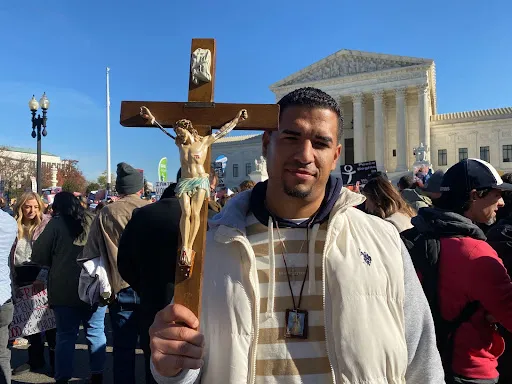
Juanito Estevez, from Freeport, a village on Long Island, New York, at a pro-life rally outside the U.S. Supreme Court on Dec. 1, 2021. Katie Yoder/CNA
Juanito Estevez, from Freeport, a village on Long Island, New York, arrived Tuesday. He woke up at 6 a.m. to arrive at the Supreme Court with a crucifix in hand.
“I believe that God is the giver of life and we don’t have the right [to decide] whether a baby should live or die,” he said.
He also said that he believed women have been lied to about abortion.
“We say it’s their right, and there’s a choice,” he said. When girls tell him “I have the right,” his response, he said, is to ask back, “You have the right for what?”
Mallory Finch, from Charlotte, North Carolina, was among the pro-life demonstrators outside the U.S. Supreme Court on Dec. 1, 2021.
Mallory Finch, from Charlotte, North Carolina, also woke up early but emphasized “it was worth it.” A pro-life podcast host, she called abortion a “human-rights issue.”
“I hope that it overturns Roe,” she said of the case, “but that doesn’t mean that our job as pro-lifers is done. It makes this, really, just the beginning.”
ACI Prensa Staff, Apr 12, 2023 / 11:45 am (CNA).
Two Catholic Relief Services (CRS) workers were shot and killed April 9, Easter Sunday, while riding in a CRS vehicle in the Amhara region of Ethiopia on their way back from an assign… […]
CNA Staff, May 12, 2020 / 03:20 pm (CNA).- An employee of the Diocese of Saginaw, Michigan is suing the diocese, alleging that his fellow employees retaliated against him after he reported that a Saginaw priest sexually abused his son.



Leave a Reply