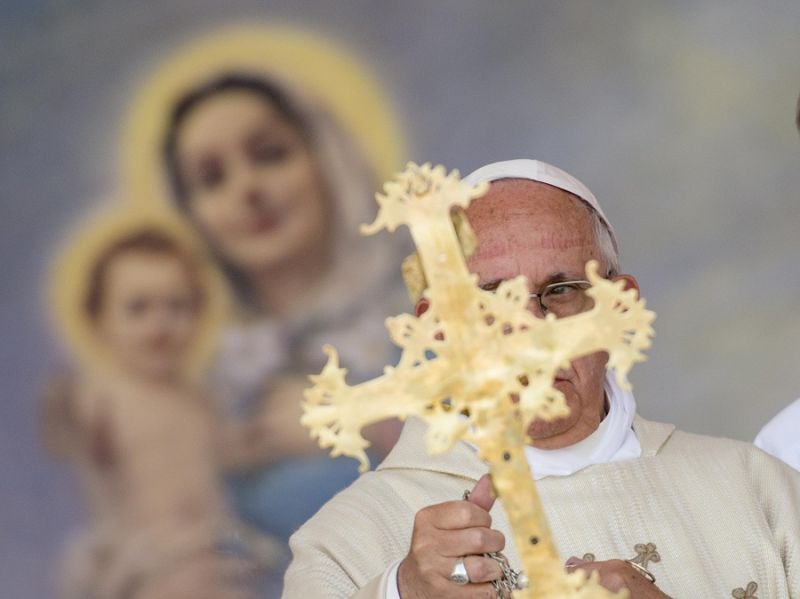
Pope Francis celebrates Mass in Gyumri, Armenia, June 25, 2016. / L’Osservatore Romano/CNA
Vatican City, Dec 10, 2022 / 07:00 am (CNA).
Pope Francis told seminarians on Saturday that praying the rosary can “unveil the mysteries of the priesthood” in its moments of joy, sorrow, and the glory to come.
In a meeting with seminarians from Barcelona, the pope urged the young men to remember that “when you are a priest your first obligation will be a life of prayer.”
“Dear seminarians, take up your rosary and ask Mary, Queen and Mother of Mercy, to help unveil the mysteries of the priesthood to which God calls you, contemplating the mysteries of his Son, realizing that the joy of discipleship and perfect identification with the cross are the only way to glory,” Pope Francis said on Dec. 10.
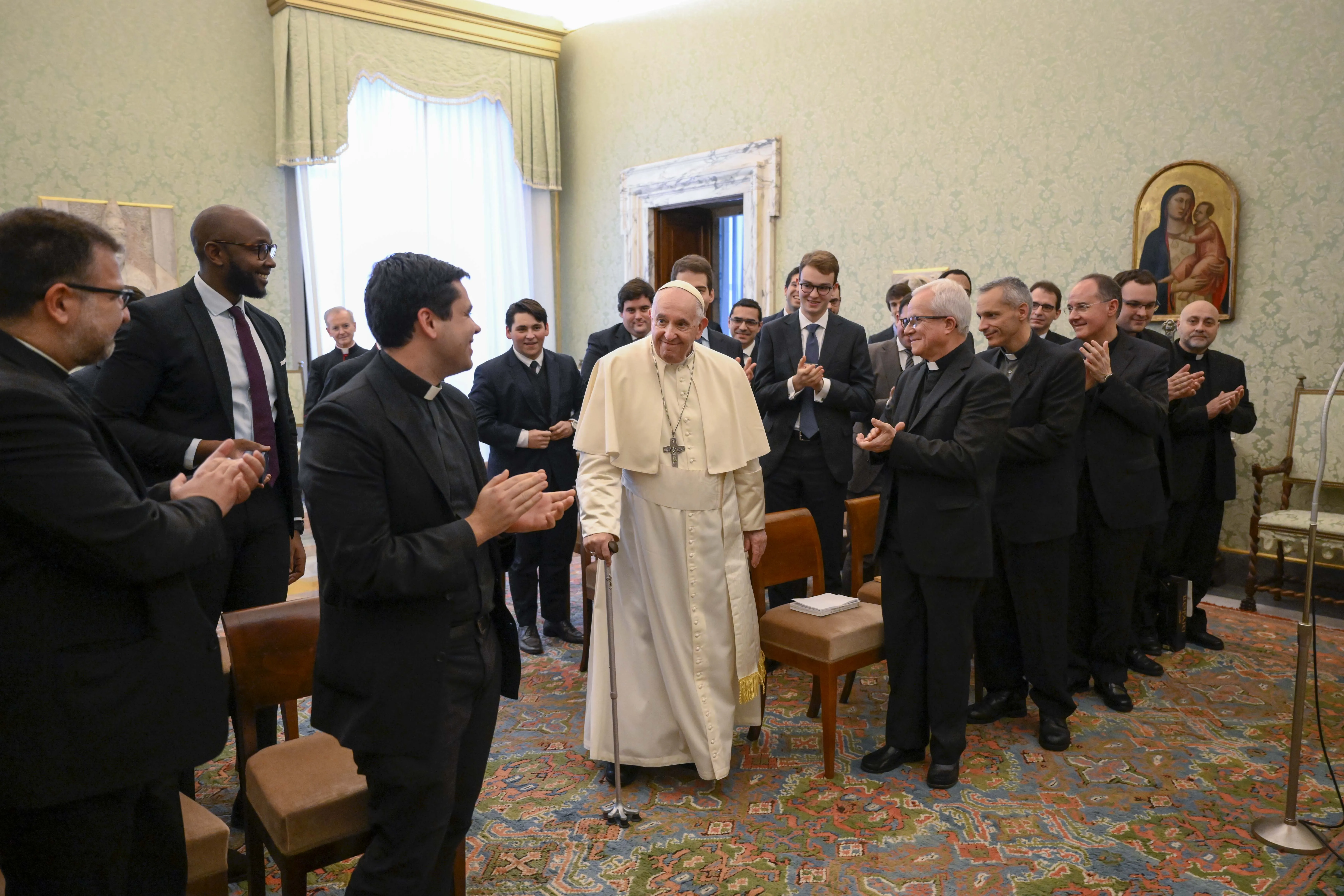
Pope Francis spoke to seminarians from Barcelona at the Vatican on Dec. 10, 2022. Vatican Media
The pope explained that the joyful mysteries of the priesthood are “born of gratitude for that preferential love that God showed you by calling you to his service.”
He recommended that seminarians contemplate the Blessed Virgin Mary’s attitude at the Annunciation and ask: “How was she when God called her? And how was I? With what zeal do I consider my future priestly life? Will I rise up … with love, to bring God to the world? Will I take him up the most arduous and painful of mountains?”
Pope Francis added that the fifth joyful mystery of the rosary, the finding of Jesus in the temple, contains a particular lesson that should never be forgotten.
Throughout life, we must always return to look for Jesus in the tabernacle, he said, encouraging the future priests to “lose yourselves there with Him.”
In the sorrowful mysteries of the rosary, a priest is reminded that he “must aspire to a crown of thorns,” to be identified with the Lord in his suffering, the pope said.
“There is the sacrifice of assuming one’s own cross and beginning a path, often of abandonment. It is the sacrifice of life. Looking at the cross we raise our eyes to heaven and see our destiny,” Pope Francis said.
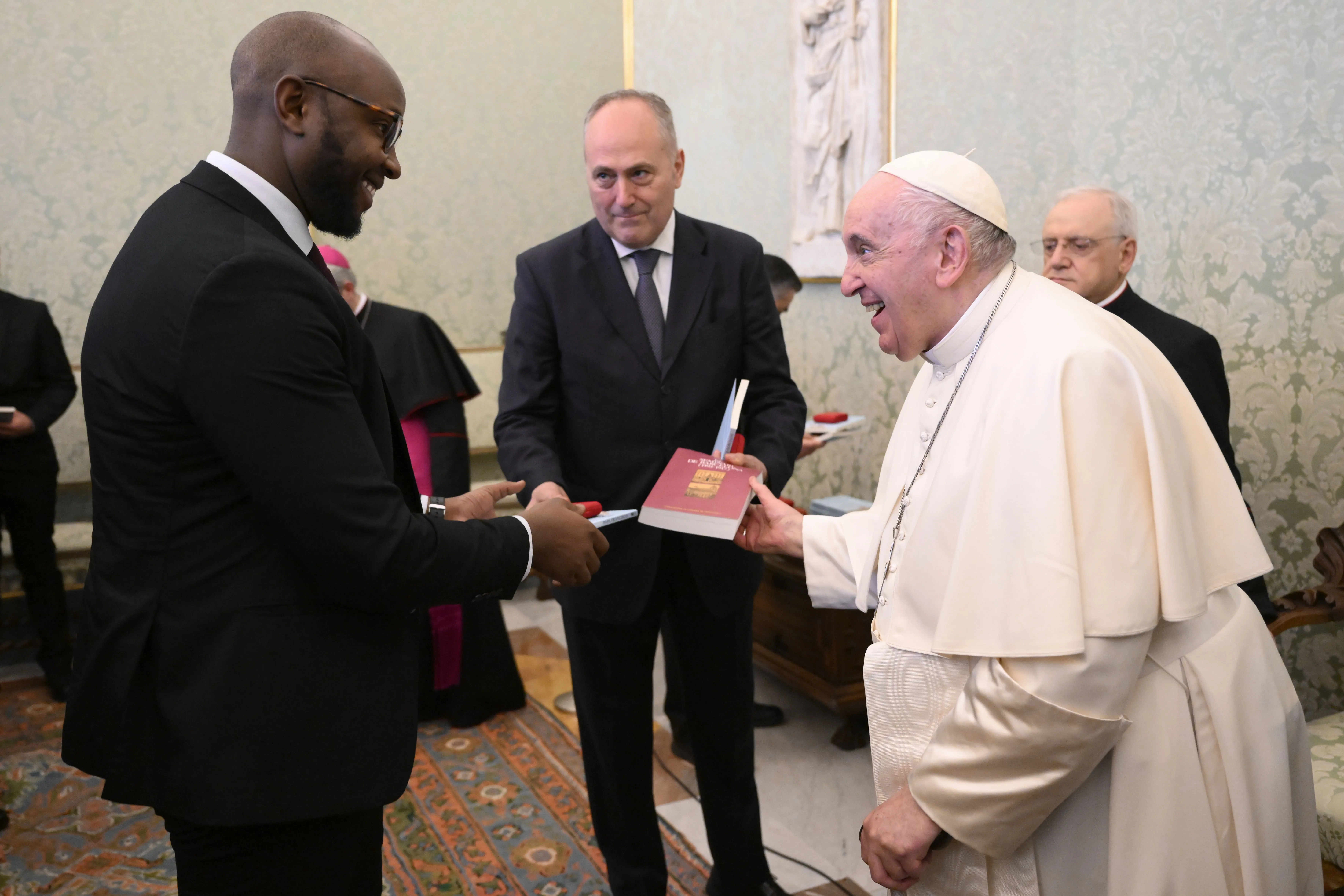
Pope Francis spoke to seminarians from Barcelona at the Vatican on Dec. 10, 2022. Vatican Media
For a priest, the glorious mysteries are found in the Mass in thanksgiving for the Passion of Jesus, he explained.
“After the triumph of the resurrection, Jesus entered the sanctuary of heaven and from there he perpetuates this continuous thanksgiving. Seeing him seated at the right hand of the Father calls us to hope and fills us with joy because he assures us of heaven,” he said.
“For this God sends the Holy Spirit, the only one who can teach us these mysteries, and one day he will give you the gift of being priests of Christ. Never cease to savor and remember this love of predilection that is poured and will be poured abundantly into your heart, at your ordination, and for the rest of your days.”
“Never extinguish this fire that will make you fearless preachers of the Gospel, dispensers of divine gifts. Unite your flesh to that of Jesus, like Mary, to immolate yourselves with him in the Eucharistic sacrifice, and also in the glory of his triumph,” Pope Francis said.
If you value the news and views Catholic World Report provides, please consider donating to support our efforts. Your contribution will help us continue to make CWR available to all readers worldwide for free, without a subscription. Thank you for your generosity!
Click here for more information on donating to CWR. Click here to sign up for our newsletter.
Patrick Norton stands near Sister Annella Zervas’ grave, October 2022. / Credit: Patti Armstrong
St. Paul, Minn., Dec 10, 2023 / 06:00 am (CNA).
Pointing toward the Our Lady of Lourdes Grotto at the Saint Benedict Monastery cemetery in St. Joseph, Minnesota, 61-year-old Patrick Norton recounts the day 13 years ago when he was painting light posts in front of a statue of the Blessed Mother and encountered who he believes was Sister Annella Zervas, OSB.
Zervas, a Benedictine sister, died in 1926 at the age of 26 of a debilitating skin disease.
Norton, who was plucked from the streets of Bombay as a child by Mother Teresa and later adopted by an American family, had been hired by the College of Saint Benedict on Oct. 27, 2010, to do some painting. He told CNA that while finishing up the last light post in front of the grotto he thought to himself, “I wonder if the Blessed Mother thinks I am doing a good job?” When he looked down, there was a nun in full Benedictine habit.
“‘You are doing a good job,’ she told me. We talked a little, but I don’t remember what it was about. Then I watched as she disappeared,” he told CNA.
The encounter was so astonishing that Norton kept it to himself for a year. But in a chance conversation, he was told “there is a holy nun buried in that cemetery” and he came to learn it was Zervas. Eventually, he saw a picture of her and was certain that she was the one who had appeared to him.
Patrick Norton stands beside the lamp post he was painting near the Marian grotto when he saw a woman in full Benedict habit who he believes was Sister Annella Zervas. Credit: Patti Armstrong
An elderly religious sister at Saint Benedict Monastery — who also happened to be named Sister Annella — shared with Norton pictures of Zervas and a booklet about the young sister’s life called “Apostles of Suffering in Our Day” by Benedictine priest Joseph Kreuter, published in 1929.
“Why isn’t she a saint yet?’ Norton asked.
“Oh, I’m in my 80s and I’m the only one promoting her cause,” she replied.
“Sister, why can’t I help you out?” he replied.
Norton said she just looked at him. “I didn’t have any experience but felt compassion for her, and also, I did see Sister Annella, so I felt I had to promote her cause.”
He read in the booklet that Zervas entered the convent at age 15 and died from a painful, unsightly, and odiferous skin disease at age 26. She was also subjected to attacks from the devil and from a heartburn that made it hard to keep food down. At the time of her death, she weighed only 40 pounds. Yet, she asked God to allow her even more suffering and for the strength to bear it so she could offer it up for the Church.
Every week, Norton made 10 copies of the booklet to pass out. “I went to Sister Annella’s grave and told her, ‘If I am going to make more books, I need money.’”
A short time later he had a conversation with someone he had just met and told about Zervas. “How can I help?” the person asked him.
“Can you help me make 20 books a week instead of just 10?”
“How about 20,000?” the donor, who wanted to remain anonymous, replied.
The number of books Norton has now distributed is about 100,000. It was also previously published in French and Sri Lanken.
Another good Samaritan arranged for Norton to be interviewed for a video called “The Sanctity of Two Hearts.”
A friend of Norton’s located Joanne Zervas, a niece of Sister Annella’s, and Norton met with her. She gave him many of her aunt’s personal effects for safekeeping, including family letters, a silver spoon used to give holy Communion when Zervas was incapacitated, her rosary, a book stained with what is believed to be her blood, and candles that burned in her room when she died.
Word spread about the sister and there were reports of answered prayers through her intercession. Yet, it seemed unlikely that a cause for her canonization would open.
Norton recounted that Bishop Donald Joseph Kettler of the Diocese of St. Cloud encouraged him to keep telling his story but declined to take further steps in order to respect the wishes of the Benedictine sisters who were not interested in opening a cause for Zervas.
In a SC Times article in 2017, a spokesperson for the Sisters of the Order of St. Benedict in St. Joseph, Minnesota, said it was not the Benedictine way to promote one sister above another as it would “be contrary to humility.” A spokesperson from the diocese said that without their support, there would be no cause.
But Norton and a small group that had formed to pray that her cause be opened met monthly at the cemetery and kept praying.
After years of disappointment, Archbishop Bernard Hebda of St. Paul and Minneapolis informed Norton that he was appealing to the wrong diocese. Zervas had died in her parents’ home in Moorhead, Minnesota, which is in the Crookston Diocese. But again, there was no interest in opening a cause there.
“I went through darkness,” Norton admitted. “I would say, ‘Really Lord, are you hearing me?’ One day I said, ‘I’m not getting any younger you know.’”
Norton questioned if he was even the right person to promote Zervas. “I’m not a doctor or a lawyer; I’m just a painter,” he said. But he had told the Lord: “Let me live each day for you, and I will tell people about her through my nothingness.”
Patrick Norton speaks during event at the grotto in the cemetery during event where the bishop’s letter was read in October 2023. Credit: Patti Armstrong
Then in 2021, Bishop Andrew Cozzens was appointed to the Diocese of Crookston. Norton heard that Cozzens had known about Zervas since he was a boy. Then on Oct. 15 Norton heard — through a letter from the bishop that was read at the cemetery to the prayer group — that initial steps are being put in place by the diocese to begin an investigation into Zervas’ life, which will make it possible for a cause to be opened.
Norton has now been promoting Zervas’ story for more than a decade.
“I couldn’t fall asleep that night,” Norton told CNA. “I was overwhelmed. The first thing I did was to thank Our Lord and Our Lady. Before going to bed, every night, I always kiss the cheek of Our Lady of Fátima statue [in his home] and say, ‘Good night, Mother.’ And I kiss the feet of Our Lord on a big crucifix from a monastery in Spain and say, ‘You are my Lord and my God. There is no other God, and I love you.’”
“Even before Sister Annella appeared to me, every Mother’s Day, I brought roses to the grotto and would tell [Mary], ‘You are the best Ma in the whole world. Happy Mother’s Day, Ma.’ I’d sit there and look at the big crucifix and pray the rosary.”
Norton said he is at peace with his efforts over the years to make Zervas’ life and holiness known. “Since the diocese is taking over, I’m going to just be silent and do my best to live in humility and pray,” he said. “I will pray a lot and thank the Lord for the work he is doing.”
Denver, Colo., Sep 12, 2018 / 01:00 pm (CNA).- A Vatican summit on abuse prevention next February will gather the presidents of bishops’ conferences from around the world. While a Sept. 12 statement from the Vatican said the gathering’s theme would be the “protection of minors,” a Vatican spokesperson clarified that the meeting would discuss “prevention of abuse of minors and vulnerable adults.”
The USCCB’s “Charter for the Protection of Children and Young People,” does not use the term “vulnerable adult.”
Nor do the “Essential Norms for Diocesan/Eparchial Policies Dealing with Allegations of Sexual Abuse of Minors by Priests or Deacons,” which are binding Church policies for addressing sex abuse allegations in the United States.
Several dioceses, do, however, define the term in their own sexual abuse policies.
Policies of the Archdiocese of St. Paul-Minneapolis say that: “‘Vulnerable Adult’ means persons with physical, mental or emotional conditions that render them unable to defend or protect themselves, or get help when at risk of harm.”
In the Archdiocese of Louisville, “an adult 18 years or older is considered vulnerable when, because of impairment of mental or physical functions, that person is unable or unlikely to report abuse or neglect without assistance.”
The Archdiocese of Miami defines a “vulnerable person” as “a minor under 18 years of age or a person whose ability to perform normal activities of daily living is impaired due to a mental, emotional, long-term physical or developmental disability or dysfunction, or brain damage, or the infirmities of aging.”
The Archdiocese of Washington’s policies for child protection say that “a vulnerable individual over the age of seventeen (17) is also covered by this policy…when such a person is unable or unlikely to report abuse without assistance because of impairment of physical or mental function or emotional status.”
Edward Mechmann, director of the Safe Environment Program in the Archdiocese of New York, told CNA that the archdiocese considers a vulnerable person to be “a person of any age who lacks the capacity to give consent due to a mental or developmental condition or disability.”
The Code of Canon Law does not use or define the term “vulnerable adult.” However, the Church’s 2010 “Norms on delicta graviora” say that “a person who habitually lacks the use of reason is to be considered equivalent to a minor” with regard to allegations of clerical sexual abuse.
The February summit was announced in the wake of clerical sexual misconduct allegations across the Church involving minors, as well as allegations of misconduct that targeted seminarians, priests, and other adults.
On Aug. 14, a Pennsylvania grand jury released a report documenting 70 years of sexual abuse allegations in six dioceses in that state. On Sept. 12, a report from the German bishops’ conference documented allegations of clerical sexual abuse during a similar time period.
On June 20, the Archdiocese of New York announced that it had deemed credible an allegation that Archbishop Theodore McCarrick had serially sexually abused a teenage boy in the 1970s. Subsequent reports, however, allege that McCarrick had serially sexually coerced and assaulted seminarians and young priests during decades of his episcopal ministry in New Jersey and Washington, D.C.
Mechmann told CNA that the term “vulnerable adult” as his archdiocese defines it, “would not include seminarians. It is really aimed at protecting people who have developmental disabilities or cognitive disabilities, for instance someone who is suffering from Alzheimer’s disease.”
“A sound diocesan policy, however, would also encompass any kind of non-consensual sexual conduct, even if it is not strictly covered by the Charter,” Mechmann added.
The Archdiocese of New York’s “Policy on Sexual Misconduct” includes in its definition of sexual misconduct “any sexual act with another person without consent,” as well as “any sexual conduct that is a violation of civil law.”
Deacon Bernie Nojadera, executive director of the USCCB’s office for child and youth protection, told CNA that several U.S. dioceses use the definition of “vulnerable adult” provided by civil law.
That definition often refers to a “dependent adult,” he said.
Nojadera noted that “there is nothing in [the Charter] that talks about differential of power. So if you’re looking at differential of power, that’s not addressed in the Charter.”
“That’s where applicability of state law comes in, with regard to the differential of power. A lot of dioceses are looking at their state laws and trying to apply them accordingly,” he said.
With regard to allegations of abuse involving seminarians and other adults, he said he thinks “it would be wise for those types of situations to also be brought forward” at the February meeting of bishops.
“I would hope that there would be a seat at the table for seminarians and for that issue to be addressed,” he told CNA.
In addition to the abuse of minors, vulnerable adults, seminarians, and other adults, Nojadera noted other situations that could, in his view, be addressed, mentioning the difficulties faced by the children of priests, the use of corporal punishment in the Church, and situations involving religious orders.
He also mentioned the importance of consulting with victims of clerical sexual abuse.
“I would hope that survivor victims were invited to this table as well, to be able to address [the meeting],” he said.
Nojadera said that his office often looks for insights from victims of clerical sexual abuse, calling their perspective “invaluable.”
“There’s an awareness that those who have not been abused do not have.”
He also encouraged broader lay involvement in discussions about sexual misconduct in the Church. “The lay faithful have been offering to help and contribute to the solution to this,” he said.
Nojadera said he hopes the February summit will take an expansive view of abuse-related problems in the Church.
“I think we have an opportunity here to just talk about abuse in general. Period.”
“Hopefully,” he said, “they’ll have an opportunity to see the big picture.”
Three attacks against the Rome headquarters of the Italian pro-life center Pro Vita & Famiglia have taken place in the last month alone. / Credit: Pro Vita & Famiglia
ACI Prensa Staff, Jun 10, 2024 / 16:30 pm (CNA).
The pro-life Italian… […]
1 Comment
The harvest is plentiful but the laborers are few. May the Lord of the harvest inspire generous laborers to take up the challenge of humble service.
