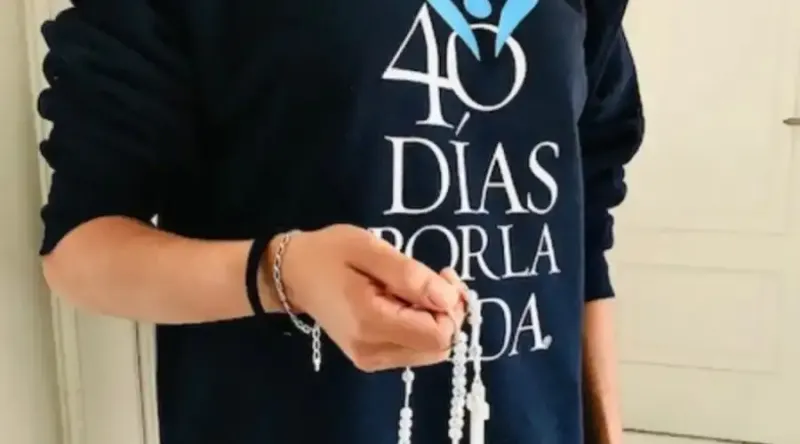
The bishop of Orihuela-Alicante, Spain, José Ignacio Munilla, joined the 40 Days for Life campaign Nov. 2 in front of an abortion facility to pray for an end to abortion.
His actions were significant because Spain passed a law in April that can construe praying in front of an abortion clinic as a form of harassment punishable by fines.
Munilla shared a photograph on Twitter showing himself with other volunteers from 40 Days for Life.
“On this day of #TodosLosFielesDifuntos (All the Faithful Departed) I participated in the 40 Days for Life campaign, praying before an abortion center in Alicante,” the prelate wrote.
“If abortion is progressivism, then the law of the jungle is the height of democracy!” he added.
En este día de #TodosLosFielesDifuntos he participado en la campaña de 40 Días Por La Vida, orando ante un abortorio en Alicante.
¡Si el aborto es progresismo, entonces la ley de la selva es la cumbre de la democracia!#SiAlaVidapic.twitter.com/8vjuqoW8jD
40 Days for Life is a prayer and fasting campaign to end abortion that began in the United States in 2004 and has spread throughout the world.
There are two 40-day campaigns held each year, one in the spring and one in the fall. Volunteers take time slots praying in front of clinics where abortions are performed or in significant places in the cities that join the campaign.
This story was first published by ACI Prensa, CNA’s Spanish-language news partner. It has been translated and adapted by CNA.
If you value the news and views Catholic World Report provides, please consider donating to support our efforts. Your contribution will help us continue to make CWR available to all readers worldwide for free, without a subscription. Thank you for your generosity!
Click here for more information on donating to CWR. Click here to sign up for our newsletter.
London, England, Apr 6, 2018 / 04:07 pm (CNA/EWTN News).- As the parents of a sick toddler fight for continued treatment, saying that he is showing signs of improvement, the hospital where he is staying is requesting court permission to end his life su… […]
ACI Prensa Staff, Jun 17, 2024 / 17:15 pm (CNA).
The Archdiocese of Burgos in Spain has granted an extension to the Poor Clares of Belorado, giving them a new deadline of Friday, June 21, to appear before an… […]
Pope Francis smiles during the general audience in the Vatican’s San Damaso Courtyard on June 30, 2021. / Credit: Pablo Esparza/CNA.
Vatican City, Jun 30, 2021 / 05:05 am (CNA).
Pope Francis said on Wednesday that the dramatic conversion of St. Paul should remind us that God has a plan for our lives.
Speaking at the general audience June 30, the pope noted that Paul experienced a “radical transformation” from a persecutor to an Apostle.
“How often, in the face of the Lord’s great works, does the question arise: how is it possible that God uses a sinner, a frail and weak person, to do His will?” the pope asked.
“And yet, none of this happens by chance, because everything has been prepared in God’s plan. He weaves our history, the history of each of us: He weaves our history and, if we correspond with trust to His plan of salvation, we realize it.”
The pope’s livestreamed address, dedicated to “Paul, the true Apostle,” was the second in a new cycle of catechesis on St. Paul’s Epistle to the Galatians.
/ Pablo Esparza/CNA.
He observed that Paul began the letter by reminding the Christians in Galatia, present-day Turkey, of his deep love for them.
But Paul also recognized that the community was divided. He responded, the pope said, by underlining the novelty of the Gospel.
“We immediately discover that Paul has a profound knowledge of the mystery of Christ. From the beginning of his Letter he does not follow the low arguments used by his detractors,” the pope said.
“The Apostle ‘flies high’ and shows us, too, how to behave when conflicts arise within the community. Only towards the end of the Letter, in fact, is it made explicit that at the heart of the diatribe is the question of circumcision, hence of the main Jewish tradition.”
/ Pablo Esparza/CNA.
The pope praised Paul for identifying the issue that lay beneath the dispute, rather than seeking a quick fix.
“Paul chooses to go deeper, because what is at stake is the truth of the Gospel and the freedom of Christians, which is an integral part of it,” he said.
“He does not stop at the surface of the problems, as we are often tempted to do in order to find an immediate solution that deludes us into thinking that we can all agree with a compromise.”
“This is not how the Gospel works, and the Apostle chose to take the more challenging route.”
Paul reminded the Galatians that he was a true Apostle, the pope said, by telling the story of how he was called by God on the road to Damascus.
“On the one hand, he insists in underlining that he had fiercely persecuted the Church and that he had been a ‘blasphemer, a persecutor, and a man of violence’ (1 Timothy 1: 13); on the other, he highlights God’s mercy towards him, which led him to experience a radical transformation, well known to all,” he observed.
Commenting on Paul’s journey from “a blameless observer of the Mosaic Law” to “a herald among the pagans,” the pope said: “We must never forget the time and the way in which God entered our lives: keep fixed in your heart and mind that encounter with grace, when God changed our existence.”
/ Pablo Esparza/CNA.
Concluding his catechesis, the pope said that when we are called by God, we also receive a mission that He wishes us to undertake.
“That is why we are asked to prepare ourselves seriously, knowing that it is God Himself who sends us, God himself who supports us with His grace,” he said.
“Let us allow ourselves to be led by this awareness: the primacy of grace transforms existence and makes it worthy of being placed at the service of the Gospel.”
/ Pablo Esparza/CNA.
A precis of the pope’s catechesis was then read out in seven languages. After each summary, he greeted members of each language group.
One of the greetings was to pilgrims from Slovakia, a country that the Vatican is considering for a possible papal visit in September.
He said: “I greet with affection the Slovakian faithful, especially the participants in the Pilgrimage of Thanksgiving of the Eparchy of Košice, which celebrates the 350th anniversary of the miraculous weeping of the icon of Our Lady of Klokočov, led by their ordinary Archbishop Cyril Vasiľ.”
/ Pablo Esparza/CNA.
“Brothers and sisters, may this celebration of the Mother of God renew in your people the faith and the lively sense of her intercession on your journey.”
Addressing Italian speakers, the pope thanked his senior driver Renzo Cestiè, who he noted was retiring that day.
“He started working when he was 14, he came by bicycle,” the pope said. “Today he is the pope’s driver: he did all of this. An applause for Renzo and his faithfulness.”
/ Pablo Esparza/CNA.
“He is one of those people who carries the Church forward with his work, with his benevolence and with his prayer. I thank him and also take the opportunity to thank the many lay people who work with us in the Vatican,” he said.
The general audience ended with the recitation of the Our Father and the Apostolic Blessing.
Leave a Reply
