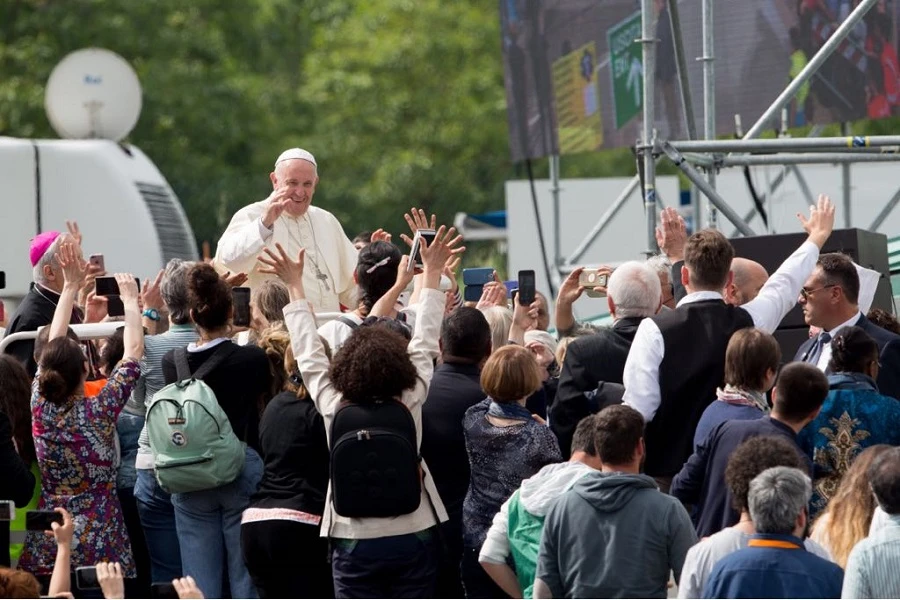
Vatican City, May 10, 2018 / 05:17 am (CNA/EWTN News).- Pope Francis Thursday paid a visit to two small Catholic communes in central Italy dedicated to living solidarity and promoting ecumenical unity, telling members that their “prophetic” way of living the Gospel must continue with boldness and perseverance.
Speaking to members of the Nomadelfia community and commune, the pope said theirs is “a prophetic reality that proposes the creation of a new civilization, implementing the Gospel as a form of a good and beautiful life.”
Similarly, he told members of the Focolare Movement, which has a Marian spirituality and places an emphasis on ecumenism, that their community is “an illustration of the mission of the Church today, as traced by the Second Vatican Council.”
He told members they should not stay locked inside, but must “go out, to encounter, to take care of, to throw the leaven of the Gospel in the pasta of society, above all where there is most need, where the Gospel is awaited and invoked: in poverty, in suffering, in trials, in the search and in doubt.”
He said “frankness” and “perseverance” – in Greek “parresia” and “hypomone” – were two keywords members should to keep in mind going forward.
Parresia, or frankness, he said, speaks of the “courage and sincerity in bearing witness to the truth” that a disciple of Jesus needs to have, even in prayer.
“Prayer must have frankness, to say things face-to-face,” he said, and, pointing to how Abraham bartered with God to continue lowering the number of righteous people needed to save Sodom and Gomorrah from destruction, told members to “fight with God in prayer.”
Perseverance, he said, means learning to move beyond the difficult situations that life presents and not get bogged down by challenges.
“This term expresses the constancy and firmness in carrying forward the choice of God and of new life in Christ. It means keeping this choice firm, even at the cost of difficulty and opposition, knowing that this constancy, this firmness and this patience produce hope, and hope does not disappoint,” he said.
Referring to the image of the “Maria Theotokos” housed in a shrine in Loppiano, which is the epicenter of the Focolare Movement, the pope noted that “the first disciple of Jesus was his mother,” and told members, most of whom are laypeople, not to forget that “Mary was a laywoman.”
Pope Francis met briefly with members of the Nomadelfia and Focolare communities during a May 10 half-day trip to Grosetto and Loppiano, where each of the movements operate.
Nomadelfia – which in Greek means ‘where brotherhood is law’ – is a small community and commune within the Tuscan city of Grosseto consisting of practicing Catholics seeking to live a life inspired by the events in the biblical book of the Acts of the Apostles.
The community was founded by Fr. Zeno Saltini, who after his ordination to the priesthood in 1931, spiritually adopted as his “son” a 17-year-old boy who had recently left prison.
Saltini continued to welcome more and more troubled and abandoned youth. Eventually, as more young people knocked on his door, the community grew and laywomen came as “mothers” to care for the youth who arrived. Soon couples also began to arrive who welcomed the children and raised them as a family.
The first commune of Nomadelfia was located on the grounds of a former concentration camp in Fossoli following the German occupation of Italy during the Second World War, before later transferring to Grosseto.
There is no private property in the commune; everything is shared, and children who come are required to attend school until the age of 18. Today there are some 5,000 youth who have been welcomed into the Grosseto commune. Many of the couples in the community have welcomed children and youth as foster-parents.
The last pope to visit Nomadelfia was St. John Paul II in 1989, just eight years after Fr. Saltini’s death in 1981.
After arriving around 8a.m. May 10, Pope Francis was welcomed by Saltini’s successor, Don Ferdinando Neri, and the president of the community, Francesco Matterazzo.
He visited the commune’s cemetery and led the community in a prayer at Saltini’s tomb, leaving a stone with his name on it, as other inhabitants of Nomadelfia have done, before visiting the tombs of the first members of the community.
Francis then made his way to the chapel of the main house of the community, where he entrusted two children into the care of two separate families, after which he met with the wider community.
In his speech, Pope Francis pointed to the meaning of their name, Nomadelfia, saying the “law of brotherhood” they live was the life-goal of their founder.
Saltini, he said, understood when he saw abandoned and suffering youth that “the only language they understood was that of love.”
Because of this, the priest was able to identify a unique type of society “where there is no space for isolation or solitude, but the principle collaboration between different families is in force, where the members recognize their brothers in faith.”
Francis also pointed to the care shown toward the elderly in the commune, who even when in poor health are not abandoned, but are supported by the entire community.
“Continue on this path, incarnating the model of fraternal love through visible works and signs in the many contexts where evangelical charity calls you,” the pope said, telling members that when faced with a world that is often hostile to Christ and his Church, “do not hesitate in responding to the joyful and serene witness of your lives, inspired by the Gospel.”
After his brief visit to Nomadelfia, Pope Francis made another short stop in Loppiano, heart of the Focolare Movement launched by Chiara Lubich in 1943 as a means of spiritual and social renewal.
The movement, which places an emphasis on universal brotherhood and ecumenical unity, and promotes a Marian spirituality, is currently present in 182 countries around the world.
Although the movement was established by a Catholic, it embraces and welcomes members of other religions who do not necessarily share Catholic beliefs. Focolare has around two million Catholic members as well as thousands of members from other Christian churches and religious traditions, including Jews, Muslims, Buddhists and Hindus.
After arriving to Loppiano, the pope immediately went to the shrine of “Maria Theotokos,” where he sat in adoration of the Blessed Sacrament, and prayed in front of the image of the Mary the “Theotokos” – the “God-bearer” or “Mother of God” in Greek.
In an audience with members of the movement in the sanctuary’s churchyard, the pope responded to three questions on how to live a life of true charity amid modern challenges; how academic and formational entities can grow and build new forms of leadership in society, and what the mission of Focolare is in the New Evangelization.
Speaking of frankness and perseverance, Pope Francis said these qualities mean “to have a heart turned toward God, believing in his love so that his love casts out every false fear, every temptation of hiding oneself in a quiet life, in respectability or even in a subtle hypocrisy.”
“One must ask the Holy Spirit for frankness – always united to respect and tenderness – in bearing witness to the great and beautiful works that God has done in us and in our midst,” he said, and encouraged members to be honest and sincere in their relationships, but to avoid sowing discord and murmuring through gossip.
As he often has in the past, Francis called a gossiper a “terrorist” who “destroys the community, destroys the Church, and also destroys oneself.”
He also stressed the need to persevere amid modern challenges, saying perseverance is a sign of God’s love. “which precedes us and renders us capable of living with tenacity, serenity and positivity,” as well as a sense of humor, “even in the most difficult moments.”
In order for the community to go forward, it also needs memory, he said, because it “allows you to go forward and bear fruit. If you don’t have memory, the tree won’t bear fruit because it doesn’t have roots.”
Speaking of the numerous centers for education and formation run by the movement, the pope urged them to give the entities “a new momentum, opening them to even more vast horizons and projecting them to the frontiers.”
A special emphasis, he said, should be placed on the courses that connect children, older youth, families and people from different vocations.
In terms of the movement’s role in the New Evangelization, Pope Francis said that at 50 years old, the life of the Loppiano community is just beginning in terms of their service in announcing the Gospel, which requires “humility, openness, synergy and the ability to risk.”
“We need men and women – young people, families, persons from all vocations and professions – to trace new paths to follow together,” he said.
Francis then said the big challenge in this regard is to have a “faithful creativity,” which means being faithful to their charism while also being open to the inspiration of the Holy Spirit, courageously interpreting new paths forward.
Discernment is necessary for this “faithful creativity” to be successful, he said, adding that :we are all called to be artisans of communitarian discernment. This is the path so that also Loppiano can discover and follow, step by step, but path of God in service to the Church and to society.”
 […]
[…]




The person who writes statements for Papa does a commendable job. The one who writes the homilies he delivers, also does admiral work.
As we examine the “Religion of Peace”, some might say it has a hollow ring to it! Yet, different people have divergent views of what peace is! Jesus is the Prince of Peace, this is how we are to be guided:
John 16:33 I have said these things to you, that in me you may have peace. In the world you will have tribulation. But take heart; I have overcome the world.”
2 Thessalonians 3:16 Now may the Lord of peace himself give you peace at all times in every way. The Lord be with you all.
Isaiah 26:3 You keep him in perfect peace whose mind is stayed on you, because he trusts in you.
Matthew 5:9 “Blessed are the peacemakers, for they shall be called sons of God.
Philippians 4:6 Do not be anxious about anything, but in everything by prayer and supplication with thanksgiving let your requests be made known to God.
John 14:27 Peace I leave with you; my peace I give to you. Not as the world gives do I give to you. Let not your hearts be troubled, neither let them be afraid.
I request you call these criminals terrorists instead of calling them “Islamic terrorists.” As you can read in your own story, the Pope did not use that term. As a matter of fact, your entire news text above does not use that term which appears only in your headline.
From NPR:
The al-Shabab extremist group is Islamic, not Methodist or Amish or Scientologist.
Dear Abdul:
First, I praise God that you are reading CWR. It may be your first introduction to the Gospel of Jesus Christ. Indeed it is no accident that God sent you to this site.
Regardless of how one labels these men, does it bring favour to Islam?
Psalm 34:14 Turn away from evil and do good; seek peace and pursue it.
James 3:18 And a harvest of righteousness is sown in peace by those who make peace.
2 Thessalonians 3:16 Now may the Lord of peace himself give you peace at all times in every way. The Lord be with you all.
It would be a pleasure to dialogue with you.
God’s richest blessings.
Brian
“I request you call these criminals terrorists instead of calling them “Islamic terrorists.”
The perpetrators of this violence in Somalia, and indeed in other parts of the world, are followers of the Islamic faith, which calls for their actions found in the Quran and Sunnah. To claim otherwise would be disingenuous.
Islam has one agenda to “proclaim Islam over all religion” QS 48.28 which pious Muslims have been acting upon, up to the present day.
When the group claiming responsibility for the attack releases a statement describing its target as an “enemy” that is “committed to removing Somali children from the Islamic faith”, it’s fair to label it an Islamic terrorist group. That Pope Francis, for predictable and discreditable ideological reasons declines to do so, does not mean the rest of us should join him.. The headline is accurate, and Mr. Olson defends it well.
Do you dispute the motive of the terrorists?
Yours truly poses a question in the spirit of dialogue and fraternity….
What if, instead of the term “Islamic terrorists,” we used the term zealot? Or, better yet, the term “terribles simplificateurs” (terrible simplifiers), a term coined by historian Jacob Burckhardt, in reference to ideological simpletons in the West, also set on destruction?
Regarding which, this question:
While in the Qur’an the “law of Moses” is respected throughout (as in Christianity), why are explicit references to this law (known in Western thought as our baked-in Natural Law) limited to the first four (affirmative) of the Ten Commandments, and (I ask) not to the prohibitive final six (e.g., Though shalt not kill)?
Yes, Western history does not have clean hands either, but authorization (by omission) for terrorism is not found in the Gospels, because all ten of Moses’ Commandments are included. Ideological terrorism is a violation of the “the Word made flesh,” but is not prohibited under the Islamic “word made book.”
Where in the Qur’an might we find explicit recognition of the prohibitive commandments? As a non-credentialed researcher I have looked, but possibly not thoroughly enough? Instead, unrestrained incitements to terrorism—as followed by Islamic/cross-cultural (!) “terrible simplifiers”: e.g., Q 9:123; 8:34; 2:187/191, 9:5, 47:4.
If you’re going to call this Islamic terrorism maybe you will call the numerous attacks on abortion clinics, doctors and staff – always done by pious Christians- as “Christian Terrorism”? How about the mass bombings by American troops as “American Terrorism” or the fact that they are blessed by Christians as “Christian Terrorism” also?
No?
Back on September 11, 2010, the Jesuit scholar Fr. Samir Khalil Samir, an Egyptian scholar of Islam who spent most of his life living and teaching in Muslim countries (and who also taught at the Pontifical Oriental Institute in Rome), was interviewed by Edward Pentin and said the following:
In his excellent book 111 Questions on Islam (Ignatius Press, 2008), Samir makes the following statement:
Yes, many Muslims do reject and denounce terrorism. But, as Samir rightly notes, they cannot point to the Qur’an or the Islamic tradition for support. Which is completely unlike Christianity.
Though this happens infrequently, the focus is to save lives! If Christians don’t stand up against this slaughter, who will? Christ advises us to respect life, not to take it.
On the other hand, the Prophet of Islam advises the follower to wage war on the non-believer. The marked difference here is that Jesus calls us to peace, Muhammad calls his followers to war and violence. Christians may fail individually, however Christ’s way is always the best path for all men. Let us respect all and strive for God’s peace.
Psalm 4:8 In peace I will both lie down and sleep; for you alone, O Lord, make me dwell in safety.
Hebrews 12:14 Strive for peace with everyone, and for the holiness without which no one will see the Lord.
Romans 15:13 May the God of hope fill you with all joy and peace in believing, so that by the power of the Holy Spirit you may abound in hope.
God bless you.
Islam has a political agenda, Christianity does not.
Jesus never called His followers to use violence in His name, to gain political control over countries, because the combat is against sin not people..
Islam inverts this call to be combat against people not accepting Allah as the only god with Mohammed as prophet, proving the god of Islam is not the God of the Bible, but a counterfeit.
Maybe your focus should be on your own faith first, before condemning others.
America’s interest is to prevent or stop war. Islam is war to its core. Jihad and migration are core beliefs. To stop war, peace minded countries have to engage warmongers, thereby opposing the enslavers.
If a Muslim had the choice of migrating to America or another Islamic state, what would be his choice? Yes Islam likes to be accorded peaceful dealings, they have little interest in reciprocating, unfortunately.