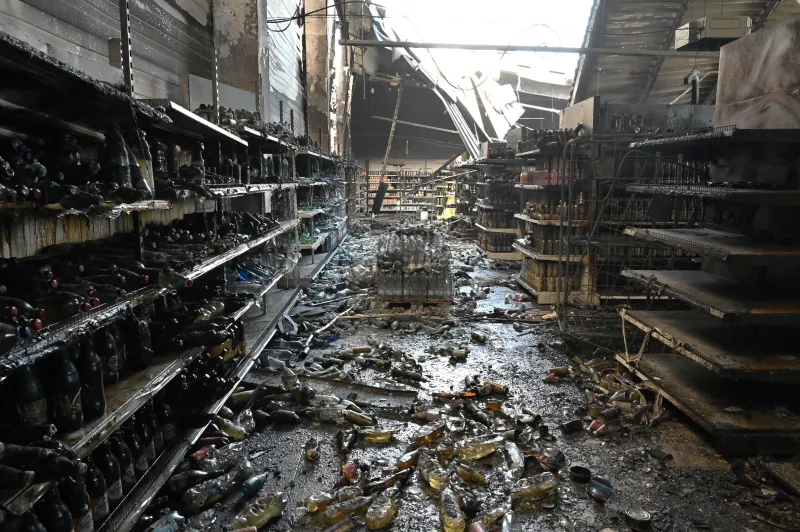
A photograph taken on June 28, 2022 shows charred goods in a grocery store of the destroyed Amstor mall in Kremenchuk, one day after it was hit by a Russian missile strike according to Ukrainian authorities. / Photo by Genya Savilov/AFP via Getty Images
Vatican City, Jun 29, 2022 / 08:20 am (CNA).
Pope Francis condemned an attack on a shopping mall in Kremenchuk, central Ukraine, as “barbaric,” during a public address on Wednesday.
“I carry in my heart every day the dear and tormented Ukraine, which continues to be plagued by barbaric attacks, such as the one that struck the Kremenchuk shopping center,” the pope said on June 29.
A Russian missile strike hit a shopping mall in Kremenchuk on June 27. Ukrainian authorities said the next day that at least 18 people were killed in the attack and another 36 were missing.
“I pray that this foolish war may soon see an end, and I renew the invitation to persevere, without tiring, in the prayer for peace: may the Lord open those paths of dialogue that men are unwilling or unable to find,” he said. “And let us not neglect to come to the aid of the Ukrainian people, who are suffering so much.”
Francis spoke about Ukraine after praying the Angelus in honor of the Solemnity of Saints Peter and Paul.
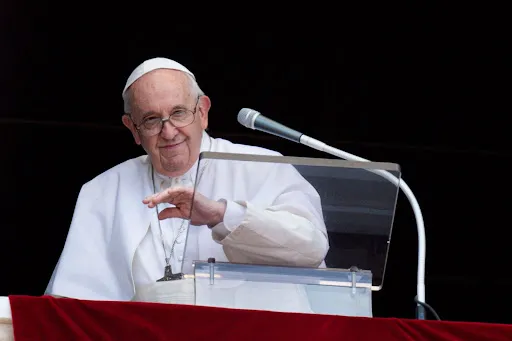
Pope Francis during his appearance for the Angelus in Rome on June 29, 2022. Vatican Media
The pope addressed an estimated 15,000 people from a window overlooking St. Peter’s Square, according to the Vatican. During the Angelus and his remarks afterward, he sometimes placed his right hand on the windowsill and leaned his weight on his right arm.
The 85-year-old pope, who has an injury in his right knee, has used a wheelchair for many of his public audiences for almost two months. He has recently walked short distances with the support of a cane.
Pope Francis extended his best wishes to Romans and those staying in Rome on the feast of Peter and Paul, the patron saints of the capital city of Italy. He said he hopes “that all may find in [Rome] a decent welcome worthy of its beauty.”
He also lamented the recent outbreak of fires in Rome, affected by record-high temperatures and drought across Italy.
“All this should make us reflect on the protection of creation, which is our responsibility,” he said. “It is not a fad, it is a responsibility: the future of the earth is in our hands and with our decisions.”
Temperatures reached over 104 degrees Fahrenheit across most of Italy on June 28, and Rome tied its highest heat on record.
If you value the news and views Catholic World Report provides, please consider donating to support our efforts. Your contribution will help us continue to make CWR available to all readers worldwide for free, without a subscription. Thank you for your generosity!
Click here for more information on donating to CWR. Click here to sign up for our newsletter.
As Hurricane Ian bears down on Florida’s Gulf Coast, Bishop Gregory L. Parkes of St. Petersburg asked for prayers for “protection during the storm.”
In a message emailed to each parish in his diocese, and posted on the diocese’s Facebook page and YouTube channel, Parkes offered a prayer of his own.
“Loving God, maker of heaven and earth, protect us in your love and mercy. Send the spirit of Jesus to be with us to still our fears and to give us confidence in the stormy waters. Jesus reassured his disciples by his presence, calmed the storm, and strengthened their faith,” he said.
“Guard us from harm during the storm and renew our faith to serve you faithfully. Give us the courage to face all difficulties and the wisdom to see the ways your Spirit binds us together in mutual assistance,” Parkes prayed. “With confidence, we make our prayer through Jesus Christ, our Lord. Amen.”
On Tuesday afternoon the Category 3 storm struck western Cuba and headed into the Gulf of Mexico. While the exact path of the hurricane is not yet known, forecasters have issued warnings for the entire Gulf Coast. Current projections are for the storm to hit between Tampa and Ft. Meyers on Wednesday.
The Diocese of St. Petersburg is, for now, to the north of the hurricane’s expected path, but dangerous flooding and damaging winds are expected for all of Florida’s west coast. Mandatory evacuations have been ordered for coastal and low-lying areas.
Tampa officials warned residents on Tuesday to take the hurricane seriously, as first responders are not sent out if winds are higher than 40 mph.
With sustained winds expected to reach 115 mph, and gusts up to 145 mph, the National Hurricane Center warned that “locations may be uninhabitable for weeks or months.”
National Hurricane Center’s track of Hurricane Ian, expected to make landfall onWednesday. Public Domain
Pope Francis meets with the Order of Malta’s Fra’ Marco Luzzago on June 25, 2021. / Vatican Media
Vatican City, Mar 7, 2022 / 09:35 am (CNA).
The Order of Malta’s future is in Pope Francis’ hands. After a meeting with senior members on Feb. 26, the pope will take time to ponder the proposals for renewal and eventually decide on a path of reform.
Cardinal Silvano Maria Tomasi, the papal delegate to the organization, reported on the meeting in a letter to confreres of the order.
Tomasi stressed that “we explained to the Holy Father that the reform under study keeps and better frames the order as a lay religious order and at the same time consents to the continuation of its charitable, diplomatic and humanitarian action for ‘our lords the sick’ and at the service of the Church.”
The Italian cardinal added that the pope had “decided to keep listening to us, and granted us another hearing. After the meetings, the pope will rule about the projects presented to him.”
Also present at the papal meeting were Fra’ Marco Luzzago, Lieutenant of the Grand Master, members of Tomasi’s working group for the reform, and a delegation representing the order’s members.
In a Feb. 27 press release, the 1,000-year-old institution stressed that “the focus of the meeting was the Order of Malta’s reform.”
It said that “in a letter sent to the Order of Malta’s leaders worldwide, Marwan Sehnaoui, chairman of the steering committee for the constitutional reform process, expressed his gratitude to ‘His Holiness for having dedicated two hours of his valuable time to the Order of Malta.’”
Sehnaoui said: “The Holy Father began and ended the audience by stating that he had taken himself the final decision-making of the critical issues regarding the order’s constitutional reform.”
“Pope Francis listened carefully to the presentations and interventions of both sides. After exchanging views, the Holy Father said there is no urgency in making a final decision. His Holiness also said that he wishes to gather and review more information and that he would probably convene another audience.”
These statements require a close reading. First, by explaining that the order’s diplomatic and humanitarian work will not be affected by the reform, Tomasi implicitly addressed a criticism raised after the circulation of a draft reform text, which described the Order of Malta as “subject to the Holy See.” This triggered concern that the new statutes would dilute the order’s sovereignty.
Cardinal Silvano Maria Tomasi. Martin Micallef/Maltese Association Order of Malta via Flickr.
Although it possesses no real territory, the order has the hallmarks of sovereignty, such as its own official currency, postage stamps, and vehicle registration plates. It has diplomatic relations with more than 100 states and permanent observer status at the United Nations. It also oversees a flourishing humanitarian network that is currently delivering aid to refugees fleeing Ukraine.
Speaking with the National Catholic Register on Jan, 23, Tomasi stressed that in a subsequent draft, the order was no longer described as subject to the Holy See.
“We didn’t keep that expression,” he said, “and it’s not going to be in the text of the constitution that we’re going to circulate.”
He continued: “In a letter to the order, I said that, when we would be finished with the work under the constitution, government, and working group of the special delegate, we would send the text to the ‘fras’ — the religious — to the presidents of the associations, to the sovereign council and the members of the government so that we have everybody’s input and objections — if there were aspects of the constitution or the text that weren’t acceptable or considered objectionable.”
The most important reform is, in the end, that of fras, who are known as first-class knights. Only first-class knights who descend from a family of four quarters of nobility are eligible to be elected as the Grand Master, the order’s religious superior and sovereign. This provision means that fewer than 40 people in the order are able to be considered for the role.
Pope Francis took over the reform process after a fierce debate within the order.
The working group entrusted to draft the new statutes was composed of the canon law expert Father Gianfranco Ghirlanda, Msgr. Brian Ferme, secretary of the Vatican’s Council for the Economy, Maurizio Tagliaferri, Federico Marti, and Gualtiero Ventura.
Albrecht von Boeselager. Daniel Ibáñez/CNA.
The group was later enlarged with the addition of a few senior members of the order, including the Grand Chancellor Albrecht von Boeselager. But Boeselager announced in January that he was stepping down from the expanded group. Sehnaoui, president of the order’s Lebanese association, was appointed to take Boeselager’s place, assisted by Péter Szabadhegÿ.
Tomasi refused to recognize the Sehnaoui appointment, and so he could not attend the two-day meeting to discuss the draft text.
It is particularly significant, then, that Sehnaoui was included in the group that met with the pope on Feb. 26. Sehnaoui’s presence might be considered a gesture of detente.
Tomasi sent a letter to the knights after a private meeting with the pope on Jan 29, after the two-day reform meeting, held on Jan. 25-26.
The cardinal said that “the pope has decided that he wants to meet the mixed working group with some members representing the professed, the government of the order, the procurators of the priories and the presidents of the associations, to present to him concrete reform projects.”
So, Tomasi wrote, “the Holy Father, therefore, decided to suspend all other activities until this meeting is taking place, following which he will make a final decision.”
“Therefore, the meeting of the mixed working group of Feb. 22-23 is suspended, and the meetings of the steering committee chaired by President Marwan Sehnaoui are also suspended.”
The Magistral Villa of the Sovereign Military Order of Malta in Rome. Lalupa via Wikimedia (CC BY-SA 3.0).
Tomasi stressed that “any other activity before the meeting with the pope will be considered an act of disobedience to the Holy Father.”
It was a notably harsh statement which indicated that the pope would be taking responsibility for the process.
Knights who took part in the papal meeting told CNA that “they had a positive feeling” and that the pope “listened carefully to their issues.”
Members of the order must now wait to see what the pope decides. It will eventually become clear whether he has chosen to treat the order principally as a religious order or will also consider the vast humanitarian network overseen by this sovereign entity with no territory.
President’s Hall, Seton Hall University. / Credit: Wikimedia/cc by sa 3.0
CNA Staff, Apr 9, 2024 / 13:00 pm (CNA).
A Catholic university in New Jersey returned to its historic tradition of naming a “priest-president” following the previous president’s abrupt resignation and lawsuit against the school.
Seton Hall University, one of the oldest diocesan-run universities in the nation, on April 2 announced Monsignor Joseph Reilly as the 22nd president of the university. Reilly is an alumnus of the university and the current vice provost of academics and Catholic identity.
The 168-year-old university had a “priest-president” for 146 years of its history, and Reilly’s appointment marks a “return” to the tradition, the university press release noted.
Reilly will take over from interim president Katia Passerini, who took up the role after former Seton Hall president Joseph Nyre’s resignation in July 2023.
Nyre and his wife, Kelli, filed a lawsuit alleging that the former chairman of the university’s board of regents, Kevin Marino, had intimidated Nyre and sexually harassed his wife by kissing and touching her.
The suit alleged that the university violated New Jersey’s Conscientious Employee Protection Act. Nyre also alleged that Seton Hall engaged in discrimination and retaliation, and breach of the separation and general release agreement.
Laurie Pine, a spokeswoman for the school, said the allegations were “completely without merit” in a February statement.
An independent financial review uncovered a series of embezzlement schemes by a “small number of trusted, longtime employees of Seton Hall Law,” Marino and Nyre announced in a joint email to the university in December 2022.
The university, which is home to Immaculate Conception Seminary and St. Andrew’s Hall seminary, also suffered under the leadership of the disgraced former cardinal and former archbishop of Newark Theodore McCarrick.
McCarrick “used his position of power as then-archbishop of Newark to sexually harass seminarians,” according to a university statement in 2019.
Seton Hall has about 10,000 students, including 6,000 undergraduates. Cardinal Joseph Tobin, the archbishop of Newark and chair of the board of trustees, and president of the board of regents, said in an April 2 statement that he is “confident” that Reilly will be “an outstanding president.”
“In my service with Monsignor Reilly on the board of trustees, he impressed me with his abiding faith, keen intellect, and genuine care for the entire university,” he said.
The current chair of the board of regents and the presidential search committee, Hank D’Alessandro, said that Reilly “was the ideal choice.”
“He possesses a deep faith in God and a demonstrable commitment to nurturing our students to greatness as we advance among the nation’s foremost Catholic universities,” D’Alessandro said in the statement.
“There is no one better suited to leading the university at this moment — a time when Seton Hall stands at the cusp of extraordinary progress,” he said.
Reilly attended Seton Hall Prep and graduated from Seton Hall University in 1987. After he was ordained a priest in 1991, he returned as rector of the college seminary in 2002.
Reilly served as dean of the Immaculate Conception Seminary School of Theology from 2012 to 2022 and most recently served as vice provost of academics and Catholic identity.
Reilly said he is both “profoundly grateful” and “exceedingly energized” to take on the role.
“Seton Hall is the place where I have come to know the truth about God, about who I am before God, and about what contribution to society that God is inviting me to make,” he said.
In 2005, St. John Paul II named Reilly as a chaplain to his holiness, and in 2015 Pope Francis appointed him as a missionary of mercy.
Reilly has a bachelor’s degree in sacred theology from the Pontifical Gregorian University in Rome, a licentiate in sacred theology from Pontificio Istituto Teresianum in Rome, and a doctorate in educational administration from Fordham University.
Reilly also served on the Faithful Citizenship Strategy Committee and the Catholic Social Teaching Task Force for the United States Conference of Catholic Bishops.
“I cannot wait to engage our community as together we strive to bring new life to the timeless Catholic mission that makes Seton Hall unique among American universities,” Reilly said.
Life is sacred and a precious gift. May each life be blessed.
