Pope Francis’ general audience in St. Peter’s Square, May 18, 2022. / Daniel Ibáñez/CNA.
Vatican City, May 18, 2022 / 10:25 am (CNA).
Pope Francis has changed the Church’s regulations to allow religious brothers who are not priests to lead their religious communities with Vatican permission.
In a “rescriptum ex audientia” issued May 18, the pope said that the Vatican congregation overseeing religious orders can, in individual cases and at its own discretion, grant permission for non-priest religious members to assume the role of major superior.
The change includes the derogation of the second paragraph of canon 588 in the Code of Canon Law, which says that clerical institutes are under the direction of ordained priests.
The congregation, the rescriptum said, “reserves the right to evaluate the individual case and the reasons given by the Supreme Moderator or the General Chapter.”
A non-cleric member can be nominated as a local superior without the Vatican’s permission.
The change marks a shift from a requirement that only an ordained brother or friar can be the head of a religious community, mirroring a recent innovation by Pope Francis allowing not just clerics but “any member of the faithful” to lead a dicastery of the Roman Curia.
If you value the news and views Catholic World Report provides, please consider donating to support our efforts. Your contribution will help us continue to make CWR available to all readers worldwide for free, without a subscription. Thank you for your generosity!
Click here for more information on donating to CWR. Click here to sign up for our newsletter.
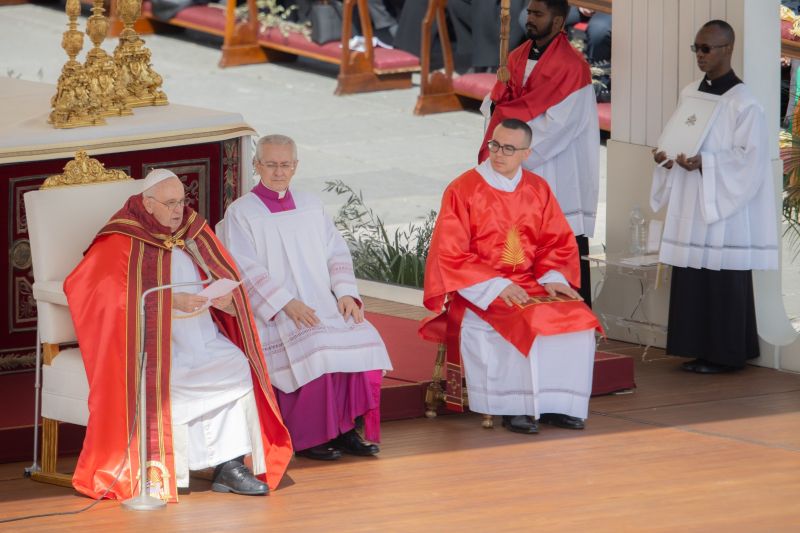
Pope Francis presided over Palm Sunday Mass in St. Peter’s Square on April 2, 2023. / Daniel Ibanez/CNA
Vatican City, Apr 2, 2023 / 05:15 am (CNA).
On Palm Sunday, Pope Francis said Jesus voluntarily took on the pain and abandonment of his Passion and Crucifixion so that he could be with us in whatever sorrow or difficulty we might be experiencing.
Jesus “experienced abandonment in order not to leave us prey to despair, in order to stay at our side forever,” the pope said during Palm Sunday Mass in St. Peter’s Square April 2.
“He did this for me, for you,” he said, “because whenever you or I or anyone else seems pinned to the wall — and we have seen someone pinned to the wall — you see someone lost in a blind alley, plunged into the abyss of abandonment, sucked into a whirlwind of ‘whys’ without answer, there can still be some hope…”
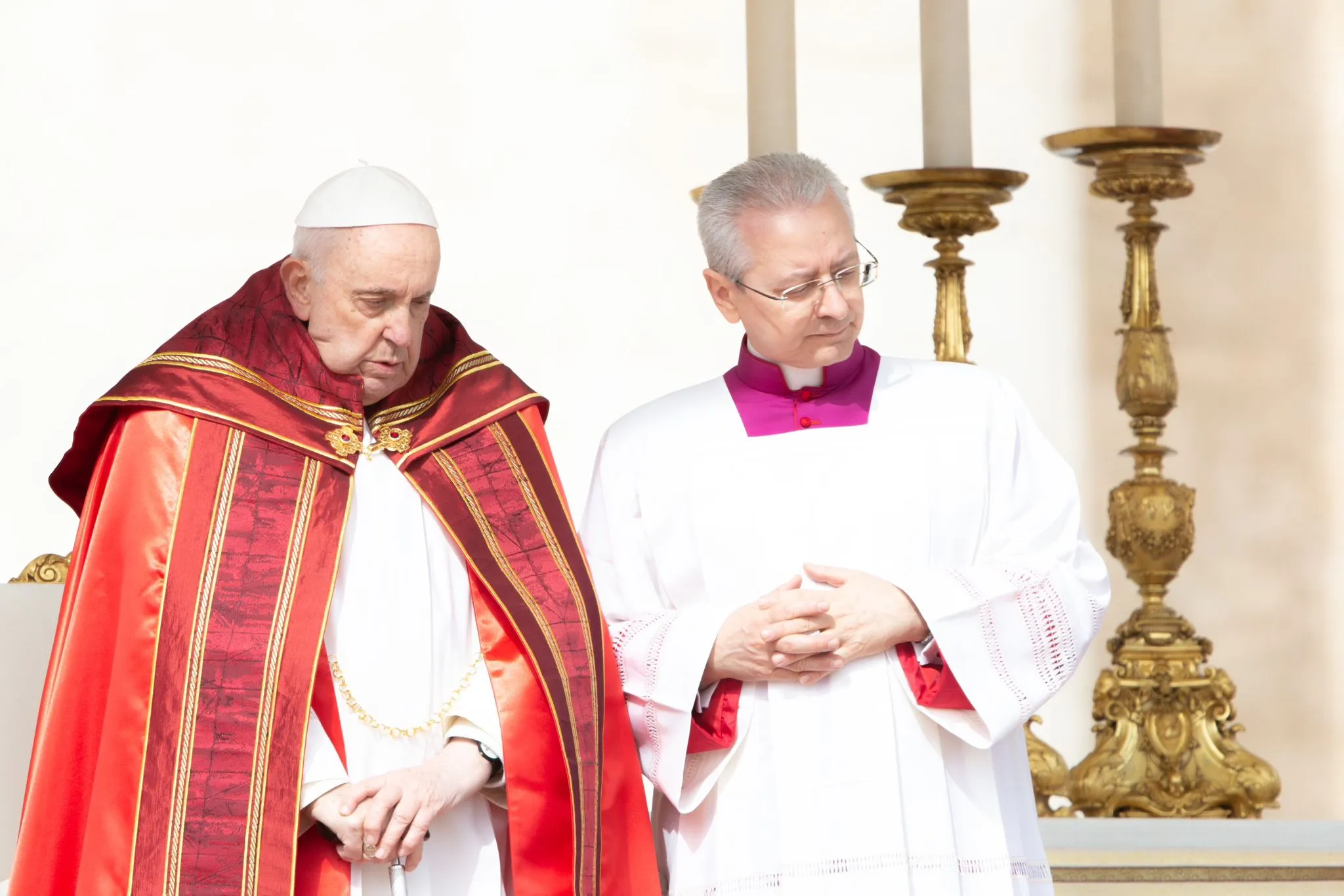
Pope Francis presided over Palm Sunday Mass in St. Peter’s Square on April 2, 2023. Daniel Ibanez/CNA
Pope Francis presided over the Palm Sunday Mass one day after being discharged from Rome’s Gemelli Hospital.
The pope was admitted to the hospital for three days beginning March 29 for treatment for a bronchitis infection, the Vatican said.
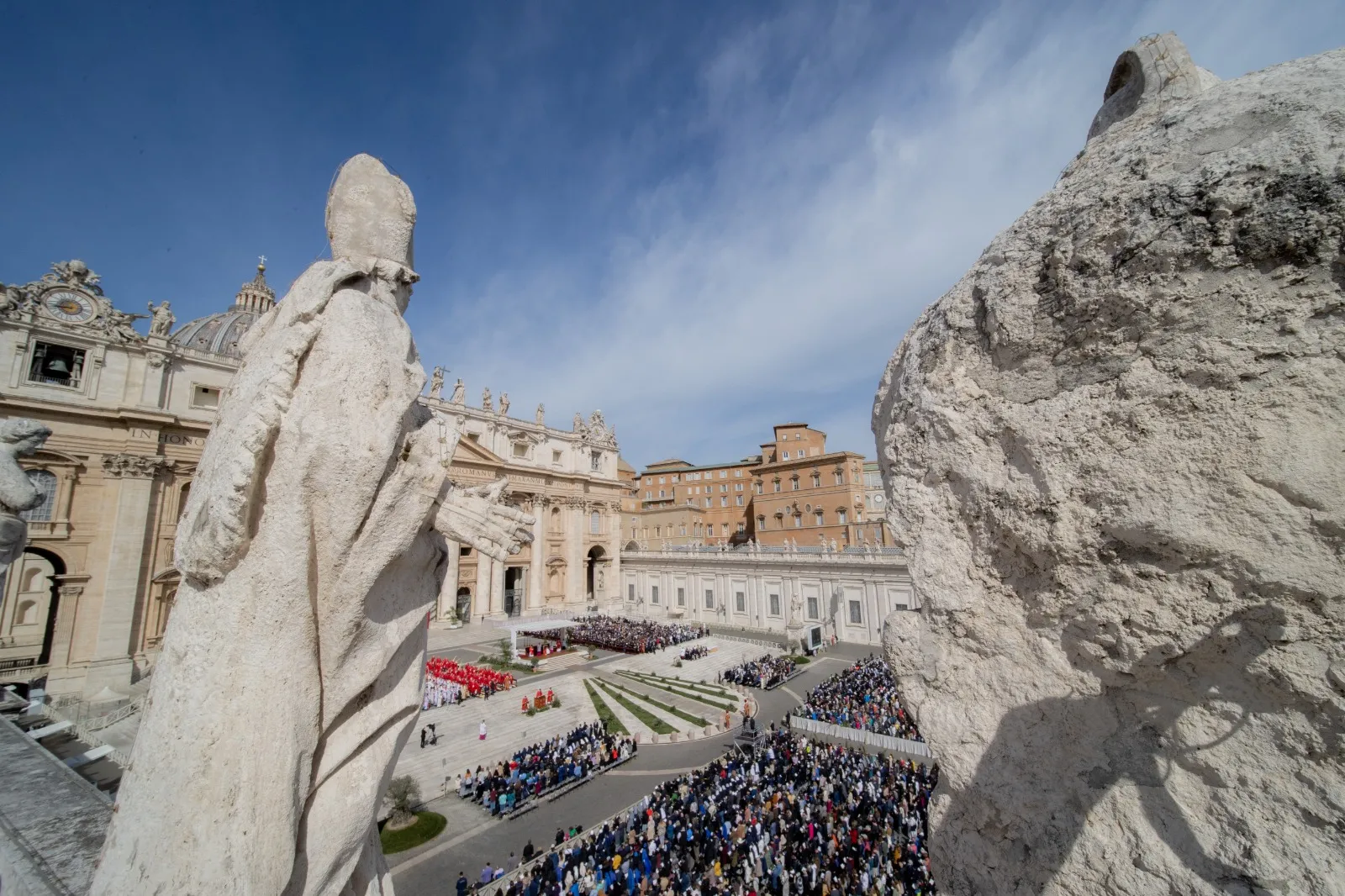
An estimated 60,000 people were at the papal Mass, according to the Vatican Gendarmes.
In his homily, Francis spoke in a soft voice as he emphasized that whatever situation of abandonment we find ourselves in, Jesus is at our side.
The pope also said that we will find Jesus in those who are abandoned, recalling the death in November last year of a homeless man from Germany, who was found under the colonnade of St. Peter‘s Square.
Pope Francis presided over Palm Sunday Mass in St. Peter’s Square on April 2, 2023. Daniel Ibanez/CNA
Jesus “wants us to care for our brothers and sisters who resemble him most, those experiencing extreme suffering and solitude,” he said. “Today, brothers and sisters, there are entire peoples who are exploited and abandoned; the poor live on our streets and we look the other way, we turn around; there are migrants who are no longer faces but numbers; prisoners are disowned; people written off as problems.”
Pope Francis said these people are “Christs” for us: “People who are abandoned, invisible, hidden, discarded with white gloves,” such as the unborn, the isolated elderly, the forgotten sick, the abandoned disabled, and the lonely young.
“Jesus, in his abandonment, asks us to open our eyes and hearts to all who find themselves abandoned,” he said.
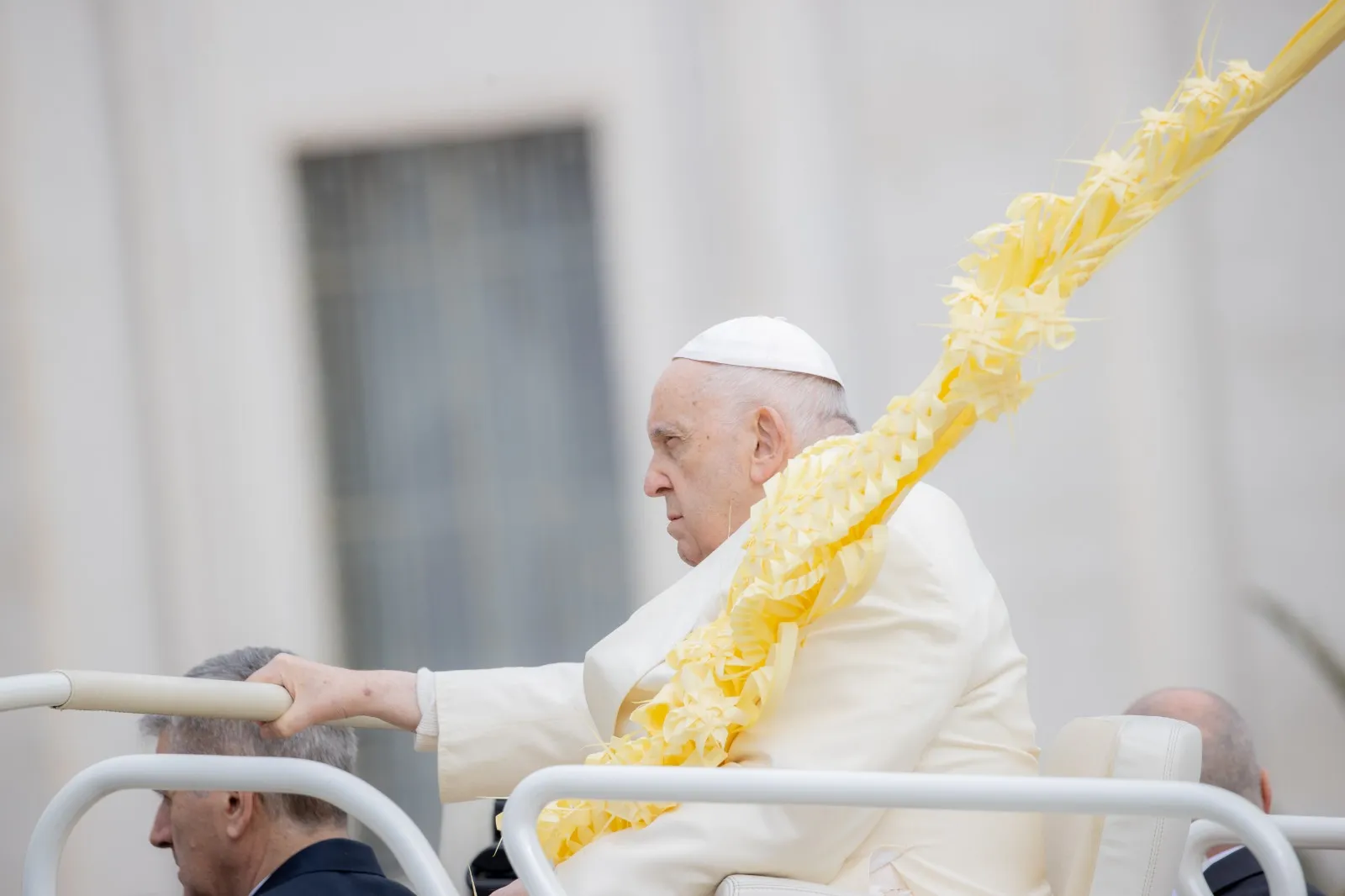
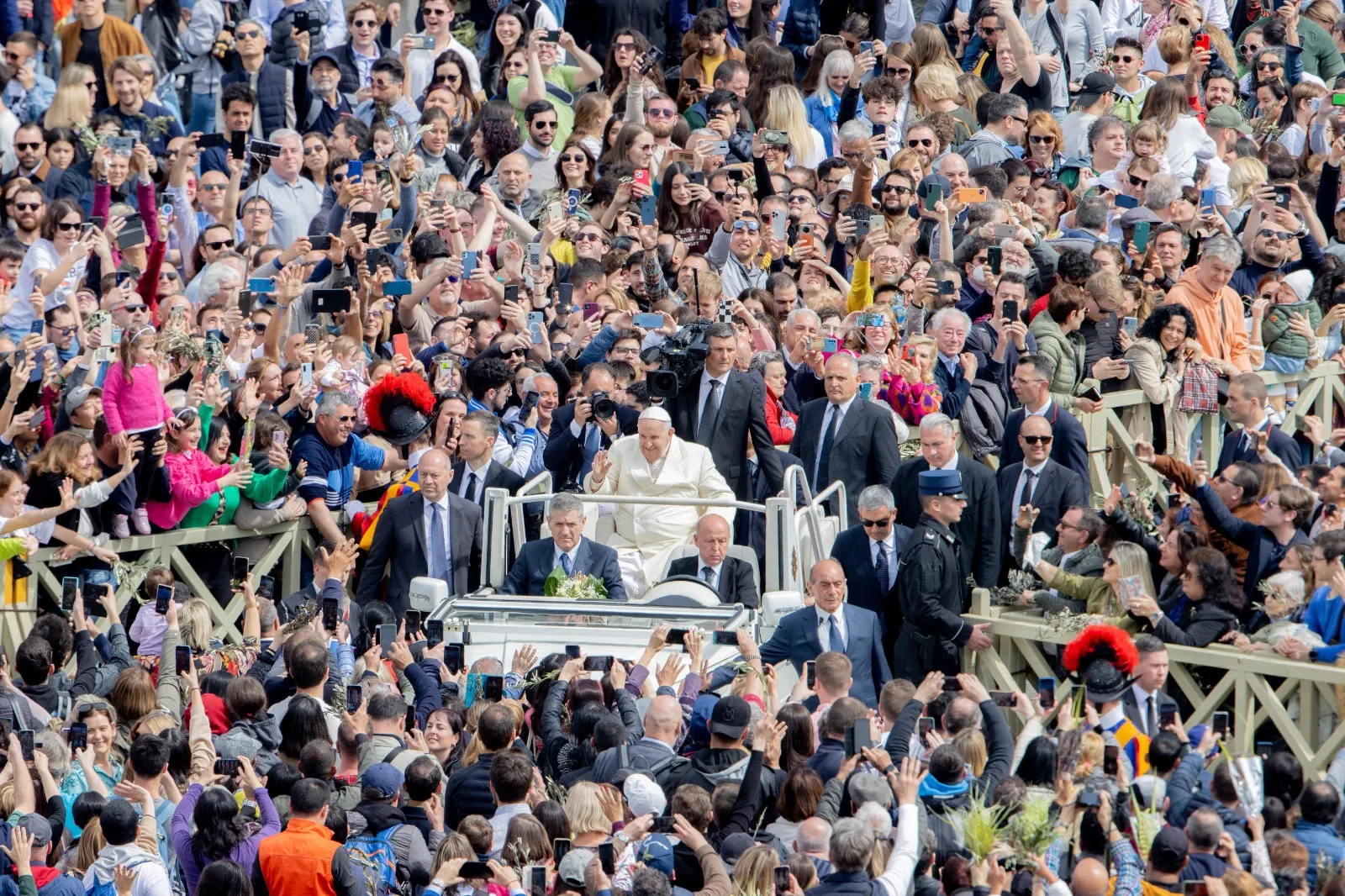
Pope Francis entered St. Peter’s Square in the popemobile April 2. He was driven to the central obelisk for the blessing of the palms and the proclamation of a reading from the Gospel of St. Matthew and the singing of Psalm 23.
Pope Francis presided over Palm Sunday Mass in St. Peter’s Square on April 2, 2023. Daniel Ibanez/CNA
The blessing followed the procession of cardinals, bishops, priests, deacons, and laypeople carrying palm fronds, olive branches, and the large weaved palms called “parmureli” to commemorate Jesus’ entrance into Jerusalem. Pope Francis has not led the procession since 2019.
For the start of Mass, the pope was again driven in the popemobile from the obelisk to the altar in front of St. Peter’s Basilica.
Palm Sunday, also called Passion Sunday, marks the beginning of Holy Week, which will lead in to the sacred Triduum of Holy Thursday, Good Friday, and Holy Saturday, and concludes with the celebration of Christ’s Resurrection beginning at the Easter Vigil.
On Palm Sunday, the Mass includes the reading of the Lord’s Passion from the Gospel of St. Matthew.
In his homily on April 2, Pope Francis focused on a line from the Gospel and repeated in the Psalm — Jesus’ cry of abandonment to the Father — “My God, my God, why have you forsaken me?”
“‘My God, my God, why have you forsaken me?’ In the Bible, the word ‘forsake’ is powerful,” the pope said.
An estimated 60,000 people attended Pope Francis’ Mass for Palm Sunday April 2, 2023. Daniel Ibanez/CNA
He noted how one might feel forsaken “at moments of extreme pain: love that fails, or is rejected or betrayed; children who are rejected and aborted; situations of repudiation, the lot of widows and orphans; broken marriages, forms of social exclusion, injustice and oppression; the solitude of sickness.”
“In a word, in the drastic severing of the bonds that unite us to others,” he said. “There [Jesus] tells us this word: abandonment. Christ brought all of this to the cross; upon his shoulders, he bore the sins of the world. And at the supreme moment, Jesus, the only begotten, beloved Son of the Father, experienced a situation utterly alien to his very being: the abandonment, the distance of God.”
“But, why did it have to come to this? For us. There is no other answer: Us,” Francis underlined. “He became one of us to the very end, in order to be completely and definitively one with us.”
At the end of his homily, Pope Francis remained in silence for over two and a half minutes before the singing of the Creed.
Jesus, the pope said, “has endured the distance of abandonment in order to take up into his love every possible distance that we can feel. So that each of us might say: in my failings — each of you has fallen many times — and I can say in my failings, in my desolation, whenever I feel betrayed or I have betrayed someone, when I feel cast aside or I have cast aside others, or when I feel forsaken or have forsaken others, we can think that Jesus was abandoned, betrayed, cast aside.”
An estimated 60,000 people attended Pope Francis’ Mass for Palm Sunday April 2, 2023. Daniel Ibanez/CNA
In our failures, we can remember that Jesus is at our side, Pope Francis said. “When I feel lost and confused, when I feel that I can’t go on, he is with me, he is there. In the thousand fits of ‘why…?’ and with many ‘whys’ unanswered, he is there.”
At the conclusion of Mass, Pope Francis led the Angelus, a traditional prayer honoring Mary.
In a brief message before the prayer, he invited Catholics to live Holy Week “as the tradition of God’s holy faithful people teaches us, that is, accompanying the Lord Jesus with faith and love.”
“Let us learn from our Mother, the Virgin Mary,” he said. “She followed her Son with the closeness of her heart; she was one soul with him and, although she did not understand everything, together with him she surrendered herself fully to the will of God the Father.”
“May Our Lady help us to be close to Jesus present in the suffering, discarded, abandoned people. May Our Lady take us by the hand to Jesus present in these people,” he said. “To all, happy journey toward Easter.”
From the popemobile, Pope Francis greeted those gathered in the square and in the adjoining thoroughfare after the Mass.
The full text of Pope Francis’ homily for Palm Sunday 2023 can be read here.
Bishop Mark Davies of Shrewsbury preaches at St. Columba’s Church in Chester, Feb. 15, 2014. Photo courtesy of the Diocese of Shrewsbury. / null
Norwich, England, Oct 25, 2021 / 18:19 pm (CNA).
There will be many pro-life battles this century, but foes of abortion, assisted suicide, and other crimes against human life cannot give up joy and hope, Bishop Mark Davies of Shrewsbury has told a pro-life pilgrimage.
“In this century we can expect a protracted struggle and we must be ready for repeated assaults on both the laws and the social environments of care, which have long protected and cherished the lives of our society’s weakest members,” Bishop Davies said Saturday. “Yet, this struggle is the opportunity to give witness to the value of every human life and to announce once more the Gospel of Life with joy.”
The bishop spoke Oct. 23 at the Shrine of Our Lady of Walsingham in Norfolk during the noontime Mass of the National Pro-Life Pilgrimage, now in its 38th year.
He looked back at the legalization of abortion in the Abortion Act 1967, when pro-life advocates thought they could find easy success.
“If we were confident at the time, that a ‘culture of death’ would be quickly overcome; that public opinion would never long tolerate the killing of the unborn on an industrial scale; if we thought that rational argument must surely prevail; and that to move consciences it would be sufficient to expose the cruel reality of abortion, we soon came to see how a culture of death advances remorselessly, precisely by dulling human consciences,”
This process has made it possible “to propose that pre-born children with disabilities be killed up to the point of birth,” Davies lamented.
He praised the “brave voice” of Heidi Crowter, a woman with Down syndrome who had helped lead an unsuccessful challenge to abortion law in England, Scotland, and Wales for discrimination against the disabled. Abortion law allows broad permission for abortion after 24 weeks if there is a substantial risk that the unborn child would be born with “physical or mental abnormalities as to be seriously handicapped.”
“‘The law does not respect my life,” she had told reporters in July.
“Remarkably, this cry barely elicited a moment of public concern,” said Davies.
Legal assisted suicide is again being debated, a fact the bishop said was among the “many contradictions” on a path to pro-life victory.
“How are we to understand that in Britain today, a society that mobilized itself in a pandemic, making many sacrifices to protect the lives of the vulnerable, is now considering assisting the suicide of some the most vulnerable members of society?” he asked.
“Dismayed by such contradictions, we must never lose the joy and hope that is the hallmark of the cause of life,” Davies continued.
He criticized “the euthanasia lobby” for repeatedly advocating for bills “to break the legal protections surrounding the care of the sick and the dying.” He noted this movement’s history dates back to the 1930s and the crimes of the eugenics movement.
“It advocates opening the way for assisted suicide theoretically, in carefully regulated cases. Yet, experience in other jurisdictions shows that in practice this culture of assisted suicide extends rapidly to include those with mental illnesses and even young children,” the bishop warned.
Christ’s words, “Whatever you did to the least of my brothers and sisters, you did to me,” means that “In today’s proliferating attacks on the lives of those most vulnerable, we are witnessing nothing less than a rejection of God-made-man.”
Davies drew on St. John Paul II’s teaching that every rejection of human life is “really a rejection of Christ” himself. As a counterexample to this rejection, he praised the motherhood of the Virgin Mary as “the incomparable model of how life should be welcomed and cared for.”
In the Book of Revelation, “Death shall be no more,” is “the promise that every fearful manifestation of evil which threatens to overwhelm humanity and thwart God’s purpose will finally be dispelled by the total victory of life.”
He closed his homily with an invocation of the Virgin Mary as the “Mother of the Living,” entrusting to her “the cause of life.”
The National Pro-Life Pilgrimage to Walsingham also offered chances for confession and Eucharistic Adoration, as well as organized recitations of the Rosary, the Stations of the Cross, the Divine Mercy Chaplet, and other prayers, the pilgrimage website said.
Walsingham was a major pilgrimage site in English Christianity, dating back to the 11th century. The original shrine and a nearby Augustinian priory were destroyed in the 16th century during the English Reformation. Covert Catholic pilgrimages to the site continued until they were legalized once again in the 19th century.
The pro-life pilgrimage concluded with an afternoon walk to the ruins of the priory.





It’s good news. Bothers have been serving their communities with dedication and distinction. Surely, they too can lead.