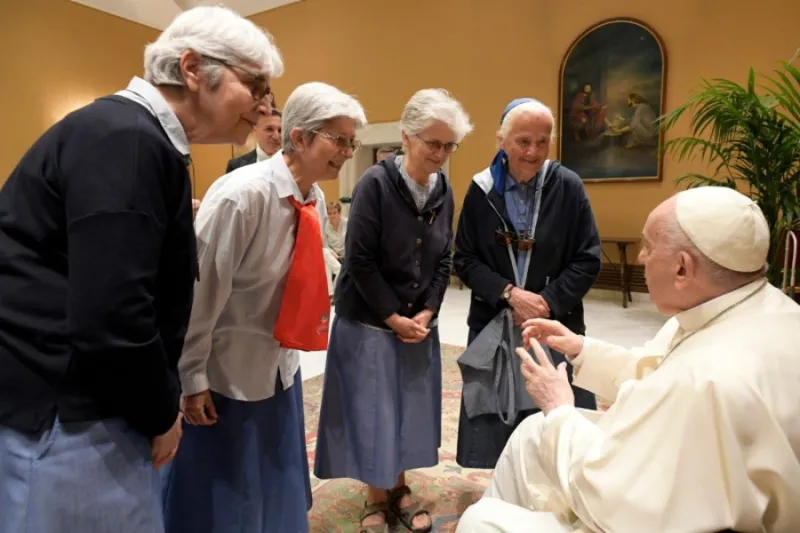
Pope Francis meets members of the Charles de Foucauld Spiritual Family Association in the study of the Paul VI Hall, May 18, 2022. / Vatican Media.
Vatican City, May 18, 2022 / 06:03 am (CNA).
Pope Francis said on Wednesday that learning about St. Charles de Foucauld’s spirituality helped him during a period of crisis as a theology student.
“I would like to thank St. Charles de Foucauld, because his spirituality did me so much good when I was studying theology, a time of maturation and also of crisis,” the pope said on May 18, during a meeting with members of the Spiritual Family of Charles de Foucauld.
The association’s members were in Rome for the May 15 canonization of the French explorer who became a hermit and missionary in Algeria, where he was killed in 1916.
Pope Francis said he learned about St. Charles de Foucauld from the Italian priest Father Arturo Paoli and books by René Voillaume, which he said he had read often.
Charles de Foucauld “helped me so much to overcome crises and to find a way of Christian life that was simpler, less Pelagian, closer to the Lord,” the pope said. “I thank the saint and bear witness to this, because he did me so much good.”
During the meeting, held in a room off of the Vatican’s Paul VI Hall before his general audience, Francis did not offer more details about the crisis he experienced as a theology student.
The pope studied theology as a seminarian from 1967 to 1969. In 1986, he spent three months at the Sankt Georgen Graduate School of Philosophy and Theology in Frankfurt, Germany, where he began a doctoral dissertation on Romano Guardini, an Italian-born German priest.
His studies were cut short when the Jesuits called him back to Argentina to be a spiritual director in Córdoba and his dissertation was never finished.
At the meeting on Wednesday, Pope Francis called Charles de Foucauld “a prophet of our time, who was able to bring to light the essentiality and universality of faith.”
The Trappist priest condensed the meaning of belief, the pope said, “into two simple words, in which there is everything: ‘Jesus — Caritas.’”
Francis quoted a letter of the martyred saint, who wrote to his cousin Marie de Bondy in 1915, while “in the silence of the hermit life,” that “we are inclined to put first works, whose effects are visible and tangible, God gives first place to love and then to sacrifice inspired by love and obedience resulting from love.”
“As a Church,” the pope said, “we need to return to the essentials, not to get lost in so many secondary things, at the risk of losing sight of the simple purity of the Gospel.”
If you value the news and views Catholic World Report provides, please consider donating to support our efforts. Your contribution will help us continue to make CWR available to all readers worldwide for free, without a subscription. Thank you for your generosity!
Click here for more information on donating to CWR. Click here to sign up for our newsletter.
Vienna, Austria, Jun 2, 2021 / 08:00 am (CNA).
Austria’s Catholic bishops urged the authorities on Tuesday to offer people “assistance to live,” rather than assistance to suicide.The bishops issued a statement June 1 in th… […]
Members of the Holy Land Coordination meet with young people of Jerusalem at St James the Apostle Beit Hanina parish, May 21, 2022. / Mazur/cbcew.org.uk via Flickr (CC BY-NC-ND 2.0)
Denver Newsroom, May 26, 2022 / 18:00 pm (CNA).
At the end of … […]
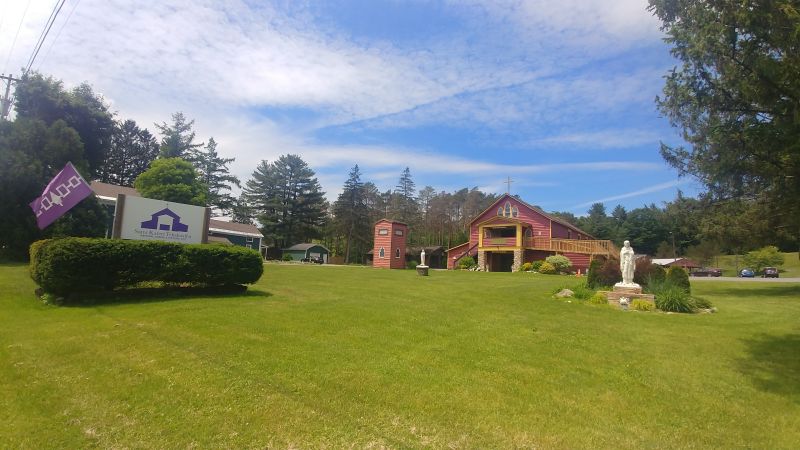
Saint Peter’s Chapel and Native American Museum at Saint Kateri Tekakwitha National Shrine and Historic Site in Fonda, New York. / Photo courtesy of Saint Kateri Tekakwitha National Shrine and Historic Site
Chicago, Ill., Jul 13, 2023 / 12:00 pm (CNA).
Shrines to various saints can be found in every part of the world, including every state in the U.S. Each one is dedicated to faith and prayer, but one shrine in the northeastern United States also has a distinct mission of connecting pilgrims with Native American culture and sharing the fascinating history of Kateri Tekakwitha, the first American Indian to be canonized a saint.
The Saint Kateri Tekakwitha National Shrine and Historic Site in Fonda, New York, honors not only the life of St. Kateri, whose feast day is July 14, but also the life and history of the local Indigenous people to whom she belonged.
“We have cultivated strong ties to both the Catholic Mohawk community and the traditional Mohawk community,” said Melissa Miscevic Bramble, director of operations at the St. Kateri Shrine, in an interview with CNA. “We see it as our mission to educate about her Mohawk culture as well as her Catholic faith.”
Who was St. Kateri?
Called the Lily of the Mohawks, Kateri Tekakwitha was the child of a Mohawk father and a Christian Algonquin mother but was orphaned at age 4 when the rest of her family died of smallpox. Her own early bout with the illness left lasting scars and poor vision.
She went to live with an anti-Christian uncle and aunt, but at age 11 she encountered Jesuit missionaries and recognized their teaching as the beliefs of her beloved mother. Desiring to become a Christian, she began to privately practice Christianity.
Beginning at about age 13, she experienced pressure from her family to marry, but she wanted to give her life to Jesus instead. A priest who knew her recorded her words: “I have deliberated enough. For a long time, my decision on what I will do has been made. I have consecrated myself entirely to Jesus, son of Mary, I have chosen him for husband, and he alone will take me for wife.”
At last, she was baptized at about age 19, and her baptism made public her beliefs, which had been kept private up until then. The event was the catalyst for her ostracism from her village. Some members of her people believed that her beliefs were sorcery, and she was harassed, stoned, and threatened with torture in her home village.
Tekakwitha fled 200 miles to Kahnawake, a Jesuit mission village for Native Amerian converts to Christianity to live together in community. There, she found her mother’s close friend, Anastasia Tegonhatsiongo, who was a clan matron of a Kahnawake longhouse. Anastasia and other Mohawk women took Kateri under their wings and taught her about Christianity, and she lived there happily for several years until her death around age 23 or 24.
Although she never took formal vows, Tekakwitha is considered a consecrated virgin, and the United States Association of Consecrated Virgins took her as its patron. She is also the patron saint of traditional ecology, Indigenous peoples, and care for creation.
A shrine with a special mission
The Saint Kateri Tekakwitha National Shrine and Historic Site has a unique mission of archaeological and historical research related to Kateri Tekakwitha and her people. Welcoming several thousand visitors per year, the shrine ministers not only to Christians but also to all American Indians.
According to its website, the shrine and historic site “promotes healing, encourages environmental stewardship, and facilitates peace for all people by offering the natural, cultural, and spiritual resources at this sacred site.” Describing itself as a sacred place of peace and healing with a Catholic identity, its ministry and site are intended to be ecumenical and welcome people of all faiths.
In keeping with this mission, the shrine’s grounds include an archaeological site, the village of Caughnawaga, which is the only fully excavated Iroquois/Haudenosaunee village in the world. St. Kateri lived in this village, which is on the National Register of Historic Places. Visitors can also visit the Kateri Spring, where Kateri Tekakwitha was baptized.
“The water from the Kateri Spring is considered holy water by the Catholic Church,” Bramble said. “People are welcome to come take the waters, and we regularly get reports of healing. We’ve sent that water all over North America to folks who have requested it.”
Besides the archaeological site, the main grounds of the shrine include St. Peter’s Chapel, housed in a former Dutch barn built in 1782; museum exhibits of Native American culture and history; St. Maximilian Kolbe Pavilion; a Candle Chapel dedicated to St. Kateri; Grassmann Hall and the Shrine office; a friary; a gift shop; an outdoor sanctuary; and maintenance facilities. The 150-acre property includes hiking trails that are open to the public year-round from sunrise to sunset.
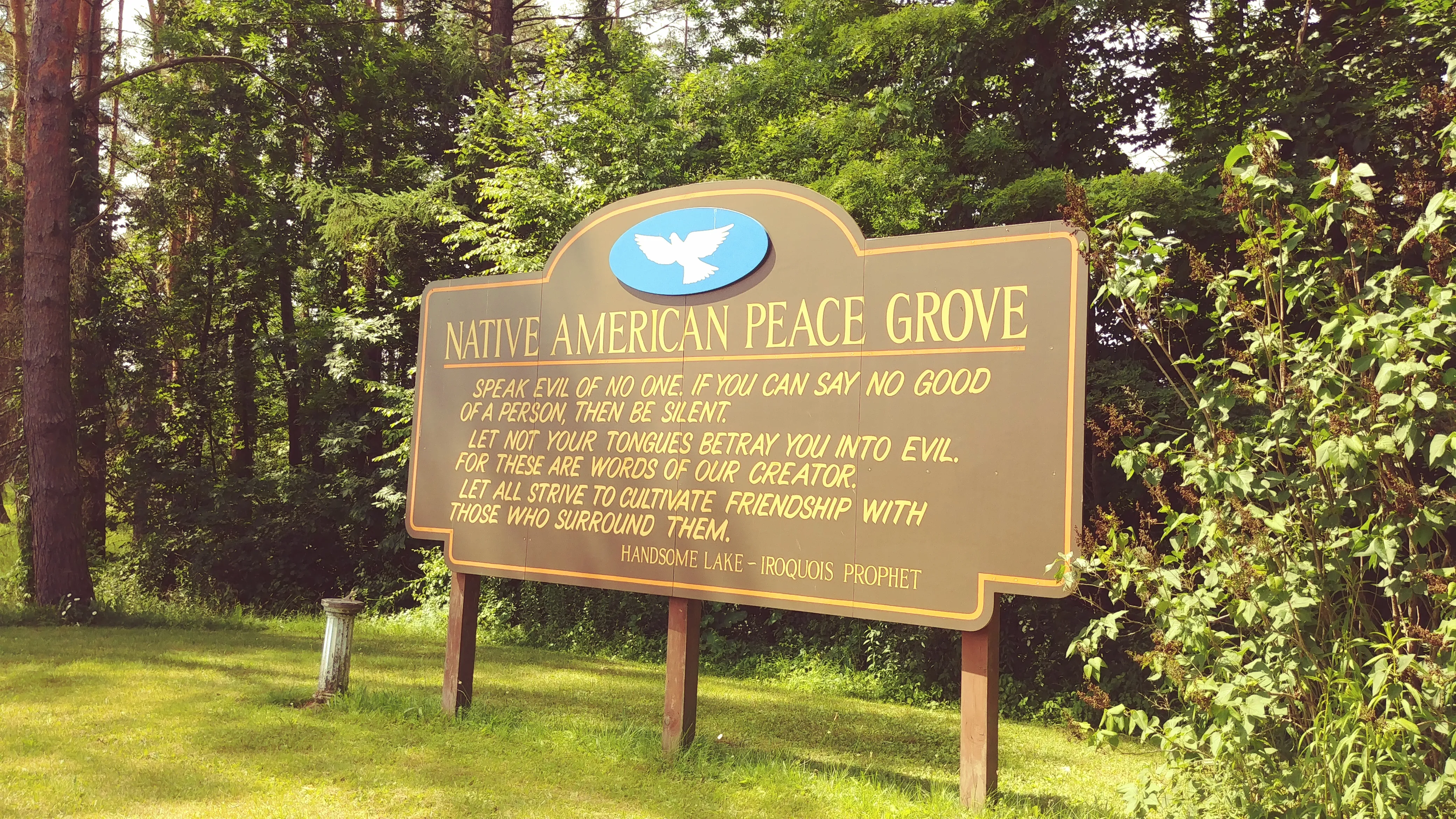
Peace Grove at Saint Kateri Tekakwitha Shrine and Historic Site in Fonda, New York. Photo courtesy of Saint Kateri Tekakwitha Shrine and Historic Site
Outside the Candle Chapel, which is always open for prayer, visitors can participate in a ministry of “Kateri crosses.”
“St. Kateri was known for going into the forest, gathering sticks, binding them into crosses, and then spending hours in prayer in front of crosses she created,” Bramble said. Sticks are gathered from the shrine grounds and visitors are invited to make their own “Kateri crosses” and take them home to use as a prayer aid. Bramble shared that the shrine sends materials for Kateri crosses to those who aren’t able to visit, including recently to a confirmation group.
The feast day weekend
The Saint Kateri Tekakwitha National Shrine has a schedule of special events planned for St. Kateri’s feast day on July 14. Bramble said they anticipate several hundred visitors for the feast day events this year, which include Masses, a healing prayer service, and talks. (A listing of the full schedule can be found here.)
The weekend Masses, which include special blessings and the music of the Akwesasne Mohawk Choir, “incorporate American Indian spiritual practices in keeping with the Catholic Church,” Bramble said. “The Akwesasne Mohawk Choir is made up of descendants of St. Kateri’s community who lived in the area historically.”
Bramble described numerous events each year that partner with the local American Indian community, such as the fun-filled “Three Sisters Festival” in May (celebrating corn, beans, and squash — the “three sisters” that were staples of Native cuisine), healing Masses during Indigenous Peoples’ Week in October, and a recent interfaith prayer service with Mohawk elders.
“There is a reestablished traditional Mohawk community a few miles west of the shrine, and we feel very blessed that we’ve been able to cultivate a very cooperative and mutually respectful relationship with the folks there,” Bramble said.
The Saint Kateri Shrine is also a great place for families. Events often include activities and crafts for children, there is an all-ages scavenger hunt available at the site, and the shrine’s museum is “a phenomenal educational opportunity.”
Bringing together American Indian archaeology and history with the story of St. Kateri, the shrine and its programs shed light on the saint’s story and keep alive the traditions and history of her people.
The doctors attested that the fall and impaling should have killed the carpenter, and ordinarily would have caused the organs of the body to burst
Louis Knuffke
Wed May 18, 2022 – 10:19 A.M EDT
Excerpt:
On November 30, 2016, a young carpenter named Charle (no –S) fell 50 feet from the scaffolding of a ceiling vault in the chapel of St. Louis high school in Saumur, France, landing on the armrest of a pew below. “This piece of wood went through his abdomen and under his heart and out the back,” his supervisor François Asselin told EWTN in an interview in Paris. “He impaled himself on the wood.”
Although extremely injured, Charle remained conscious after his fall. He got up and walked to find help. He was rushed to the hospital for an immediate operation, but according to Asselin, the doctors found that “no vital organ had been touched, [there were] no after-effects, either of the brain or physical.”
The doctors attested that the fall and impaling should have killed the carpenter, and ordinarily would have caused the organs of the body to burst. However, not only did Charle survive, he recovered in a matter of days.
“Three days later, I tell you,” Asselin declared. “I was in his hospital room, [and] he was talking to me like I am talking to you. The following week, eight days later, he was released from the hospital, and two months later, he was back to work as a carpenter in the company as if nothing had happened.”




Impaled after a 50-foot fall: The miracle that led to the canonization of St. Charles de Foucauld
The doctors attested that the fall and impaling should have killed the carpenter, and ordinarily would have caused the organs of the body to burst
Louis Knuffke
Wed May 18, 2022 – 10:19 A.M EDT
Excerpt:
On November 30, 2016, a young carpenter named Charle (no –S) fell 50 feet from the scaffolding of a ceiling vault in the chapel of St. Louis high school in Saumur, France, landing on the armrest of a pew below. “This piece of wood went through his abdomen and under his heart and out the back,” his supervisor François Asselin told EWTN in an interview in Paris. “He impaled himself on the wood.”
Although extremely injured, Charle remained conscious after his fall. He got up and walked to find help. He was rushed to the hospital for an immediate operation, but according to Asselin, the doctors found that “no vital organ had been touched, [there were] no after-effects, either of the brain or physical.”
The doctors attested that the fall and impaling should have killed the carpenter, and ordinarily would have caused the organs of the body to burst. However, not only did Charle survive, he recovered in a matter of days.
“Three days later, I tell you,” Asselin declared. “I was in his hospital room, [and] he was talking to me like I am talking to you. The following week, eight days later, he was released from the hospital, and two months later, he was back to work as a carpenter in the company as if nothing had happened.”
Saint Charles de Foucauld – Pray for us.