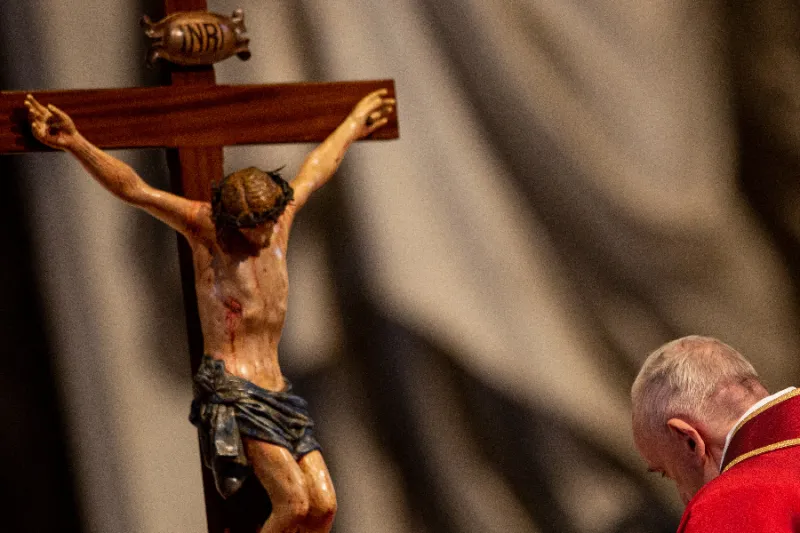
Are you planning to stay at home for the Holy Week and Easter Season celebrations? Join some of the biggest celebrations of this holy season right from home! Below is EWTN’s schedule of upcoming events:
Holy Thursday
April 14, 2022
3:30 AM EDT | Chrism Mass in Rome with Pope Francis
12:00 PM EDT | Solemn Mass of the Lord’s Supper from Rome
6:00 PM EDT | Solemn Mass of the Lord’s Supper broadcasted from the Basilica of the National Shrine of the Immaculate Conception
Good Friday
April 15, 2022
11:00 AM EDT | re-airs April 16th 2:00 AM EDT | Celebration of the Lord’s Passion from Rome with Pope Francis
3:00 PM EDT | Liturgy of the Lord’s Passion, broadcasted from the Basilica of the National Shrine of the Immaculate Conception
6:30 PM EDT | re-airs April 16th 5:00 AM EDT | Pope Francis presiding at Way of the Cross in Rome
Holy Saturday
April 16, 2022
1:30 PM EDT | Easter Vigil Mass with Pope Francis
Easter Sunday
April 17, 2022
6:00 AM EDT | re-airs April 17th 9:00 PM EDT | Pope Francis’ Urbi et Orbi Message and Blessing “to the city and the world”
8:00 AM EDT | re-airs April 18th 12:00 AM EDT | Solemn Mass of Easter Sunday with the Franciscan Missionaries of the Eternal Word
7:00 PM EDT | Solemn Mass of Easter Sunday with Pope Francis
Divine Mercy Sunday
April 24, 2022
8:00 AM EDT | Sunday Mass from Our Lady of the Angels Chapel in Irondale, Alabama
10:00 AM EDT | Divine Mercy Celebration and Mass from Vilnius, Lithuania
1:30 PM EDT | re-airs 1:30 AM EDT | Divine Mercy Celebration and Mass from Stockbridge, Massachusetts
10:00 PM EDT | Holy Mass on Divine Mercy Sunday with Pope Francis
On behalf of Catholic News Agency and all of EWTN, we wish each one of you a blessed Holy Week and Easter Season!
If you value the news and views Catholic World Report provides, please consider donating to support our efforts. Your contribution will help us continue to make CWR available to all readers worldwide for free, without a subscription. Thank you for your generosity!
Click here for more information on donating to CWR. Click here to sign up for our newsletter.
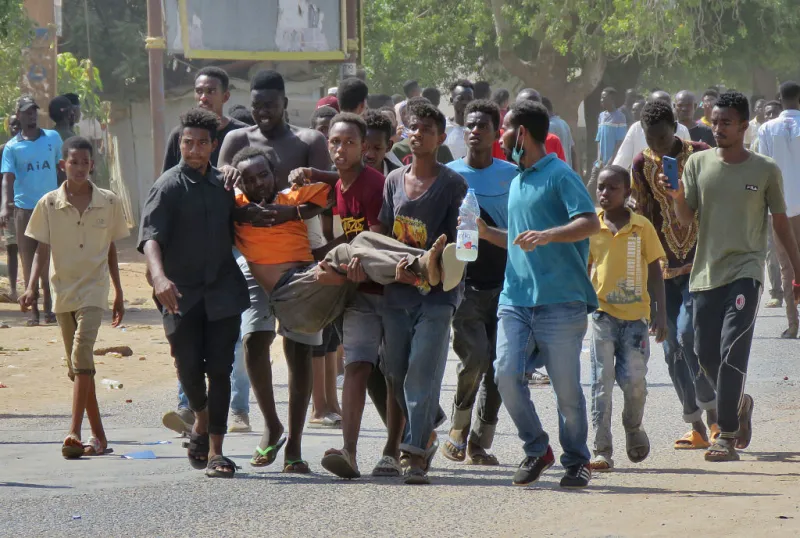
Sudanese carry a man injured during clashes as part of protests against a military coup that overthrew the transition to civilian rule, on Oct. 25, 2021 in the capital Khartoum. – Sudan’s top general declared a state of emergency Monday as soldiers rounded up civilian leaders, with three people killed as soldiers put down furious protests decrying a coup. / -/AFP via Getty Images
El Obeid, Sudan, Oct 27, 2021 / 15:19 pm (CNA).
The international community must to put pressure on Sudan’s military to show respect and value for human life, a Catholic bishop in the country said Tuesday, shortly after a coup.
Sudan’s military launched a coup against the country’s transitional government Oct. 25. Civilian rule was dissolved and General Abdel Fattah al-Burhan became head of state. Protesters have been fired on, with 10 reportedly killed.
Bishop Yunan Tombe Trille Andali of El Obeid told ACI Africa Oct. 26 that the coup is a retrogression that brings Sudan “back to the military junta rule.”
“We hear of the death of the people who express their feelings towards the coup against civilian governments,” Bishop Tombe Trille said after multiple protesters were reportedly killed.
“The international community should put their pressure on the junta to value the life of their citizens,” he said.
Bishop Tombe Trille also urged the international community “to assist the military junta to respect and abide with the norms, release the detained civil ministers and dialogue with them to hand back the power to civil government.”
“The message of the scripture remains to be the strength of the people of God in the light of any situation,” the bishop, who is also president of the Sudanese bishops’ conference, commented.
He added, “The Church in Sudan has (never) remained silent under the Cross of Christ despite some changes which took place in Sudan; the attitude of the rulers towards the Church never changed.”
Sudan had been under the military dictatorship of Omar al-Bashir since 1989, but pro-democracy protests led to his overthrow in April 2019 and the installation of a transitional government which had both civilian and military elements.
There was a failed coup in September, but this week Burhan, who was chair of the power-sharing Sovereignty Council, has detained civilian government and political party leaders.
The coup has been widely condemned, with the US and the World Bank withholding aid, and the African Union suspending Sudan from the bloc.
Sudan was listed by the US Department of State as a Country of Particular Concern for its religious freedom record from 1999 to 2019.
In December 2019, it was moved to the Special Watch List “due to significant steps taken by the civilian-led transitional government to address the previous regime’s ‘systematic, ongoing, and egregious violations of religious freedom.’”
At least 90 percent of Sudan’s population is Muslim, though Islam was disestablished in 2020.
Lia Garcia, director of Hispanic Ministry at the Archdiocese of Baltimore, speaks at a panel discussion exploring the impact of U.S. Latinos on the 2024 election hosted by Georgetown University’s Initiative on Catholic Social Thought and Public Life on Monday, Oct. 7, 2024. / Credit: Georgetown University/Art Pittman
Washington, D.C. Newsroom, Oct 10, 2024 / 06:00 am (CNA).
As a record number of Hispanic Americans will be eligible to vote this November, many are asking what impact Latinos — and Latino Catholics in particular — will have on the 2024 election.
Though acknowledging the great diversity in culture and thought among American Hispanic communities, the panelists posited that the overarching values of family, faith, and care for the poor will factor largely into Latinos’ decisions at the ballot box this November.
“We are big on family, family values … We want to be welcoming and be very attentive to the needs of others,” said Lia Garcia, one of the panelists and the director of Hispanic ministry at the Archdiocese of Baltimore.
“We throw big parties, we eat a lot of food,” she added, laughing. “Everybody is invited to our gatherings, so our faith teaches us that we are built to be in communion in relationship with God and in relationship with one another.”
Hispanics don’t fit into a box
Speaking with CNA after the panel, Garcia said that in her work with Hispanic Catholics, she has heard “a lot of anxiety about what is going to happen” and “about who is going to win” the presidency.
She said that many Hispanic voters “feel pinned” between conflicting priorities held by Trump and Harris.
“They feel that they have to choose between the issue of abortion and defending immigrants,” she said. “Latino Catholics are very much for life. You can see that in our big families. But they also have a concern about the immigration issues. Even if immigration doesn’t directly affect them because now they’re documented, but they know someone, they know a family member, they know a colleague … it’s really scary to people how Latinos are portrayed to the rest of the world as criminals.”
A member of the audience asks a question during a panel discussion exploring the impact of U.S. Latinos on the 2024 election hosted by Georgetown University’s Initiative on Catholic Social Thought and Public Life on Monday, Oct. 7, 2024. Credit: Georgetown University/Art Pittman
Hispanic voters have historically favored Democrats in national and local elections. The panelists noted, however, that Republicans have been faring better with Latinos in recent elections and polls, giving credence to predictions that the Hispanic vote is no longer a monolith.
Recent polling on Hispanics backs up this theory. Newsweek reported this week that while Democratic presidential candidate Kamala Harris is still leading among Hispanics by a wide margin, 56% to 38%, her lead has shrunk from the 59% Joe Biden held in 2020 and even further from the 66% held by Hillary Clinton in 2016.
Instead of loyalty to a party, panelists said Hispanics appear motivated mostly by their family values and concern for the poor and downtrodden.
Father Agustino Torres, a priest with the New York-based Franciscan Friars of the Renewal, said that in his ministry to young Latinos he has witnessed that Hispanic youth “have this fire” for caring for the downtrodden, especially for poor migrants.
“Sometimes we’re American Catholics rather than Catholic Americans. We allow our politics to inform our faith rather than our faith informing our politics,” Torres said. “But this is the reality: I’m responsible for you and you’re responsible for me. If I see someone falling down on the sidewalk, like, I am obligated because of my baptism, and this is a good thing … This is the Gospel.”
Father Agustino Torres, a priest and member of the Franciscan Friars of the Renewal, pointed out that
“sometimes we’re American Catholics rather than Catholic Americans. We allow our politics to inform our faith rather than our faith informing our politics.” Credit: Peter Pinedo/CNA
“When we teach this, they are just like, ‘yes,’ and it unites their worlds, family, faith, outreach,” he said.
To be clear, like most Americans, U.S. Hispanics are most concerned with the economy. EWTN published a poll of U.S. Catholics in September that found that most of the country’s Hispanic Catholics — 56.8% — said the economy (including jobs, inflation, and interest rates) is the most important issue deciding their vote this election cycle.
The next-highest priorities were border security/immigration at 10.5%, abortion at 9.7%, health care at 5.3%, and climate change at 5%.
Yet, according to panelist Santiago Ramos, a Catholic philosopher at the Aspen Institute, even when it comes to their approach to economic issues, Hispanics do not easily fit into the political right or left.
Ramos said Hispanics challenge the “nationalist, right-wing” as well as progressivist categorizations.
“There is a community aspect to our existence, family-oriented, dare I call it socially conservative aspect to our existence that doesn’t always mesh with mainstream liberal institutions,” he explained. “So, there are all sorts of ways that we pop up in American politics and force people to see things they don’t want to see.”
Among new voters, Hispanics loom large
Aleja Hertzler-McCain, a reporter on Latino faith and American Catholicism for Religion News Service, pointed out that half of the new voters who have become eligible to vote since 2020 are Hispanic.
According to the Pew Research Center, there will be 36.2 million eligible Hispanic voters this year, up almost 4 million from 2020. While noting that U.S. Hispanics historically have low voter turnout, Hertzler said the sheer volume of new Hispanic voters could have a “big impact” on the election.
Whatever the outcome of the election, Garcia said she is “really excited” to see the Hispanic community have its voice heard in the democratic process.
“I can’t wait to see that. I’m really excited about the election for that particular reason,” she said.
“The beauty of our culture,” Garcia went on, “is we can draw from our own experiences growing up with big families, big celebrations, and also with our faith that draws us to relationship with one another. And I think that is where we can sense how [concern for] the common good is not only something that comes from God but comes from our culture as well.”
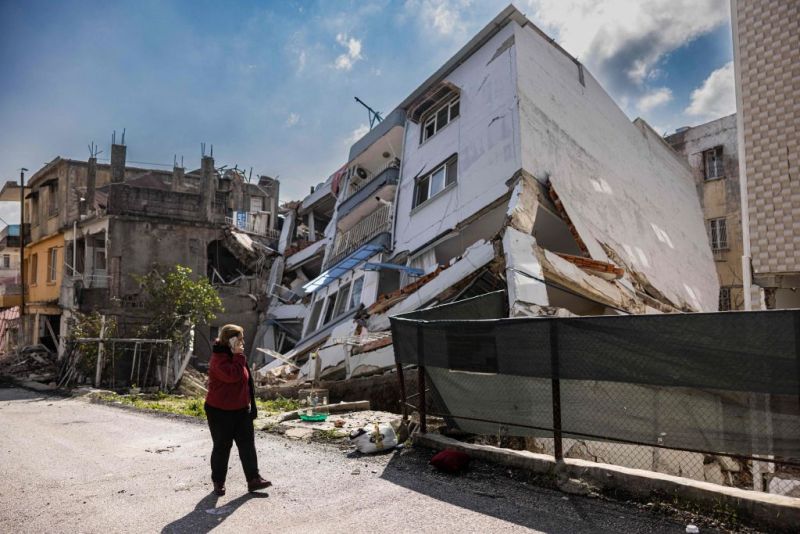
A pedestrian uses a smartphone as she walks past a collapsed building in Antakya, southern Turkey on Feb. 21, 2023. A 6.4-magnitude earthquake late Feb. 20, 2023, rocked Turkey’s southern province of Hatay and northern Syria. / Photo by SAMEER AL-DOUMY/AFP via Getty Images
ACI Prensa Staff, Feb 21, 2023 / 11:35 am (CNA).
Antoine Chahda, the Syrian Catholic archbishop of Aleppo, Syria, asked for prayers after a new 6.4-magnitude earthquake shook Turkey and Syria on Feb. 20.
In a statement to ACI Prensa, CNA’s Spanish-language news partner, after the earthquake Chahda encouraged prayers “for us because all the people are out on the streets, the whole city. It was horrible, very terrible, we’re all trembling.”
According to the U.S. Geological Survey, the quake occurred three kilometers (about two miles) southwest of Uzunbağ, Turkey, near the Syrian border, at 8:04 p.m. local time.
This was one of the most intense of the thousands of aftershocks that have followed the Feb. 6 earthquake, which to date has claimed more than 47,000 lives and more than 122,000 injuries in the border region.
The Syrian Catholic archbishop of Aleppo said that “so far, no buildings have collapsed, the cathedral is okay. But tomorrow, when the sun rises, we will see what will happen.”
“People are out on the street. We’re okay. There seem to be no injuries in Aleppo. We won’t know until tomorrow,” the prelate commented.
The archbishop said that “for now we are receiving people who like to come to the cathedral. It’s full of people, just like the street.”
“We don’t know what will happen,” he added. “Only God knows. Pray for us.”
Father Esteban Dumont, who lives in Tarsus, Turkey, about 135 miles by air from Aleppo, said “We’re okay. It felt strong, but we didn’t suffer any damage.”
This story was first published by ACI Prensa, CNA’s Spanish-language news partner. It has been translated and adapted by CNA.







Leave a Reply