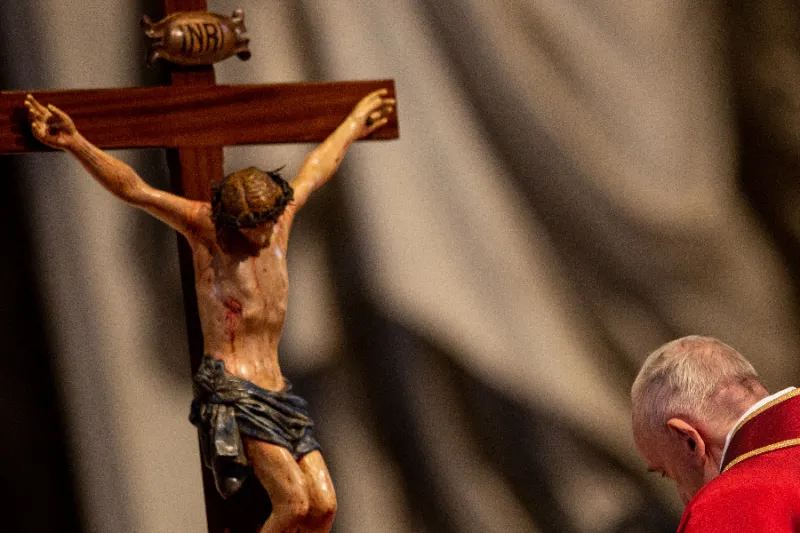
Are you planning to stay at home for the Holy Week and Easter Season celebrations? Join some of the biggest celebrations of this holy season right from home! Below is EWTN’s schedule of upcoming events:
Holy Thursday
April 14, 2022
3:30 AM EDT | Chrism Mass in Rome with Pope Francis
12:00 PM EDT | Solemn Mass of the Lord’s Supper from Rome
6:00 PM EDT | Solemn Mass of the Lord’s Supper broadcasted from the Basilica of the National Shrine of the Immaculate Conception
Good Friday
April 15, 2022
11:00 AM EDT | re-airs April 16th 2:00 AM EDT | Celebration of the Lord’s Passion from Rome with Pope Francis
3:00 PM EDT | Liturgy of the Lord’s Passion, broadcasted from the Basilica of the National Shrine of the Immaculate Conception
6:30 PM EDT | re-airs April 16th 5:00 AM EDT | Pope Francis presiding at Way of the Cross in Rome
Holy Saturday
April 16, 2022
1:30 PM EDT | Easter Vigil Mass with Pope Francis
Easter Sunday
April 17, 2022
6:00 AM EDT | re-airs April 17th 9:00 PM EDT | Pope Francis’ Urbi et Orbi Message and Blessing “to the city and the world”
8:00 AM EDT | re-airs April 18th 12:00 AM EDT | Solemn Mass of Easter Sunday with the Franciscan Missionaries of the Eternal Word
7:00 PM EDT | Solemn Mass of Easter Sunday with Pope Francis
Divine Mercy Sunday
April 24, 2022
8:00 AM EDT | Sunday Mass from Our Lady of the Angels Chapel in Irondale, Alabama
10:00 AM EDT | Divine Mercy Celebration and Mass from Vilnius, Lithuania
1:30 PM EDT | re-airs 1:30 AM EDT | Divine Mercy Celebration and Mass from Stockbridge, Massachusetts
10:00 PM EDT | Holy Mass on Divine Mercy Sunday with Pope Francis
On behalf of Catholic News Agency and all of EWTN, we wish each one of you a blessed Holy Week and Easter Season!
If you value the news and views Catholic World Report provides, please consider donating to support our efforts. Your contribution will help us continue to make CWR available to all readers worldwide for free, without a subscription. Thank you for your generosity!
Click here for more information on donating to CWR. Click here to sign up for our newsletter.
The Catholic faithful gathered in the Cenacle in Jerusalem for the Mass of the Lord’s Supper that the Franciscan friars celebrated on Holy Thursday, March 28, 2024. The Cenacle is at the center of strong tensions and disputes regarding ownership and rights of access and celebration. An ancient tradition places King David’s tomb here and over the centuries Jews and Muslims have leveraged this to first expel the Franciscans and then to prevent Christian worship, which they deemed sacrilegious. / Credit: Marinella Bandini
Jerusalem, Mar 28, 2024 / 17:15 pm (CNA).
On Holy Thursday, the doors of the Cenacle in Jerusalem were opened to welcome the Franciscans of the Custody of the Holy Land. In this “Upper Room,” called the Cenacle in the Holy Land, Jesus had his Last Supper, washed his apostles’ feet, and instituted the Eucharist.
It was here that the Franciscans celebrated the Mass of the Lord’s Supper, reenacting those same gestures. (At the Basilica of the Holy Sepulcher, however, the celebration is held on Thursday morning due to the Status Quo. Here is Cardinal Pierbattista Pizzaballa’s homily from that Mass.)
Cardinal Pierbattista Pizzaballa, the Latin Patriarch of Jerusalem, kisses the feet of a Franciscan friar during the “Washing of the Feet” ritual at the Mass of the Lord’s Supper celebrated at the Holy Sepulchre on Holy Thursday. The celebration is held on Thursday morning due to the Status Quo. March 28, 2024. Courtesy of the Custody of the Holy Land
The custos of the Holy Land, Father Francesco Patton, presided over the Eucharistic celebration at the Cenacle. In his homily, before washing the feet of six teachers and six students from the Terra Sancta School in Jerusalem, he emphasized the value of the “new commandment” that Jesus gave to his apostles here: “As I have loved you, so you also should love one another” (Jn 13:34).
“To love means to give oneself and to serve,” he said. “In this celebration, we want to nourish ourselves with Jesus because if he is alive within us, then we too will become capable of loving one another as he loved us. And we also want to learn from Jesus not to be served but to serve.”
Some students from the Terra Sancta School in Jerusalem who took part in the “Washing of the Feet” ritual during the Mass of the Lord’s Supper celebrated at the Cenacle in Jerusalem on Holy Thursday, March 28, 2024. Addressing them specifically in his homily, the Custos of the Holy Land emphasized the value of the “new commandment” that Jesus gave to his apostles here: “As I have loved you, so you also should love one another” (John 13:34). Credit: Marinella Bandini
Holy Thursday is the only day, along with Pentecost Sunday, when the Franciscans have the right to gather in the Upper Room to pray. Usually, it is a liturgy of the word, but since 2021 they have celebrated Mass. Outside, Israeli Army personnel ensure security.
The Cenacle is at the center of strong tensions and disputes regarding ownership and rights of access and celebration. An ancient tradition places King David’s tomb here, and over the centuries, Jews and Muslims have leveraged this place to first expel the Franciscans and then to prevent Christian worship, which they deem sacrilegious.
Father Narciso Klimas, historian and archivist of the Custody of the Holy Land, explained to CNA: “The Custody has all the documents confirming our ownership of Mount Zion.” Even today, traces of Christian presence are visible, both in the architecture of the place and in some symbols.
“The presence of the Franciscans at the Cenacle,” Klimas explained, “dates back to 1342, but as early as 1333, the rulers of Naples, Robert of Anjou and Sancha of Majorca, acquired the land and donated it to the friars. This was the first headquarters of the Custody of the Holy Land.” To this day, the official title of the Custos of the Holy Land is “Guardian of Mount Zion and the Holy Sepulchre.”
Father Francesco Patton, custos of the Holy Land, incenses the altar at the beginning of the Mass of the Lord’s Supper that the Franciscan friars celebrated inside the Cenacle in Jerusalem on Holy Thursday, March 28, 2024. This is the only day, along with Pentecost Sunday, that the Franciscans have the right to gather here to pray. Usually, it is a liturgy of the word, but since 2021 they have celebrated Mass. Credit: Marinella Bandini
In 1421, a rabbi submitted a petition to the local emirs, claiming the right for Muslims and Jews to this place due to the presence of King David’s tomb. One hundred years later, Klimas continued, “the Ottomans used this argument to gradually expel the Franciscans, until in 1551 the sultan decreed the total expulsion of the Franciscans from Mount Zion.” The Cenacle first became a mosque and later, in the lower part, also a synagogue.
“Since then,” Klimas recounted, “the Franciscans have never stopped attempting to regain possession of the Cenacle. The friars have always tried to ensure a presence, at least on Holy Thursday and Pentecost, sometimes even with methods that are not exactly orthodox (such as bribing the local guardian).”
Something began to change in the 19th century, during the time of the Ottoman Sultan Abdülmecid. Since then, the Franciscans have had the right to pray at the Cenacle on Holy Thursday and Pentecost. After a failed attempt in the 1930s to regain control of it, the friars managed to purchase adjacent land where they built the convent of San Francesco “ad Coenaculum” (next to the Cenacle).
In 1948, with the founding of the State of Israel, the entire Mount Zion came under Israeli control, and until today, the Israeli state owns the entire complex of the Cenacle. The neighborhood has a strong Jewish religious character and is characterized by the presence of synagogues and rabbinical schools.
The Franciscan friars and the faithful in the Armenian Cathedral of St. James in Jerusalem after the Mass of the Lord’s Supper celebrated at the Cenacle. Here, the friars commemorate the hospitality they received here in the 16th century. After being expelled from the Cenacle, the Franciscans were welcomed by the Armenians for seven years while the convent of St. Saviour was purchased, to this day the headquarters of the Custody of the Holy Land. March 28, 2024. Credit: Marinella Bandini
“Even if the Cenacle cannot return to our hands,” Klimas explained, “we ask at least to celebrate regularly, even with pilgrims, without the need for special permits.”
Negotiations on these matters (taxation and property) have been ongoing for over 25 years between the Holy See and the State of Israel, following the signing of the Fundamental Agreement in 1993 and the agreement recognizing the legal personality of the Catholic Church in Israel in 1997.
Despite the slow pace of diplomatic negotiations, some practical progress can be observed informally. The ability to celebrate Mass on Holy Thursday at the Cenacle is among these developments. Permissions to access the site on other special occasions are usually granted without significant issues as well.
After the Mass at the Cenacle, as tradition dictates, the Franciscans proceeded in a procession to three churches in two other symbolic places: the Armenian churches of St. James and of the Holy Archangels (of the Armenian Apostolic Church), and the Syro-Orthodox Church of St. Mark.
The Franciscan friars and the faithful in the Armenian Church of the Holy Archangels in Jerusalem after the Mass of the Lord’s Supper celebrated at the Cenacle on March 28, 2024. Friars and faithful pray together and receive the blessing from the representative of the Armenian Apostolic Church. Credit: Marinella Bandini
This yearly visit commemorates the hospitality the friars received in the 16th century. After being expelled from the Cenacle, the Franciscans were welcomed by the Armenians for seven years while the convent of St. Saviour was purchased, to this day the headquarters of the Custody of the Holy Land. Friars and faithful prayed together and received the blessing from the representative of the Armenian Apostolic Church.
The Syriac Orthodox Church of St. Mark is said to be built on the house of Mary, the mother of the evangelist Mark. According to Syriac tradition, this is the place where Jesus had the Last Supper. Here as well, those present prayed together and were able to listen to the Lord’s Prayer sung in Aramaic by one of the monks, who then gave a blessing.
The Franciscan friars and the faithful in the Syro-Orthodox church of St. Mark in Jerusalem after the Mass of the Lord’s Supper celebrated at the Cenacle on March 28, 2024. According to Syriac tradition, this is the upper room where Jesus had the Last Supper. Here as well, those present pray together and listen to the Lord’s Prayer sung in Aramaic by one of the monks, who then gives the blessing. Credit: Marinella Bandini
The episcopal consecration of Bishop Stephen Chow Sau-yan’s in Hong Kong’s Cathedral of the Immaculate Conception, Dec. 4, 2021 / Screenshot from livestream
Denver Newsroom, Dec 31, 2021 / 11:00 am (CNA).
Four clerics have told Reuters that several bishops and other officials from the Chinese Catholic Patriotic Association met in October with senior clerics of the Diocese of Hong Kong to talk to them about sinicization, a Chinese government campaign to bring religion into its vision of culture, society, and politics.
“We all know the word sinicization carries a political agenda behind it, and they didn’t have to spell that out,” said one of the four Hong Kong clerics who spoke to Reuters about the meeting.
Sinicization was proposed by Chinese president Xi Jinping in 2015. The U.S. Commission on International Religious Freedom has called the effort “a far-reaching strategy to control, govern, and manipulate all aspects of faith into a socialist mold infused with ‘Chinese characteristics.”
Reuters’ report on the Oct. 31 meeting was published Dec. 30.
The Hong Kong Liaison Office, which represents the Chinese government in the special administrative region, arranged and monitored the encounter. Participating were three bishops and “about 15 religious figures” from the Patriotic Association, and “about 15 senior clergymen” of the Hong Kong diocese.
Two of the men who spoke to Reuters said the officials from the government-backed Church spoke about the compatibility of sinicization and inculturation, and one described Xi as the “elephant in the room” during the conversation.
“This was just the first step and I felt they knew that they could not come into this too heavy,” another said.
Several told Reuters that Bishop Stephen Chow Sau-yan of Hong Kong attended the meeting only a short time. The Jesuit was consecrated Dec. 4.
Hong Kongers have, historically, largely enjoyed political fredom and freedom of worship and evangelization, while in mainland China there is a long history of persecution of religious persons who run afoul of the government.
Beijing has in recent years tightened control over the island territory and cracked down on dissent.
The Hong Kong diocese has been divided in recent years over reactions to a movement protesting China’s increasing control over the special administrative region.
The Catholic Church in China has been split between the government-sanctioned Chinese Patriotic Catholic Association and the underground Church, which is persecuted and whose episcopal appointments are frequently not acknowledged by Chinese authorities.
In 2018, the Vatican reached an agreement with the Chinese government on the appointment of bishops in the country; the terms of the agreement, which was renewed in October 2020 for two more years, have never been fully revealed. It is meant to help unite the Patriotic Association and the underground Church.
The October meeting’s focus on the compatibility of sinicization and inculturation is not novel.
Fr. Benoit Vermander, a Jesuit priest in China, attempted to outline a path for “sinicization” of religion in a March 2018 issue of La Civiltà Cattolica, whose publication is overseen by the Secretariat of State.
While there are “evident dangers” in following a top-down policy that can bring “a substantial loss of identity,” he argued, Catholics should not avoid sinicization simply because it is government backed. Rather, despite the problems created by the policy, dialogue between Catholics and the communist government is needed.
Fr. Vermander argued that Christians should listen to the government’s appeal for sinicization and “examine which kind of changes it could lead them to imagine and undertake,” while “being aware of the danger.”
And in May 2019 Cardinal Pietro Parolin, Vatican Secretary of State, said that inculturation and sinicization can be “complementary” and “can open avenues for dialogue.”
“These two terms, ‘inculturation’ and ‘sinicization,’ refer to each other without confusion and without opposition,” he told the Global Times, an English-language newspaper owned by the People’s Daily, the official newspaper of the Central Committee of the Communist Party of China.
“For the future, it will certainly be important to deepen this theme, especially the relationship between ‘inculturation’ and ‘sinicization,’ keeping in mind how the Chinese leadership has been able to reiterate their willingness not to undermine the nature and the doctrine of each religion,” Cardinal Parolin said.
“Inculturation is an essential condition for a sound proclamation of the Gospel which, in order to bear fruit, requires, on the one hand, safeguarding its authentic purity and integrity and, on the other, presenting it according to the particular experience of each people and culture,” he said.
A group of comedians and humorists, including Chris Rock and Jimmy Fallon (center), share a lighthearted exchange with Pope Francis during a gathering with the pope in the Apostolic Palace at the Vatican on June 14, 2024. / Credit: Vatican Media… […]
Leave a Reply
