


Washington D.C., Oct 4, 2021 / 15:01 pm (CNA).
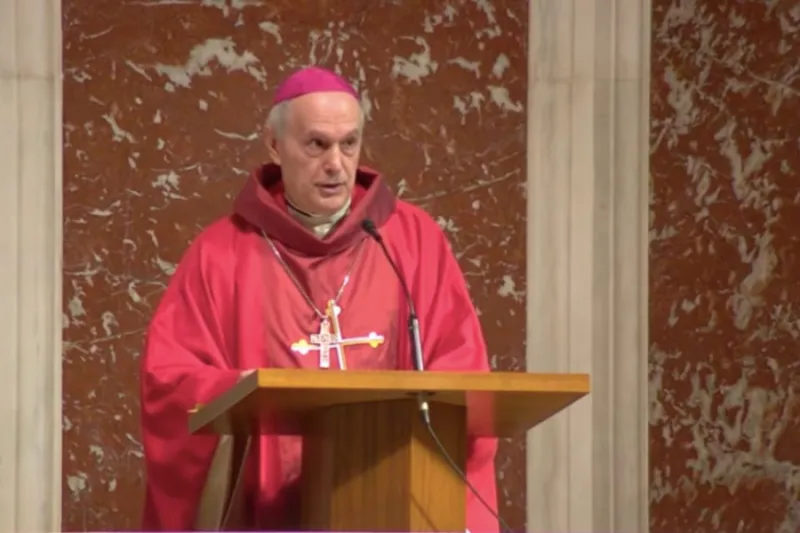
A leading Vatican diplomat on Sunday exhorted U.S. government officials and justices to not use God for their own selfish ends.
“There is the risk to use even God for our own ends instead of serving him,” said Archbishop Gabriele Caccia, Permanent Observer of the Holy See to the United Nations, in his homily for the 69th annual Red Mass at St. Matthew’s Cathedral in Washington, D.C.
“Even just laws,” he noted, “can result in injustice when unaccompanied by a just heart.”
Those who, instead of trying to “grasp” God, ask for and receive Him, by doing so “draw near” to God’s justice, Caccia said.
This also applies to human relationships, he added. “Every time we treat others as objects that we can grasp and use for our own purposes, we lose them,” he said. “If we, however, receive them as a gift, we can start a relationship that may last a lifetime.”
The Red Mass has been held annually in Washington, D.C. since 1953. Attended by government officials and justices, the Mass is offered to invoke God’s blessing upon civic leaders for the coming year. It is held just before the beginning of the Supreme Court’s fall term.
The Mass also has a tradition dating back centuries in Rome, Paris, and London. Its name is derived from the color of the celebrant’s vestments for the Mass of the Holy Spirit.
Cardinal Wilton Gregory of Washington celebrated the Mass on Sunday. Those in attendance included Supreme Court Chief Justice John Roberts and Secretary of Veterans Affairs Denis McDonough, along with the presidents of Georgetown University and The Catholic University of America. Clergy who were present included Archbishop Christopher Pierre, Apostolic Nuncio to the United States, and Bishop Michael Burbidge of Arlington.
At the end of Mass, Cardinal Gregory expressed gratitude for those in attendance, and thanked Archbishop Caccia for representing Pope Francis, “calling and summoning us to peace and international unity.”
Archbishop Caccia noted the current risk “to exploit justice instead of deliver it.” He urged those in attendance at the Red Mass to always practice justice with mercy in a spirit of fraternity.
“Justice without fraternity is cold, blind, and minimalistic,” he said, noting that justice together with fraternity “is transformed into an attentive application of laws to persons we care about.”
“Fraternity is what makes it possible for justice to be perfected by mercy for all involved, since the restoration of justice is ultimately the resolution of a family dispute, considering we are all members of the same human family,” he said, citing Pope Francis’s 2020 encyclical Fratelli tutti (“All brothers”).
The encyclical, he added, presented “a new vision of fraternity and social friendship that will not remain at the level of words.” In contrast to the biblical figure of Cain, who asked “am I my brother’s keeper,” he noted, “Pope Francis proposes the way of the Good Samaritan.”
The upcoming Supreme Court term will feature arguments in a critical abortion case, Dobbs v. Jackson Women’s Health Organization, as well as arguments in several religious freedom cases.
If you value the news and views Catholic World Report provides, please consider donating to support our efforts. Your contribution will help us continue to make CWR available to all readers worldwide for free, without a subscription. Thank you for your generosity!
Click here for more information on donating to CWR. Click here to sign up for our newsletter.


Wondering here is the world has drifted into a condition of extremis (extreme situations) across the board? Such that new or even ambiguous language is employed to bridge the gap between concrete cases and sound moral “judgments” (not to be confused in conscience with the pretense of situational “decision making,” Veritatis Splendor, n. 55)?
Archbishop Caccia affirms that, “[f]raternity is what makes it possible for justice to be perfected by mercy for all involved, since the restoration of justice is ultimately the resolution of a family dispute, considering we are all members of the same human family.” So far, so good…
Is he referring to immigration laws/asylum seekers—-and whether mass migrations indicate a situation of extremis? (Rerum Novarum: “It is a duty [‘to give to the indigent’], not of justice (except in extreme cases), but of Christian charity—a duty which is not enforced by human law” [Rerum Novarum, n. 19].) Or, as the article implies, in addition to immigration/asylum seekers more or less in extremis, is Archbishop Caccia also referring to pending review of Roe v. Wade?
In which case he might have an interesting conversation with Cardinal Turkson on how, exactly (and within the Church itself), the sacrilege and scandal of Eucharistic incoherence is to be addressed—-if at all—-with Catholic members of all three branches of government. Turkson seems to suggest that a ramped-up government imposition of the entrenched abortion culture, terminating tens of millions and counting, does not yet rise to the level of extremis—-calling for both justice and fraternity with the unborn “members of the same human family,” and members of more concrete families. https://www.catholicworldreport.com/2021/10/04/cardinal-turkson-talks-biden-holy-communion-on-hbo/
Pastoral abortion is not the Catholic faith.
Apparently there is a middle way between fundamental truths being “fundamentalist” and abortionist politicians being “relativist”? I must admit that the positioning of these 2 sides to locate a middle way is not instructive to me.
‘ Pope Francis stressed the danger in fighting fundamentalism and intolerance with as much fundamentalism and intolerance. He stated that religious freedom today must “consciously deal with two, equally menacing, opposing ideologies: secular relativism and religious radicalism – in reality, pseudo-religious radicalism”.
Pope Francis told the members of ICLN that, though they all play different roles within their respective countries, what they have in common is the good will to serve the Kingdom of God through an honest political commitment.
“Far from feeling or appearing as a hero or a victim, the Christian politician is called upon, first and foremost, like every baptised person, to try to be a witness – through humility and courage – and to propose consistent laws based on the Christian view of humanity and society, always seeking collaboration with all those who share these views,” Francis said. ‘
https://zenit.org/2018/08/23/pope-asks-christian-politicians-to-witness-to-the-faith/
This was Archbishop Zimowski in 2010, he says it is a crisis at the level of an emergency. Will the Synod eventually conclude that conscience is all about discerning and non-elitism?
‘ Archbishop Zimowski went on to single out three points for analysis. In the first place, he explained that public opinion is influenced by ideological campaigns that lead to perceiving attacks on life as “rights of individual liberty.”
The Vatican official further observed how medical practice socially legitimizes these evils. “The scientific context and the moral authority of the health organizations are largely sufficient, in the eyes of many, to make them acceptable,” he lamented.
And in the third place, the archbishop indicated that “the juridical norm of the state confers on these practices the accrediting of a law approved by the majority, which, hence, dispenses from subsequent scruples of conscience.”
In this context, Archbishop Zimowski affirmed that we are before a genuine cultural crisis, at whose root is the phenomenon of the tendency to disassociate private conscience and the socio-civil systems. ‘
https://zenit.org/2010/12/07/social-doctrine-facing-unheard-of-attacks/
“Justice without fraternity is cold, blind, and minimalistic” (Archbishop Caccia). Caccia envisions a humane justice that satisfies familial concern for each other. Cold, blind, minimalism inferred to those who say there are limits to immigration, that open borders and tidal migrations destroys nations and their culture. And certainly there are those minimalist pro life advocates who, absent an effective Church policy, are the remaining line of appeal imploring, begging that the unspeakable slaughter of innocent life in the womb cease. A thin red line of prelates, presbyter, and laymen that actually believe in practice of the faith. Sophistry reaches its exquisite reversal of the right to life with the wrong of infanticide with, “Even just laws can result in injustice when unaccompanied by a just heart.” As if a just heart must be empathetic toward a dispatcher of infants.