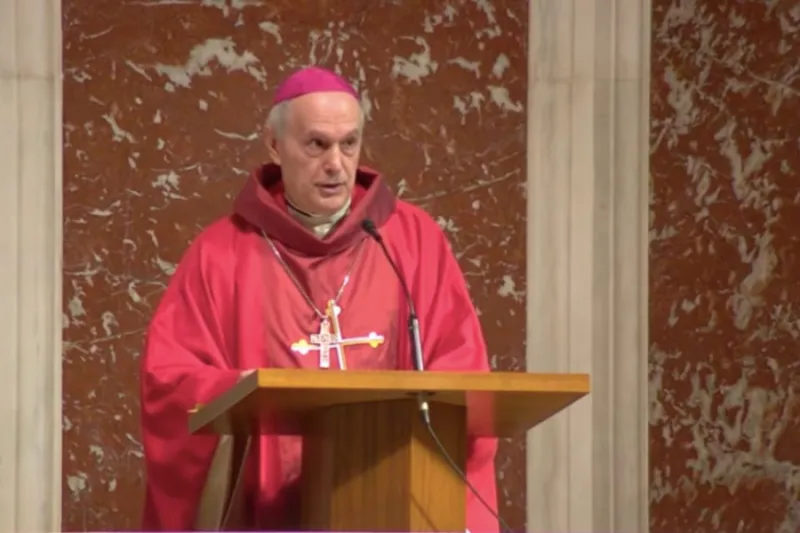
Archbishop Gabriele Caccia, Permanent Observer of the Holy See to the United Nations, delivers the homily for the 69th annual Red Mass at St. Matthew’s Cathedral in Washington, D.C. on Oct. 3. / Archdiocese of Washington/YouTube
Washington D.C., Oct 4, 2021 / 15:01 pm (CNA).
A leading Vatican diplomat on Sunday exhorted U.S. government officials and justices to not use God for their own selfish ends.
“There is the risk to use even God for our own ends instead of serving him,” said Archbishop Gabriele Caccia, Permanent Observer of the Holy See to the United Nations, in his homily for the 69th annual Red Mass at St. Matthew’s Cathedral in Washington, D.C.
“Even just laws,” he noted, “can result in injustice when unaccompanied by a just heart.”
Those who, instead of trying to “grasp” God, ask for and receive Him, by doing so “draw near” to God’s justice, Caccia said.
This also applies to human relationships, he added. “Every time we treat others as objects that we can grasp and use for our own purposes, we lose them,” he said. “If we, however, receive them as a gift, we can start a relationship that may last a lifetime.”
The Red Mass has been held annually in Washington, D.C. since 1953. Attended by government officials and justices, the Mass is offered to invoke God’s blessing upon civic leaders for the coming year. It is held just before the beginning of the Supreme Court’s fall term.
The Mass also has a tradition dating back centuries in Rome, Paris, and London. Its name is derived from the color of the celebrant’s vestments for the Mass of the Holy Spirit.
Cardinal Wilton Gregory of Washington celebrated the Mass on Sunday. Those in attendance included Supreme Court Chief Justice John Roberts and Secretary of Veterans Affairs Denis McDonough, along with the presidents of Georgetown University and The Catholic University of America. Clergy who were present included Archbishop Christopher Pierre, Apostolic Nuncio to the United States, and Bishop Michael Burbidge of Arlington.
At the end of Mass, Cardinal Gregory expressed gratitude for those in attendance, and thanked Archbishop Caccia for representing Pope Francis, “calling and summoning us to peace and international unity.”
Archbishop Caccia noted the current risk “to exploit justice instead of deliver it.” He urged those in attendance at the Red Mass to always practice justice with mercy in a spirit of fraternity.
“Justice without fraternity is cold, blind, and minimalistic,” he said, noting that justice together with fraternity “is transformed into an attentive application of laws to persons we care about.”
“Fraternity is what makes it possible for justice to be perfected by mercy for all involved, since the restoration of justice is ultimately the resolution of a family dispute, considering we are all members of the same human family,” he said, citing Pope Francis’s 2020 encyclical Fratelli tutti (“All brothers”).
The encyclical, he added, presented “a new vision of fraternity and social friendship that will not remain at the level of words.” In contrast to the biblical figure of Cain, who asked “am I my brother’s keeper,” he noted, “Pope Francis proposes the way of the Good Samaritan.”
The upcoming Supreme Court term will feature arguments in a critical abortion case, Dobbs v. Jackson Women’s Health Organization, as well as arguments in several religious freedom cases.
If you value the news and views Catholic World Report provides, please consider donating to support our efforts. Your contribution will help us continue to make CWR available to all readers worldwide for free, without a subscription. Thank you for your generosity!
Click here for more information on donating to CWR. Click here to sign up for our newsletter.
Vatican City, Jul 5, 2018 / 11:50 am (CNA).- Most mayors do not live in unheated monastic cells, deliver candy from Orthodox patriarchs to the pope, or become ambassadors for international peace.
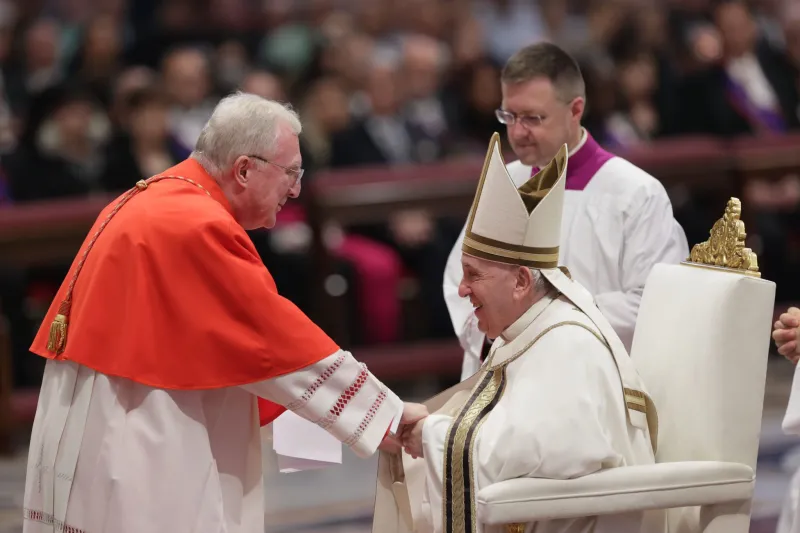
Pope Francis with Cardinal Arthur Roche, Prefect of the Vatican’s Dicastery of Divine Worship and Discipline of Sacraments, at the consistory in St. Peter’s Basilica, Aug. 27, 2022 / Daniel Ibáñez / CNA
Rome Newsroom, Aug 27, 2022 / 08:31 am (CNA).
Pope Francis created 20 new cardinals for the Catholic Church during a liturgy in St. Peter’s Basilica Saturday.
“Jesus calls us by name; he looks us in the eye and he asks: Can I count on you?” Pope Francis said in a homily addressed to the College of Cardinals and its new members on Aug. 27.
“The Lord,” he said, “wants to bestow on us his own apostolic courage, his zeal for the salvation of every human being, without exception. He wants to share with us his magnanimity, his boundless and unconditional love, for his heart is afire with the mercy of the Father.”
The pope’s reflection followed a reading from the Gospel of Luke, chapter 12, verses 49-50: “In that time, Jesus said to his disciples: ‘I have come to set the earth on fire, and how I wish it were already blazing! There is a baptism with which I must be baptized, and how great is my anguish until it is accomplished!’”
“The words of Jesus, in the very middle of the Gospel of Luke, pierce us like an arrow,” Francis said.
“The Lord calls us once more to follow him along the path of his mission,” he said. “A fiery mission – like that of Elijah – not only for what he came to accomplish but also for how he accomplished it. And to us who in the Church have been chosen from among the people for a ministry of particular service, it is as if Jesus is handing us a lighted torch and telling us: ‘Take this; as the Father has sent me so I now send you.’”
The pope ended his homily mentioning that one cardinal-elect, Richard Kuuia Baawobr of Wa (Ghana), was not present. Francis asked for prayers for the African prelate, explaining Baawobr had been taken ill.
At the beginning of the consistory, Pope Francis pronounced the opening prayer of the ceremony in Latin.
During the ceremony, the new cardinals made a profession of faith by reciting the Creed. They then pronounced an oath of fidelity and obedience to the pope and his successors.
Each cardinal then approached Pope Francis, kneeling before him to receive the red birretta, the cardinal’s ring, and a document naming the titular church he has been assigned.
Pope Francis embraced each new cardinal, saying to him: “Pax Domini sit semper tecum,” which is Latin for “the peace of the Lord be with you always.” Each cardinal responded: “Amen.”
The new cardinals also exchanged a sign of peace with a number of the members of the College of Cardinals, representative of the whole college.
While placing the red biretta on the head of each cardinal, the pope recited these words: “To the glory of almighty God and the honor of the Apostolic See, receive the scarlet biretta as a sign of the dignity of the cardinalate, signifying your readiness to act with courage, even to the shedding of your blood, for the increase of the Christian faith, for the peace and tranquility of the people of God and for the freedom and growth of the Holy Roman Church.”
As he gave each new cardinal the ring, Francis said: “Receive this ring from the hand of Peter and know that, with the love of the Prince of the Apostles, your love for the Church is strengthened.”
In his homily, the pope said: “The Lord wants to bestow on us his own apostolic courage, his zeal for the salvation of every human being, without exception. He wants to share with us his magnanimity, his boundless and unconditional love, for his heart is afire with the mercy of the Father.”
He also recalled another kind of fire, that of charcoal. “This fire,” he said, “burns in a particular way in the prayer of adoration, when we silently stand before the Eucharist and bask in the humble, discreet and hidden presence of the Lord. Like that charcoal fire, his presence becomes warmth and nourishment for our daily life.”
“A Cardinal loves the Church, always with that same spiritual fire, whether dealing with great questions or handling everyday problems, with the powerful of this world or those ordinary people who are great in God’s eyes,” he said.
The pope named three men as examples for the cardinals to follow: Saint Charles de Foucauld, Cardinal Agostino Casaroli, and Cardinal Van Thuân.
The consistory to create cardinals also included a greeting and thank you to Pope Francis, expressed by Cardinal Arthur Roche, prefect of the liturgy dicastery, on behalf of all the new cardinals.
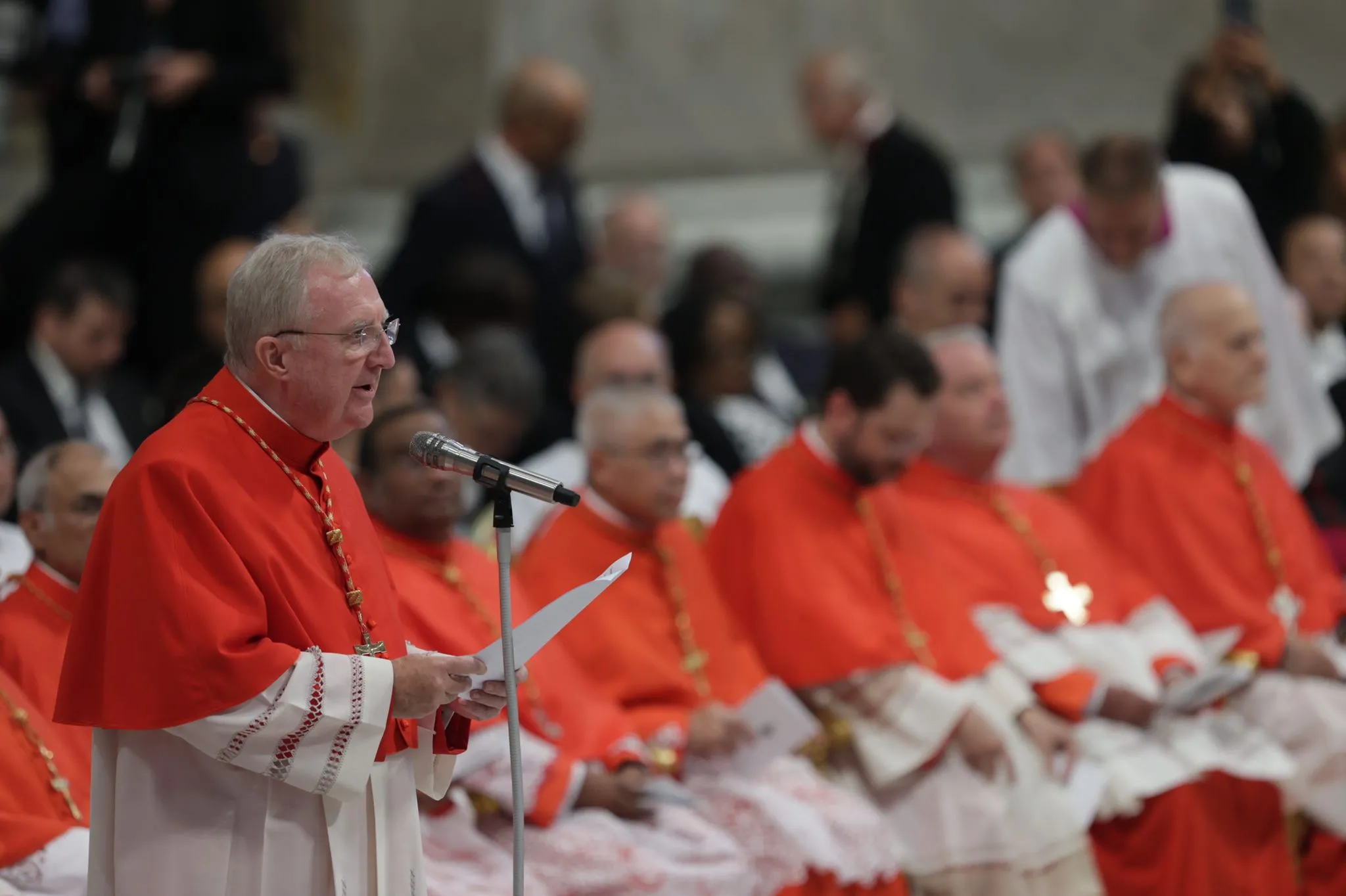
Cardinal Arthur Roche speaking on behalf of the new cardinals in St. Peter’s Basilica, Aug. 27. 2022. Daniel Ibáñez / CNA
“All of us, coming from different parts of the world, with our personal stories and different life situations, carry out our ministry in the vineyard of the Lord. As diocesan and religious priests, we are at the service of preaching the Gospel in many different ways and in different cultures, but always united in the one faith and the one Church,” Roche said.
“Now, in manifesting your trust in us, you call us to this new service, in an even closer collaboration with your ministry, within the broad horizon of the universal Church,” he continued. “God knows the dust of which we are all made, and we know well that without Him we are capable of falling short.”
Roche quoted Saint Gregory the Great, who once wrote to a bishop: “We are all weak, but he is weakest of all who ignores his own weakness.”
“However, we draw strength from you, Holy Father,” he said, “from your witness, your spirit of service and your call to the entire Church to follow the Lord with greater fidelity; living the joy of the Gospel with discernment, courage and, above all, with an openness of heart that manifests itself in welcoming everyone, especially those who suffer the injustice of poverty that marginalizes, the suffering of pain that seeks a response of meaning, the violence of wars that turn brothers into enemies. We share with you the desire and commitment for communion in the Church.”
At the end of the consistory to create cardinals, Pope Francis convened a consistory for the cardinals to give their approval to the canonizations of Blessed Artemide Zatti and Giovanni Battista Scalabrini.
The new cardinals are:
— Cardinal Arthur Roche, 72, prefect of the Congregation for Divine Worship and former Bishop of Leeds (England);
— Lazarus You Heung-sik, 70, prefect of the Congregation for Clergy and former Bishop of Daejeon (South Korea);
— Jean-Marc Noël Aveline, 63, Archbishop of Marseille, the first French diocesan bishop to get the honor during Pope Francis’ pontificate;
— Peter Ebere Okpaleke, 59, Bishop of Ekwulobia in the central region of Nigeria, who was created bishop in 2012 by Benedict XVI;
— Leonardo Ulrich Steiner, 77, Archbishop of Manaus, in Brazil’s Amazon region, a Franciscan who played a leading role during the Amazon Synod and as Vice President of the recently created Amazonian Bishops’ Conference;
— Filipe Neri António Sebastião do Rosário Ferrão, 69, Archbishop of Goa (India), appointed bishop by St. John Paul II in 1993;
— Robert McElroy, 68, Bishop of San Diego (United States), whose diocese is suffragan to the Archdiocese of Los Angeles, led by the President of the USCCB, Archbishop José Gomez;
— Virgilio do Carmo Da Silva, 68, a Salesian, since 2019 the Archbishop of Dili (East Timor);
— Oscar Cantoni, 71, Bishop of Como (Italy), appointed in January 2005 by St. John Paul II, who is suffragan to Milan;
— Archbishop Fernando Vérgez Alzaga, L.C., 77, president of the Governorate of the Vatican City State and of the Pontifical Commission for the Vatican City State; the Spaniard is the first Legionary of Christ to become a cardinal;
— Anthony Poola, 60, Archbishop of Hyderabad (India), a bishop since 2008 and the first dalit to become a cardinal;
–Paulo Cezar Costa, 54, Archbishop of Brasilia (Brazil), the fourth archbishop of the Brazilian capital to become a cardinal;
— Richard Kuuia Baawobr, 62, Bishop of Wa (Ghana), former Superior General of the White Fathers, and bishop since 2016;
— William Goh Seng Chye, 65, Archbishop of Singapore since 2013;
— Adalberto Martinez Flores, 71, Archbishop of Asunción (Paraguay) and the first Paraguayan cardinal;
— Giorgio Marengo, 47, Italian Missionary of the Consolata and Apostolic Prefect of Ulan Bator in Mongolia, the youngest cardinal in recent history, along with Karol Wojtyla, who also was created a cardinal at 47, during the consistory of June 26, 1967.
Furthermore, Pope Francis appointed the following prelates over the age of 80, who are therefore excluded from attending a future conclave.
Jorge Enrique Jiménez Carvajal, 80, Archbishop Emeritus of Cartagena (Colombia); Arrigo Miglio, 80, Archbishop Emeritus of Cagliari (Italy); Fr. Gianfranco Ghirlanda, a Jesuit and former rector of the Pontifical Gregorian University, who extensively collaborated in the drafting of the Apostolic Constitution Praedicate Evangelium; and Fortunato Frezza, 80, (Italy) currently a Canon at the Basilica of St. Peter, who collaborated for several years at the Secretariat General for the Synod of the Bishops.
Pope Francis had originally also nominated Ghent Bishop Luc Van Looy, 80, who later declined to accept the post because of criticism of his response to clergy abuse cases.
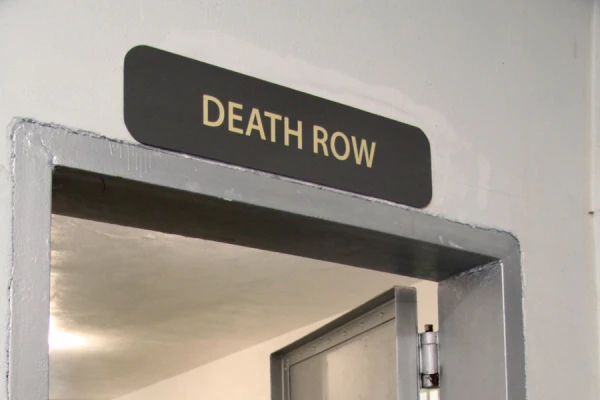
Birmingham, Ala., Mar 6, 2020 / 05:00 pm (CNA).- Following a controversial execution in Alabama on Thursday night, Catholics in the state have reiterated their opposition to the death penalty.
Late Thursday evening, the state of Alabama executed 43-year-old Nathan Woods by lethal injection.
Woods, who was black, was convicted in 2005 on four counts of capital murder and one count of attempted murder in the shootings of three white police officers in 2004 in Birmingham.
The three officers had arrived at a house where Woods and his co-defendant Kerry Spencer were believed to stash and sell drugs, and served Woods an arrest warrant for another misdemeanor offense.
As the officers tried to take Woods into custody, three of the officers were shot dead and a fourth survived.
The survivor, Officer Michael Collins, took cover behind the patrol car and testified that he saw Spencer shooting at him from inside the apartment.
The state conceded that Spencer shot the three officers, but argued that Woods was “an accomplice to the shootings,” according to local news KIRO 7. Woods, according to court records, allegedly threatened the officers if they were to enter the residence.
His co-defendant Kerry Spencer claimed that Woods was “100% innocent” in the killings of the officers, in a handwritten letter from prison.
Woods was sentenced to death by a jury, although not unanimously—Alabama is the only state where a death sentence does not require a unanimous vote by a jury.
A last-minute appeal to halt the execution was rejected by the U.S. Supreme Court on Thursday night.
Justice Clarence Thomas granted a temporary administrative stay to give the Court more time to fully consider the case. Later on Thursday evening, the application for a halt to the execution was denied by the full Court.
In response to Thursday night’s execution of Woods, the Diocese of Birmingham directed CNA to a joint statement of the bishops of Alabama and Mississippi on capital punishment.
“As Christians, we remember that wrongdoing, no matter how evil, deserves punishment but not vengeance,” the statement reads.
“God can touch and change even the most bitter and hardened heart. Mindful of this, we do not support the execution of criminals. When we execute someone, we take away any opportunity they have to repent and develop a relationship with God in this life,” the bishops stated.
The Archdiocese of Mobile referred to a column written by Archbishop Thomas Rodi in The Catholic Week in August of 2018.
“The death penalty is not a private matter,” the archbishop wrote in the column.
“It is not the grieving loved ones who execute those found guilty, it is not merely the governor who executes, it is not merely the warden of the prison who executes, it is all of us, the citizens of Alabama, since capital punishment is the law that we have enacted and enforce.”
“I remain convinced that we the citizens of Alabama need to end capital punishment in our civil courts,” he wrote.
The group Catholic Mobilizing Network, which advocates for an end to use of the death penalty, was following Woods’ case and asked supporters for prayers.
“At times like these we may feel at a loss of what to do in the face of such egregious acts of violence. These are the moments when we pray for God’s guidance and Grace. Please pray, on behalf of Nathaniel Woods that he may come to know God’s peace and ever-present mercy,” the group stated on its website.
Pope Francis in 2018 approved new language for the Catechism on the death penalty, calling it “inadmissible.”
The new language states that “the Church teaches, in the light of the Gospel, that ‘the death penalty is inadmissible because it is an attack on the inviolability and dignity of the person,’ and she works with determination for its abolition worldwide.”
Wondering here is the world has drifted into a condition of extremis (extreme situations) across the board? Such that new or even ambiguous language is employed to bridge the gap between concrete cases and sound moral “judgments” (not to be confused in conscience with the pretense of situational “decision making,” Veritatis Splendor, n. 55)?
Archbishop Caccia affirms that, “[f]raternity is what makes it possible for justice to be perfected by mercy for all involved, since the restoration of justice is ultimately the resolution of a family dispute, considering we are all members of the same human family.” So far, so good…
Is he referring to immigration laws/asylum seekers—-and whether mass migrations indicate a situation of extremis? (Rerum Novarum: “It is a duty [‘to give to the indigent’], not of justice (except in extreme cases), but of Christian charity—a duty which is not enforced by human law” [Rerum Novarum, n. 19].) Or, as the article implies, in addition to immigration/asylum seekers more or less in extremis, is Archbishop Caccia also referring to pending review of Roe v. Wade?
In which case he might have an interesting conversation with Cardinal Turkson on how, exactly (and within the Church itself), the sacrilege and scandal of Eucharistic incoherence is to be addressed—-if at all—-with Catholic members of all three branches of government. Turkson seems to suggest that a ramped-up government imposition of the entrenched abortion culture, terminating tens of millions and counting, does not yet rise to the level of extremis—-calling for both justice and fraternity with the unborn “members of the same human family,” and members of more concrete families. https://www.catholicworldreport.com/2021/10/04/cardinal-turkson-talks-biden-holy-communion-on-hbo/
Apparently there is a middle way between fundamental truths being “fundamentalist” and abortionist politicians being “relativist”? I must admit that the positioning of these 2 sides to locate a middle way is not instructive to me.
‘ Pope Francis stressed the danger in fighting fundamentalism and intolerance with as much fundamentalism and intolerance. He stated that religious freedom today must “consciously deal with two, equally menacing, opposing ideologies: secular relativism and religious radicalism – in reality, pseudo-religious radicalism”.
Pope Francis told the members of ICLN that, though they all play different roles within their respective countries, what they have in common is the good will to serve the Kingdom of God through an honest political commitment.
“Far from feeling or appearing as a hero or a victim, the Christian politician is called upon, first and foremost, like every baptised person, to try to be a witness – through humility and courage – and to propose consistent laws based on the Christian view of humanity and society, always seeking collaboration with all those who share these views,” Francis said. ‘
This was Archbishop Zimowski in 2010, he says it is a crisis at the level of an emergency. Will the Synod eventually conclude that conscience is all about discerning and non-elitism?
‘ Archbishop Zimowski went on to single out three points for analysis. In the first place, he explained that public opinion is influenced by ideological campaigns that lead to perceiving attacks on life as “rights of individual liberty.”
The Vatican official further observed how medical practice socially legitimizes these evils. “The scientific context and the moral authority of the health organizations are largely sufficient, in the eyes of many, to make them acceptable,” he lamented.
And in the third place, the archbishop indicated that “the juridical norm of the state confers on these practices the accrediting of a law approved by the majority, which, hence, dispenses from subsequent scruples of conscience.”
In this context, Archbishop Zimowski affirmed that we are before a genuine cultural crisis, at whose root is the phenomenon of the tendency to disassociate private conscience and the socio-civil systems. ‘
“Justice without fraternity is cold, blind, and minimalistic” (Archbishop Caccia). Caccia envisions a humane justice that satisfies familial concern for each other. Cold, blind, minimalism inferred to those who say there are limits to immigration, that open borders and tidal migrations destroys nations and their culture. And certainly there are those minimalist pro life advocates who, absent an effective Church policy, are the remaining line of appeal imploring, begging that the unspeakable slaughter of innocent life in the womb cease. A thin red line of prelates, presbyter, and laymen that actually believe in practice of the faith. Sophistry reaches its exquisite reversal of the right to life with the wrong of infanticide with, “Even just laws can result in injustice when unaccompanied by a just heart.” As if a just heart must be empathetic toward a dispatcher of infants.





Wondering here is the world has drifted into a condition of extremis (extreme situations) across the board? Such that new or even ambiguous language is employed to bridge the gap between concrete cases and sound moral “judgments” (not to be confused in conscience with the pretense of situational “decision making,” Veritatis Splendor, n. 55)?
Archbishop Caccia affirms that, “[f]raternity is what makes it possible for justice to be perfected by mercy for all involved, since the restoration of justice is ultimately the resolution of a family dispute, considering we are all members of the same human family.” So far, so good…
Is he referring to immigration laws/asylum seekers—-and whether mass migrations indicate a situation of extremis? (Rerum Novarum: “It is a duty [‘to give to the indigent’], not of justice (except in extreme cases), but of Christian charity—a duty which is not enforced by human law” [Rerum Novarum, n. 19].) Or, as the article implies, in addition to immigration/asylum seekers more or less in extremis, is Archbishop Caccia also referring to pending review of Roe v. Wade?
In which case he might have an interesting conversation with Cardinal Turkson on how, exactly (and within the Church itself), the sacrilege and scandal of Eucharistic incoherence is to be addressed—-if at all—-with Catholic members of all three branches of government. Turkson seems to suggest that a ramped-up government imposition of the entrenched abortion culture, terminating tens of millions and counting, does not yet rise to the level of extremis—-calling for both justice and fraternity with the unborn “members of the same human family,” and members of more concrete families. https://www.catholicworldreport.com/2021/10/04/cardinal-turkson-talks-biden-holy-communion-on-hbo/
Pastoral abortion is not the Catholic faith.
Apparently there is a middle way between fundamental truths being “fundamentalist” and abortionist politicians being “relativist”? I must admit that the positioning of these 2 sides to locate a middle way is not instructive to me.
‘ Pope Francis stressed the danger in fighting fundamentalism and intolerance with as much fundamentalism and intolerance. He stated that religious freedom today must “consciously deal with two, equally menacing, opposing ideologies: secular relativism and religious radicalism – in reality, pseudo-religious radicalism”.
Pope Francis told the members of ICLN that, though they all play different roles within their respective countries, what they have in common is the good will to serve the Kingdom of God through an honest political commitment.
“Far from feeling or appearing as a hero or a victim, the Christian politician is called upon, first and foremost, like every baptised person, to try to be a witness – through humility and courage – and to propose consistent laws based on the Christian view of humanity and society, always seeking collaboration with all those who share these views,” Francis said. ‘
https://zenit.org/2018/08/23/pope-asks-christian-politicians-to-witness-to-the-faith/
This was Archbishop Zimowski in 2010, he says it is a crisis at the level of an emergency. Will the Synod eventually conclude that conscience is all about discerning and non-elitism?
‘ Archbishop Zimowski went on to single out three points for analysis. In the first place, he explained that public opinion is influenced by ideological campaigns that lead to perceiving attacks on life as “rights of individual liberty.”
The Vatican official further observed how medical practice socially legitimizes these evils. “The scientific context and the moral authority of the health organizations are largely sufficient, in the eyes of many, to make them acceptable,” he lamented.
And in the third place, the archbishop indicated that “the juridical norm of the state confers on these practices the accrediting of a law approved by the majority, which, hence, dispenses from subsequent scruples of conscience.”
In this context, Archbishop Zimowski affirmed that we are before a genuine cultural crisis, at whose root is the phenomenon of the tendency to disassociate private conscience and the socio-civil systems. ‘
https://zenit.org/2010/12/07/social-doctrine-facing-unheard-of-attacks/
“Justice without fraternity is cold, blind, and minimalistic” (Archbishop Caccia). Caccia envisions a humane justice that satisfies familial concern for each other. Cold, blind, minimalism inferred to those who say there are limits to immigration, that open borders and tidal migrations destroys nations and their culture. And certainly there are those minimalist pro life advocates who, absent an effective Church policy, are the remaining line of appeal imploring, begging that the unspeakable slaughter of innocent life in the womb cease. A thin red line of prelates, presbyter, and laymen that actually believe in practice of the faith. Sophistry reaches its exquisite reversal of the right to life with the wrong of infanticide with, “Even just laws can result in injustice when unaccompanied by a just heart.” As if a just heart must be empathetic toward a dispatcher of infants.