Supreme Court building Credit: Rena Schild/Shutterstock
Washington D.C., Mar 15, 2021 / 11:00 am (CNA).- The Biden administration is asking the Supreme Court to throw out a challenge to restrictions on federal funding of pro-abortion groups, signaling it intends to roll back the restrictions.
In 2019, the Trump administration issued the Title X Protect Life Rule, clarifying that recipients of Title X family planning grants could not refer for abortions and could not be co-located with abortion facilities. Rather than comply with the rule, Planned Parenthood announced its withdrawal from the program later that year, forfeiting an estimated $60 million in annual Title X funding.
The Baltimore mayor and city council, as well as a number of states and pro-abortion groups, challenged the rule in court. While the Fourth Circuit court in September ruled 8-6 against the rule, the Ninth Circuit court upheld the rule in Feb., 2020, in a separate challenge.
In February, the Supreme Court agreed to hear the case which is currently scheduled to be argued in the fall of 2021.
The Biden administration and other groups that challenged the rule in court are now asking the court to throw the case out as they are now in agreement, SCOTUSBlog reported on Saturday.
In his Jan. 28 executive order, President Biden instructed the Secretary of Health and Human Services (HHS) to review the rule, the first administrative step toward reversing it. In that same order, Biden also allowed for U.S. global health assistance to go to international pro-abortion groups.
Meanwhile, pro-life groups represented by Alliance Defending Freedom (ADF) are seeking to intervene at the Supreme Court in defense of the rule. Currently, the court case is between the Biden HHS and a collection of pro-abortion groups and state and local governments that challenged the Trump HHS rule.
The American Association of Pro-Life Obstetricians & Gynecologists, the Christian Medical and Dental Associations, and the Catholic Medical Association filed a motion last week to intervene in the case, saying that they would be directly affected by a rule change.
“It is a near certainty that the Administration will decline to defend the Rules,” the groups stated.
Part of the Trump administration’s final rule on the Title X program was removing requirements that grant recipients provider abortion counseling and referrals. Under the new rules, clinics can now provide “nondirective” counseling on abortion if they wish, but the counseling is optional. If the rule were to be struck down, the pro-life groups argue that Title X grant recipients would once again be forced to provide abortion counseling and referrals.
The pro-life groups said that some of their members work at clinics receiving Title X funding.
The American Association of Pro-Life Obstetricians & Gynecologists claims 4,000 OB-GYN members and associates, while the Christian Medical and Dental Associations claims 20,000 members and 329 chapters in the United States. The Catholic Medical Association includes more than 2,400 Catholic physicians, nurses, and physician assistants as members.
They stated their “strong interest in ensuring that Congress’s refusal to fund abortion counseling and advocacy through the public fisc is respected, and in defending efforts to implement Congress’s conscience protections, which make pro-life healthcare organizations and providers’ participation in the Title X program possible.”
Title X is a federal family planning program established in 1970. Although it has provided family planning and contraceptives to low-income families, the law that established the program said that no funds could be used for abortion as a method of family planning.
A Clinton-era rule, however, required Title X grantees to provide abortion counseling and referrals. The Trump administration in 2019 walked that rule back, making the non-directive abortion counseling optional and prohibiting abortion referrals.
One California-based pro-life network that provides prenatal care but no contraceptives, Obria Group, received a Title X grant in 2019.
If you value the news and views Catholic World Report provides, please consider donating to support our efforts. Your contribution will help us continue to make CWR available to all readers worldwide for free, without a subscription. Thank you for your generosity!
Click here for more information on donating to CWR. Click here to sign up for our newsletter.
CNA Staff, May 31, 2020 / 07:00 am (CNA).- When Monica Salinas went to work on May 2, she didn’t expect to become a viral social media hit, or the subject of news features across the country. But she did. Because she took a moment to pray, and th… […]
CNA Staff, Jul 24, 2020 / 12:25 pm (CNA).- Two statues of Christopher Columbus in Chicago parks were removed Friday following demonstrations and attempts to pull down one of the monuments.
The office of Chicago mayor Lori Lightfoot announced July 24 that the city had “temporarily removed the Christopher Columbus statues in Grant Park and Arrigo Park until further notice. This action was taken after consultation with various stakeholders. It comes in response to demonstrations that became unsafe for both protesters and police, as well as efforts by individuals to independently pull the Grant Park statue down in an extremely dangerous manner.”
It said the move “is about an effort to protect public safety and to preserve a safe space for an inclusive and democratic public dialogue about our city’s symbols. In addition, our public safety resources must be concentrated where they are most needed throughout the city, and particularly in our South and West Side communities.”
The city will be assessing each of its “monuments, memorials, and murals” and will “develop a framework for creating a public dialogue to determine how we elevate our city’s history and diversity.”
The mayor’s office emphasized that “this is not about a single statue or mural, but how we create a platform to channel our city’s dynamic civic energy to collaboratively, purposefully and peacefully reflect our values as Chicagoans and uplift the stories of all of our diverse city’s residents, particularly when it comes to the permanent memorialization of our shared heritage.”
The statues were removed in the early morning, between 3:00 and 5:30 am, the AP reported.
Both the statues had been vandalized recently, protesters had violently clashed with police in Grant Park.
There has been a spate of vandal attacks on statues of historic figures and a wave of critical commentary on American monuments. Vandals particularly targeted statues of Confederate leaders, but also moved against statues of Ulysses S. Grant and St. Junipero Serra. Catholic churches and statues have also come under attack.
The protests were originally launched in response to the death of Minnesotan George Floyd, a black man, while he was being detained by Minneapolis police
Columbus has long been an American Catholic and Italian-American folk hero. They have seen his pioneering voyage from Europe as a way of validating their presence in a sometimes hostile majority-Protestant country and as the means by which Christianity reached the New World.
He was depicted as a symbol of exploration and discovery, critical for launching the encounter between Europe and the Americas. He was also a symbol of immigrants, and honors for Columbus drew opposition from nativist and anti-Catholic groups such as the Ku Klux Klan.
While Columbus never set foot in North America, the District of Columbia bears his name and he is the namesake of the Knights of Columbus, now the largest Catholic men’s fraternal organization in the world.
In recent decades, Columbus has drawn critical coverage. Some blame him for the launch of the transatlantic slave trade, and fault him for the enslavement and other mistreatment of some Native Americans under his command. Some critics blame him for the subsequent sufferings of Native Americans under Spanish rule, or under the rule of European colonists generally.
A statue of Columbus in Philadelphia’s Marconi Plaza has also been targeted for removal by activists. That monument has been surrounded by a makeshift wooden box since June to protect it from being defaced.
In June a Columbus statue in Boston’s historically Italian North End was beheaded, and one in St. Paul was toppled.
The Worcester city council voted July 21 to shelve a proposal that would have ordered the removal of a Columbus statue located outside the city’s Union Station, citing the need to respect the local Italian community.
And in June, a Catholic high school in Wisconsin said it not change its name from “Columbus Catholic High School” after a petition from alumni and other members of the community requested the change. The school was named for the Knights of Columbus, who funded its construction.
Carol Delaney, an emerita professor of anthropology at Stanford University and author of “Columbus and the Quest for Jerusalem,” told CNA in 2017 that a popular current narrative around Columbus is tarred by bad history.
“They’re blaming Columbus for the things he didn’t do. It was mostly the people who came after, the settlers,” Delaney said. “He’s been terribly maligned.”
She said Columbus initially had a favorable impression of many of the Native Americans he met and instructed the men under his command not to abuse them but to trade with them; he also punished some of his own men who committed crimes against the natives.
Delaney acknowledged that some Native Americans were sent to Spain as slaves or conscripted into hard labor at the time Columbus had responsibility for the region, but she attributed this mistreatment to his substitutes acting in his absence.
The explorer had good relations with a Native American leader on Hispaniola. There, a Taino chief named Guacanagari aided Columbus after the wreck of his main ship the Santa Maria. Columbus adopted one of his sons, who took the name of Columbus’ natural son, Diego, and accompanied Columbus on his final three voyages.
The Knights of Columbus have said that their namesake “has frequently been falsely blamed for the actions of those who came after him and is the victim of horrific slanders concerning his conduct.”
Leo XIII wrote an encylical marking the Columban quadricentennial in 1892, reflecting on Columbus’ desire to spread the faith. In Quarto abeunte saeculo, the pope wrote that Columbus “resolved to go before and prepare the ways for the Gospel” by his exploration.
“When [Columbus] learned from the lessons of astronomy and the record of the ancients, that there were great tracts of land lying towards the West … he saw in spirit a mighty multitude, cloaked in miserable darkness, given over to evil rites, and the superstitious worship of vain gods. Miserable it is to live in a barbarous state and with savage manners: but more miserable to lack the knowledge of that which is highest, and to dwell in ignorance of the one true God. Considering these things, therefore, in his mind, he sought first of all to extend the Christian name and the benefits of Christian charity to the West,” Leo declared.
Regarding the recent controversy over Columbus, Delaney told CNA that Columbus is being blamed “for things he did not do,” including the history of slavery in the U.S.
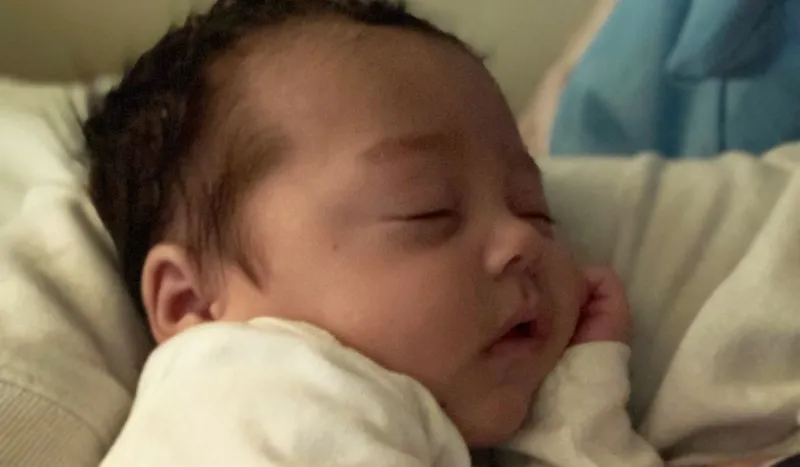
Leon is a baby boy cared for and loved at Mary’s Shelter, a pro-life maternity home in Fredericksburg, Virginia. / Courtesy of Mary’s Shelter
Washington, D.C. Newsroom, May 24, 2022 / 13:15 pm (CNA).
Amid a shortage of baby formula in the U.S., experts recommend parents scour smaller drug stores, check online, and join social media groups sharing information.
But here’s another, perhaps lesser-known, option they can also turn to for help: pregnancy resource centers.
Nearly 3,000 pro-life pregnancy centers serve millions of people each year in the United States. They offer women and parents in need everything from health care and material assistance to educational classes and job support — at little to no cost. Right now, for many of these centers, their work also includes connecting struggling families to baby formula.
One center in Michigan, an affiliate of Heartbeat International, a pro-life pregnancy resource center network, revealed to CNA that it has a surplus of formula.
“At this time, we haven’t heard of formula shortages at the pregnancy centers,” Andrea Trudden, vice president of communications and marketing at Heartbeat International, told CNA. “Quite the contrary, actually!”
Trudden recommended families turn to their local pregnancy help organizations for assistance and use OptionLine.org as a tool to find the center closest to them.
“Since pregnancy centers are equipped to help pregnant women and new families with practical resources such as diapers and formula,” Trudden said, “they have been able to step into that gap during this time.”
Some pro-life maternity homes in states such as Virginia and North Carolina said mothers are in desperate need and exploring all of their options, including feeding their babies with formula samples. But, these homes tell CNA, they are walking with mothers in their search, every step of the way.
What is this shortage about?
The nationwide baby formula shortage was caused, and then exacerbated, by a series of factors: supply-chain issues, recalls, the closure of a major production plant in February, and even U.S. trade policy. The result, data-firm company Datasembly found, is that more than 40 percent of baby formulas were out of stock in early May.
Babies with special needs and allergies rely on formula, along with babies in general. According to data from the Centers for Disease Control and Prevention (CDC), 63.3% of infants were exclusively breastfeeding seven days after birth in 2018. Three months after birth, only 46.3% of infants exclusively breastfed. Six months after birth, that percentage changed to 25.8%
The trouble with formula began partially with the Covid-19 pandemic. Parents stockpiled baby formula at the beginning, which increased production, only to later discover that they had a surplus to use up, which decreased production.
After consuming formula from an Abbott plant in Sturgis, Michigan, four babies became sick, including two who died, from bacterial infections. This led to a recall and the plant shutting down in February.
These incidents exposed the formula market as one not structurally prepared for emergencies, with just four companies largely in control of supply in the United States. U.S. and regulatory trade policy only added to the problem, restricting the exchange of formula internationally, The Atlantic reported.
Months into the shortage, the Food and Drug Administration (FDA) has reached an agreement with Abbott, one of the largest U.S. baby formula manufacturers, to reopen its Sturgis plant in the coming weeks. President Joe Biden invoked the Defense Production Act to prioritize the production of formula. And, in the meantime, the U.S. military has begun importing formula from Europe.
Members of Congress on both sides of the aisle have called for action. Senate Democrats are pushing a bill that would send $28 million in emergency funding to the FDA. Congress passed, and Biden signed into law, a bill to expand access to formula for lower-income families during emergencies.
In the meantime, before the shelves are fully stocked once more, pregnancy centers and maternity homes around the country are helping parents in need.
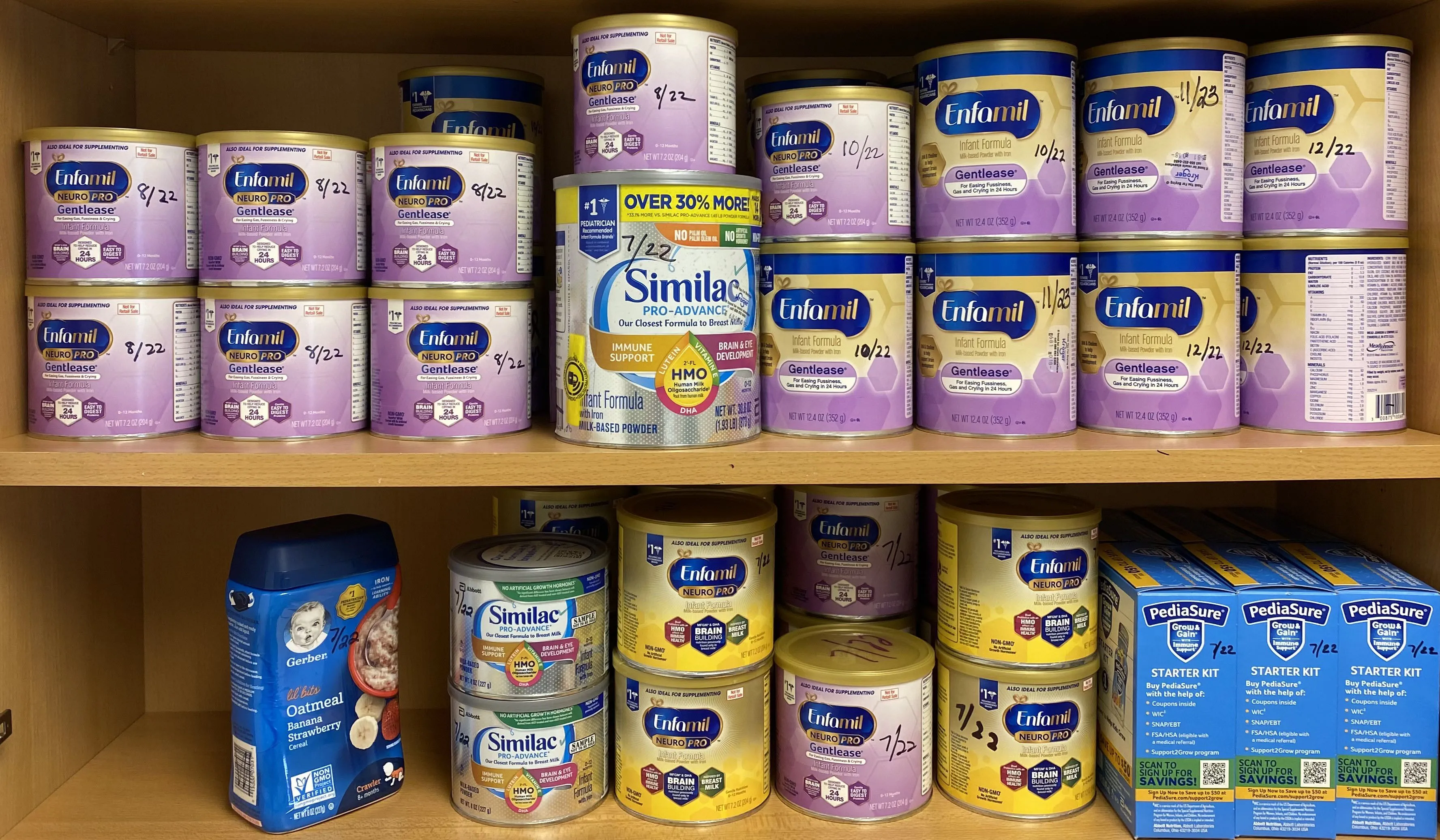
“I have never seen this much formula. We have an overflow!” Lois Stoll, a volunteer who manages the formula supply at the center, said in a press release. The center, one of Heartbeat International’s 1,857 affiliate locations, accumulated its surplus over the last two years, during the pandemic.
“It really is the result of an unexpected set of circumstances,” Bryce Asberg, the executive director, added in the release. “During the COVID-19 pandemic, the number of clients fell but donations continued to come in.”
Baby formula is stored on shelves at Helping Hands Pregnancy Resource Center in Hillsdale, Michigan. Courtesy of Helping Hands
Asberg told CNA that the center has been running a material assistance program for several years where it provides mothers and families with baby clothes, diapers, wipes, and baby food or formula.
“We still offer all those items to clients who come in, but recently we have noticed a surge of interest in formula,” he said. “God has been building our supply of formula for many months, and we didn’t know why we had so much. Now we do!”
Washington, D.C.
In Washington, D.C., Janet Durig, the executive director of Capitol Hill Pregnancy Center, said that her center also has baby formula on hand.
“We’ve had some phone calls seeking help and we’ve had formula to give them,” she told CNA. But, she emphasized, the supply is limited because they rely on donations.
“We have it to help people on a limited basis and are helping people on a limited basis,” she said, adding that the center welcomes donations of unopened bottles or cans of formula as long as they have not expired.
Connecticut
Leticia Velasquez, executive director and co-founder of Pathways Pregnancy in Norwich, Connecticut, encouraged moms and families to reach out if they need formula.
She told CNA that the three-year-old center is there for any woman or mom in need.
“We just say, ‘How can we fill the need? That’s what we’re here for,’” she said. “We definitely stand with them in any crisis, whether it be a formula shortage or an unplanned pregnancy.”
Parents in eastern Connecticut looking for baby formula can text the center at (860) 222-4505.
North Carolina
Debbie Capen, the executive director of MiraVia, said that the baby formula shortage is affecting her group’s work in supporting and providing resources to new moms in need. The Catholic nonprofit runs an outreach center in Charlotte and a free college residence at nearby Belmont Abbey College where a pregnant student — from any university or college — can stay until her child turns two years old.
“Yes, the mothers we serve are very concerned about the baby formula shortage,” Capen told CNA. “We always encourage breastfeeding for our expectant mothers, but for those who cannot breastfeed, they usually rely on vouchers for baby formula through the USDA’s WIC program.”
The U.S. Department of Agriculture’s WIC program, also known as the “Special Supplementation Nutrition Program for Women, Infants and Children,” offers federal grants to states for supplemental foods, health care referrals, and nutrition education for low-income pregnant and postpartum women, and young children at nutritional risk.
Capen highlighted that WIC only covers one specific brand of formula, which means that moms must pay full price for any other label. Formula is at a premium price right now, she added, which only puts more stress on their limited resources.
In each state, baby formula manufacturers bid for exclusive rights to provide formula to WIC participants in that state. In return, they offer the state discounts, or rebates. For those who rely on WIC, this means that they face limited options.
In response to the scarcity, the mothers at MiraVia are turning to alternatives: food pantries and the MiraVia community.
“They communicate with our staff and each other when they find formula at a certain location, as well as contact stores to find out when shipments are expected,” Capen said. “They substitute with generic brands when possible and reach out to their pediatricians for recommendations and even free samples.”
Capen listed some ways that people can help during this shortage, beginning with communication and the sharing of resources.
“For example, you can help by searching posts on social media and community apps like NextDoor or OfferUp to find those with formula and suggest where it can be donated,” she said. “Remind friends and family not to stockpile so that the supply of formula can flow to those in most urgent need. If you are pregnant and have received free samples of formula, donate what you won’t use to food pantries or programs for new mothers.”
Virginia
Kathleen Wilson, the executive director of Mary’s Shelter, a faith-centered maternity home in Fredericksburg, Virginia, agreed that “our moms have had many difficulties.”
She told CNA about one of their mothers who gave birth to her fourth baby three months ago. At first, she used a formula brand called Enfamil Reguline. After it became unavailable, she began switching between brands and using whatever she can find, Wilson said. The mother has also tried ordering on Amazon and turned to her pediatrician for samples.
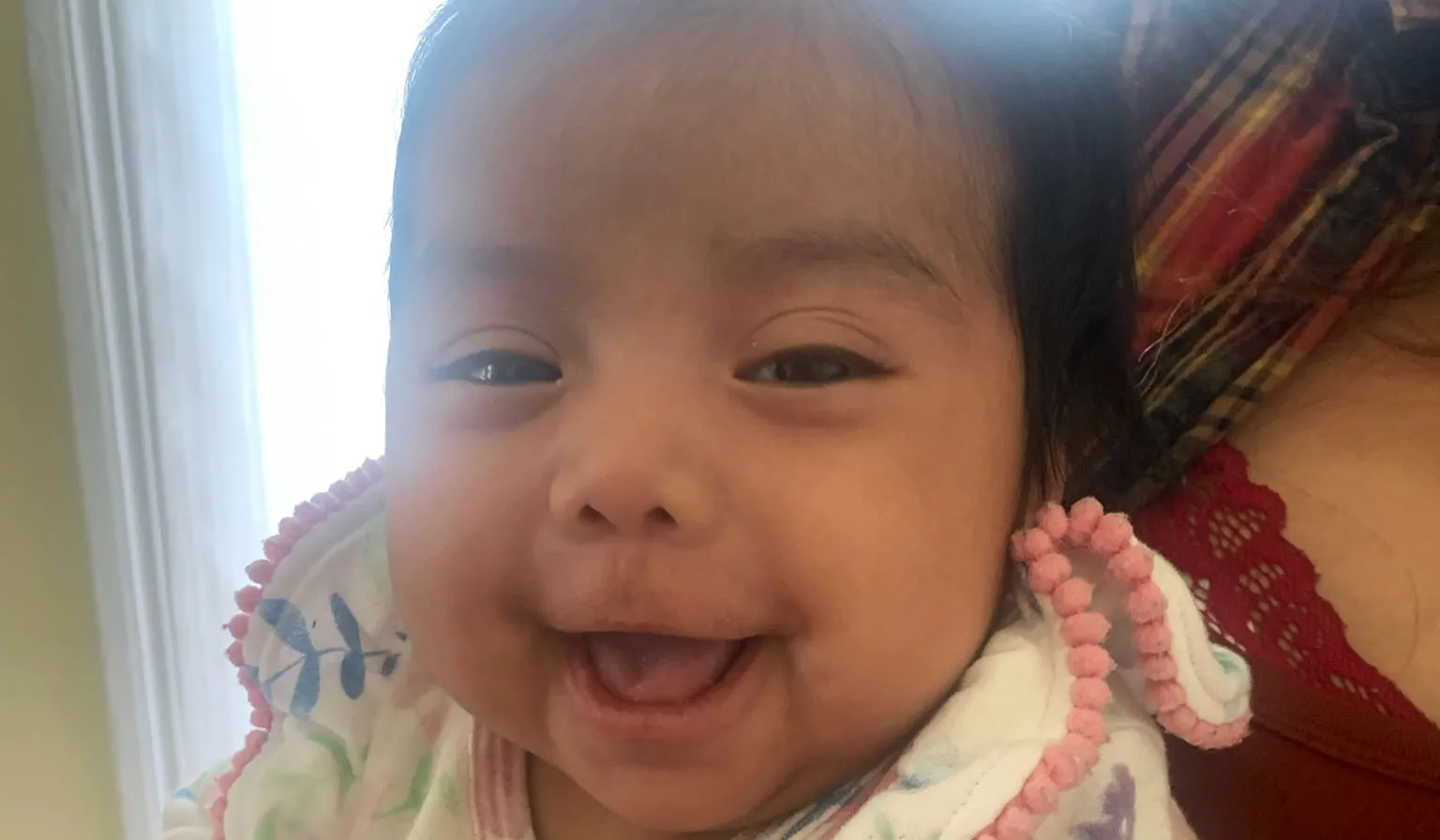
Yaretzi is a baby girl cared for and loved at Mary’s Shelter, a pro-life maternity home in Fredericksburg, Virginia. Courtesy of Mary’s Shelter
“This is a mom who is trying to hold down a job, with an infant and other children to tend to,” Wilson stressed the “very difficult” situation.
Wilson said that two of the other mothers spent days driving around at one point to try to find formula for their babies. When necessary, they are also turning to sample packets of baby formula.
“Our staff and volunteers have been assisting with this and picking up and delivering formula when they can get their hands on it,” Wilson said, adding that donors have also pitched in.
“We are blessed with wonderful donors,” she said. “A friend just stopped in this morning with two cans of formula that he was able to find.”
“If donors are willing and can find formula, we would be thrilled to take their donation,” she said, concluding that she is “praying this comes to an end soon.”





Leave a Reply