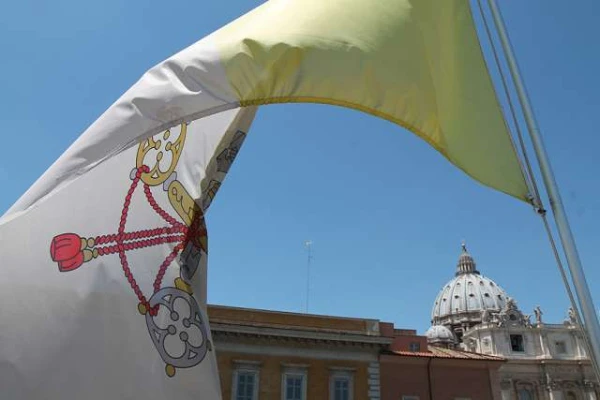
A Vatican flag waves over the dome of St. Peter’s Basilica. Credit: Bohumil Petrik/CNA.
Vatican City, Feb 10, 2021 / 07:00 am (CNA).- Cecilia Marogna, an Italian woman expected to face trial at the Vatican on charges of embezzlement, has lodged an appeal with a Milan court over the confiscation of her cellphone.
According to Italian media reports, Marogna appealed to the Court of Review of Milan on Feb. 9 against the seizure of her cellphone as part of a Vatican investigation against her.
The smartphone is reported to have been recently sent to Vatican investigators after being in the possession of Italian investigators since October.
Marogna, a 39-year-old from Sardinia, has been accused of misappropriating Vatican funds from payments of more than 500,000 euros (around $600,000) she received from the Vatican’s Secretariat of State through her Slovenia-registered company in 2018 and 2019.
Marogna has said that she worked for the Secretariat of State as a security consultant and strategist. She acknowledged receiving hundreds of thousands of euros from the Vatican but insisted that the money was for her Vatican consultancy work and salary.
Media have claimed that the payments were made under the direction of Cardinal Angelo Becciu, the former sostituto of the Secretariat of State and a fellow Sardinian. He has repeatedly denied any wrongdoing.
In January, the Vatican announced that it had dropped a request for Marogna’s extradition from Italy to the Vatican, and that a trial against her would begin soon.
The Vatican issued the statement on the day that Italian judges had been due to rule on whether to allow Marogna’s extradition.
Marogna’s cellphone was taken on Oct. 13, 2020, when she was arrested in Milan for extradition to the Vatican. She was released from jail after 17 days, on the condition that she register her presence to local police daily. This obligation was lifted on Jan. 16.
Marogna appealed against the extradition order, but the Vatican dropped its extradition request right before the appeal hearing.
According to the Sardinia Post, earlier this month Marogna lodged a complaint in the Brescia prosecutor’s office for alleged crimes committed against her in connection with her arrest.
She reported claims that she was “deprived of freedom unjustly” from the day of her arrest until the lifting of the obligation to register her presence with Milan police in mid-January.
Marogna submitted the complaint through her new legal representation, after her previous lawyers, who specialize in corporate criminal law, parted ways with her in early February.
If you value the news and views Catholic World Report provides, please consider donating to support our efforts. Your contribution will help us continue to make CWR available to all readers worldwide for free, without a subscription. Thank you for your generosity!
Click here for more information on donating to CWR. Click here to sign up for our newsletter.

Vatican City, Mar 5, 2020 / 03:00 pm (CNA).- In a video released on Thursday by Vatican Media, Pope Francis announced that his prayer intention for the month of March is for “the unity of Christians in China.”
Pope Francis celebrates Christmas Mass in St. Peter’s Basilica Dec. 24, 2020. / Vatican Media.
Greccio, Italy, Dec 17, 2021 / 04:00 am (CNA).
In 2019, Pope Francis issued an apostolic letter on the meaning and importance of the Christmas nativity scene. He signed the document, Admirabile signum (“Enchanting image”), on Dec. 1 that year, at the Shrine of the Nativity in Greccio, a hilltown in the Italian region of Lazio.
The choice of Greccio was significant, because it was there in 1223 that St. Francis of Assisi created history’s first nativity scene.
In the apostolic letter, widely regarded as one of the most moving documents of Francis’ pontificate, the pope sets out “to encourage the beautiful family tradition of preparing the nativity scene in the days before Christmas.”
Here are 10 things that Pope Francis wants us to learn from the nativity scene, drawn from Admirabile signum.
1.The nativity scene is like a living Gospel. The depiction of Jesus’ birth is “a simple and joyful proclamation of the mystery of the Incarnation of the Son of God,” the pope writes. The nativity scene invites everyone who contemplates it “on a spiritual journey, drawn by the humility of the God who became man in order to encounter every man and woman.”
The Vatican Nativity scene. Agencia Andina
2. The custom is rooted in the Bible. The pope underlines that the nativity scene rises from “the pages of sacred Scripture.” St. Luke’s Gospel says that Mary “gave birth to her firstborn son and wrapped him in swaddling cloths, and laid him in a manger, because there was no place for them in the inn” (2:7). The manger is the focus of nativity scenes. Indeed, the Italian word for nativity scene is “presepe,” from the Latin word “praesepium,” meaning “manger.”
Pope Francis visits the site of the first nativity scene in Greccio, Italy, on Jan. 4, 2015. Vatican Media.
3.The tradition was born in an unassuming Italian town. St. Francis of Assisi stopped in Greccio in November 1223, probably on his way back from Rome after receiving papal approval for the Rule of his religious order. Fifteen days before Christmas, he asked a local man named John to help him “bring to life the memory of that babe born in Bethlehem, to see as much as possible with my own bodily eyes the discomfort of his infant needs, how he lay in a manger, and how, with an ox and an ass standing by, he was laid upon a bed of hay.” On Christmas Day, St. Francis was joined by his friars and people from the surrounding area before a manger full of hay, watched over an ox and a donkey.
Pope Francis blesses nativity scenes near the Vatican Dec. 9, 2019. .
4.The first nativity scene was connected to the Eucharist. Describing the scene in Greccio that day, Pope Francis writes: “All those present experienced a new and indescribable joy in the presence of the Christmas scene. The priest then solemnly celebrated the Eucharist over the manger, showing the bond between the Incarnation of the Son of God and the Eucharist.” Unlike in nativity scenes today, the pope says, there were no statues. Instead, “the nativity scene was enacted and experienced by all who were present.”
Nativity scene. . Ben White Photography via Unsplash.com.
5.The original nativity scene inspired a vision. The pope recalls that one of the witnesses to the first nativity scene saw “a marvelous vision.” Thomas of Celano, the first biographer of St. Francis, wrote that “one of those present saw the Baby Jesus himself lying in the manger.”
. fotorutkowscy / Shutterstock.
6.The nativity scene is a means of evangelization. The pope says that by creating the nativity scene, St. Francis “carried out a great work of evangelization” that continues to touch hearts to this day. The saint had discovered “a simple yet authentic means of portraying the beauty of our faith” that was accessible to all.
Pope Francis incenses the nativity scene in St. Peter’s Basilica Dec. 24, 2017. . Vatican Media.
7.The manger is a sign of God’s love. Pope Francis writes that nativity scenes resonate so deeply because they show God’s tender love. They proclaim that “the Creator of the universe lowered himself to take up our littleness.” They engage the senses and imagination, helping people “to ‘feel’ and ‘touch’ the poverty that God’s Son took upon himself in the Incarnation.”
A detail from the monumental Nativity scene of the Castelli. . YouTube.
8.The nativity scene contains a call to service. The pope says that the Christmas crib contains an implicit message. “It summons us to follow him along the path of humility, poverty, and self-denial that leads from the manger of Bethlehem to the cross,” he writes. “It asks us to meet him and serve him by showing mercy to those of our brothers and sisters in greatest need.”
The Nativity, by Rogier van der Weyden, part of the Bladelin Altarpiece. Public Domain.
9.Even a nativity scene’s landscapes are meaningful. The pope notes that depictions of the Nativity often include “the ruins of ancient houses or buildings.” He writes: “More than anything, the ruins are the visible sign of fallen humanity, of everything that inevitably falls into ruin, decays, and disappoints. This scenic setting tells us that Jesus is newness in the midst of an aging world, that he has come to heal and rebuild, to restore the world and our lives to their original splendor.”
Courtney Mares.
10.Nativity scenes nourish devotion to Mary and Joseph. The pope observes that the Virgin Mary is shown as “a mother who contemplates her child and shows him to every visitor.” In her, “we see the Mother of God who does not keep her Son only to herself, but invites everyone to obey his word and to put it into practice.” St. Joseph stands at Mary’s side, protecting her and the Christ Child. The nativity scene reminds us that Joseph “entrusted himself always to God’s will, and put it into practice,” encouraging us to do the same.
Father Cosimo Damiano Muratori. / Credit: Sanctuary Of The Servant Of God Odorico D Andrea
CNA Newsroom, Feb 17, 2023 / 12:30 pm (CNA).
The Nicaraguan dictatorship led by President Daniel Ortega and his wife, Vice President Rosario Murillo, has… […]
Leave a Reply