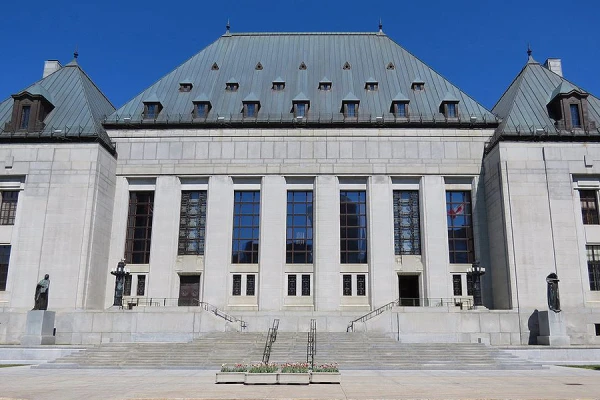
Supreme Court of Canada. Credit: Robert Linsdell via Flickr (CC BY 2.0).
CNA Staff, Jan 14, 2021 / 05:47 pm (CNA).- Canada’s highest court has ruled that the Archdiocese of St. John’s in Newfoundland and Labrador will be responsible for Mount Cashel Orphanage child abuse lawsuits against the Congregation of Christian Brothers.
On Thursday, Canada’s Supreme Court announced that it rejected a final appeal of the archdiocese, which had argued that it should not be held responsible for abuse by the congregation (also known as the Christian Brothers of Ireland), because it was the lay group of brothers and not diocesan priests in charge of the orphanage.
The court did not provide a reason for its decision.
According to the CBC, the decision ends a 21-year court process for a case involving four men, who served as “test cases” for about 60 men total, who suffered abuse as children at Mount Cashel Orphanage between the 1950s-1970s. The abuse was uncovered in a 1989 investigation known as the Hughes Inquiry.
The Archdiocese of St. John’s will now be responsible for paying any outstanding settlements with the men since the Christian Brothers of Ireland went bankrupt nine years ago. The CBC reported that the archdiocese will now be responsible for paying roughly $2.61 million in damages for the four victims in the case.
“As this judgement has just been received, the Archdiocese will need to review and analyze it with its legal counsel before providing any further comment,” the Archdiocese of St. John’s said in a statement posted to its website on January 14.
“The Archdiocese of St. John’s has immense sympathy for those who suffered abuse at Mount Cashel Orphanage and we ask that all join with us in praying for healing for those who suffer as a result of abuse.”
Blessed Edmund Rice founded the Presentations Brothers, later called the Christian Brothers, in Ireland in 1808. They were founded as an order of men dedicated to education of poor children, and the Brothers became renowned for their schools all over the world.
Beginning in the 1980s, numerous accusations of child abuse in schools and homes run by the Christian Brothers emerged in multiple countries, including the United States, Ireland, Australia and the U.K. as well as Canada.
If you value the news and views Catholic World Report provides, please consider donating to support our efforts. Your contribution will help us continue to make CWR available to all readers worldwide for free, without a subscription. Thank you for your generosity!
Click here for more information on donating to CWR. Click here to sign up for our newsletter.
Bishop José Ignacio Munilla speaks at the International Eucharistic Congress taking place in Quito, Ecuador, Sept. 8–15, 2024. / Credit: Eduardo Berdejo/EWTN News
Quito, Ecuador, Sep 13, 2024 / 15:15 pm (CNA).
One of Spain’s most prominent prel… […]
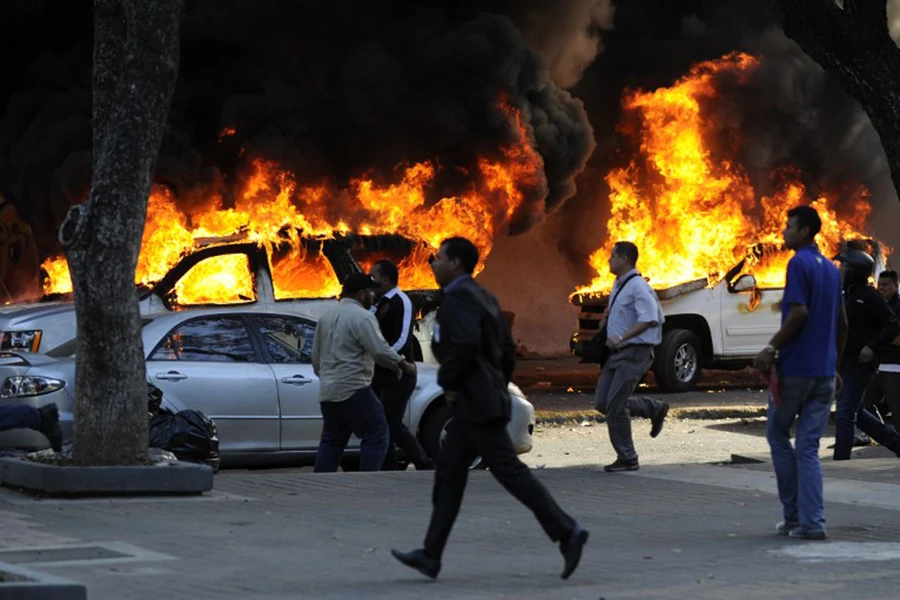
Caracas, Venezuela, Jan 31, 2017 / 02:50 pm (CNA/EWTN News).- When asked by a reporter about the threat of civil war in his country, Archbishop Ubaldo Santana of Maracaibo responded starkly: “there is already a bloodbath of considerable proportions in Venezuela.”
“We’re talking about 30,000 people murdered a year, and if we don’t manage to find peaceful ways to understand each other, that number can increase,” he said in a recent interview.
Archbishop Santana, the former head of the Venezuelan bishops’ conference, made his remarks to the Alpha and Omega news weekly during a visit to Spain, in which he discussed various issues related to the grave crisis affecting Venezuela.
In the wake of Nicolas Maduro succeeding former socialist president Hugo Chavez after the latter died from cancer in 2013, the country has been marred by violence and social upheaval.
Poor economic policies, including strict price controls, coupled with high inflation rates, have resulted in a severe lack of basic necessities such as toilet paper, milk, flour, diapers and medicines.
Venezuela’s socialist government is widely blamed for the crisis. Since 2003, price controls on some 160 products, including cooking oil, soap and flour, have meant that while they are affordable, they fly off store shelves only to be resold on the black market at much higher rates.
The Venezuelan government is known to be among the most corrupt in Latin America, and violent crime in the country has spiked since Maduro took office.
In response to a question about the possibility of a civil war in the South American country, Archbishop Santana said that a potential conflict “would be in very asymmetrical terms.”
“The party that possesses weaponry belongs to the government,” he clarified. “I can’t say the opposition groups don’t have weapons, because today arms trafficking is uncontrollable, but perhaps not in the number and quantity of the other groups.”
“That doesn’t mean there can’t be a bloodbath. In fact, we can say that in Venezuela there already is a bloodbath of considerable proportions,” the archbishop said.
He noted added that “there are armed groups all over the country. In Maracaibo, we have in addition groups of criminals and gang members that would seem to enjoy a certain impunity. We know that there’s a lot of overcrowding in the prisons and at times the authorities have opted for a massive release of prisoners to reduce the congestion.”
There are also “extortion rings,” he noted, “that operate in the city, many are undercover in the security forces, not infrequently backed by operatives in some of those groups who by day keep order and at night are robbing.”
To this “is added is the presence of irregular armed groups on the border who come from Colombia,” he said. “They ensure protection, order and the resolution of small neighborhood conflicts
upon payment of what we call a ‘vaccine.’”
A “vaccine” is an illegal charge that armed groups in Venezuela and Colombia use to allow passage through territory they control. Archbishop Santana said that these are paramilitary groups, the National Liberation Army (ELN) and some factions of the Revolutionary Armed Forces of Colombia (FARC) that have not demobilized.
Despite the country’s problems, a recent assembly of bishops and lay people held in Venezuela had an upshot that “was highly positive,” he said. “You could feel a great deal of consensus in the lay people’s feeling regarding the need for political change in the country.”
“We talked about how the laity could play a more important role in the Church and in their transformative action in diverse social environments,” he said.
The meeting also discussed “the formation being offered to lay people and its impact because we see they are not sufficiently present as Catholics in the political, economic and cultural worlds. The time was short, but it resulted in proposals for future meetings.”
Pope Francis also met with President Maduro in October of last year, According to the official Vatican communique on the meeting, Francis invited the president “to undertake with courage the path of sincere and constructive dialogue.”
He also invited the Venezuelan dictator to make it a priority “to alleviate the suffering of the people – first of all, those who are poor – and to promote a climate of renewed social cohesion which would offer a vision forward with hope for the future of the nation.”
The President of the Communications Commission of the 2024 International Eucharistic Congress, Father Livingston Olivares (left), accompanies EWTN Vice President for Programming and Production Peter Gagnon (center-right), EWTN Vice President for Spanish-language Production, Marketing, and Radio Enrique Duprat (center-left), EWTN Production Director Michael Holmes (far right), and IEC Quito 2024 Communications Coordinator Marcelo Mejía (front, kneeling) at the Monument to the Equator, the exact location of the Equator (from which the country of Ecuador takes its name) on the outskirts of the country’s capital city of Quito, site of the 2024 International Eucharistic Congress. / Credit: Communications Commission of the 2024 International Eucharistic Congress
ACI Prensa Staff, May 21, 2024 / 06:40 am (CNA).
The 53rd International Eucharistic Congress (IEC) has chosen EWTN as the official channel for providing live coverage of the event, which will take place from Sept. 8–15 in Quito, Ecuador.
“The 53rd International Eucharistic Congress, which will be held in Quito Sept. 8–15, has chosen EWTN as its official channel, which will broadcast everything related” to this great event, said Father Juan Carlos Garzón, secretary-general of the IEC Quito 2024, in a statement sent from Rome to ACI Prensa, CNA’s Spanish-language news partner.
The theme for this year’s International Eucharistic Congress is “Fraternity to Heal the World.” On Monday, the Vatican also announced that Pope Francis designated Cardinal Kevin Farrell, prefect for the Dicastery for the Laity, the Family, and Life, as pontifical legate to the congress.
Garzón was in Rome last week as part of a delegation, chaired by Alfredo Espinoza Mateus, archbishop of Quito and primate of Ecuador, “to hold a series of meetings with the main papal authorities.”
Since the beginning of the preparations for IEC 2024, Garzón added: “EWTN has been present at the orientation and training for IEC 2024 communications personnel.”
Logo for the 53rd International Eucharistic Congress that will take place in Quito, Ecuador, from Sept. 8-15, 2024. Credit: Communications Commission of the 2024 International Eucharistic Congress
EWTN preparations for IEC Quito 2024
In tandem, to coordinate EWTN’s transmissions of IEC Quito 2024, a team from the network visited the Ecuadorian capital, including the Quito Metropolitan Convention Center, where the congress will be held.
The team was comprised of EWTN Vice President for Programming and Production Peter Gagnon, EWTN Director of Production Michael Holmes, and EWTN Vice President for Spanish-language Production, Marketing, and Radio Enrique Duprat.
Gagnon said EWTN transmissions of the event will be offered in Spanish, English, and German. “This will be a wonderful event for those attending and for those watching,” Gagnon said.
“For EWTN, it is an immense joy to be the channel for the Quito 2024 International Eucharistic Congress,” Duprat said. “It is essential for us to be the platform on which, no matter where our audience is, everyone can enjoy the most important Catholic events in the Church.”
As for coverage details, Duprat said: “The plan is to be able to offer this International Eucharistic Congress live and direct from Quito and in multiple languages [Spanish, English, and German] both through our television and radio signals, the internet, and through our digital app.”
The event coincides with the 150th anniversary of the 1874 consecration of Ecuador to the Sacred Heart of Jesus. In 1886, Quito was also the site of the first National Eucharistic Congress.
During their preparatory visit, the EWTN team traveled the route of a procession that will take place on Sept. 14 in the historic center of Quito, which will begin with a Mass in San Francisco Plaza and then head to the Basilica of the National Vow, where benediction will be given.
They also visited the IEC offices, where they were received by Garzón, who explained how the organization of the event is progressing, including the schedule of a theological symposium to be held Sept. 4–7, just prior to the Sept. 8–15 congress.
The EWTN delegation also visited the Middle of the World Park and Monument to the Equator, marking the equator dividing the northern and southern hemispheres and where a Liturgy of the Word is planned with emphasis on care for creation.
Registration underway
Registration for the International Eucharistic Congress, both for the theological symposium and for the congress itself, is underway and available through the event website.
The largest Catholic media organization in the world, EWTN’s 11 global TV channels and numerous regional channels are broadcast in multiple languages 24 hours a day, seven days a week to over 425 million television households in more than 160 countries and territories. EWTN platforms also include radio services transmitted through SIRIUS/XM, iHeart Radio, and more than 600 domestic and international AM and FM radio affiliates and a worldwide shortwave radio service.
Headquartered in Washington, D.C., EWTN News operates multiple global news services, including Catholic News Agency; The National Catholic Register newspaper and digital platform; ACI Prensa in Spanish; ACI Digital in Portuguese; ACI Stampa in Italian; ACI Africa in English, French, and Portuguese; ACI Mena in Arabic; CNA Deutsch in German; and ChurchPop, a digital platform that creates content in several languages. It also produces numerous television news programs including “EWTN News Nightly,” “EWTN News In Depth,” “EWTN Pro-Life Weekly,” and “The World Over with Raymond Arroyo.”
This story was first published by ACI Prensa, CNA’s Spanish-language news partner. It has been translated and adapted by CNA.





Leave a Reply