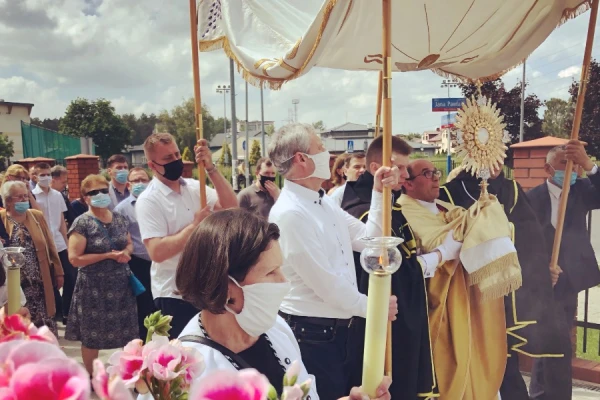
CNA Staff, Jun 11, 2020 / 11:00 am (CNA).- Catholics took part in traditional Corpus Christi processions across Poland Thursday amid strict safety measures intended to prevent the spread of the coronavirus.
People wearing cloth face coverings took to the streets June 11 to celebrate the Solemnity of the Most Holy Body and Blood of Christ, one of the high points of the liturgical calendar.
As the sun shone across the country, girls who had recently made their first Holy Communions scattered rose petals before the Blessed Sacrament, which was carried by a priest under a processional canopy.
Preaching at a Corpus Christi Mass at Poznań Cathedral, Archbishop Stanisław Gądecki noted that the slogan for the Polish Church’s current pastoral program is “The Eucharist gives life.”
The president of the Polish bishops’ conference recalled that access to public Masses was restricted at the height of the crisis in March.
Gądecki said: “We were used to the fact that the Eucharist was always at hand. Even if someone participated irregularly, they were always aware of its universal availability. Maybe we didn’t appreciate it enough for that reason, maybe we even fell into a routine.”
“Meanwhile, the lack of it made us realize that without the Eucharist — in a spiritual sense — we are dying. Perhaps — as a result of the epidemic — the slogan of this pastoral year will cease to be a pious slogan, and will become a task with which our heart will identify.”
Poland, which has a population of almost 38 million, 93% of whom are Catholic, is emerging relatively unscathed by the pandemic compared to other European countries. It has recorded 28,201 infections and 1,215 deaths as of June 11, according to the Johns Hopkins Coronavirus Resource Center.
Gądecki issued an appeal to Poles June 9 to comply with health and safety requirements while taking part in Corpus Christi processions. He urged them to wear masks covering their mouth and nose and to keep a distance of six feet from others.
“Let us make every effort to celebrate the sacred mysteries of our faith with dignity and safely, with a sense of responsibility for ourselves and others,” he said.
If you value the news and views Catholic World Report provides, please consider donating to support our efforts. Your contribution will help us continue to make CWR available to all readers worldwide for free, without a subscription. Thank you for your generosity!
Click here for more information on donating to CWR. Click here to sign up for our newsletter.

Pope Francis greets pilgrims at his general audience in St. Peter’s Square on Wednesday, Sept. 18, 2024. / Credit: Daniel Ibáñez/CNA
Vatican City, Sep 18, 2024 / 08:54 am (CNA).
Pope Francis on Wednesday said the Catholic Church is “more alive” outside of Europe as he reflected back on his recent apostolic journey to Southeast Asia.
“A first reflection that comes spontaneously after this trip is that in thinking about the Church we are still too Eurocentric, or, as they say, ‘Western,’” the pope said in St. Peter’s Square on Sept. 18.
“But in reality, the Church is much bigger, much bigger than Rome and Europe … and may I say much more alive in these countries,” he added.
Pope Francis greets pilgrims at his general audience in St. Peter’s Square on Wednesday, Sept. 18, 2024. Credit: Daniel Ibáñez/CNA
In his first general audience since returning from the longest international trip of his pontificate, the pope expressed gratitude to God for his experiences in Indonesia, Papua New Guinea, East Timor, and Singapore Sept. 2–13.
“I thank the Lord who allowed me to do as an elderly pope what I would have liked to do as a young Jesuit,” Francis said.
The pope, who turns 88 in December, expressed his enthusiasm for the “missionary, outgoing Church” he encountered on his visit to the four island nations in Asia and Oceania.
The pope recalled his visit to the grounds of the Istiqlal Mosque, the largest mosque in Southeast Asia, where he signed a joint declaration with Grand Imam Nasaruddin Umar condemning religious-based violence and promoting religious harmony.
“There, I saw that fraternity is the future, it is the answer to anti-civilization, to the diabolical plots of hatred, war, and also sectarianism,” he said.
Pope Francis arrives at his general audience in St. Peter’s Square on Wednesday, Sept. 18, 2024. Credit: Daniel Ibáñez/CNA
Pope Francis commented that the missionaries and catechists were the “protagonists” of his visit to Papua New Guinea, where the pope was welcomed by the beating drums of some of the country’s Indigenous tribes who have accepted the Catholic faith.
“I rejoiced to be able to stay a while with the missionaries and catechists of today; and I was moved to listen to the young people’s songs and music: In them, I saw a new future, without tribal violence, without dependency, without economic or ideological colonialism; a future of fraternity and care for the wondrous natural environment,” Francis said.
The pope added that he has “a beautiful memory” from traveling to the remote coastal town of Vanimo, a jungle outpost where he said Argentine missionaries “go into the jungle in search of the most hidden tribes.”
Pope Francis said that he experienced the “air of springtime” in East Timor, a small Catholic country that gained its independence from Indonesia in 2002.
He praised the Catholic country for its many large families and many religious vocations.
“I will never forget the smiles of the children,” he said. “In East Timor, I saw the youthfulness of the Church: families, children, young people, many seminarians and aspirants to consecrated life.”
Frequently throughout his trip, Pope Francis commended the high birth rates found not only in East Timor but also in Indonesia, saying that such high fertility rates should be an example for other countries around the world.
On his return flight to Rome, the pope praised East Timor’s “culture of life,” adding that wealthier countries, including Singapore, could learn from the small country that “children are the future.”
Looking back on his final stop in Singapore, the pope remarked that the modern city-state was very different from other countries he visited during his apostolic journey.
“Even in wealthy Singapore there are the ‘little ones,’ who follow the Gospel and become salt and light, witnesses to a hope greater than what economic gains can guarantee,” he added.
Pope Francis reflected on his journey to the four tropical islands on a cloudy fall morning in Rome. The pope was quite animated as he spoke about his travels, frequently making extra comments off the cuff to the crowd.
He underlined to the crowd that an “apostolic journey” is much different than tourism because “it is a journey to bring the Word of God, to make the Lord known, and also to know the soul of the people.”
At the end of the audience, the pope offered a prayer for the victims of the recent severe flooding in Europe and encouraged the local Catholic communities who are working to provide relief to the flooding caused by Storm Boris.
“In these days, heavy torrential rains have hit Central and Eastern Europe causing victims, missing persons, and extensive damage in Austria, Romania, Czech Republic, and Poland, who have to cope with tragic inconveniences caused by the floods. I assure everyone of my closeness, praying for those who have lost their lives and their families,” he said.
Pope Francis commented that there were many newly married couples who came to the general audience to receive his blessing for their marriages, with the Holy Father giving a shoutout to two Vatican employees who will be married in Vatican City this weekend.
The pope asked the Virgin Mary’s intercession for the newlyweds to have the grace “to accept work and daily crosses as opportunities for growth and purification of your love.”
Francis also prayed for the sick, elderly, and disabled present at the general audience.
“May Our Lady of Sorrows, whom we recalled a few days ago in the liturgy, help you, dear sick and elderly people, to grasp in suffering and difficulties the call to make of your existence a mission for the salvation of your brothers and sisters,” he said.
Rome, Italy, Feb 20, 2017 / 02:08 pm (CNA/EWTN News).- There are about three million people without heath care in war-torn Syria, and the papal envoy to the country has launched a project to help some of them.
Cardinal Mario Zenari launched the Open Hospitals project to enhance and empower three Catholic hospitals in Syria. He visited Rome’s Gemelli Hospital to help promote the initiative.
“It is just a drop, albeit a very precious drop, in our sea of necessities,” the cardinal told CNA. “It is a sign of the solidarity of the Church toward so many poor people.”
“In the end, Catholic means ‘universal,’ that is, open to anyone who is in need. A Catholic hospital is, by its own nature, an open hospital,” he added.
Since March 2011, the Syrian Civil War has ravaged the country, killing hundreds of thousands and driving millions from their homes.
“A great number of health care facilities have been knocked out by warfare,” the cardinal said. “This is the moment to enhance and help three Catholic hospitals, managed by the religious congregation, that have been working in Syria for more than 100 years.”
Cardinal Zenari has been papal nuncio to Syria since 2008. Pope Francis made him a cardinal during the last consistory, an unusual honor for a residential nuncio that showed papal support for Syria.
The cardinal conceived the idea of the Open Hospitals effort with Msgr. Giampetro Dal Toso, secretary of the Dicastery for Promoting Integral Human Development, who visited Aleppo at the end of conflict in the city. The initiative is operated by the Catholic NGO AVSI, with the contribution of the Gemelli Foundation.
The project will collect and financially support three Catholic hospitals in Syria: the French Hospital in Damascus, owned by the Congregation of the Sisters of Charity of St. Vincent de Paul; the Italian Hospital ANSMI, managed by the Daughters of Mary Auxiliatrix; and St. Louis Hospital in Aleppo, managed by the Sisters of St. Joseph of the Apparition.
“These hospitals are held in great esteem for their professionalism, but they are also facing great economic difficulties because of the warfare,” Cardinal Zenari said. “As they are private institutes, they also need patients to pay for their care, even with a minimum amount of money. But these sick people cannot even give a minimum economic contribution, as 80 percent of the Syrian population is currently living in poverty.”
About 400,000 Syrians are estimated to have died in the war.
“However, the death toll for lack of health care and medicines is even larger,” the cardinal said. “Yes, it is necessary to repair and rebuild houses and infrastructure. But above all we should ‘repair’ the physical health of people.”
There are an estimated two million people without health care in Aleppo, and one million more in Damascus. Hence, the necessity to enhance and supply the three Catholic hospitals.
“Each of these hospitals is going to open new departments to face needs and urgencies that came out after the conflict: special departments for traumatized children, for women who were subjected to violence and rape during the conflict, and for those mutilated by war,” the cardinal said.
Reflecting further on the situation in Syria, he said that “suffering in Syria is universal, as every religious and ethnic group had its victims, its martyrs.” But, he added, “Christians are the minority group most at risk, as they have no weapons to defend themselves.”
The papal ambassador recounted that “Christian communities saw their villages and blocks invaded and there were churches damaged and destroyed.”
However, emigration represents the “biggest wound” to the community.
“For example, two-thirds of the Christian in Aleppo emigrated. This is an incalculable loss for the churches. Even if sacred buildings will be rebuilt, the question is whether Christian communities will be rebuilt the way they were before,” the cardinal said.
The churches are committed to charitable works for the whole community, an effort that is appreciated.
When Cardinal Zenari arrived in Syria eight years ago, he said, “there was a certain progress in the economic field, although not all society could benefit from that.”
“Yes, an improvement was needed in terms of respecting human rights and fundamental freedoms, but in general Syria was a mosaic of good coexistence among the ethnic-religious groups.”
Now, Syria is “profoundly lacerated by grave external wounds and grave internal wounds.”
Thinking about the future, the papal nuncio saw a need for a Syria that could enjoy the support of all social sectors and avoid the risk of dividing society between winners and losers.
For Cardinal Zenari, the Christian community could act as a bridge in a post-war Syria.
The new Syria should be “reconciled, more respectful of human rights and fundamental freedoms, more democratic,” with a “guaranteed territorial unity and integrity,” he said. He lamented that external forces like the Islamic State group have entered the Syrian conflict, among other regional and international powers.
Cardinal Zenari said that the most urgent challenge for Syria is to stop the violence and guarantee access to humanitarian aid.
Citing United Nations data, there are 13.5 million people in need of humanitarian aid, including 4.9 million who live in hard-to-access places. There are 640,000 people living in 13 places under military siege.
There are 6.1 million internally displaced Syrians and 4.8 million Syrians who have become refugees in other countries.
The cardinal stressed the need for determination to reach a political solution to the conflict. After the conflict, will require restoring the social fabric and working for reconciliation. He emphasized the need to rebuild houses, villages, and infrastructure.
Paris, France, Mar 3, 2017 / 12:54 am (CNA/EWTN News).- Catholic and Orthodox leaders in a joint statement urged Europeans to remember their Christian roots, and to return to them during this time of “widespread concern for (the) future” of… […]
Leave a Reply