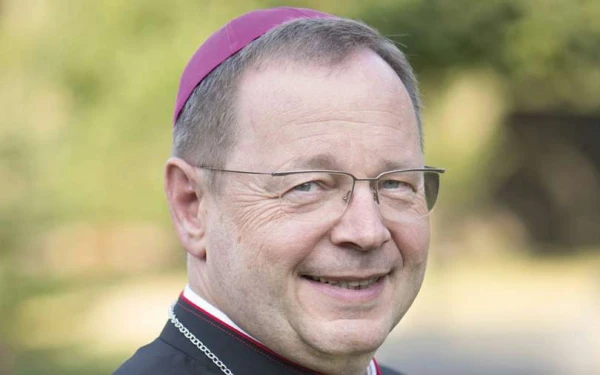
Mainz, Germany, Mar 7, 2020 / 06:00 am (CNA).- The new president of the German bishops’ conference has emphasized his support for the ongoing synodal process of German bishops and laity, and for a paper supporting intercommunion with Lutherans.
Speaking at the closing of the plenary assembly of the German bishops in Mainz on Thursday, Bishop Georg Bätzing of Limburg also affirmed he is following in “the big footsteps” of Cardinal Reinhard Marx in continuing along the “synodal path” currently underway in Germany.
Bätzing described as having gotten off to a “good start”, despite strong criticism about the first synodal assembly in January from a number of attending bishops.
Bishop Bätzing also claimed Pope Francis supported the controversial process, stating the “synodal way” was “in line” with and exactly what the Holy Father wanted.
Pope Francis has issued a cautionary personal letter to all German Catholics on the matter, and the Vatican has repeatedly intervened, raising a number of concerns about the process.
Asserting that ecumenism is “on the right track” in Germany, Bätzing reiterated his support for a document titled “Together at the Lord’s Table” by the ecumenical working group of Lutheran and Catholic theologians (ÖAK) in Germany, a body chaired by himself and the Protestant bishop Martin Hein.
The document promotes non-Catholics receiving the Eucharist at Catholic Mass. Bätzing also suggested in future, Christians of any denomination should simply decide on their own, individual accord if – and when to receive the Body of Christ.
Cardinal Kurt Koch, president of the Pontifical Council for Promoting Christian Unity, has dismissed the document, saying it was based on an “assumption” he could not share, “namely, that the Catholic Eucharistic celebration and the Protestant last supper are identical.” Koch also pointed out that there were several further “open questions” that needed clarifying.
This year’s spring plenary assembly of the German bishops’ conference also saw the announcement that the bishops had reached an agreement about compensation payments for victims of clerical sexual abuse.
A version of this story was first published by CNA Deutsch, CNA’s German-language news partner. It has been translated and adapted by CNA.
If you value the news and views Catholic World Report provides, please consider donating to support our efforts. Your contribution will help us continue to make CWR available to all readers worldwide for free, without a subscription. Thank you for your generosity!
Click here for more information on donating to CWR. Click here to sign up for our newsletter.

The Swiss bishops’ call for adherence to Catholic “rules” followed an internet controversy over an August 2022 video of a laywoman who seemed to concelebrate Mass with priests. / Credit: Katholisches Medienzentrum YouTube screenshot
Denver, Colo., Sep 11, 2023 / 14:45 pm (CNA).
A viral video showing two priests celebrating Mass with a Swiss laywoman at the altar has resulted in a formal reprimand of the pastors by Bishop Joseph Bonnemain of Chur, Switzerland, but there will not be a canonical proceeding.
“Careful investigation of the matter has shown that there were no serious liturgical violations in this service, the assessment of which would be reserved for the Vatican Dicastery for the Doctrine of the Faith,” said a Sept. 8 joint statement whose signatories included Bonnemain. “Therefore, no criminal proceedings are required under canon law.”
“However, important liturgical regulations that are binding for the entire Church were ignored in this service,” the statement added. “The bishop therefore cannot avoid issuing a formal reprimand to the pastors involved in this regard.”
The joint statement came from the Diocese of Chur, St. Martin Catholic Parish, the pastors and clergy involved in the controversy, and Monika Schmid.
The August 2022 Mass in the Diocese of Chur marked the retirement of Schmid, a longtime de facto parish administrator. Video of the Mass depicted Schmid as she appeared to concelebrate the Eucharist with the priests.
Schmid stood at the altar in ordinary dress with two priests beside her. She extended her arms and pronounced with them the words of the Consecration and an extensively revised version of the Eucharistic Prayer.
The joint statement noted that the farewell service received broad media coverage.
Following controversy over the video, Schmid denied her actions constituted an attempt to concelebrate Mass or to be provocative. She acknowledged that as a woman she can’t validly celebrate the Eucharist as ordained Catholic priests do.
Canon 907 of the Catholic Church’s canon law bars Catholic deacons and Catholic laity from offering the Eucharistic Prayer and from performing actions “proper to the celebrating priest.”
The joint statement discussed the bishop’s response.
“On Aug. 15, 2023, Bishop Joseph Maria Bonnemain issued the appropriate warning to the five affected people during detailed personal discussions in the expectation that these mistakes will not be repeated in the future,” the statement said.
At the same time, the statement from the diocese said Bonnemain “expressed his confidence in all the pastors involved and thanks them for their committed pastoral work for the good of the people.”
In the wake of the controversial video, Bonnemain joined Bishops Felix Gmür of Basel and Markus Büchel of Sankt Gallen in writing a Jan. 5 letter to people active in pastoral care in their dioceses, as CNA previously reported.
Only ordained priests may preside at Mass, and the liturgy should not be “a testing ground for personal projects,” said the three bishops, whose dioceses are the predominantly German-speaking dioceses of Switzerland.
The bishops acknowledged people’s desire to participate in the liturgy but said the Catholic liturgy has a universal character, and this especially concerns celebrations of the sacraments. They referred to Pope Francis’ June 2022 apostolic letter Desiderio Desideravi. It insists on the quality of liturgies, the careful attention to every aspect of liturgical celebration, and the observance of every rubric.
“Common witness requires common forms and rules. We bishops regularly receive requests and worried reactions: The faithful have a right to religious services that respect the rules and forms of the Church,” they said.
Schmid, the pastoral worker whose retirement Mass sparked the controversy, was critical of the bishops’ letter upon its release in January. She advocated a liturgical celebration that, in her view, “reaches out to people in their daily lives, in their language, and in their understanding of themselves,” the Swiss Catholic internet news portal Cath.ch reported.
Dublin, Ireland, Oct 3, 2018 / 05:01 pm (CNA/EWTN News).- A “small but significant” number of general practitioners in the Republic of Ireland are appealing to the county’s health minister to exempt them from being forced to refer pat… […]
A close-up of the copy of Michelangelo’s Vatican Pietà, usually kept at the Vatican Museums. / Ela Bialkowska/OKNO studio.
Rome Newsroom, Mar 7, 2022 / 04:00 am (CNA).
As war rages in Ukraine and the pandemic lingers, Michelangelo’s celebrated Vatican Pietà — and two lesser-known figures he also sculpted — can be deeply meaningful to a pain-wracked world, says a priest and art historian.
Michelangelo Buonarotti’s Pietà depicts a larger-than-life Virgin Mary as she mourns her crucified Son, Jesus, lying limp in her lap. The masterpiece, carved out of Carrara marble, was finished before the Italian artist’s 25th birthday.
Over the course of more than 60 years, Michelangelo created two more sculptures on the same theme — and a new exhibit in the Italian city of Florence brings the three works together for the first time.
The Three Pietà of Michelangelo exhibit at Museo dell’Opera del Duomo in Florence, Italy. Museo dell’Opera del Duomo
The exhibit opened at the Museo dell’Opera del Duomo on Feb. 24, and includes the Florentine Pietà, also called the Deposition, which Michelangelo worked on from 1547 to 1555, and exact casts, or copies, of the Vatican Pietà and Milan Pietà — which could not be moved from their locations.
Msgr. Timothy Verdon, the director of the Museo dell’Opera del Duomo, told CNA by phone that the gallery wanted to do something to show its solidarity with a Feb. 23-27 meeting of mayors and Catholic bishops.
“The images of suffering that the Pietà always implies I think will deeply touch people. I think that visitors will be moved to see these works,” he said. The image of the Pietà evokes “the personal suffering of mothers who hold their children not knowing if their children will survive.”
A close-up of the copy of Michelangelo’s Vatican Pietà, usually kept at the Vatican Museums. Ela Bialkowska/OKNO studio.
The 75-year-old Verdon is an expert in art history and sacred art. He was born in Hoboken, New Jersey, but has lived in Italy for more than 50 years.
“So many of the issues that face the Mediterranean world today are forms of suffering,” he said, “and so this ideal series of images of the God who becomes man [and] accepts suffering, and whose Mother receives his tortured body into her arms, these are deeply meaningful.”
“All human situations of suffering and exclusion invite a comparison with the suffering of Christ, the death of Christ. And [the Pietà] condenses and concentrates a devout reflection on that,” the priest said.
The lesser-known Pietàs
Many years after Michelangelo completed the Pietà displayed in St. Peter’s Basilica, he began his Florentine Pietà, which depicts Nicodemus, Mary Magdalene, and the Virgin Mary receiving the body of Christ as it is removed from the Cross.
The 72-year-old Michelangelo worked on the sculpture for eight years before eventually abandoning it in 1555.
Michelangelo’s Florentine Pietà, part of the permanent collection at the Museo dell’Opera del Duomo in Florence, Italy. Museo dell’Opera del Duomo in Florence, Italy.
He probably began the Rondanini Pietà, which is in Milan, in 1553. Michelangelo continued to work on the piece until just days before his death in 1564.
According to a press release from the city of Florence, “near his own death, Michelangelo meditated deeply on the Passion of Christ.”
One way this is known is because shortly before his death, Michelangelo gave a drawing of the Pietà to Vittoria Colonna, the Marquess of Pescara, on which he wrote: “They think not there how much of blood it costs.”
The line, from Canto 29 of Paradiso, one of the books of Dante’s “Divine Comedy”, is also the subtitle of the Florence exhibition.
A perfect cast of Michelangelo’s unfinished Rondanini Pietà, on display at the Museo dell’Opera del Duomo in Florence, Italy. Museo dell’Opera del Duomo
Bringing the three Pietàs together into one exhibit gives the viewer the chance to see “the full range of Michelangelo’s reflection on this subject across 60-some years,” Verdon explained.
Not only is the Renaissance artist’s stylistic evolution on display, but also his spiritual development.
“We know that [Michelangelo] was a religious man,” Verdon said. “His interpretation of religious subjects, even in his youth, is particularly sensitive and well informed.”
According to the priest, Michelangelo seems to have had a range of theological influences.
“His older brother was a Dominican friar and in Michelangelo’s old age we’re told that he could still remember the preaching of Savonarola,” Verdon said.
Girolamo Savonarola was a popular Dominican friar, preacher, and reformer active in Renaissance Florence. He spoke against the ruling Medici family and the excesses of the time, and in 1498 he was hanged and his body burned after a trial by Church and civil authorities.
According to the Catholic Encyclopedia, “In the beginning Savonarola was filled with zeal, piety, and self-sacrifice for the regeneration of religious life. He was led to offend against these virtues by his fanaticism, obstinacy, and disobedience. He was not a heretic in matters of faith.”
“That’s an interesting page in cultural history,” Verdon said, “because the early Pietà is done in effect shortly after the Savonarola period, or in the Savonarola period.”
“So we’re talking about an artist to whom this subject means a great deal, and which he is also equipped to treat.”
The Three Pietà of Michelangelo exhibit at Museo dell’Opera del Duomo in Florence, Italy. Museo dell’Opera del Duomo
The artist’s last Pietàs were created, instead, in the context of the Counter-Reformation.
The council, he explained, “had to rebut the heretical ideas of Protestant reformers, and so it insists, in a decree on the Eucharist published in 1551, that indeed in the bread and wine, Christ’s Body and Blood are truly present.”
“So Michelangelo, who was personally religious, and who, especially in his later period, worked exclusively for the Vatican, was therefore very close to the changes occurring in Catholic thought, Catholic theology, Catholic devotion,” Verdon said.
The exhibit “really gives us the opportunity to gauge the evolution of a theme from one time to a very different one, from the end of the 15th, to the mid- 16th century.”
The St. Peter’s Basilica Pietà
Verdon said that the Vatican Pietà is the only one of the three to remain in the place it was intended for — above an altar in St. Peter’s Basilica.
The sculpture was originally created for the 4th-century Constantinian basilica, the “Old St. Peter’s Basilica,” which was replaced by the Renaissance basilica standing today.
In Michelangelo’s Pietà, the Virgin Mary holds her Son as she did at his birth. . Paweesit via Flickr.
Viewing art in a church is not the same as viewing it in a museum, the art historian noted.
“Obviously it is different, especially for the fact that the Vatican Pietà has remained on an altar, above an altar, and so the body of Christ depicted by Michelangelo would have been seen in relation to the sacramental body of Christ in the Eucharist.”
“This was true of the first situation in the Old St. Peter’s, the work was on an altar, and it’s true of the present collocazione [position],” he said.
“And actually,” the priest continued, “the same thing was true of both of the other Pietàs. They were intended by Michelangelo to go on an altar in a chapel in a Roman church where he expected to be buried. We think the church was Santa Maria Maggiore.”
“So the relationship of the image of Christ’s body with the Eucharistic Corpus Christi is very important,” he said.
The Three Pietà of Michelangelo exhibit at Museo dell’Opera del Duomo in Florence, Italy. Museo dell’Opera del Duomo
The copies of the Vatican and Milan Pietàs are on loan from the Vatican Museums, and will be in Florence for the Three Pietàs exhibit through Aug. 1.
“And in our museum, in the Florence Opera del Duomo Museum, we have put the Pietà, our Pietà, on a base that evokes an altar, as the very specific Church meaning [of an altar] has to do with the Sacrament,” Verdon said.
Gosh, it would be nice if a Catholic could be eleted president of the German bishops council.