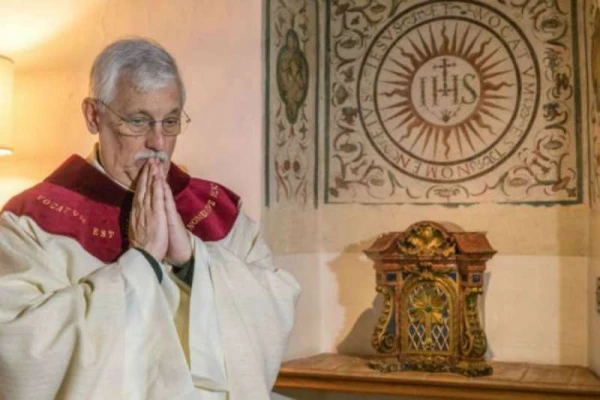
Vatican City, Dec 6, 2019 / 12:12 pm (CNA).- The superior general of the Jesuit order told reporters Tuesday that the devil is real, after making headlines in August by stating that Satan is a symbol, not a person.
Satan “is the one who stands between God’s plan and his work of salvation accomplished in Christ, because he has made this irreversible and free decision, and he wants to drag others to reject the merciful God, who prefers to give his life to save instead of to condemn,” Fr. Arturo Sosa, SJ, said in a Dec. 2 meeting with journalists, according to a report from Vida Nueva.
Sosa added that “the power of the devil…obviously still exists as a force that tries to ruin our efforts.”
Sosa’s comments came amid remarks he offered on the six Jesuits and two employees killed in November 1989 by Salvadoran soldiers at the University of Central America in San Salvador.
On Aug 21, Sosa told an Italian magazine that the devil “exists as the personification of evil in different structures, but not in persons, because is not a person, is a way of acting evil. He is not a person like a human person. It is a way of evil to be present in human life.”
“Good and evil are in a permanent war in the human conscience and we have ways to point them out. We recognize God as good, fully good. Symbols are part of reality, and the devil exists as a symbolic reality, not as a personal reality,” he added in August.
The Catechism of the Catholic teaches that “Satan was at first a good angel, made by God: ‘The devil and the other demons were indeed created naturally good by God, but they became evil by their own doing.’”
Sosa, 71, was elected the Jesuits’ superior general in 2016. A Venezuelan, he has a pontifical licentiate in philosophy and a doctorate in political science. He served as a Jesuit provincial superior in Venezuela from 1996 to 2004, and in 2014 began an administrative role at the general curia of the Jesuits in Rome.
Sosa has offered controversial comments about Satan in the past. In 2017, he told El Mundo that “we have formed symbolic figures such as the Devil to express evil.”
After his 2017 remark generated controversy, a spokesman for Sosa told the Catholic Herald that “like all Catholics, Father Sosa professes and teaches what the Church professes and teaches. He does not hold a set of beliefs separate from what is contained in the doctrine of the Catholic Church.”
If you value the news and views Catholic World Report provides, please consider donating to support our efforts. Your contribution will help us continue to make CWR available to all readers worldwide for free, without a subscription. Thank you for your generosity!
Click here for more information on donating to CWR. Click here to sign up for our newsletter.
Pope Francis addresses pilgrims gathered in the Paul VI Audience Hall for his Wednesday general audience on Jan. 15, 2025, at the Vatican. / Credit: Vatican Media
Vatican City, Jan 23, 2025 / 10:40 am (CNA).
Pope Francis on Thursday released hi… […]
Vatican City, May 15, 2019 / 04:03 am (CNA).- Pope Francis Wednesday appointed Bishop Peter Baldacchino to head the Diocese of Las Cruces, New Mexico – making him the first diocesan bishop associated with the Neocatechumenal Way to serve in a mainland U.S. diocese.
Baldacchino, 58, has been an auxiliary bishop of Miami, Florida, since 2014. He was ordained a priest for the Archdiocese of Newark in 1996.
As a seminarian in Newark, Baldacchino studied at the Immaculate Conception Seminary at Seton Hall University but lived at the Redemptoris Mater Archdiocesan Missionary Seminary.
Baldacchino’s formation was in part guided by the Neocatechumenal Way, a post-baptismal itinerary of Christian formation first approved by Pope Paul VI and supported by each of the subsequent popes.
Seminarians who discern their vocation while involved with the Neocatechumenal Way are encouraged to place special emphasis on the universal missionary character of the priesthood and offer themselves, at the discretion of their local bishop, in service to the New Evangelization anywhere in the world.
Baldacchino is the first graduate of a Redemptoris Mater seminary to serve as a diocesan bishop in a mainland U.S. diocese.
He was born on the European island country of Malta, to a family of four children. His family joined the Neocatechumenal Way while he was a child, but he was not initially drawn to the priesthood.
After studying science and chemistry at the University of Malta, he began working as a technical manager at a bottling plant. At age 28 he attended the 1989 World Youth Day in Santiago de Compostela, Spain, after which he became more involved in the Neocatechumenal Way.
Through the movement he was sent on mission, during which he started to feel called to the priesthood, eventually being matched with the Redemptoris Mater seminary in Newark. He was ordained a priest for the Archdiocese of Newark on May 25, 1996.
Baldacchino served for over a decade as a missionary in the Turks and Caicos Islands in the Caribbean, and speaks Maltese, English, Italian, Creole, and Spanish.
The Diocese of Las Cruces was established in 1982. According to 2015 estimates, it has more than 236,600 Catholics, accounting for just over 42% of the area’s population.
Pope Francis prays during Christmas Mass in St. Peter’s Basilica on Dec. 24, 2023. / Vatican Media
Vatican City, Dec 24, 2023 / 18:00 pm (CNA).
Below is the full text of Pope Francis’ homily for the Solemnity of the Nativity of the Lord, delivered on Dec. 24, 2023, in St. Peter’s Basilica.
“A census of the whole earth” (cf. Lk 2:1). This was the context in which Jesus was born, and the Gospel makes a point of it. The census might have been mentioned in passing, but instead is carefully noted. And in this way, a great contrast emerges. While the emperor numbers the world’s inhabitants, God enters it almost surreptitiously. While those who exercise power seek to take their place with the great ones of history, the King of history chooses the way of littleness. None of the powerful take notice of him: only a few shepherds, relegated to the margins of social life.
The census speaks of something else. In the Scriptures, the taking of a census has negative associations. King David, tempted by large numbers and an unhealthy sense of self-sufficiency, sinned gravely by ordering a census of the people. He wanted to know how powerful he was. After some nine months, he knew how many men could wield a sword (cf. 2 Sam 24:1-9). The Lord was angered and the people suffered. On this night, however, Jesus, the “Son of David”, after nine months in Mary’s womb, is born in Bethlehem, the city of David. He does not impose punishment for the census, but humbly allows himself to be registered as one among many. Here we see, not a god of wrath and chastisement, but the God of mercy, who takes flesh and enters the world in weakness, heralded by the announcement: “on earth peace among those whom he favors” (Lk 2:14). Tonight, our hearts are in Bethlehem, where the Prince of Peace is once more rejected by the futile logic of war, by the clash of arms that even today prevents him from finding room in the world (cf. Lk 2:7).
The census of the whole earth, in a word, manifests the all-too-human thread that runs through history: the quest for worldly power and might, fame and glory, which measures everything in terms of success, results, numbers and figures, a world obsessed with achievement. Yet the census also manifests the way of Jesus, who comes to seek us through enfleshment. He is not the god of accomplishment, but the God of Incarnation. He does not eliminate injustice from above by a show of power, but from below, by a show of love. He does not burst on the scene with limitless power, but descends to the narrow confines of our lives. He does not shun our frailties, but makes them his own.
Christmas Mass in St. Peter’s Basilica on the night of Dec. 24, 2023. Vatican Media
Brothers and sisters, tonight we might ask ourselves: Which God do we believe in? In the God of incarnation or the god of achievement? Because there is always a risk that we can celebrate Christmas while thinking of God in pagan terms, as a powerful potentate in the sky; a god linked to power, worldly success, and the idolatry of consumerism. With the false image of a distant and petulant deity who treats the good well and the bad poorly; a deity made in our own image and likeness, handy for resolving our problems and removing our ills. God, on the other hand, waves no magic wand; he is no god of commerce who promises “everything all at once”. He does not save us by pushing a button, but draws near us, in order to change our world from within. Yet how deeply ingrained is the worldly notion of a distant, domineering, unbending, and powerful deity who helps his own to prevail against others! So many times this image is ingrained in us. But that is not the case: our God was born for all, during a census of the whole earth.
Let us look, then, to the “living and true God” (1 Thess 1:9). The God who is beyond all human reckoning and yet allows himself to be numbered by our accounting. The God, who revolutionizes history by becoming a part of history. The God who so respects us as to allow us to reject him; who takes away sin by taking it upon himself; who does not eliminate pain but transforms it; who does not remove problems from our lives but grants us a hope that is greater than all our problems. God so greatly desires to embrace our lives that, infinite though he is, he becomes finite for our sake. In his greatness, he chooses to become small; in his righteousness, he submits to our injustice. Brothers and sisters, this is the wonder of Christmas: not a mixture of sappy emotions and worldly contentment, but the unprecedented tenderness of a God who saves the world by becoming incarnate. Let us contemplate the Child, let us contemplate the manger, his crib, which the angels call “a sign” for us (cf. Lk 2:12). For it truly is the sign that reveals God’s face, a face of compassion and mercy, whose might is shown always and only in love. He makes himself close, tender, and compassionate. This is God’s way: closeness, compassion, tenderness.
Pope Francis brings a figure of the Christ child over to the nativity scene inside of St. Peter’s Basilica at the end of Mass. Vatican Media
Sisters and brothers, let us marvel at the fact that he “became flesh” (Jn 1:14). Flesh: the very word evokes our human frailty. The Gospel uses this word to show us that God completely assumed our human condition. Why did he go to such lengths? Because he cares for us, because he loves us to the point that he considers us more precious than all else. Dear brother, dear sister, to God, who changed history in the course of a census, you are not a number, but a face. Your name is written on his heart. But if you look to your own heart, and think of your own inadequacies and this world that is so judgmental and unforgiving, you may feel it difficult to celebrate this Christmas. You may think things are going badly, or feel dissatisfied with your limitations, your failings, your problems, and your sins. Today, though, please, let Jesus take the initiative. He says to you, “For your sake, I became flesh; for your sake, I became just like you”. So why remain caught up in your troubles? Like the shepherds, who left their flocks, leave behind the prison of your sorrows and embrace the tender love of the God who became a child. Put aside your masks and your armor; cast your cares on him and he will care for you (cf. Ps 55:22). He became flesh; he is looking not for your achievements but for your open and trusting heart. In him, you will rediscover who you truly are: a beloved son or daughter of God. Now you can believe it, for tonight the Lord was born to light up your life; his eyes are alight with love for you. We have difficulty believing in this, that God’s eyes shine with love for us.
Christmas Mass in St. Peter’s Basilica on the night of Dec. 24, 2023. Vatican Media
Christ does not look at numbers, but at faces. However, who looks at him amid the many distractions and mad rush of a bustling and indifferent world? Who is watching? In Bethlehem, as crowds of people were caught up in the excitement of the census, coming and going, filling the inns, and engaged in petty conversation, a few were close to Jesus: Mary and Joseph, the shepherds, and then the Magi.
Let us learn from them. They stood gazing upon Jesus, with their hearts set on him. They did not speak, they worshiped. Tonight, brothers and sisters, is a time of adoration, of worship.
Worship is the way to embrace the Incarnation. For it is in silence that Jesus, the Word of the Father, becomes flesh in our lives. Let us do as they did, in Bethlehem, a town whose name means “House of Bread”. Let us stand before him who is the Bread of Life. Let us rediscover worship, for to worship is not to waste time, but to make our time a dwelling place for God. It is to let the seed of the Incarnation bloom within us; it is to cooperate in the work of the Lord, who, like leaven, changes the world. To worship is to intercede, to make reparation, to allow God to realign history. As a great teller of epic tales once wrote to his son, “I put before you the one great thing to love on earth: the Blessed Sacrament… There you will find romance, glory, honor, fidelity, and the true way of all your loves on earth” (J.R.R. TOLKIEN, Letter 43, March 1941).
Brothers and sisters, tonight love changes history. Make us believe, Lord, in the power of your love, so different from the power of the world. Lord, make us, like Mary, Joseph, the shepherds, and the Magi, gather around you and worship you. As you conform us ever more to yourself, we shall bear witness before the world to the beauty of your countenance.
It is good that he corrected himself, at least this one time.
Good. Hopefully he will repent, correct all the other heterodox things he has said during his career, and become a beacon of orthodoxy.
