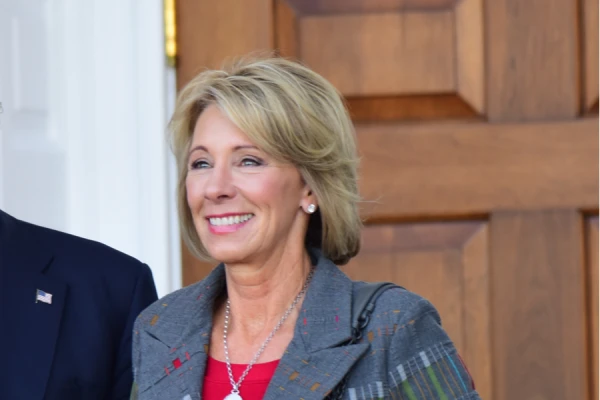
Washington D.C., Sep 30, 2019 / 08:00 pm (CNA).- The Secretary of Education said on Monday that churches are among the institutions with the best solutions for using education to reduce incarceration and reoffending.
“I’m not one to suggest that government should step in or can step in in an effective way into many situations,” Education Secretary Betsy DeVos said at the Justice Declaration Symposium, hosted by the group Prison Fellowship, at the National Museum of the Bible in Washington, D.C. on Sept. 30.
“I am one that believes that the Church and private sector organizations are by definition the best solutions and answers very often.”
DeVos was speaking at the Museum of the Bible about the role of churches in advancing education and other initiatives to reduce incarceration. Her appearance followed a day of panel discussions on prison ministry at the Justice Declaration Symposium.
Dr. Russell Moore, president of the Ethics and Religious Liberty Commission of the Southern Baptist Convention, followed her as the keynote speaker.
The Justice Declaration is a document signed by 4,700 Christians and faith leaders expressing the need for churches to lead efforts to reduce incarceration.
The declaration states principles of human dignity and acknowledges the responsibility of churches and communities to be “seedbeds of virtue.” It commits signatories to fighting on behalf of the poor for better education and access to legal representation, proportional punishment in the justice system, care for victims of crime, and help for former prisoners to reenter society.
The U.S. represents five percent of the world’s population but houses 25% of the world’s incarcerated population, the declaration notes. Nearly 2.2 million Americans are in prison and an estimated 65 million American citizens have a criminal record, presenting an obstacle to their future career opportunities.
The role of education in reducing incarceration was the topic of discussion on Monday, with DeVos noting that, at one of her visits to a prison in Indiana, the warden told her the biggest problem was not violence, but illiteracy.
She noted that many in the audience may already have been involved in church-run ministries to address problems like illiteracy or education and training for former inmates reentering society. “There’s great opportunity to expand on that,” she said.
DeVos addressed efforts to promote Second Chance Pell Grants for former inmates. In 1994, Congress stopped access to Pell grants for those incarcerated in state and federal prisons, but in 2015 the Obama administration announced the Second Chance Pell (SCP) pilot program.
The administration partnered with 67 colleges and universities in the 2016 pilot, which allowed inmates a chance to pursue post-secondary studies with Pell Grants. Over 10,000 students received Federal Pell Grant funding from 64 institutions from July 1, 2018, through June 30, 2019.
Legislation is currently in the Senate to make the Second Chance Pell Grants permanent.
While Pell grants and other policy initiatives are important for reducing incarceration, “it really, to me, is only a vehicle for helping to compensate for the access to some of these education opportunities,” DeVos said on Monday.
“I believe that the church writ large, and our local churches, and those who make up those communities, really do have very often the best methods and the best way forward to form relationships with individuals that are behind bars,” she said.
Moderator Craig DeRoche, senior vice president of advocacy and public policy at Prison Fellowship, said that “the Church and others have to be there” to mentor and volunteer children and teens at risk, and ensure they have the education they need. “Absolutely,” DeVos agreed, emphasizing the need to help each individual person figure out their education goals and interests, and help steer them towards their vocation.
For those reentering society from prison, “I try to put myself in their position,” DeVos said, one perhaps of uncertainty. “And education is the ticket to a good future for just about anyone and everyone.”
“We should be embracing these opportunities for brothers and sisters who are behind bars today, who will be in our communities and with their families, and giving them a purpose—giving them a means for their purpose,” she said.
If you value the news and views Catholic World Report provides, please consider donating to support our efforts. Your contribution will help us continue to make CWR available to all readers worldwide for free, without a subscription. Thank you for your generosity!
Click here for more information on donating to CWR. Click here to sign up for our newsletter.

Father J.J. Mech, rector of the Cathedral of the Most Blessed Sacrament in Detroit, stands next to the life-sized statues of the apostles that have now been installed in the cathedral’s worship space, along with first-class relics of each apostle. The “Journey with the Saints” pilgrimage, which will be dedicated Feb. 8, 2024, in a special ceremony with Archbishop Allen H. Vigneron, is part of the cathedral’s ongoing transformation into an “apostolic center for the arts and culture.” / Credit: Photo courtesy of the Cathedral of the Most Blessed Sacrament and Detroit Catholic
Detroit, Mich., Jan 29, 2024 / 06:00 am (CNA).
At the Cathedral of the Most Blessed Sacrament in Detroit, the band is getting back together. The band of Christ’s 12 apostles, that is.
On Feb. 8, Detroit’s mother church will publicly unveil its long-awaited “Journey with the Saints” project, a permanent installation of 14 “larger than life” statues accompanied by first-class relics of each apostle, the latest accomplishment in the cathedral’s ongoing mission to turn itself into an apostolic center in the city of Detroit.
Archbishop Allen H. Vigneron will join Father J.J. Mech, rector of the cathedral, to dedicate the new installation during a special event at 7 p.m.
From its central perch on Woodward Avenue, the looming gothic cathedral of the Archdiocese of Detroit stands out in its neighborhood. Following Vigneron’s instruction to turn the church into a “cathedral of the arts,” Mech has spent the last several years converting the cathedral into a hub of missionary activity and beauty, drawing people to the faith via “shallow entry points.”
“Our goal is that we are going to be more accessible to people off of Woodward,” Mech told Detroit Catholic. “We want this to be a flexible public space, maybe even a community hub for not only spiritual enrichment but cultural enrichment, and it will be a safe place, and we will have security and all of that.”
St. Simon, St. Thomas, and St. Matthias are pictured in their permanent fixtures atop the pillars inside the Cathedral of the Most Blessed Sacrament. The statues and relics of the apostles will be officially unveiled Feb. 8, 2024, as part of a permanent pilgrimage experience at the cathedral, “Journey with the Saints.” Credit: Photo courtesy of Detroit Catholic
The name “Cathedral of the Arts,” Mech explained, is a reminder that the proof of God is beauty — a principle that guides each of the new initiatives he and his team have undertaken on the cathedral’s campus.
The latest project, the installation of the seven-and-a-half-foot-tall statues and relics encircling the cathedral’s interior worship space, is the crowning jewel of those efforts, transforming the cathedral into a permanent pilgrimage site, guided by the men who knew Christ most intimately during his time on earth.
Complete with first-class relics, the new installation is among the first of its kind in North America bringing together all 12 of Christ’s apostles for veneration, and the only exhibit in the world with the relics accessible in this way.
The 14 statues — including two eight-foot angels — each were carved from a single tree trunk in St. Ulrich Groeden, in modern-day Italy, in 1927. The statues were rescued from St. Benedict Church in Highland Park, which closed in 2014. After undergoing extensive restoration, the statues were installed in the cathedral’s nave in December.
The statue of St. Andrew. Each of the statues were carved from a single tree trunk and rescued from St. Benedict Church in Highland Park, which closed in 2014. After undergoing extensive restoration, the statues were installed in the cathedral’s nave in December 2023. Credit: Photo courtesy of Detroit Catholic
The statues include two angels, 10 of the original 12 apostles, St. Paul, and St. Matthias, the apostle who replaced Judas. Mech discovered that he had relics corresponding to the 12 saints, part of a collection of nearly 200 relics owned by the cathedral, all of which he hopes to be able to one day put on display.
The relics and the signage were installed beneath each statue beginning on Jan. 8, in time for the dedication and blessing of the new reliquary pilgrimage on Feb. 8.
“I am so excited about the transformation that is happening,” Mech said. “When you come in, there will be three main signs that tell you how to go on a pilgrimage, what the goal of a pilgrimage is, and how to interact with these relics. [Pilgrims] are going to walk away transformed, different, and they are going to enter through prayer.”
“Journey with the Saints” is much more than a museum of Church history, Mech said, but a rare opportunity to invoke the help of Catholicism’s greatest saints.
“It’s not just about looking at a pretty statue and touching some bones. [Pilgrims] are going to have a purpose when they walk away,” Mech said. “People can decide what they want intercession for, what they are hoping for when they pray to a particular saint, and when they walk away, they’ll keep praying for that.”
Keith Calleja began installation of relics on Jan. 8, 2024, starting with the relic of St. Philip. Credit: Photo courtesy of Detroit Catholic
Mech said those whose prayers have been answered through the intercession of the saints will be invited to return to the cathedral and contribute a tile to a mosaic art piece that will be installed to show how God is answering prayers through the project.
While the saints and relics are the culmination of a long-sought project, it’s all part of a greater vision for Detroit’s cathedral, Mech said.
Another piece of the puzzle will be dedicated on May 12, when Archbishop Vigneron will unveil a new outdoor grotto at the cathedral in honor of the Blessed Virgin Mary.
During the height of the coronavirus pandemic in 2020, as the archbishop emotionally addressed the faithful during a livestreamed Mass from the cathedral, he entrusted the archdiocese to the protection of Our Lady of Lourdes and pledged to build the grotto “as a perpetual reminder” of her care and in memory of the lives lost to COVID-19.
Under the guidance of the archbishop, the Cathedral of the Most Blessed Sacrament finished a majority of the work on the grotto this fall, including statues of St. Bernadette Soubirous and Our Lady, whose face will reflect the one St. Bernadette saw in Lourdes, France, in 1858.
The first-class relics are among nearly 200 relics currently housed in the cathedral, which Father Mech hopes to find a way to display. The gold reliquaries are installed beneath each of the apostles’ statues. January 2024. Courtesy of Detroit Catholic
“People are already presently coming to pray [at] the grotto with the Blessed Mother,” Mech said. “We put some beautiful landscaping in this fall so people would feel welcomed, and in fact, we have used the site in a couple of ways for prayer services already.”
The grotto will also connect seamlessly with a garden walk that is being created around the cathedral’s plaza lawn, which will include art, benches, solar charging stations, a dog park, a bird sanctuary and pollination habitat.
Working alongside the U.S. Fish and Wildlife Service, the cathedral’s co-director of family ministries, Christine Broses, is spearheading the transformation of two previously empty lots on the corner of Trowbridge and John R Streets into green space for wildlife to thrive.
“We learned that the city of Detroit is a north, south, east, and west crossing for bird migration,” Broses said. “So a lot of birds fly over the city of Detroit, but they don’t have anywhere to stop and rest because there isn’t a lot of green space. Creating green space is really important for the city and for wildlife in general, and research shows hearing birds and having green space in neighborhoods helps improve people’s mental health.”
Last spring, Broses oversaw the planting of native flowers in the area, and the next step is to let the space grow wild, which will inevitably attract birds and bees over the coming years. Broses said the final step will be to add educational plaques and pathways to make the spot accessible to schools and families.
Mech wants the garden spaces and pathways to be welcoming and intends to build benches — something the neighborhood is currently lacking.
The statues, pictured in their final fixed locations above the cathedral’s pillars, are just one piece of an ever-developing project to turn the cathedral into a true apostolic center in the heart of Detroit, Father J.J. Mech said. Credit: Photo courtesy of Detroit Catholic
“We did a study of our neighborhood and found there is not a single park bench in any of the parks in our area,” Mech said. “We want to have park benches so people can come and rest and enjoy themselves. This will be a place where community can be built, and people will realize that the cathedral is not a fortress; we are actually unleashing the Gospel.”
And there is more.
In June, construction began on the Cathedral Arts Apartments, which will include four stories and 53 two-bedroom housing units for low-income Detroiters. The $19.7 million project is the joint effort of the Archdiocese of Detroit; MHT Housing, Inc.; and the city of Detroit and will include a community space and workforce training center.
At the end of the day, the vision of a “Cathedral of the Arts” — like the cathedrals of old — is about listening to the Holy Spirit and making a difference from the very small to the large scale, so that everyone who steps onto the property is transformed, Mech said.
“When we get people onto the campus, they start to see what we are doing, and they get involved,” he said. “Then, the Holy Spirit does the rest and helps them to get to know Our Lord in new and wonderful ways.”
"Christ and the Woman of Samaria," by Guercino. / Public domain
Denver Newsroom, Dec 16, 2021 / 10:55 am (CNA).
A document addressing the pastoral care of persons experiencing same-sex attraction and gender dysmorphia is about accompa… […]
Washington D.C., Mar 12, 2020 / 03:00 pm (CNA).- Political, ethnic and religious prisoners are being used as forced labor in China, making goods that end up in U.S. supply chains, a new report from the U.S. China Commission has found.
Leave a Reply