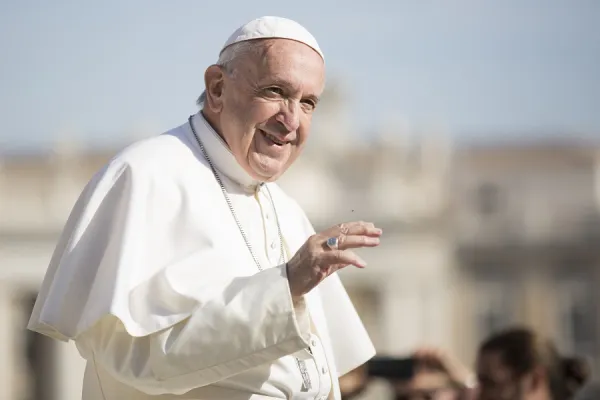
Vatican City, Apr 7, 2019 / 05:52 am (CNA).- Pope Francis Sunday emphasized the need for people to have a firm resolve to change their lives when they ask for forgiveness of their sins.
“Every true conversion is aimed at a new future, at a new life, a beautiful life, a life free from sin, a generous life,” the pope said April 7. And people are not afraid to ask Jesus for forgiveness, “because He opens the door to this new life.”
Lent, Francis pointed out, is a time when Catholics are called to recognize their sinfulness and to ask God for forgiveness. “And forgiveness, in turn, as it reconciles us and gives us peace, makes us begin a renewed story.”
Pope Francis, in his Angelus address, reflected on the Gospel passage of the woman caught in adultery. The scribes and Pharisees, he said, try to trap Jesus by catching him going against the law, which says the woman should be stoned.
The scribes and Pharisees “are closed in the bottlenecks of legalism and want to lock up the Son of God in their perspective of judgment and condemnation,” the pope said. “But He did not come into the world to judge and condemn, but to save and offer people a new life.”
This episode contrasts two different attitudes, he underlined: The scribes and Pharisees “want to condemn the woman, because they feel they are the guardians of the Law and of its faithful application. Instead, Jesus wants to save her, because he personifies the mercy of God who, by forgiving redeems, reconciles, and renews.”
Francis noted that Jesus’ reaction to this “test” is to remain in silence, bending down to write in the dirt, as if to recall that the only Judge and Legislator is God, “who has written the Law in stone.”
And then Jesus says: “Let the one among you who is without sin be the first to throw a stone at her.” With these words he appeals to the consciences of the scribes and Pharisees, reminding them of their own sinfulness, Pope Francis said.
Jesus continues to write in the dirt, and when he looks up, they have all left – only “misery and mercy” remain between him and the woman, he said, quoting St. Augustine.
Jesus then invites the woman to “Go, and from now on do not sin anymore.”
“And so, Jesus opens a new road before her, created by mercy, a road that requires her commitment not to sin anymore,” the pope said, noting that “it is also an invitation that applies to each of us. When Jesus forgives us, he always opens a new way to move forward.”
Speaking badly of others is one thing which makes people like the scribes and Pharisees, throwing stones, he stated.
“This scene also invites each of us to become aware that we are sinners,” he said, “and to let fall from our hands the stones of denigration and condemnation, of gossip, which at times we would like to hurl against others.”
Invoking the Virgin Mary, he concluded by asking for her help in witnessing “to all the merciful love of God who, in Jesus, forgives us and makes our existence new, always offering us new possibilities.”
If you value the news and views Catholic World Report provides, please consider donating to support our efforts. Your contribution will help us continue to make CWR available to all readers worldwide for free, without a subscription. Thank you for your generosity!
Click here for more information on donating to CWR. Click here to sign up for our newsletter.

Bishops process into St. Peter’s Basilica for the closing Mass of the first assembly of the Synod on Synodality on Oct. 29, 2023. / Vatican Media
Rome Newsroom, Jul 9, 2024 / 06:00 am (CNA).
The guiding document for the final part of the Synod on Synodality, published Tuesday, focuses on how to implement certain of the synod’s aims, while laying aside some of the more controversial topics from last year’s gathering, like women’s admission to the diaconate.
“Without tangible changes, the vision of a synodal Church will not be credible,” the Instrumentum Laboris, or “working tool,” says.
The six sections of the roughly 30-page document will be the subject of prayer, conversation, and discernment by participants in the second session of the 16th Ordinary General Assembly of the Synod of Bishops, to be held throughout the month of October in Rome.
Instead of focusing on questions and “convergences,” as in last year’s Instrumentum Laboris, “it is now necessary that … a consensus can be reached,” said a FAQ page from synod organizers, also released July 9, answering a question about why the structure was different from last year’s Instrumentum Laboris.
The guiding document for the first session of the Synod on Synodality in 2023 covered such hot-button topics as women deacons, priestly celibacy, and LGBTQ outreach.
By contrast, this year’s text mostly avoids these subjects, while offering concrete proposals for instituting a listening and accompaniment ministry, greater lay involvement in parish economics and finances, and more powerful parish councils.
“It is difficult to imagine a more effective way to promote a synodal Church than the participation of all in decision-making and taking processes,” it states.
The working tool also refers to the 10 study groups formed late last year to tackle different themes deemed “matters of great relevance” by the Synod’s first session in October 2023. These groups will continue to meet through June 2025 but will provide an update on their progress at the second session in October.
The possibility of the admission of women to the diaconate will not be a topic during the upcoming assembly, the Instrumentum Laboris said.
The new document was presented at a July 9 press conference by Cardinals Mario Grech and Jean-Claude Hollerich, together with the special secretaries of the synodal assembly: Jesuit Father Giacomo Costa and Father Riccardo Battocchio.
“The Synod is already changing our way of being and living the Church regardless of the October assembly,” Hollerich said, pointing to testimonies shared in the most recent reports sent by bishops’ conferences.
The Oct. 2-27 gathering of the Synod on Synodality will mark the end of the discernment phase of the Church’s synodal process, which Pope Francis opened in 2021.
Participants in the fall meeting, including Catholic bishops, priests, religious, and laypeople from around the world, will use the Instrumentum Laboris as a guide for their “conversations in the Spirit,” the method of discussion introduced at the 2023 assembly. They will also prepare and vote on the Synod on Synodality’s advisory final document, which will then be given to the pope, who decides the Church’s next steps and if he wishes to adopt the text as a papal document or to write his own.
The third phase of the synod — after “the consultation of the people of God” and “the discernment of the pastors” — will be “implementation,” according to organizers.
Prominent topics
The 2024 Instrumentum Laboris also addresses the need for transparency to restore the Church’s credibility in the face of sexual abuse of adults and minors and financial scandals.
“If the synodal Church wants to be welcoming,” the document reads, “then accountability and transparency must be at the core of its action at all levels, not only at the level of authority.”
It recommends effective lay involvement in pastoral and economic planning, the publication of annual financial statements certified by external auditors, annual summaries of safeguarding initiatives, the promotion of women to positions of authority, and periodic performance evaluations on those exercising a ministry or holding a position in the Church.
“These are points of great importance and urgency for the credibility of the synodal process and its implementation,” the document says.
The greater participation of women in all levels of the Church, a reform of the education of priests, and greater formation for all Catholics are also included in the text.
Bishops’ conferences, it says, noticed an untapped potential for women’s participation in many areas of Church life. “They also call for further exploration of ministerial and pastoral modalities that better express the charisms and gifts the Spirit pours out on women in response to the pastoral needs of our time,” the document states.
Formation in listening is identified as “an essential initial requirement” for Catholics, as well as how to engage in the practice of “conversation in the Spirit,” which was employed in the first session of the Synod on Synodality.
Pope Francis and delegates at the Synod on Synodality at the conclusion of the assembly on Oct. 28, 2023. Credit: Vatican Media
The document says the need for formation has been one of the most universal and strong themes throughout the synodal process. Interreligious dialogue also is identified as an important aspect of the synodal journey.
On the topic of the liturgy, the Instrumentum Laboris says there was “a call for adequately trained lay men and women to contribute to preaching the Word of God, including during the celebration of the Eucharist.”
“It is necessary that the pastoral proposals and liturgical practices preserve and make ever more evident the link between the journey of Christian initiation and the synodal and missionary life of the Church,” the document says. “The appropriate pastoral and liturgical arrangements must be developed in the plurality of situations and cultures in which the local Churches are immersed …”
How it was drafted
Dubbed the “Instrumentum Laboris 2,” the document released Tuesday has been in preparation since early June when approximately 20 experts in theology, ecclesiology, and canon law held a closed-door meeting to analyze around 200 synod reports from bishops’ conferences and religious communities responding to what the Instrumentum Laboris called “the guiding question” of the next stage of the Synod on Synodality: “How to be a synodal Church in mission?”
After the 10-day gathering, “an initial version” of the text was drafted based on those reports and sent to around 70 people — priests, religious, and laypeople — “from all over the world, of various ecclesial sensitivities and from different theological ‘schools,’” for consultation, according to the synod website.
The XVI Ordinary Council of the General Secretariat of the Synod, together with consultants of the synod secretariat, finalized the document.
According to the working tool, soliciting new reports and feedback after the consultation phase ended is “consistent with the circularity characterizing the whole synodal process.”
“In preparation for the Second Session, and during its work, we continue to address this question: how can the identity of the synodal People of God in mission take concrete form in the relationships, paths and places where the everyday life of the Church takes place?” it says.
The document says “other questions that emerged during the journey are the subject of work that continues in other ways, at the level of the local Churches as well as in the ten Study Groups.”
Expectations for final session
According to the guiding document, the second session of the Synod on Synodality can “expect a further deepening of the shared understanding of synodality, a better focus on the practices of a synodal Church, and the proposal of some changes in canon law (there may be yet more significant and profound developments as the basic proposal is further assimilated and lived.)”
“Nonetheless,” it continues, “we cannot expect the answer to every question. In addition, other proposals will emerge along the way, on the path of conversion and reform that the Second Session will invite the whole Church to undertake.”
The Instrumentum Laboris says, “Synodality is not an end in itself … If the Second Session is to focus on certain aspects of synodal life, it does so with a view to greater effectiveness in mission.”
In its brief conclusion, the text states: “The questions that the Instrumentum Laboris asks are: how to be a synodal Church in mission; how to engage in deep listening and dialogue; how to be co-responsible in the light of the dynamism of our personal and communal baptismal vocation; how to transform structures and processes so that all may participate and share the charisms that the Spirit pours out on each for the common good; how to exercise power and authority as service. Each of these questions is a service to the Church and, through its action, to the possibility of healing the deepest wounds of our time.”
Vatican City, Dec 24, 2017 / 06:23 am (CNA/EWTN News).- With Christmas just a day away, Pope Francis said Mary’s humble and modest response at the announcement of Jesus’ birth reflects what our own attitude should be regarding God’s plan for our lives as we prepare for the incarnation.
In her response to the angel during the Annunciation, Mary’s attitude “perfectly corresponds to that of the Son of God when he comes into the world: he wants to become the Servant of the Lord, putting himself at the service of humanity in order to fulfill the plan of God,” the Pope said Dec. 24.
By saying “I am the handmaid of the Lord,” Mary “perfectly reflects” the words of Jesus himself, who in the Gospels tells God the Father that “I come to do your will.”
“In this way Mary is revealed as a perfect collaborator in the plan of God, and she is also revealed as a disciple of her son, and in the Magnificat she is able to proclaim that ‘God has exalted the lowly,’ because with this humble and generous response she has obtained a high joy, and even the highest glory.”
Pope Francis spoke to pilgrims in St. Peter’s Square during his Angelus address for the fourth Sunday of Advent, which this year falls on Christmas Eve. Later this evening, at 9:30p.m. local time in Rome, he will celebrate the vigil Mass for Christmas in St. Peter’s Basilica.
In his Angelus address, the Pope pointed to the difference between the responses of the angel and Mary during the Annunciation in the Gospel of Luke.
The angel’s declaration that Mary will conceive a son, that his name will be Jesus, that he will be the Messiah, and that he will have a specific mission in line with his ancestors David and Jacob, is “a long revelation, which opens unheard of perspectives,” he said, adding that after Mary’s question, the angel goes into further detail, and the revelation becomes “still more detailed and surprising.”
Mary’s response, on the other hand, “is a brief phrase, which doesn’t speak of joy, it doesn’t speak of privilege, but only of availability and service.”
Even the content of her response that “I am the handmaid of the Lord, do unto me according to your word,” is different, he said, noting that “Mary doesn’t exalt before the prospect of becoming the mother of the Messiah, but remains modest and expresses her own adhesion to the project of the Lord,” Francis said.
This contrast in their responses is important, he said, because it shows us that Mary is “truly humble and doesn’t try to show off.” Instead, Mary recognizes that “she is small before God, and she is content to be like this.”
However, at the same time Mary is also aware that the fulfillment of God’s plan depends on her response, and that she is therefore called to “adhere to it with her whole self.”
Pope Francis closed his address saying while admiring Mary for her response to the call and mission of God, we must also pray that she help each person “to welcome the plan of God in our lives with sincere humility and courageous generosity.”
After leading pilgrims in the traditional Angelus prayer, the Pope noted that the birth of the “Prince of Peace” is drawing nearer, and prayed for the gift of peace for the whole world, especially for those who “suffer most due to ongoing conflicts.”
He also prayed that everyone who has been kidnapped in these conflicts – priests, religious and lay men and women – would be set free and able to return to their homes.
Francis also prayed for the victims of a massive tropical storm that tore through the Philippine Island of Mindanao yesterday, killing at least 180 people, asking that God “welcome the souls of the deceased and comfort those who suffer due to this calamity.”
The Pope then gave a final piece of advice before Christmas, telling pilgrims to find a moment of silence to stop and pray in front of the nativity scene, and to “adore the mystery of the true Christmas, that of Jesus, who draws near to us with his love, humility and tenderness.”
Fr. Juan Antonio Guerrero Alves. / Office of Communication Society of Jesus.
Vatican City, Jun 22, 2021 / 15:00 pm (CNA).
The Vatican’s Secretariat for the Economy issued on Tuesday a set of regulations related to new norms for awarding public c… […]
Conversion is a mighty gift.
Stop the presses! Did Francis accidentally say something Catholic?!!! Maybe our rosaries for him are starting to bear fruit.