Pope Francis greets staff at the Gemelli Hospital in Rome, July 11, 2021. / Vatican Media.
Vatican City, Apr 1, 2023 / 04:16 am (CNA).
Pope Francis was discharged from the hospital Saturday morning after a three-night stay in Rome’s Gemelli Hospital.
Before departing by car, the pope greeted the crowd gathered outside of the hospital. In an emotional moment, he stopped to embrace and pray with a sobbing mother whose five-year-old daughter died in the hospital the night before.
When asked by a journalist how he was feeling, the pope quipped: “Still alive!”
Pope Francis stops on way out of Gemelli hospital to thank journalists for their work.
A Vatican statement on April 1 said that the pope spoke to the hospital administrators, as well as the team of doctors and medical staff who treated him before leaving the hospital around 10:30 a.m. local time.
Pope Francis’ first stop before returning to Vatican City was to pray in the Roman Basilica of St. Mary Major, where he entrusted the sick children he met at the hospital, as well as all who are sick and suffering from illnesses to the care of the Blessed Virgin Mary.
After being discharged from the hospital on April 1, 2023, Pope Francis went to pray in the Basilica of St. Mary Major. Vatican Media
Pope Francis was released from the hospital one day before the start of Holy Week. Vatican spokesman Matteo Bruni said that the pope is expected to be present at Palm Sunday Mass in St. Peter’s Square on April 2.
The 86-year-old pope was admitted to the hospital on March 29 with difficulty breathing. He was later diagnosed with bronchitis. His condition improved after receiving antibiotic infusion therapy, according to the Vatican.
While being treated in the hospital’s papal medical suite, the pope read the newspaper, did some work, and even shared a pizza dinner together with some of the medical staff.
On his last full day at Gemelli, Pope Francis visited the pediatric oncology ward, where he gave out rosaries and chocolate Easter eggs to the children. The pope also baptized a baby named Miguel Angel, who was only a few weeks old.
📹VIDEO | The Vatican released the first video of Pope Francis at Rome’s Gemelli Hospital, where he baptized a baby boy named Miguel Angel. He is expected to return to the Vatican this Saturday. pic.twitter.com/J6pk05NJak
Gemelli is the same hospital where Pope Francis was hospitalized for ten days in July 2021 when he underwent surgery on his colon for diverticulitis, or inflammation of the intestinal wall.
In an interview with the Associated Press in January, Pope Francis disclosed that the diverticulitis had “returned.” At the time, the pope — who traveled to South Sudan and the Democratic Republic of Congo in late January — insisted he was in relatively good condition.
Rome’s Gemelli Hospital. The papal medical suite can be identified from the street by its five large windows covered by white blinds. Courtney Mares/CNA.
Pope Francis recovered from bronchitis in the papal medical suite situated on the 10th floor of Gemelli University Hospital in a wing reserved for papal medical emergencies.
It is the same hospital suite where John Paul II was treated throughout his pontificate, including after being shot in an assassination attempt in 1981.
If you value the news and views Catholic World Report provides, please consider donating to support our efforts. Your contribution will help us continue to make CWR available to all readers worldwide for free, without a subscription. Thank you for your generosity!
Click here for more information on donating to CWR. Click here to sign up for our newsletter.
Portrait of St. Benedict (1926) by Herman Nieg (1849–1928); Heiligenkreuz Abbey, Austria; “Exorcism of St. Benedict,” by Spinello Aretino, late 14th century. / Credit: Public Domain
Pilgrims on their way to Ugandan Martyrs’ Day on May 21, 2024. / Credit: St. Joseph’s Cathedral of Kakamega Diocese
ACI Africa, May 25, 2024 / 08:00 am (CNA).
One of Africa’s — and the world’s — largest religious gatherings will take place on June 3 in Kampala, Uganda, and one group from Kenya has already begun its more than 200-mile pilgrimage to arrive for the yearly event.
Ugandan Martyrs Day this year will draw anywhere from 500,000 to millions of Catholics and other Christians from across the continent of Africa.
Pilgrims from the Nzoia Deanery of the Diocese of Kakamega are traveling to Uganda’s Namugongo Shrine, where the event takes place, bringing with them various prayer intentions — among them, “praying that more people may embrace, in faith and fidelity, the call of God in their respective lives,” according to ACI Africa, CNA’s news partner in Africa.
Blessed and sent off on Tuesday, May 21, by Father Columban Odhiambo, the parish priest of St. Joseph the Worker Kongoni Parish in the Kakamega Diocese, the pilgrims will cover 18-25 miles each day.
Pilgrims to Uganda Martyrs’ Day 2024 from Nzoia Deanery of the Catholic Diocese of Kakamega in Kenya, with the parish priest of St. Joseph the Worker Kongoni Parish, Father Columban Odhiambo, on May 21, 2024. Credit: St. Joseph the Worker Kongoni Parish/Kakamega Diocese
In an interview with ACI Africa, Odhiambo said the intention to pray for the growth of vocations to the priesthood, religious life, and marriage was inspired by a May 11 priestly ordination, which the Kenyan Deanery hosted at St. Mark’s Nzoia Parish in the Kakamega Diocese. Nine deacons were ordained priests — seven for the diocese and two for the Order of Friars Minor Capuchin (OFM Cap).
The long pilgrimage to Namugongo, Odhiambo said, “is simply a spiritual journey. The pilgrims have personal intentions, and some have been given intentions by their parishes” to be included in their collective prayer intention.
The Kenyan pilgrims, who are being accompanied by two priests, had an opportunity to participate in the sacrament of confession and Mass before embarking on their spiritual journey to Namugongo. Along the way, they will meet dozens of other faithful walking from the Kakamega Diocese and, together, about 150 of them “will sing, pray the rosary, pray the Chaplet of Divine Mercy, and will go to confession,” Odhiambo told ACI Africa.
The priest said the deanery’s pilgrimage group of 19 is the largest number so far to make the pilgrimage. “Last year, we only had three,” he said.
A blessing of pilgrims who are on their way to Uganda Martyrs’ Day, May 21, 2024. Credit: St. Joseph the Worker Kongoni Parish/Kakamega Diocese
The Ugandan Martyrs’ Day dates back to the first decade of Christian presence in the East African nation when 45 men between the ages of 14 and 50 years old were killed between Jan. 31, 1885, and Jan. 27, 1887, because they would not renounce their faith.
Twenty-two of the martyrs were beatified in 1920 and canonized in 1964.
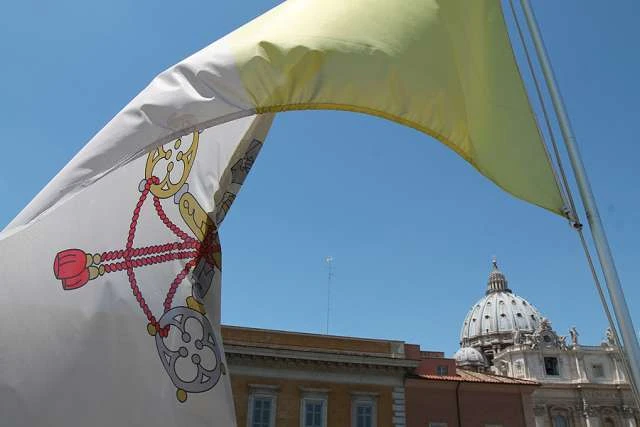
Vatican City flag waiving over St. Peter’s dome – Bohumil Petrik / CNA
Rome Newsroom, May 20, 2021 / 05:30 am (CNA).
The Vatican’s Council for the Economy faces a “huge task” in its efforts to quickly bring up the Holy See’s accounting and financial transparency to international standards, according to one of its lay members.
“We are very much focused on getting those basic standards in place and making sure the information that is in front of the pope when he makes decisions is thorough, complete, and fair. And we’re not in that situation yet,” Council for the Economy member Ruth Kelly told EWTN News.
Kelly, who was Education Secretary under British Prime Minister Tony Blair and later worked for HSBC Global Asset Management, is one of seven lay people on the Vatican council overseeing the administrative and financial structures and activities of the Roman Curia, institutions of the Holy See, and Vatican City State.
The lay members work together with eight cardinals to set the budget for the Holy See’s entities and raise the level of financial transparency — something which Kelly said can pose unique challenges.
“For example, the historic legacy is very, very difficult to tackle if you take the example of, say … a place of residence through tradition in a particular part of the Vatican, or Rome, or somewhere in the world. It may be the case that no one has ever had it valued, or really thought about who legally owned it, because through customs and tradition it was obvious to what use it should be put,” she said.
“The Holy See cannot yet account for all of the investment properties that it owns specifically around Rome and in Italy. And there’s a huge task to go through to make sure it identifies properly the ownership of each — whether it’s owned by a diocese, whether it’s owned by the Vatican, whether it’s owned by a parish, or somebody else — and then to valuate it to make sure that it’s properly accounted for in the balance sheets.”
“So that’s one real area where the Holy See needs to be moved quickly up to date.”
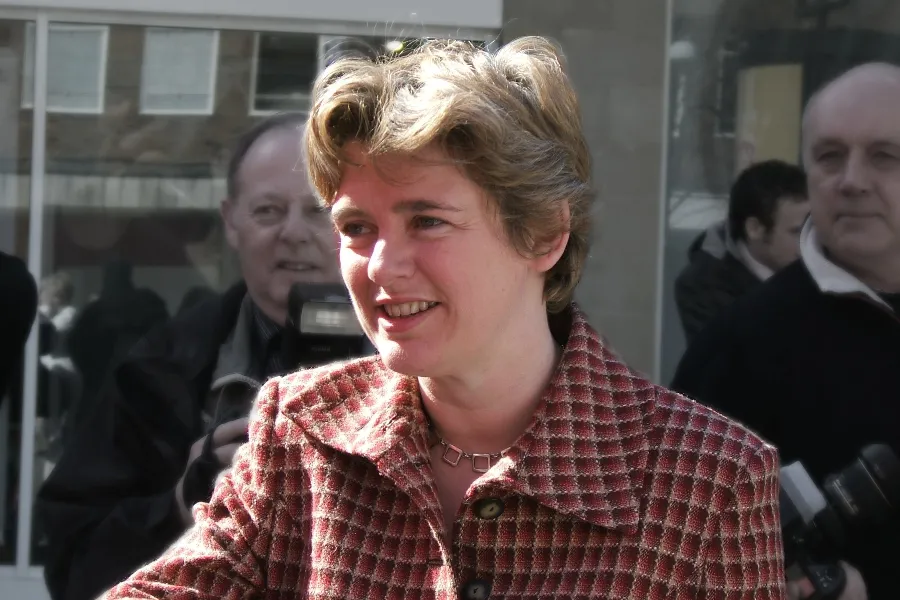
Ruth Kelly, pictured in 2006. / skuds via Flickr (CC BY-SA 2.0).
The Council for the Economy is also currently implementing an investment policy for the Vatican and “a huge training program” in financial standards for those who work in its departments and dicasteries, according to Kelly.
“I’m actually very encouraged by the steps that I’ve seen, even though there’s so much to do and so far to go,” she said.
Pope Francis established the Council for the Economy in 2014 as part of his program of financial reform. Kelly was appointed to the council for a six-year term last August along with five other women with backgrounds in banking, finance, asset management, and international law.
“There’s a real recognition that it’s now very important at the heart of the Church to have lay experts involved in overseeing the Vatican accounts and policies and so forth. And that is important, not just in its own sake, but also for the credibility of the process,” Kelly said.
“The ambition is to have international accounting standards applied in full across the Holy See,” she said. “That’s not a position which we have arrived at yet, but it is one to which we aspire.”
Kelly spoke at the webinar series, “Inspiring Trust: Church Communications and Organizational Vulnerability,” offered by the Pontifical University of the Holy Cross in Rome. The university is entrusted to Opus Dei, with which Kelly is associated.
“To be brutally honest about it, from my perspective of the council’s perspectives … it’s not clear how funds have been flowing and how they’ve been managed because the transparency hasn’t been there,” she said.
Kelly is adamant that “once that transparency is there, and international standards are applied, then you can start talking altogether differently about the Vatican’s role and its responsibility and how it manages money, and so forth.”
“If someone’s going to put money into the Peter’s Pence account, they need to know that that money is being well spent. And at the moment, you can’t say definitely that we can show that, but we’re well on the way I think to be able to do that before too long,” she said.
The Council of the Economy was very focused on cost restraint in setting this year’s budget, asking Vatican departments to come up with reductions in their spending, Kelly explained.
The Vatican’s budget, which already operated on a deficit, took another hit in 2020 and the beginning of 2021, when the Vatican Museums, a major source of income, was forced to close for months.
For the Holy See, the coronavirus crisis also meant collapsing market investments, uncertain income from real estate investments, and diminished contributions from the Church around the world.
“The Holy See suffered, along with every other organization, or many other organizations, in the pandemic, and that’s not surprising. And the question really for the council is how much of that is temporary and how much of that will bounce back,” she said.
“And it is the case that fundraising has been severely dented through the COVID crisis, not surprisingly, as it has been felt right throughout the Church,” she said.
“So, you know, it is one of the areas in our minds, as we think about how to restore the reputation and how to create a strong reputation for how the Holy See manages finances.”
Kelly is confident that there is a strong willingness among both the lay members and the cardinals on the council to “make an impact quickly.”
“We do expect results, very significant results, before the six years run out at the end of the council’s current term,” she said.
German Cardinal Reinhard Marx has overseen the council since its creation in 2014. Other cardinals currently on the council include Joseph Tobin of Newark; Anders Arborelius of Stockholm; Péter Erdő of Esztergom-Budapest; Odilo Scherer of São Paulo; Gérald Lacroix of Quebec; Giuseppe Petrocchi of L’Aquila; and Cardinal Daniel DiNardo of Galveston-Houston.
Among the lay members are German law professor Charlotte Kreuter-Kirchhof; Maria Kolak, president of the National Association of German Cooperative Banks; Alberto Minali, the former chief investment officer of the asset management group Eurizon; Leslie Ferrar, who was treasurer to Britain’s Prince Charles; elevator manufacturer Zardoya Otis; and Eva Castillo Sanz, who sits on the board of directors of the Spanish bank Bankia.
Kelly said: “One of the things that’s on my mind to really explore as we go forward is how the whole whistleblowing setup works in the Vatican. Because I think part of an open culture is not only financial transparency but the ability of people to raise issues in private, perhaps without being identified or only identified if they so wish.”
“Now I do know that whistleblowing happens, but I’m not yet sure that that works well enough within the Holy See, and the Vatican.”
“There is a huge way to go, but I do think the will is there at the very top to see change happen,” she said.






People of goodwill from different walks of life keep praying for the well-being and good health of His Holiness Pope Francis.