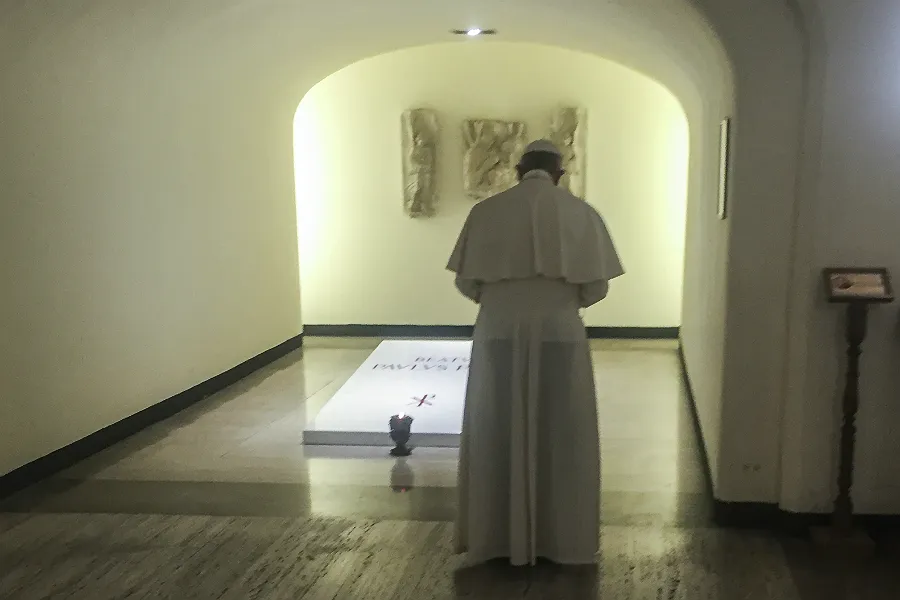
Vatican City, Aug 6, 2018 / 10:04 am (CNA/EWTN News).- Pope Francis made a private visit Monday morning to pray at the tomb of Bl. Paul VI, on the 40th anniversary of his death.
Francis made a similar visit to Bl. Paul VI’s tomb last year.
Pope Francis’ visit to the tomb took place in an absolutely private manner, said vice-director of the Holy See press office, Paloma Garcia.
She told EWTN Aug. 6 that Pope Francis prayed for about 10 minutes at the tomb, which is located in the Vatican Grottos, the crypt beneath St. Peter’s Basilica.
Bl. Paul VI, to whom Francis referred Sunday as a “pope of modernity,” was the author of the 1968 encyclical Humanae vitae, which reaffirmed Church teaching against contraception.
Bl. Paul VI will be canonized with Bl. Oscar Romero Oct. 14, during the synod on young people, faith, and vocational discernment.
At the end of his Angelus address Aug. 5, Francis recalled the blessed, calling him a “great pope of modernity,” and remembering him “with much veneration and gratitude.”
“From heaven may he intercede for the Church and for peace in the world,” the pope said.
Pope Francis unofficially confirmed the news of Paul VI’s canonization during his annual meeting with the priests of Rome Feb. 17. “Paul VI will be a saint this year,” he said Feb. 15.
After a long question and answer session, the pope gave texts containing meditations by Bl. Paul VI as a gift to each of the priests. “I saw it and I loved it,” Francis said about the book.
If you value the news and views Catholic World Report provides, please consider donating to support our efforts. Your contribution will help us continue to make CWR available to all readers worldwide for free, without a subscription. Thank you for your generosity!
Click here for more information on donating to CWR. Click here to sign up for our newsletter.
Cardinal Christoph Schönborn (left) shakes hands with Father Josef Grünwidl, whom Pope Francis appointed as apostolic administrator of the Archdiocese of Vienna on Jan. 22, 2025. / Credit: Archdiocese of Vienna / Stephan Schönlaub
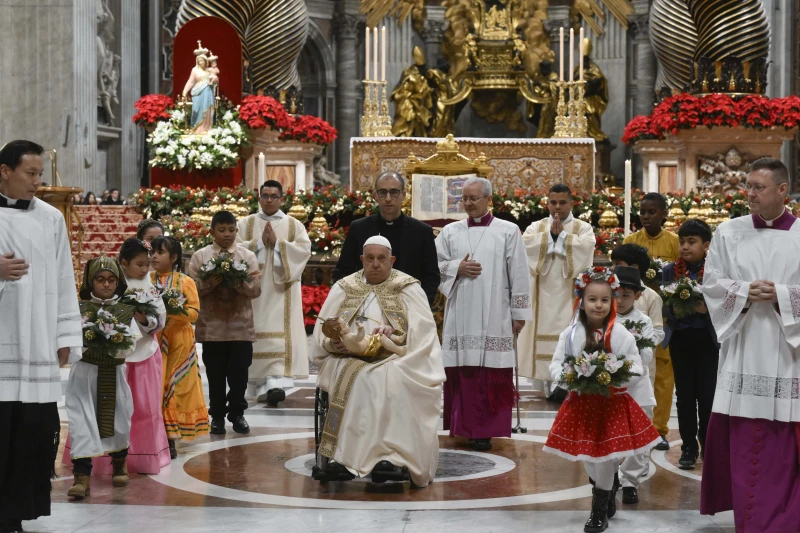
Pope Francis carries the statue of the Child Jesus to place in the Nativity scene inside St. Peter’s Basilica at the end of Mass on Christmas Eve, Dec. 24, 2024, surrounded by children dressed in traditional clothing from their countries. / Credit: Vatican Media
Vatican City, Dec 24, 2024 / 17:20 pm (CNA).
Hope lives, Pope Francis said in his homily for Christmas Eve Mass at the Vatican, as he reflected on the incredible fact that the infinite God became a small Child.
“God is Emmanuel, he is God-with-us,” the pope said in St. Peter’s Basilica on Dec. 24. “The infinitely great has become small; the divine light has shone through the darkness of the world; the glory of heaven has appeared on earth. And how? In the littleness of a Child. And if God comes, even when our hearts resemble a poor manger, then we can say: hope is not dead, hope is alive, and it envelops our lives forever.”
The 88-year-old Pope Francis presided over Mass during the Night for the Feast of the Nativity of the Lord after opening the Holy Door of the basilica to officially start the 2025 Jubilee Year.
With the opening of the Holy Door, the pontiff said, “each of us can enter into the mystery of this proclamation of grace.”
“This is the night when the door of hope has opened wide on the world; this is the night when God says to each one: there is hope for you too!” he said in his Christmas homily.
Pope Francis opened the Holy Door of St. Peter’s Basilica before Mass on Christmas Eve, Dec. 24, 2024, officially launching the Jubilee Year 2025. Credit: Vatican Media
Francis said the Jubilee, which has the theme “pilgrims of hope,” is an opportunity for all people to have hope in the Gospel, hope in love, and hope in forgiveness.
“It invites us to rediscover the joy of the encounter with the Lord, calls us to spiritual renewal, and commits us to the transformation of the world, so that this may truly become a Jubilee time,” he underlined.
The world really needs hope right now, Pope Francis continued, especially amid wars, the bombing of hospitals and schools, and the machine-gunning of children.
While symptoms of a cold kept the pope indoors on the weekend before Christmas, he was well enough on Tuesday to open the Holy Door and preside over Christmas Eve Mass. It was also one of his first public appearances sporting hearing aids.
During the rite of opening of the Holy Door, Francis, seated in his wheelchair, leaned forward to knock on the gold door, which had been sealed since the last jubilee. As assistants opened the two sides of the door, the choir sang in Latin: “This is the Lord’s own gate. Where the upright enter. I enter your house, O Lord.”
The pope then passed through the door and into the basilica, followed by cardinals, bishops, priests, and ministers for Christmas Mass, as well as representatives of other Christian churches and Catholics from five continents wearing traditional clothing from their countries.
“On this night it is for you that the ‘holy door’ of God’s heart opens,” the pontiff said in his homily. “Jesus, God-with-us, is born for you, for me, for us, for every man and woman. And, you know, with him joy flourishes, with him life changes, with him hope does not disappoint.”
He said the task of Christians during the Jubilee Year is to bring hope into different situations of life, because Christian hope “is not the happy ending of a movie” to be passively awaited. “It is the Lord’s promise to be welcomed here, now, in this suffering and groaning earth.”
“Let us learn from the example of the shepherds: the hope born on this night does not tolerate the indolence of the sedentary and the laziness of those who have settled into their comforts — and so many of us, we are in danger of settling into our comforts,” Pope Francis warned.
“Hope,” he continued, “does not admit the false prudence of those who do not get off the hook for fear of compromising themselves and the calculation of those who think only of themselves; hope is incompatible with the quiet life of those who do not raise their voices against evil and against the injustices consummated on the skin of the poorest.”
Seminarians and priests enjoyed a friendly bowling match in the St. John XXIII Pontifical Lanes during some downtime on an afternoon in May 2023. / Credit: Daniel Ibañez/CNA
Rome Newsroom, Jun 3, 2023 / 05:00 am (CNA).
The “mythical bowling all… […]




Leave a Reply