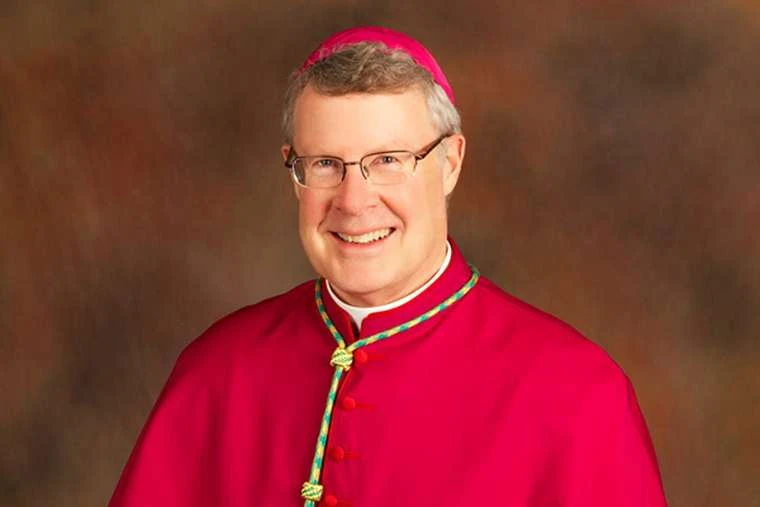
Sioux City, Iowa, May 3, 2018 / 07:00 pm (CNA/EWTN News).- An Iowa bishop said that a bill banning abortions after detection of a fetal heartbeat “affirms the life-giving intent” of the state’s pro-life efforts.
Known as the “fetal heartbeat” bill, the measure was attached to state. legislation banning the sale and transfer of fetal remains. The bill was passed by the state’s legislature this week.
Bishop Walker Nickless of Sioux City, Iowa, told CNA he supports the legislation’s aims.
“We are grateful that, right now, it looks like it would stop some trafficking of fetal body parts following an abortion,” he said. “It also affirms the life-giving intent of our stance in pro-life activities.”
The bill, passed in the Iowa House of Representatives May 1 and the Iowa Senate May 2, now awaits approval from Republican governor, Kim Reynolds, who has not commented on whether she will sign the legislation into law.
The law would require any women seeking an abortion to undergo an ultrasound to determine whether a fetal heartbeat can be detected, a milestone usually detected in the sixth week of pregnancy. The bill does make some exceptions for pregnancies conceived through rape or incest.
The bill would also ban all persons from knowingly acquiring, providing, transferring, or using fetal remains in Iowa. This would not apply to medical diagnostic samples, or forensic investigations, or to fetal body parts donated for medical research after a miscarriage or stillbirth.
“We support the life-giving intent of the provisions in the bill and we want to do everything we can to support that,” Bishop Nickless said.
Bishop Nickless told CNA that the state’s bishops recognize that some provisions of the bill might not withstand judicial scrutiny. He added that Catholics might disagree about the strategy of supporting legislation that could be overturned by courts.
At the same time, the bishop encouraged creative pro-life advocacy, saying that Iowa’s bishops had encouraged Catholics to discern those questions carefully. He said the message of the state’s bishops had been: “If you’re a Catholic and your conscience tells you to support this, please do.”
“The Catholic Church has always been pro-life and we’ll continue to be,” he added.
Nickless reaffirmed that the Catholic Church supports the health and rights of all women, including those in the womb. “If we are talking about women we need to make sure we are talking about unborn females as well, and protecting them for sure,” he said.
“Catholics respect all human life, from natural conception to natural death, and we are trying to respect the females among us as well,” he added.
If you value the news and views Catholic World Report provides, please consider donating to support our efforts. Your contribution will help us continue to make CWR available to all readers worldwide for free, without a subscription. Thank you for your generosity!
Click here for more information on donating to CWR. Click here to sign up for our newsletter.

Schoolchildren in Tigray, Ethiopia, eat biscuits and tea provided by Mary’s Meals. / Copyright Mary’s Meals
St. Louis, Mo., Sep 3, 2023 / 05:00 am (CNA).
A Catholic charity providing thousands of free meals daily to schoolchildren in Tigray, northern Ethiopia, recently resumed operations after a brutal civil war precluded it from its mission for almost three years.
Since 2017, Mary’s Meals has worked with the Daughters of Charity in Tigray to bring food to schoolchildren there. Pre-2020 they fed an estimated 24,000 children a day, but the effects of the COVID-19 pandemic and the subsequent commencement of the country’s devastating civil war halted the program. Mary’s Meals had every intention of reopening in the fall of 2020 following COVID, but the start of the conflict precluded those plans.
“It was really heartbreaking to see that what we were expecting to be quite a joyous occasion in terms of the resumption of school feeding, children being welcomed back into schools and being able to return to what must have felt a bit more like normal life, suddenly being decimated by this terrible conflict,” Alex Keay, director of programs at Mary’s Meals International, told CNA.
Schoolchildren in Tigray, Ethiopia, eat biscuits and tea provided by Mary’s Meals. Copyright Mary’s Meals
Today, as of late August, Mary’s Meals is able to serve high-energy biscuits and hot tea to approximately 10,000 children in 14 schools. Over the next few months, the group says, its program and menu will be expanded as cooking facilities that were destroyed or looted in the fighting are replaced.
Keay called the resumption of the food distribution a “joyous occasion.”
“We’ve been able to restart school feeding just in the last couple of weeks. And more of those schools will be reopening and we will be able to get food to those schools, and we would like to be able to reach even more schools. We know the need is there,” Keay said, speaking from Mary’s Meals’ home country of Scotland.
“These school meals that we’re providing are a critical lifeline at this time, but also they are enabling the children to return to school after more than a three-year absence.”
A refugee camp in Tigray, Ethiopia. Copyright Mary’s Meals
Widespread starvation has been reported recently in Tigray, especially since U.N. and U.S. food aid has been disrupted in recent months due to revelations of corruption. Overall, more than 20 million people in Ethiopia rely on food assistance. A persistent drought has made food scarcity even worse. According to reports from the region, many mothers giving birth at local hospitals in Tigray have been unable to breastfeed due to their own hunger, and many malnourished children “near death” have been showing up at hospitals.
It is estimated that 600,000 people have died in the conflict and there are reports of ongoing violence in various parts of Tigray. Though Ethiopia is extremely diverse overall, the Tigray region is overwhelmingly Orthodox Christian, at about 96%.
Keay said Mary’s Meals is focused on providing nourishing meals for children in areas where access to education is limited. The logistics are challenging, and the on-the-ground help of the Daughters of Charity is vital, he said.
“They would sooner give away the food in their cupboard than have people come to their door hungry with nothing,” Keay said of the religious sisters.
“Our model is a low-cost model, but I think a very efficient model whereby the community is taking a strong ownership and a really strong part in making sure that those programs operate successfully,” he added. “So they’ll be the ones that manage the local preparation of the meals, they’ll organize the volunteer cooks to come every day to cook the food and to make sure that every child that comes to that school gets fed. And then our role is that we’ll provide the food, the training, the monitoring, and the support to those communities so that that food is in the right place at the right time and that the children will all be fed.”
Schoolchildren in Tigray, Ethiopia, eat biscuits and tea provided by Mary’s Meals. Copyright Mary’s Meals
Schools provide a “beacon of hope” in an otherwise hope-starved country, and providing free meals at the schools helps to provide an incentive for students to get educated, he said. Major challenges remain, though, as many of the schools themselves have been shelled and looted amid the conflict.
“The children came with a lot of energy and a lot of passion for education, a lot of determination to really engage in their schools and to try and get the best from their education. And we certainly see that in terms of the … high attendance rates … once school feeding had started. That’s not uncommon for us to see that all of a sudden more children are encouraged to go to school,” Keay continued, drawing on his own experience visiting the country this year.
“The amazing thing is that the children were already coming back to those schools even though there was no furniture to sit on. Many of the teachers are still not back in their posts. A lot of the classrooms are actually damaged, the walls are damaged, or there’s holes in the ceiling. But the children are already coming back to those schools and are really, I guess, leading by example in their communities in terms of trying to get the schools back up and running.”
A destroyed school building in Tigray, Ethiopia. Copyright Mary’s Meals
The conflict in Tigray stemmed in part from the outsized role the Tigray People’s Liberation Front (TPLF), the primary political party representing the region, has played in recent decades in national politics in Ethiopia despite Tigrayans’ status as an ethnic minority. The political coalition that the TPLF led was dissolved in 2018 by Prime Minister Abiy Ahmed after he took office. The coalition’s ethnicity-based regional parties were merged into a single party, the Prosperity Party, which the TPLF refused to join. Tigrayan leaders have said they were unfairly targeted by political purges and allegations of corruption.
On Nov. 4, 2020, Abiy announced a military offensive in response to an alleged attack on a military base in Mekelle, the capital of Tigray. The conflict soon escalated into an all-out civil war in which mass atrocities have been reported. Eritrea, Ethiopia’s neighbor to the north and former adversary, joined the side of the Ethiopian government early in the conflict. Some have accused Abiy’s government of ethnic cleansing.
For much of the war, Tigray was under blockade by the Ethiopian government, which halted all humanitarian aid and forbade aid workers and media from entering the region. The Ethiopian government and the TPLF signed a peace deal brokered by the African Union (AU) in November 2022, bringing the war to an end on paper.
A damaged school building in Tigray, Ethiopia. Copyright Mary’s Meals
The needs in Tigray over the past few years have been largely overshadowed by other major world events, such as the war in Ukraine. Keay said it is important that people take notice of the “huge, devastating humanitarian situation” in Tigray.
“Tigray is a place that for the most part, people will be familiar with for probably quite negative reasons. There’s been terrible famines in that part of Africa, and a lot of those images, I think, have stuck in a lot of people’s minds. But it’s a very beautiful part of the world, with a real strong sense of identity and culture for the Tigrian people. They’re very distinctive in their culture, the way people dress. And there’s been a lot of work in that part of Ethiopia in recent years around development, and really a lot of progress has been made,” Keay said.
The brutal war, Keay said, has “really set back the development that’s been happening in Tigray.”
“From a state that was really blossoming and a lot of really positive things were happening in terms of sustainable food being grown for the communities … to a situation where the vast majority of Tigrayans are now dependent on food, hand out food aid to be able to survive. And it’s going to take a long time, I think, to repair that damage.”
Schoolchildren in Tigray, Ethiopia, eat biscuits and tea provided by Mary’s Meals. Copyright Mary’s Meals
The BBC reported earlier this month that at least 1,400 people have starved to death in Tigray since food assistance from the U.N.’s World Food Programme (WFP), the global humanitarian organization addressing food security, and the U.S. Agency for International Development (USAID) was suspended about four months ago. The suspension came about after it was revealed by Tigrayan authorities that nearly 500 people had been stealing the food, including government officials and nongovernmental organization staff.
Keay said that from an accountability standpoint, the Daughters of Charity have developed a very “transparent and accountable system that meant that the food was being put directly into [needy people’s] hands.”
“Other organizations were having to suspend their programs because of concerns about food not getting to those that it was intended to. But it was very clear when we were there and being on the ground, seeing the food being distributed, that it is really possible to be able to put the food directly into the hands of those that we’re trying to serve,” he noted.
Mary’s Meals now operates in 18 countries, after its founding in Malawi in 2002. Magnus MacFarlane-Barrow, a Catholic and founder and CEO of Mary’s Meals, was declared a “CNN Hero” in 2010 and has also been awarded the Order of the British Empire by Queen Elizabeth for his work. The organization says it feeds 2.4 million children every day throughout the 18 countries where it is present, with the largest share of those children in Malawi.
Pope Francis has repeatedly called for peace in Tigray. In 2021, after his weekly Angelus, the pope prayed a Hail Mary for the people of the Tigray region.
Pierre, S.D., Jan 30, 2020 / 03:32 pm (CNA).- A bill aiming to ban sex-reassignment surgery and puberty-blocking medication for minors passed the South Dakota House of Representatives by a vote of 46-23 on Wednesday.
Christopher Motz, executive director of the South Dakota Catholic Conference, praised the vote.
“Given the moral and ethical issues at stake, which are fundamental to the integral good of the human person, it’s great to see such a strong vote in the House,” he told CNA Thursday.
“The voices of faithful citizens encouraging their elected leaders no doubt contributed to this positive result,” he continued. “As the bill advances to the Senate, the voices of faithful citizens will be crucial to securing another strong vote.”
HB 1057 would make it a Class 1 misdemeanor for doctors to dispense puberty-blocking drugs to those under the age of 16 for the purpose of changing or affirming the perception of their sex, and lists a number of surgical procedures including castration, vasectomy, and hysterectomy that doctors would not be allowed to perform on minors.
The South Dakota Catholic Conference supports the measure and is encouraging Catholics to contact their lawmakers about the bill.
“HB 1057 would protect boys and girls from harmful medicalization with unknown, potentially life-long consequences,” the conference wrote Jan. 16.
“With deep compassion for the experience of suffering that marks those with gender dysphoria, the Church firmly insists on the dignity of all human persons as created and loved by God, and further expresses special affection for the marginalized and suffering.”
“HB 1057 would ensure children, especially those experiencing distress concerning their sex, are given the chance to develop and grow in understanding the gift of their created nature without pressures towards harmful medicalization,” the conference concluded.
Just a few Republicans voted against the bill, the Associated Press reported. The legislation will now be considered in the Senate.
The provisions of the bill do not apply to “the good faith medical decision of a parent or guardian of a minor born with a medically-verifiable genetic disorder of sex development.”
The South Dakota bill comes in the wake of an October 2019 decision by a federal judge to strike down an Obama-era requirement that doctors perform gender-transition surgeries upon request.
The regulation stemmed from Section 1557 of the Affordable Care Act, which prohibits discrimination in health care on the basis of race, color, national origin, sex, age, or disability. HHS interpreted “sex discrimination” under this rule to include gender identity, thus mandating the provision of gender-transition surgeries.
In response to the rule, an alliance of more than 19,000 health care professionals, nine states, and several religious organizations combined in two lawsuits against the mandate, saying that it unlawfully required doctors who objected to the procedures to violate their religious beliefs or the Hippocratic Oath to do no harm to the patient.
Similar bills to the one proposed in South Dakota are under consideration in other states, including ones introduced during the 2020 session in Florida and Colorado that, like the South Dakota bill, would impose criminal penalties for transgender surgery performed on minor.
In other states, like Illinois, Oklahoma and South Carolina, bills are under consideration that provide for the loss of a doctor’s medical license if they perform transgender surgery on a minor.
A bill under consideration in Missouri would revoke a doctor’s medical license if they administer gender-reassignment treatment, and parents who consent to such treatment would be reported to child-welfare officials for child abuse, the AP reports.
State lawmakers in Kentucky and Texas also have announced plans to file similar bills, the Washington Post reports.
A state representative in Georgia during November 2019 proposed a law that would make it a felony for medical professionals to attempt to change a minor’s gender either through surgery or medication.
“If you are Catholic and your conscience tells you to support this bill, please do.” This encourages Catholics whose consciences tell them not to support it to oppose it. This in turn encourages Catholics to oppose any Church teaching when their conscience does not accept it. Welcome to the Protestant approach in how to be a “faithful” Catholic.