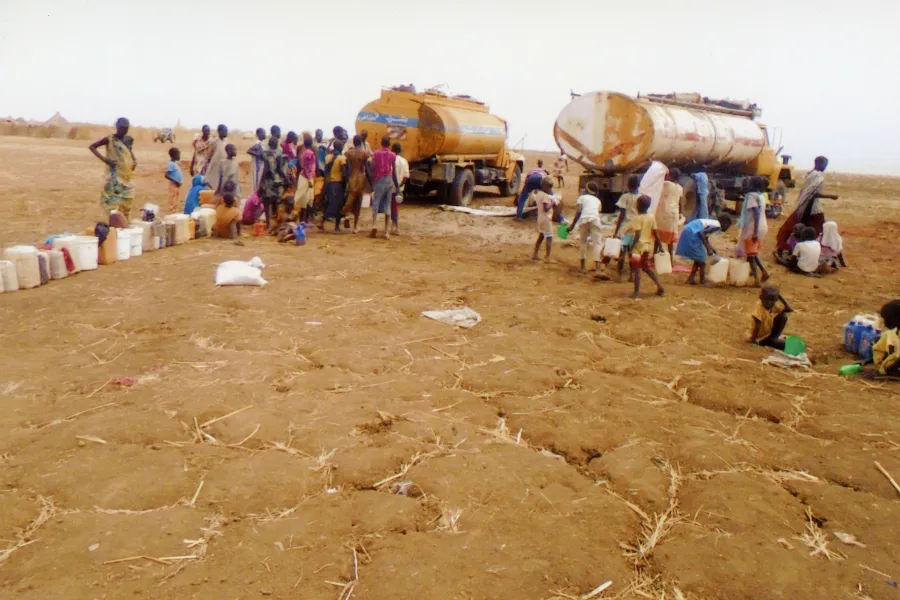
Khartoum, Sudan, Sep 19, 2017 / 12:01 am (CNA/EWTN News).- Christian children in Sudanese refugee camps are reportedly being given food only after they recite Muslim prayers, a papal aid group says.
According to Aid to the Church in Need (ACN), a papal charity that provides aid to persecuted Christians around the world, there are reports of Christian children who have fled violence in South Sudan being forced to recite Muslim prayers in order to receive food at several refugee camps in the Sudan.
Other reports from priests in the area have confirmed that the discrimination is taking place at refugee camps in Sudan, where refugees fleeing the conflict in the South Sudan suffer from poor conditions.
Seven southern states gained independence from Sudan in 2011 and the country of South Sudan was formed. Less than three years later, in December of 2013, a civil war began that has created one of the world’s fastest-growing refugee crisis.
Over two million refugees and asylum-seekers have fled the conflict to neighboring countries, according to the United Nations High Commissioner for Refugees, including hundreds of thousands who have fled north into Sudan.
Many are displaced from their homes within South Sudan and have sought shelter at churches, and millions are threatened by an emergency food crisis. In February, the UN declared a famine in parts of the country.
Aid workers have described the conditions in South Sudan as appalling, with hunger, murder, and rape becoming commonplace.
For refugees who have fled north into Sudan, conditions have reportedly been poor in the camps, according to ACN. Children in the refugee camps are being told to recite Islamic prayers before they receive their food, which is provided by the UNHCR, non-government organizations, and the Sudanese government, according to sources.
Refugees of all religions who are living outside the camps have reportedly not received sufficient amounts of food from the government, but Christians have reportedly received especially unfair treatment, ACN said.
The reports of discrimination against Christian refugees come amid concerns about the government of Sudan and its forceful promotion of Islam.
“In the case of Sudan, the same cast of characters, the same power base that promotes a perverted and violent expression of Islam is still in power,” David Dettoni, senior adviser to the Sudan Relief Fund, testified before a congressional panel on April 26.
ACN also cited reports of Christian churches in Sudan being destroyed under the guise of town planning.
If you value the news and views Catholic World Report provides, please consider donating to support our efforts. Your contribution will help us continue to make CWR available to all readers worldwide for free, without a subscription. Thank you for your generosity!
Click here for more information on donating to CWR. Click here to sign up for our newsletter.
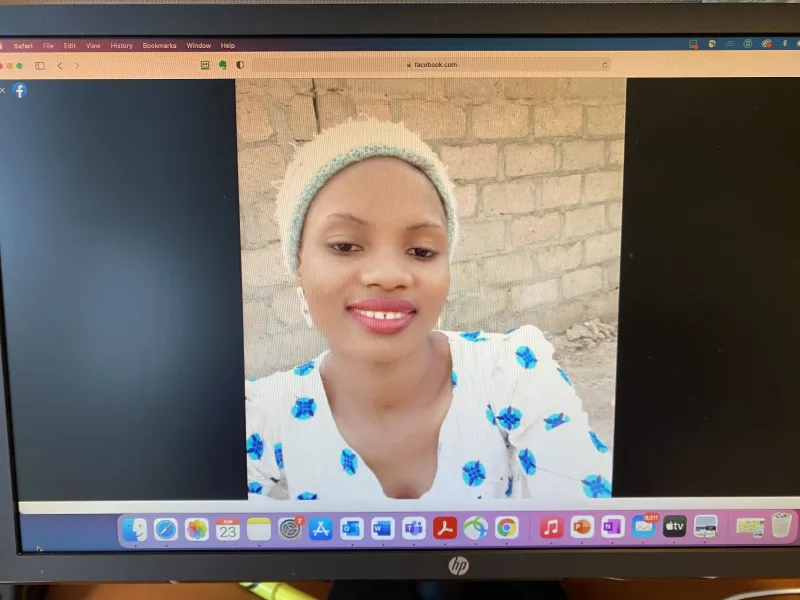
A photo of Deborah Emmanuel’s photo on her Facebook page. Emmanuel, a Christian student in Nigeria, was killed by an Islamic mob on her college campus on May 12, 2022. / CNA
Washington, D.C. Newsroom, Jun 23, 2022 / 14:01 pm (CNA).
Deborah Emmanuel, the Nigerian Christian student who was murdered by a Muslim mob last month, spent her final hours with a close friend who has shared exclusive details of the brutal killing with CNA.
CNA is using the pseudonym “Mary” for the woman’s protection. A Christian herself, she nearly was killed by the same mob.
Significantly, Mary’s account contradicts the claim of authorities that they attempted to rescue Emmanuel from the mob but were “overwhelmed.”
On the contrary, the police “could have stopped the murder if they had really tried,” Mary told CNA.
Emmanuel’s so-called “blasphemy murder” took place on May 12 on the campus of Shehu Shagari College of Education in Sokoto, Sokoto State, a major city located in the northwest corner of Nigeria. The city is home to the Muslim Sultan who serves as the top religious authority for Nigeria’s 100 million Muslim believers.
Prior to the attack, Emmanuel, a home economics major who attended Evangelical Church Winning All, was bullied by fanatical Muslim students at the teacher’s college for audio statements she made on WhatsApp, a messaging platform. She credited Jesus Christ for her success on a recent exam, and when threatened and told to apologize she refused, invoking the Holy Spirit, saying “Holy Ghost fire! Nothing will happen to me,” according to WhatsApp messages reviewed by CNA.
In the aftermath of these heated exchanges, a Muslim mob attacked Emmanuel on the college’s campus. After an hours’ long siege, the mob beat and stoned her to death, then set her body on fire with burning tires, according to graphic video footage posted online. The rioters also rampaged in a Catholic Church compound in Sokoto, according to reports. The riots spread to other Christian-owned properties over two days.
A relative of Emmanuel’s, who said he was standing approximately 60 feet from the mob, also told CNA he believes the police could have saved her. He, too, asked that his identity be withheld for his safety.
Unarmed campus security personnel made a futile attempt to rescue Emmanuel, according to a campus security report shared with CNA. But Emmanuel’s relative said there were dozens of armed police officers on the scene who didn’t fire their weapons.
The commissioner of police in the state also said officers did not fire their weapons. However, he maintained that only 15 of his officers were at the scene, according to a report in The Epoch Times.
Bishop Matthew Hassan Kukah of the Diocese of Sokoto has strongly condemned the attack and called on Emmanuel’s killers to be brought to justice..
“This matter must be treated as a criminal act,” he said. You can read his full statement here.
A plea for help
On the day of Emmanuel’s death, Mary received a frantic phone call from her around 9 a.m, asking for help. By that time, women who lived in her dormitory had begun slapping Emmanuel, Mary told CNA.
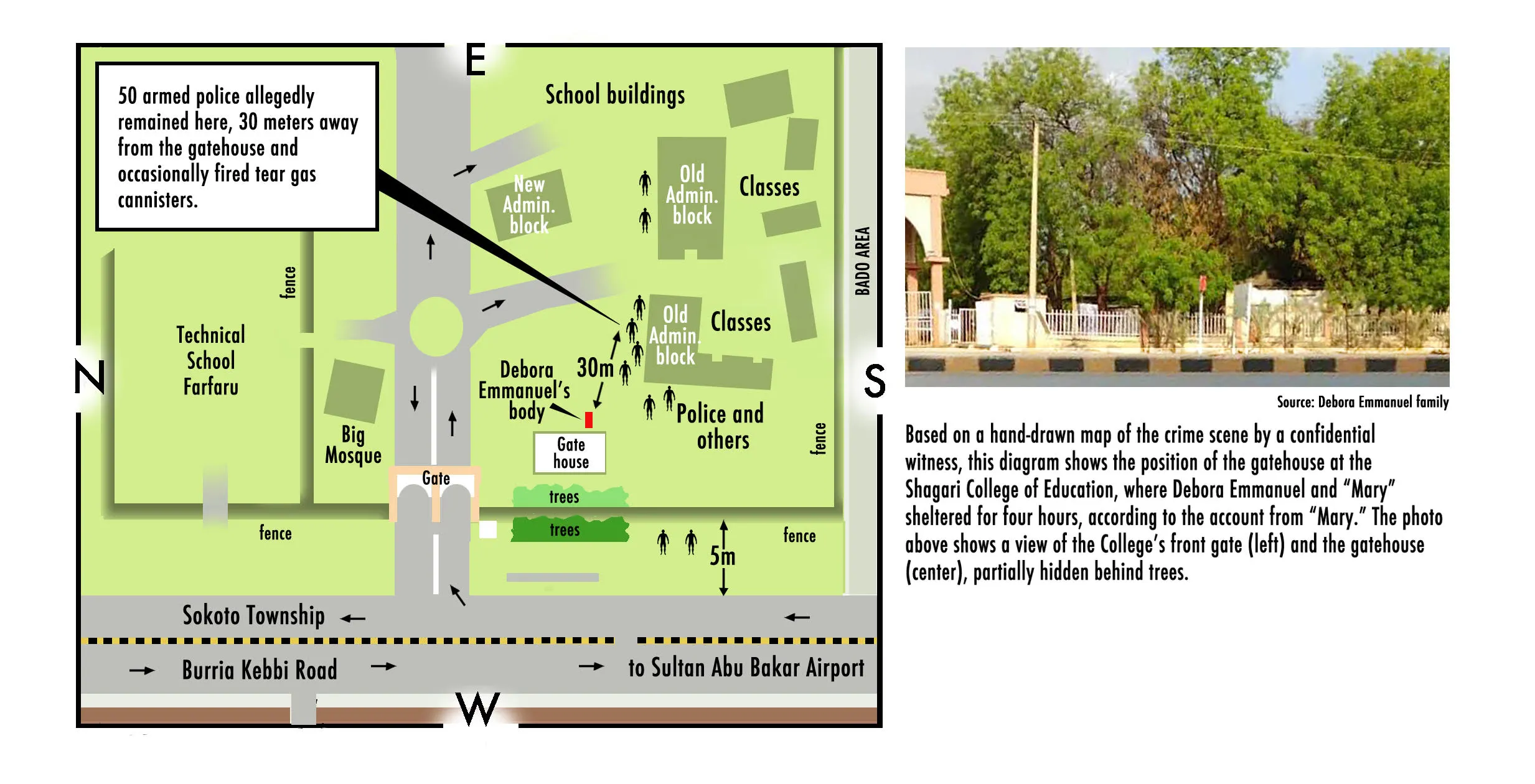
Mary arrived at the campus to see her friend surrounded by a mob and being led by a campus staffer to a gatehouse building for her protection. The Muslim students had bloodied her face and head with blows from rods and were joined by male students who believed their duty was to execute a blasphemer on the spot, Mary said.
“Allahu Akbar!” meaning “God is Great” was bellowed for hours, she said.
Mary initially stayed outside the building and tried to intercede for her friend, but she said it wasn’t long before the mob turned on her, too. Within moments Mary was trying to ward off punches and blows from sticks as she backed away from the gatehouse and toward the gate of the college 40 feet away.
Mary said a college lecturer rescued her and brought her to join Emmanuel inside the gatehouse by 10 a.m.
At 10:25 a.m., the relative said, six officers of the Department of State Security (DSS) — the equivalent to the FBI in the U.S. — arrived, firing their rifles in the air but with no effect. Five minutes later, he said, a group of Sokoto police came on the scene and fired tear gas, temporarily scattering the mob.
The above map is based on eyewitness accounts of the murder of Nigerian Christian student Deborah Emmanuel on her college’s campus on May 12, 2022. Graphic by Alexander Hunter
For about 10 minutes police had an opportunity to disperse the mob and force their way to the gatehouse to extract Mary and Emmanuel, Emmanuel’s relative believes. But that did not happen.
By 11 a.m., the mob had returned to the building, holding cloths against their faces to ward off the tear gas. The mob tried hurling stones at Mary through the windows of the locked gatehouse, but Mary barricaded herself behind a table.
The mob then threw gasoline on the women through the front windows and attempted to burn them alive, Mary said.
“Deborah was soaked with gasoline, but when lighted plastic was pitched in through the windows, I quickly stamped the flames out,” Mary said.
No escape
All of this transpired as police and DSS officers watched from a safe distance, according to Emmanuel’s relative.
The traumatized women said little to each other, but Emmanuel was still hoping to do her examination that day, Mary said. At one point, she recalled, Emmanuel asked, “What time is it? I have an examination at noon.” Mary said she looked at her cell phone and told her it was 1 p.m.
After another excruciating hour of siege, the mob pushed down a single Sokoto policeman guarding the door, broke the padlock on the door, and rushed in to find Mary and Emmanuel hiding behind furniture, Mary and the relative related. Two rioters placed a chain around Mary’s neck and pulled it hard, trying to strangle her, she recounted.
“Let this girl go! She is not an offender,” Mary recalled one of the rioters shouting. But as they released her, a young man in the mob grabbed Emmanuel and took her to the front steps of the gatehouse. There she was bludgeoned with steel pipes and wooden rods and stoned, the relative said.
Two DSS officers attempted to rescue Emmanuel but were hit by stones and pushed aside, the relative said. The police officers remained in position and did not come to her aid, he alleged.
Mary collapsed inside the gatehouse gasping from the strangulation. Approximately 40 minutes later, she said, she was roused by one of the mob to leave the building, which was on fire.
As she walked through the smoke, Mary saw the gatehouse burning and Emmanuel’s lifeless body in flames.
The face of Christian persecution
In the aftermath of Emmanuel’s murder, human rights advocates and others have leveled sharp criticism at Nigeria’s government leaders for not doing enough to stem the rising tide of violence directed at Christians and other non-Muslims.
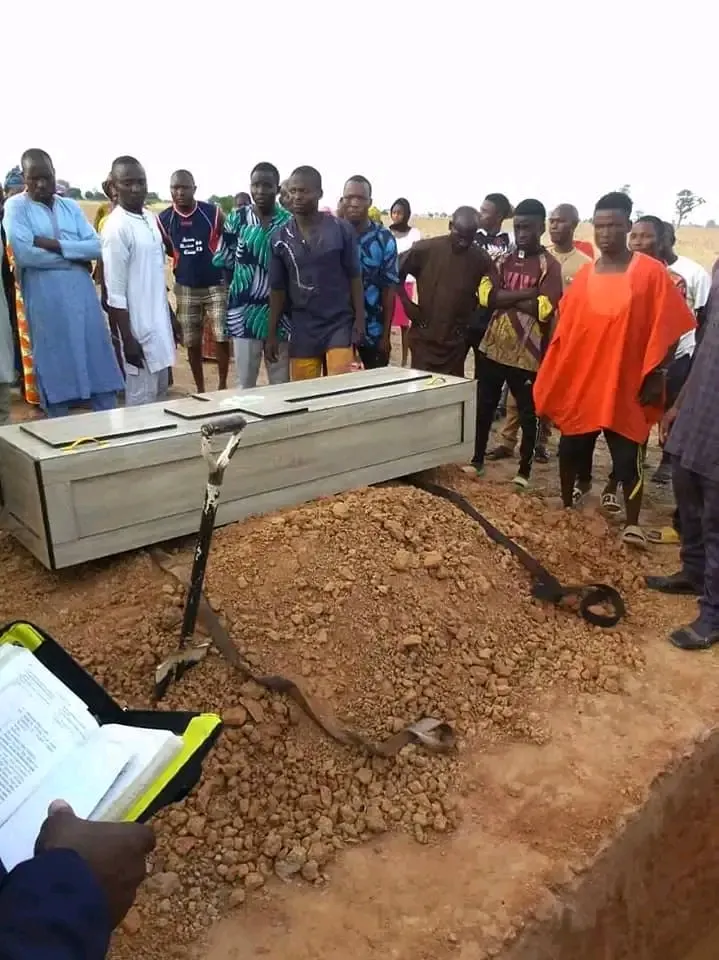
Relatives of Deborah Emmanuel at her burial in Niger State, Nigeria. Courtesy of the Emmanuel family
Anti-Christian hatred was evident in days of rioting in Sokoto following the arrest of two suspects in Emmanuel’s murder. The rioters reportedly were incensed that there were any arrests at all.
“Deborah Emmanuel, like kidnapping victim Leah Sharibu (who was enslaved by Boko Haram insurgents in 2019), has become the face of Christian persecution in Nigeria,” said Kyle Abts, executive director of the International Committee on Nigeria (ICON). “There has not been an official report from the security forces on the lynching of Ms. Emmanuel. Her killing and subsequent riots show clear government complicity and coverup.”
Tina Ramirez, founder of the international nonprofit Hardwired Global, also believes the Nigerian government has been unwilling to take a strong stand against blasphemy killings.
“The recent attacks on students are reminiscent of the attacks at Nigerian colleges two decades ago that were the precursor to the growth of extremist groups across Nigeria’s North and Middle Belt,” Ramirez wrote in a text to CNA.
Abuja, Nigeria, Jul 22, 2022 / 15:45 pm (CNA).
Nigeria’s government has everything it needs to stop the ongoing attacks that are targeting Christians, but has refused to help, a Catholic priest in the We… […]
Washington D.C., Nov 3, 2018 / 07:01 am (CNA).- Despite recent disparaging Western commentary on high African birth rates, fertility rates on the continent are normal when viewed in the context of development, new data analysis from the Institute for Family Studies shows.
The analysis comes weeks after French President Emmanuel Macron commented at a Gates Foundation event in New York that educated women do not choose to have large families. “I always say: ‘Present me the woman who decided, being perfectly educated, to have seven, eight or nine children,’” he said.
While Macron clarified that he was speaking about the lack of educational opportunities in African countries, his comments struck a nerve with women in the United States and throughout the world. One professor at Catholic University of America started the hashtag #PostcardsforMacron on social media, with which educated women from different countries shared photos of their large families.
In a new analysis published this week, Lyman Stone, a research fellow at the Institute for Family Studies, said that the fertility rate of most African countries is normal when other factors such as levels of development and child mortality rates are considered.
“What’s really going on here is quite simple: United Nations demographers have repeatedly messed up their forecasts of African fertility in more-or-less the same direction, and, rather than give a good explanation about why that is, the development community is responding by faulting Africans for having kids,” Stone wrote.
Each time the U.N. has forecasted Africa’s population for 2050, the numbers of their prediction have increased, causing some demographers to publish papers “bemoaning Africa’s curiously slow ‘demographic transition’ to near-replacement fertility,” Stone said.
For example, in 2008, the U.N. predicted that by 2050, the fertility rate in Africa would fall to about 2.5 children per woman, close to near-replacement rates, which range from about 2.1 to 2.3 children per woman.
But in 2017, the U.N. predicted that instead, the fertility rate in Africa by 2050 would be about 3.25 children per woman.
“This upward trend in forecast population stems from the fact that U.N. demographers have repeatedly overestimated how quickly Africa’s fertility would decline.”
But that doesn’t mean that Africa’s fertility rates are not declining overall, Stone noted. “You might think, then, that Africa’s fertility is rising! But actually, it isn’t! African fertility is falling!” he wrote.
Between 1965 and 2015, the fertility rate in Sub-Saharan African countries fell from almost 7 children per woman to slightly less than 5 children per woman. The decline has been slight, and slow, but steady – just not as dramatic as some Western groups had hoped, Stone noted.
“The entire scary story about African fertility really boils down to fractional differences in the rate of future fertility decline. In other words, Macron’s comments about ‘6 or 7 or 8’ kids are totally irrelevant,” he wrote.
“Africa’s ‘problem,’ as far as U.N. demographers are concerned, isn’t women having seven kids today; it’s women having three kids, 40 years from now when they ‘should’ have had just two.”
The complaint that the African population and fertility rates are high is not new, Stone noted – “it’s part and parcel of old-school racist colonialism. Colonial regimes often tried various inhuman measures to reduce population growth. It’s no surprise the successors to colonial regimes, do-gooder ‘family planning’ NGOs, are pushing the same concerns.”
One factor being ignored in the “fear-mongering” of those who say African fertility rates are too high is child mortality rates, which are typically good predictors of fertility rates, Stone said.
Typically, the more developed a country, the lower the child mortality rates and fertility rates are, he said. This is because as countries develop and people live longer, healthier lives, parents can reasonably expect that their children will live well into adulthood, driving down the need for many children in hopes that some will live into adulthood.
Furthermore, as people become more educated, they learn to manage their own fertility better, and have jobs “where brains are often more useful than brawn,” reducing the economic need for having more children.
When rates of child mortality are considered, the fertility rates in most African countries are normal, Stone wrote.
“Adding in control variables for urbanization or dependence on agriculture or natural resources doesn’t change the story: African fertility looks fairly normal for its level of development,” he said, when compared with similar countries in Asia, which have slightly lower fertility rates, and countries in Latin America which have higher fertility rates.
Africa is also a large and varied continent, and fertility rates vary significantly between its countries, Stone noted.
Furthermore, comparing fertility rates among developing countries also must take into account what kinds of family planning policies are being implemented in those countries, Stone said.
While Western groups like the Gates Foundation say that they want family planning policies in African countries to respect women’s freedom, at the same time they want the fertility rates in Africa to decline as dramatically as in countries such as China or India, which have implemented inhumane practices such as the “One Child” policy or forced sterilizations.
“In other words, Western donors need to get their story straight: do they want Africa to experience East-Asian style fertility declines, or do they want African countries to pursue democratically-compatible, rights-respecting population policies? You can’t have it both ways,” Stone noted.
In fact, Stone added, it is unclear why Western groups think they should get a say in African fertility rates at all.
“Western countries should have learned their lesson: it’s time to stop acting like African policy can be made from London or Paris or Seattle. Truth be told, Western organizations have no right, and no moral credibility, to step in and tell African women what they should or shouldn’t do with their bodies. We would be much better off looking for ways to solve our own fertility problems.”



Leave a Reply