


 By
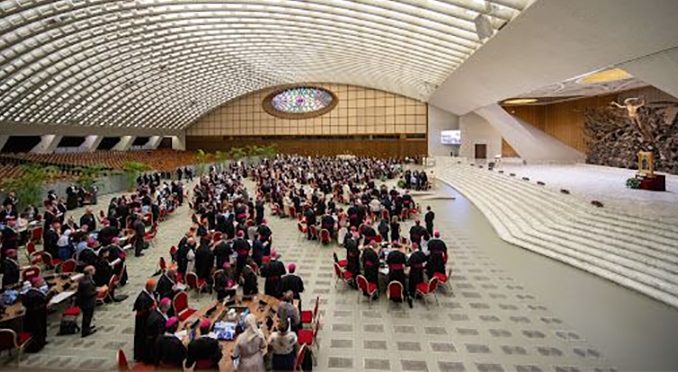
The General Secretariat of the Synod published on Wednesday the final report of the Canonical Commission, which explicitly endorses several proposals to amend the Code of Canon Law related to the participation of laymen and laywomen in the life and governance of the Church.
Specifically, the document supports changes to canons concerning the ability of lay faithful to exercise “offices, roles, and ministries within the Church for which they are qualified and competent, including in the realm of ecclesiastical governance.”
The text, originally drafted in Italian and also available in English, is not binding and must now be examined by Pope Leo XIV. It is one of the reports prepared by the 10 study groups created by Pope Francis in 2024 as part of the Synod on Synodality. These groups are dissolved once their work has been completed and published.
The commission tasked with studying the reforms was coordinated by Archbishop Filippo Iannone, prefect of the Dicastery for Bishops and president of the Pontifical Commission for Latin America, and included prominent experts in canon law.
Its members included Jesuit Cardinal Gianfranco Ghirlanda; Dutch canon lawyer Myriam Wijlens; Monsignor Matteo Visioli, referendary of the Supreme Tribunal of the Apostolic Signatura; Monsignor Giacomo Incitti, professor at the Pontifical Urbaniana University; Hungarian canonist Péter Szabó; Father Alphonse Borras; Professor José San José Prisco, dean of the Faculty of Canon Law at the Pontifical University of Salamanca; Father Benedict Ndubueze Ejeh, dean of the St. Pius X Faculty of Canon Law in Venice, Italy; and Italian Father Gianluca Merlini, secretary of the commission.
A limited but significant reform
The commission considers that a “profound reform of the canonical legal system” is not necessary in order to implement the ideas that emerged from the synodal process.
According to the report, “the Church’s current legal system already provides adequate provisions for greater recognition and designation of lay persons to assume roles and functions of ecclesial co-responsibility together with the pastors.” Nevertheless, it acknowledges that these provisions are “often overlooked” and, in some cases, “require greater normative affirmation to be more practical and effective.”
For this reason, the proposals seek to adapt certain aspects of canon law to the conclusions of the synod, especially regarding the participation of laypeople in the Church’s mission.
The document also insists that the synodal process “does not diminish the decision-making authority of the bishop, the college of bishops, or the pope, but integrates the contribution of the People of God, giving the synodal act a truly communal character.”
Among the canons examined are Canons 204, 208, and 212, which affirm the equal dignity of all the baptized and their right to participate in the life of the Church; Canons 228 and 230, which regulate the possibility of laypeople exercising ecclesiastical offices and ministries; Canon 145, concerning ecclesiastical offices; and Canon 275, which promotes collaboration between clergy and laity.
Papal infallibility under review
Also studied were Canons 476 and 483, related to certain functions of governance and administration in dioceses; Canon 1112, which under specific circumstances allows a layperson to validly assist at the celebration of marriages; Canons 1421 and 1425, concerning lay participation in ecclesiastical tribunals; and Canon 749, which regulates the exercise of the infallible magisterium of the Catholic Church.
Should the proposals advance, it would not be the first time the Vatican has examined reformulating the understanding of papal infallibility. In June 2024, a study by the Dicastery for Promoting Christian Unity, titled “The Bishop of Rome,” collected suggestions for adapting the exercise of Petrine primacy in light of the fruits of decades of ecumenical dialogue.
Greater weight for laity and religious
Among the most significant proposals is the revision of several canons to strengthen the synodal dimension of particular councils, diocesan synods, and pastoral councils.
One of the most notable changes would affect Canon 443, with the goal of making possible “the participation of all members of the People of God … in a proportion equal to that of the ‘ex officio’ members” in particular councils.
The proposal goes beyond expanding the presence of lay faithful and men and women religious. It also calls for removing the Latin word “tantum” (“only”), which currently limits their participation to “a consultative vote” in various ecclesial bodies.
This restriction appears in several canons of the code, including Canons 443 and 444 concerning particular councils; Canon 466 regarding the diocesan synod; and Canons 500, 514, and 536, which regulate the presbyteral council, diocesan pastoral council, and parish pastoral council, respectively.
If approved, these bodies would no longer be structured solely according to a consultative logic but would move toward stronger forms of power in decision-making.
Greater autonomy for bishops’ conferences
The proposals also seek to strengthen the role of bishops’ conferences and promote greater decentralization. Among the suggested changes is a revision of Canon 440, Paragraph 1, to establish a “ten-year frequency” for the celebration of particular councils. The aim is to encourage their regular convocation and restore a more significant role for them in the life of the Church.
Likewise, the commission proposes modifying Canon 1112 to eliminate the need for intervention by the Holy See when a bishops’ conference authorizes laymen and laywomen to assist at marriages under the circumstances foreseen by law.
The reforms also include adjustments to Canon 403, Paragraph 1, to provide a clearer definition of the nature and mission of auxiliary bishops within the pastoral governance of dioceses.
Similarly, a modification to Canon 450, Paragraph 3, is proposed to allow retired bishops to serve on commissions of bishops’ conferences, thereby making use of their pastoral and governance experience after they have stepped down from leading a diocese.
Accountability in episcopal governance
The third section of the report emphasizes that the “widest possible” participation of the baptized requires institutional mediation, especially within the local Church, and describes participatory bodies as “primary places of participation,” where the faithful contribute according to their “canonical condition, charisms, ministries, and competencies.”
Another of the report’s most significant developments is the addition of a new paragraph to Canon 391 inspired by the synod’s final document. The proposal explicitly introduces the principle of “accountability and evaluation” into the exercise of episcopal governance.
If approved, the change would represent a significant step toward greater transparency in the administration of dioceses by strengthening the obligation to explain and justify pastoral and administrative decisions within the processes of Church governance.
This story was first published by ACI Prensa, the Spanish-language sister service of EWTN News. It has been translated and adapted by EWTN News English.
If you value the news and views Catholic World Report provides, please consider donating to support our efforts. Your contribution will help us continue to make CWR available to all readers worldwide for free, without a subscription. Thank you for your generosity!
Click here for more information on donating to CWR. Click here to sign up for our newsletter.

On its face, this sounds like a good move. First, the “hierarchy” has fallen into corruption and has been there my entire life–devout laymen need to be making more of the decisions. Secondly, most parish priests I have met, while good, are simply not good leaders and don’t understand the life of the people in their parish. Third, those priests who ARE good leaders seem to always be reassigned or neutered whenever they really start spreading the Gospel effectively. (This isn’t an accident.)
So, with that in mind, everyone in the Church would be well-served to adopt an attitude of “whoever is the most qualified to do something (including preaching/teaching/decision-making) ought to be the one who does it, even if it involves making the most important decisions, regardless of whether that person is a layman or cleric.
If you, like me, live in America, you understand that most of America’s problems could be solved by a revitalized Catholic Church. And, of course, a revitalized Church would actually help our loved ones get to Heaven in ways beyond just celebrating the Sacraments.
The current “Catholic System” of doing things isn’t working, let’s change it.
It is deeply concerning to see synodal proposals attempt to align Church doctrine with secular social ideologies. The Catholic Church’s teaching on holy orders and the role of women is rooted in 2,000 years of Sacred Scripture, Apostolic Tradition, and the consensus of the Saints, none of which can be re-engineered to fit contemporary culture. True guidance by the Holy Spirit remains faithful to Christ’s established truth, not the spirit of the age. I pray for our shepherds to uphold the deposit of faith with clarity and courage rather than compromising with secular consensus. The more Pope Leo remains quiet and takes no action against heresy, the more I fear for his soul.
Amen.
I reject “the synod.”
I reject the “church professionals” who promote “the synod.”
It’s obvious that the purpose of “the synod” is to sanctify the LGBTQ ideology, to give power to “church professionals” who reject 2000 years of Catholic moral teaching, and to promote their “progressive politics” as the new replacement gospel.
Put “the synod” where it belongs, in the tomb of the former pontiff Jorge Bergoglio.
Autumn. And there’s the scent of reformation in the air. Has the Synod on Synodality resuscitated the Reformation? Or has it reached its logical conclusions in recommendations to Pope Leo XIV? Matters that have been debated, hotly contested causing a rift within the Church.
Now it’s the Pope, elected as our brain trust to decide. But then it’s more than reasoned resolution for an assumed primarily spiritual body.
Vaticanista Andrea Gagliarducci: “has strongly argued that the current direction under Pope Leo XIV risks swallowing up the supernatural mission of the Church into pure bureaucracy and administrative process.
Rather than focusing on fundamental principles, he observes that the Church is increasingly operating as a ‘Church of process,’ where institutional restructuring takes precedence over spiritual clarity” (personal research plus Google AI sources Monday Vatican, The Pillar). Once again Gagliarducci offers an astute interpretation of our Church state of affairs.
We read: [Studied was]…Canon 749, which regulates the exercise of the infallible magisterium of the Catholic Church [AND] The proposals also seek to strengthen the role of bishops’ conferences and promote greater decentralization.”
Four points and a question:
FIRST, about the first quote, this from St. Cardinal John Henry Newman: The effect of the definition is “not to enfeeble the freedom or vigour of human thought in religious speculation, but to resist and control its extravagance [!]” (Apologia Pro Vita Sua).
SECOND, …a clarification which might have a bearing on the second quote regarding bishops’ conferences, more or less apart from the personal and institutional responsibility of each bishop. How does the proposal conform or not with APOSTOLOS SUOS: On the Theological and Juridical Nature of Episcopal Conferences (1998). Especially nn. 22-24 on the requirement for plenary sessions (not delegation to committees), and that unless decisions are unanimous (concurrency among all individual bishops), then decisions with at least a supermajority can then be submitted to the Apostolic See (the universal Church).
THIRD, about “reformulating the understanding of papal infallibility,” how would decentralized reformulation bear on the current understanding of the ordinary and universal Magisterium: (a) matters divinely and formally revealed (not reformable, for example the Christological dogmas), (b) the dogmatic and moral area even if not formally revealed (connected historically or logically, for example the eventual articulation of papal infallibility, the male priesthood and the invalidity of Anglican ordinations, the illicitness of abortion and euthanasia as in EVANGELIUM VITAE), (c) those other matters set forth in the ordinary magisterium and requiring firm and definitive assent based on faith in the Holy Spirit’s assistance to the Church.
This summary is based on the “Commentary” attached to John Paul II, Motu Proprio: AD TUENDAM FIDEM: by which Certain Norms are Inserted into the Code of Canon Law and into the Code of Canons of the Eastern Churches (May 28 and June 29, 1998).
FOURTH, now recalling, here, that John Paul II had already explicitly entered into the ordinary Magisterium, the binding force of the natural law and moral absolutes [!], in VERITATIS SPLENDOR (1993): “This is the first time, in fact, that the Magisterium of the Church [!] has set forth in detail the fundamental elements of this [‘moral’] teaching, and presented the principles for the pastoral discernment necessary in practical and cultural situations which are complex and even crucial” (n. 115). And, “The Church is no way the author or the arbiter of this [‘moral’] norm” (n. 95).
Echoing the Second Vatican Council (superior to any self-validating synod): “Contemplating this melancholy state of humanity, the council wishes, above all things else, to recall the permanent binding force of universal natural law and its all-embracing principles. Man’s conscience itself gives ever more emphatic voice to these principles (GAUDIUM ET SPES, n. 79)
QUESTION: specifically, how do the proposed and precise refinements to Canon Law handle the above positions and now differ from the outlier der Synodal Weg?
NO!
Ah, the latest addition of the ideological project being continued full steam by Leo, though the article tends to downplay the problematic nature of it, arguably even misrepresenting the report. For example, the article states there is not a proposal/necessity to profoundly reform canon law. Yet the first paragraph of the document states, “there is an obvious need for a complete revision of the two Codes [of canon law] to reflect the theological and ecclesiological issues that have emerged.” And the Codes are the primary source of law, which means a complete revision of the canonical system, not just certain aspects. There is also a glossing over the significance of some of the proposals, i.e., that of changing definitions of infallibility and papal primacy! And let’s not start up with the usual conservative reply- “this is not a binding document, don’t worry; or Leo will step in and do something.” How many times have people repeated these silly tropes, with no change, but only an embrace of things by Leo and co. Remember the report from study group #9? Leo is Francis 2.0, and on steroids, given the more rapid speed at which he is proceeding. But, remember, the sspx and things traditional are the problem. Keep your criticism fixed on them people, not the nonsense coming out of Rome.
I can see it now. A group of feminists with ecclesial power declaring every Catholic in the pro-life movement excommunicated.
“Synod proposes reforming canon law to give greater weight to laity, women in the Church”
The Synoidal Church is a Protestant church. It will end up like the anglicans, congregationalists, methodists, lutherans, assemblies of god,
While ultramontism is unwelcome, so are these K-Mart churches.
Nothing to worry about. We are told by numerous catholic podcasters and bishops that there is no crisis in the church except for those evil SSPX supporters.