

 By
By The Aug. 2 event honoring Charles Carroll is hosted by the Faithful Citizenship Institute, which brings policymakers together to infuse Catholic social teaching into their work.
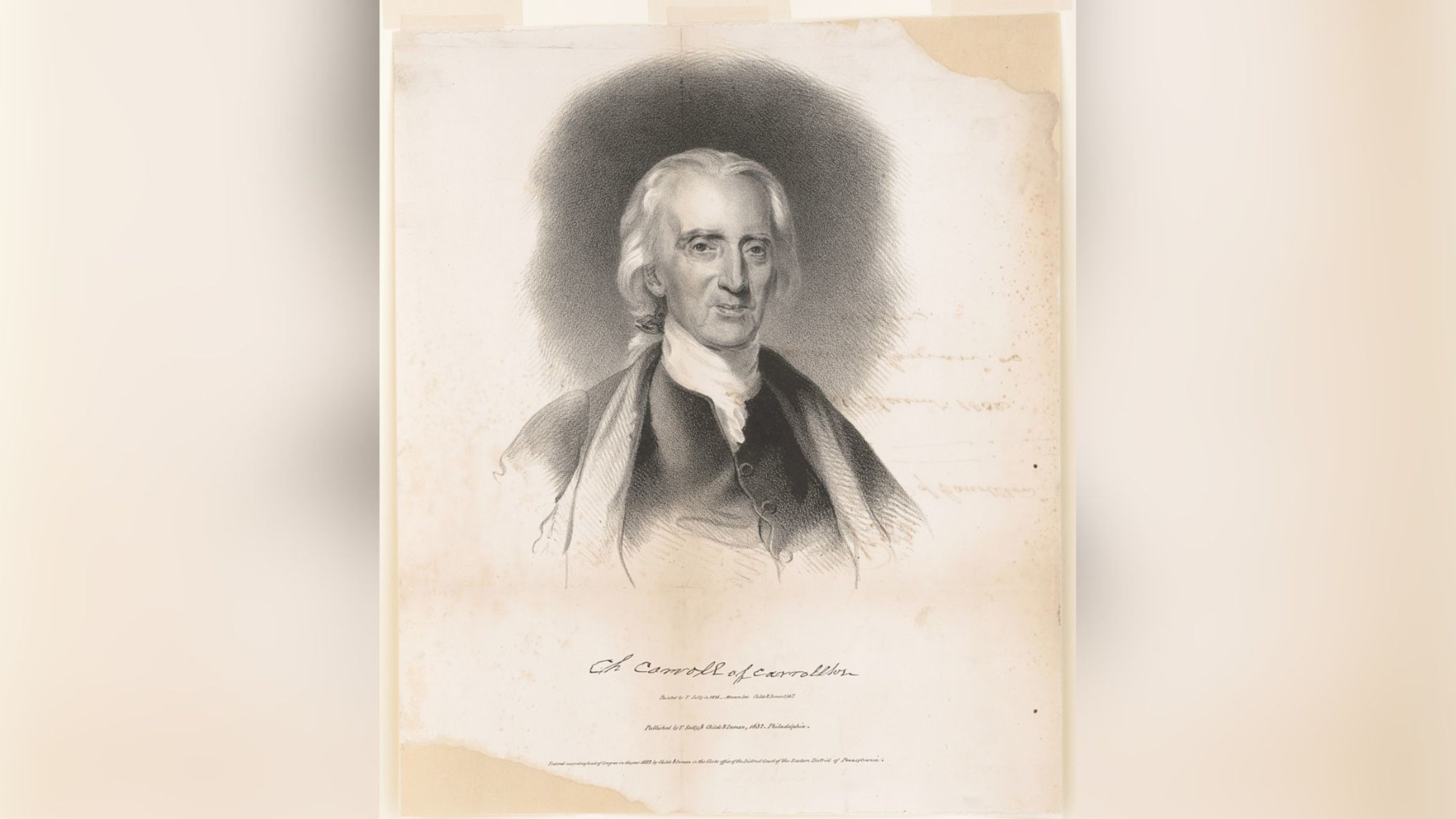
The Faithful Citizenship Institute (FCI) will host its inaugural gala honoring Charles Carroll of Maryland, the only Catholic Founding Father, whose faith endured during a time Catholics faced prejudice and marginalization.
FCI, which brings policymakers together to infuse Catholic social teaching (CST) into their work, said it plans to make the event an annual gathering dedicated to preserving and advancing Carroll’s legacy.
The Charles Carroll Legacy Gala will be at Charles Carroll House in Annapolis, Maryland, on Aug. 2, the anniversary of Carroll signing the Declaration of Independence in 1776.
Proceeds from the evening will support scholarships and the expansion of the FCIʼs CST Certification Course, which is working to equip policy workers to bring faith, reason, and the common good into civic leadership.
Carroll was “quite persecuted as a Catholic, but he chose to put his name on a piece of paper that was very dangerous to his career, his family, his life,” Jennifer Daniels, founder and president of FCI, told EWTN News.
He “chose to say, ‘I want to, and I will, sign this document.’ Now today weʼre trying to uphold that legacy in the same manner, saying, ‘If youʼre Catholic, you want to live your Catholic faith publicly,’” she said.
The event will include Mass and a reception on the grounds of Carroll’s birthplace. Upon his passing, the property was sold to the Redemptorist order, which also built St. Maryʼs Church on the property.
The event will feature tours of the grounds, and attendees will hear from Bradley Birzer, Hillsdale College history professor and author of “American Cicero: The Life of Charles Carroll.”
In the 250th year of the United States, the event will highlight Catholics in America and how “the Church approaches issues, which is not ideological and nonpartisan, very different from the way that the average policymaker in Washington does,” Daniels said.
“While the parties may argue about this and that, the first and foremost prime principle is human dignity,” she said. “If we just get Catholics … talking about human dignity as the prime principle, that translates into all kinds of policy areas.”
“If weʼre leading with human dignity and our result is the common good, weʼre certainly setting ourselves up for some better policy solutions,” Daniels said.
The Faithful Citizenship Institute
FCI, a nonprofit based in Washington, D.C., grew from the United States Conference of Catholic Bishops’ (USCCB) teaching document “Forming Consciences for Faithful Citizenship: A Call to Political Responsibility,” calling for the faithful to understand political responsibilities as Catholics.
After working in politics and policy for more than 20 years, Daniels started FCI in 2024.
“Our mission is to bring the beauty and wisdom of Catholic social teaching to policymakers and really help them to kind of infuse these foundational principles, so that they can lead with their faith in their policymaking,” Daniels said.
The institute started by “doing some briefings on Capitol Hill,” she said. “Weʼd bring in some great Catholic leaders from various Catholic national organizations that work in Washington, D.C.,” Daniels said.
“The more we started talking to people, the more we started learning that people wanted a deeper dive. They wanted a more comprehensive understanding, not just of the current political event or the current hot-button issue, but a better foundation for all the principles,” she said.
This led the institute to create its CST Certification Course — a graduate-level course designed for Catholic public policy professionals.
“We launched the course last year in the fall of 2025. We had 15 participants from basically all three branches of government, advocacy, think tanks,” Daniels said.
Over the seven-month course, “we walked through the four principles of Catholic social teaching, as well as a history of Catholic social teaching,” she said. The group worked to answer: “What is Catholic social teaching meant for within the context of civic engagement and public policy?”
The course grew into a partnership with The Catholic University of America (CUA). By completing the certification course, students become eligible for up to three credit hours toward a Master of Public Policy at CUA.
Almost all the professors are from CUA, who “do the theological and the academic course instruction, but we added something different … which is the public policy application,” Daniels said.
“With that, we brought in leaders — policy practitioners that work for groups like USCCB, Catholic Charities, Catholic Relief Services, Catholic Health Association, Catholic Climate Covenant,” that discussed “in that nonideological, nonpartisan way, that we want to help to elevate the conversation,” she said.
The institute is going through its 2026-2027 applications and has double the number of applicants since the first year. Applicants include people from the executive branch, Capitol Hill staffers, advocacy workers, and people who work for Church organizations.
With the growing interest in the course, FCI is adding new aspects. For this yearʼs course, which will begin in September, “we are going to put a focus on Pope Leoʼs document Magnifica Humanitas,” Daniels said.
“Pope Leo went through so much of Catholic social teaching in the document. It wasnʼt just about AI. It was really a very comprehensive document about all kinds of elements of Catholic social teaching,” she said.
“Then weʼll end the course with a retreat on Magnificat Humanitas and Catholic principles regarding AI policy. That will be our last event at the end of the course,” she said.
If you value the news and views Catholic World Report provides, please consider donating to support our efforts. Your contribution will help us continue to make CWR available to all readers worldwide for free, without a subscription. Thank you for your generosity!
Click here for more information on donating to CWR. Click here to sign up for our newsletter.

Leave a Reply