

 By
By University of Notre Dame theology professor Joseph Capizzi will deliver the keynote address at the Nov. 9–11 event with the theme “Living and Serving Justly.”

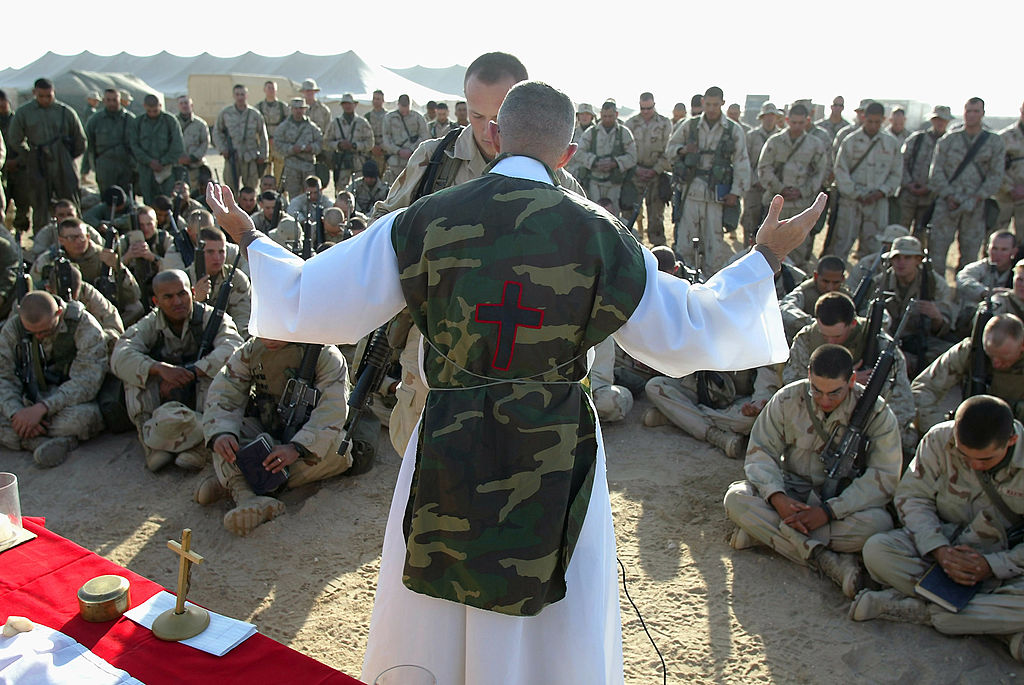
The Archdiocese for the Military Services, USA, will launch its first conference for Catholic service members to explore how the ongoing conflict with Iran fits within the Church’s teachings on just war theory.
University of Notre Dame theology professor Joseph Capizzi will deliver the keynote address at the Nov. 9–11 event under the theme “Living and Serving Justly,” according to a July 28 archdiocese press release. The conference will be held at the Westfields Marriott in Chantilly, Virginia.
The U.S.-Iran conflict has entered its fifth month, and Catholic theologians have expressed concern over the impact of U.S. military force on civilian infrastructure in Iran.
“The position of the Church,” Capizzi said in the release, “is that the use of force, including lethal force, is bound by the moral law, and even when countries resort to the use of force in conflict, it’s not anything goes. In fact, both sides remain bound to the requirements of moral international law regarding the treatment of civilian populations, the treatment of prisoners of war and wounded soldiers, among others, and this has been spelled out for a long time in Western tradition.”
Capizzi is the McGrath-Cavadini director of the McGrath Institute for Church Life at Notre Dame and is the author of “Politics, Justice, and War: Christian Governance and the Ethics of Warfare.” His remarks will include reflections on the teachings of St. Augustine and St. Thomas Aquinas and how they apply to modern warfare.
“Even when it’s resorted to, the use of force must be discriminatory or ‘distinct’ — the principle of distinction is what it’s called in international law, which means it has to distinguish between legitimate targets and illegitimate targets,” he said. “Civilian populations, civilian structures like schools, hospitals, desalinization plants and so on — they are not legitimately targeted. You must abide by this principle of distinction, and any uses of force must be proportional to the ends sought.”
Other speakers at the three-day event include Catholic radio host Katie McGrady, who will serve as emcee. The conference will feature additional keynote addresses and breakout sessions geared toward fostering “synodal” connections within the archdiocese, according to the release.
If you value the news and views Catholic World Report provides, please consider donating to support our efforts. Your contribution will help us continue to make CWR available to all readers worldwide for free, without a subscription. Thank you for your generosity!
Click here for more information on donating to CWR. Click here to sign up for our newsletter.

Yes to moral restraint in targeting against civilians, but the conference also appeals to the “Western tradition” (not Islamic) of international law…
Three points and a question:
FIRST, the nation-state as a dominant political idiom is largely an artifact of the Council of Augsburg (A.D. 1555), the Treaty of Westphalia (A.D. 1648) and Versailles following World War I (national self-determination).
SECOND, about World War I, the only two Ottoman domains not to come under Western protectorates or colonial rule were Saudi Arabia and Turkey. Today the former is still a kingdom and not a nation-state. And while the latter has a secular constitution (under the Ataturk revolution of the 1920s) Hagia Sophia (originally a 6th century cathedral) is no longer a 20th-century secular museum, but now under President Recep Tayyip Erdogan is a 21st-century mosque once again (as when confiscated in the Muslim conquest of Constantinople in A.D. 1453).
THIRD, in dialogue with 7th-century Islam today, what does the perennial Catholic Church have to say about the historical event (!) of the Incarnation and the Christian tradition—as distinguished from the Western political experience?
Apart from St. Augustine’s “just war” theory/doctrine, and with the Second Vatican Council: how to “read the signs of the times” between international law of sovereign nation-states and the Muslim der al Harb/der al Islam, the insular Qur’an and the universal Natural Law/Logos, and even Islam’s pre-modern and transnational/sectarian umma as contrasted with the sacramental and Eucharistic Church as the Mystical Body of Christ?
QUESTION: beyond just war principles and any ethnocentrism, what is the common grammar, if any, for this larger and deeper dialogue?
The “common grammar” might begin with BOTH the infinite transcendence of God and, with Revelation and Catholic Social Thought, the “transcendent dignity of each human person.” In the first instance the living God as a “fact” (rather than as an Enlightenment idea); and in the second instance man as having “freedom for the truth,” and as more than deterministic).
FIRST, in the religious skepticism of his own day (and ours!), the monk Jean-Pierre de Caussade (1675-1751) wondered at Islam: “Why (he asked) does God allow Turks and heretics to flourish?” And he answers himself, “They proclaim [!] his infinite perfection” (in John Beevers, “Abandonment to Divine Providence,” 1975).
SECOND, “Christ the Lord…by the revelation of the [Triune] mystery of the Father and His love, fully reveals man to himself [!] and makes his supreme calling clear” (Gaudium et Spes, n. 22).
AFTERTHOUGHT, living among the Touaregs in North Africa, Charles de Foucauld (1858-1916), wrote: “Neither does our role as Little Brothers include working for their adaptation to the Western materialistic, technological form of civilization, which, moreover, comes far from representing the only conceivable idea of a really human civilization [!]” (In Rene Voillaume, “Seeds of the Desert,” 1964).