

 By
By According to Pewʼs research, 65% of Catholics reported they have a positive view of religion, 12% have a negative view, and 22% have a neutral or unclear view.

A Pew Research Center survey found a growing minority of U.S. adults believe religion is gaining influence in American life, and more than half of adults have a positive view of religion.
The May 14 report found that 61% of U.S. adults said religion is losing influence in American life. In contrast, 37% said it is gaining influence, a figure that has risen 19 percentage points in the past two years.
The data in the report, “How Americans Feel About Religion’s Influence in Government and Public Life,” was based on Pew’s survey conducted April 6–12 that included more than 3,500 U.S. adults with questions about religion’s influence in society, Christian nationalism, and the relationship of church and state.
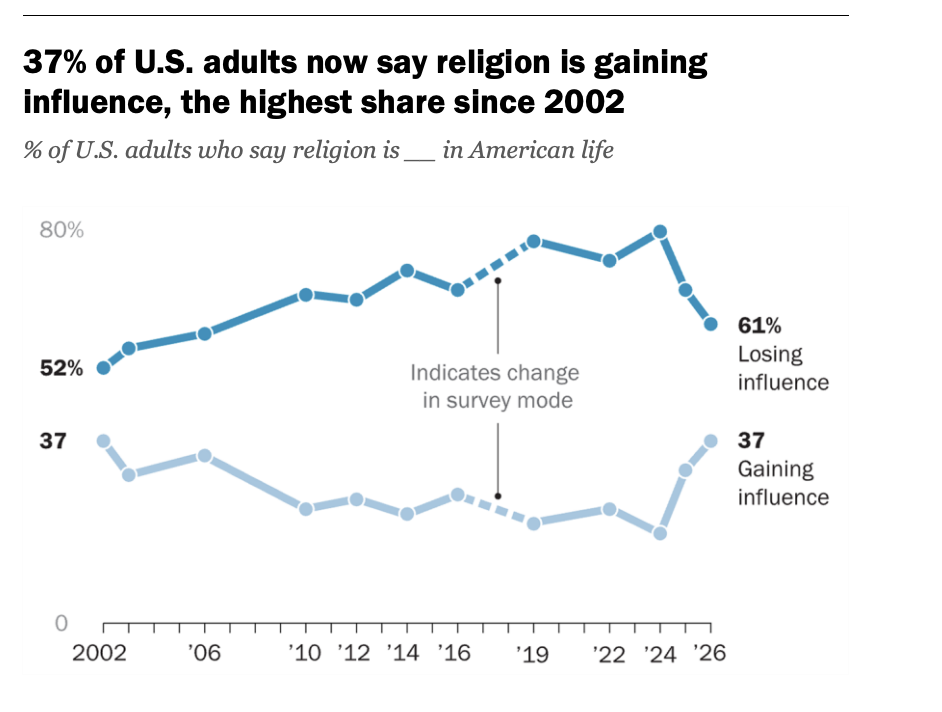
The survey has an overall margin of error of plus or minus 1.9 percentage points. Pew’s studies on the public’s views about religion’s role in public life are an ongoing effort of the center’s research and therefore included past data for comparison with the 2026 findings.
The research found that 65% of Catholics reported they have a positive view of religion, 12% said they have a negative view, and 22% they have a neutral or unclear view.
Overall, 55% of U.S. adults expressed a positive view of religion’s role in American life and either said religion’s influence is growing and this is a good thing (21%) or that its influence is declining and this is a bad thing (34%).
Christian influence in government
The survey found a small increase in the percentage of Americans who said they want the government to declare Christianity the nation’s official religion. Overall, 17% of U.S. adults express this view, up from 13% in 2024.
Most Americans said the government should promote Christian moral values without making Christianity the official religion (43%) or that the government should not establish an official religion or promote Christian values (38%).
Of adults, 28% said the Bible should have influence on U.S. law. The majority of Catholics surveyed (55%) also reported it should have influence, compared with the 43% who said it should not.
The survey also found that the public’s familiarity with the term “Christian nationalism” has grown since Pew last asked about the topic. There has been a 14 percentage point increase in the share of U.S. adults who reported they have heard or read about Christian nationalism, from 45% about two years ago to 59% in 2026.
Overall there is more of a negative view of Christian nationalism than positive with 31% of U.S. adults who reported they have an unfavorable view of it and 10% who view it favorably.
The survey also asked about the separation of church and state and found there has been a decline from 19% in 2021 to 13% in 2026 in the share of Americans who want the government to stop enforcing separation of church and state, but the percentage of Americans who said the government should enforce it has remained at 54%.
Nearly half of Catholics (49%) reported that the federal government should enforce separation of church and state, and 16% said it should stop enforcing it.
Most people (79%) reported they do not think churches and other houses of worship should endorse candidates during elections. Similarly, 66% also said churches should keep out of political matters.
Political affiliationʼs influence on views of religion in government
The survey found a large difference in respondents’ perspectives based on their political affiliation.
Of Republicans and independents who lean toward the Republican Party, 75% expressed a positive view of religion’s influence in American life compared with 38% of Democrats and Democratic leaners who do so (38%).
Similarly, 45% of Republicans and Republican leaners said the Bible should have influence on U.S. laws, whereas 13% of Democrats and Democratic leaners said the same. Most Republicans (74%) and Democrats (84%) agree that churches should not endorse political candidates.
Most Democrats (68%) said the federal government should enforce the separation of church and state, compared with 42% of Republicans.
If you value the news and views Catholic World Report provides, please consider donating to support our efforts. Your contribution will help us continue to make CWR available to all readers worldwide for free, without a subscription. Thank you for your generosity!
Click here for more information on donating to CWR. Click here to sign up for our newsletter.

Leave a Reply