

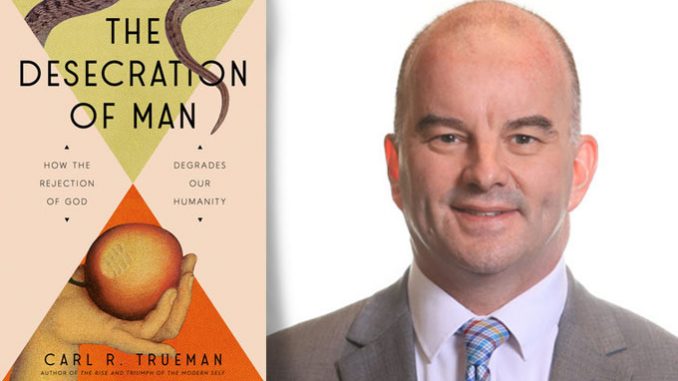
Carl R. Trueman is a professor of biblical and religious studies at Grove City College and a fellow at the Ethics and Public Policy Center, as well as a prolific author.
Last year, we conversed about his book To Change All Worlds: Critical Theory From Marx to Marcuse.
In his new book, The Desecration of Man: How the Rejection of God Degrades Our Humanity (Penguin Random House), he continues his intellectual excavation of culture, looking at the deep vein of desecration and destruction found throughout modernity.
We corresponded recently, discussing disenchantment, desecration, anthropology, nihilism, and the crisis of faith.
CWR: Let’s begin with the title and the word “desecration”. Why that word in particular? How is it central to the thesis of this book?
Carl R. Trueman: I know that the concept of disenchantment is proving somewhat popular, and it certainly captures important elements of modernity: that feeling that we are all cogs in a machine, that the world and everything in it lacks transcendent significance, that malaise and even at times despair that characterizes our day.
But I am not convinced that it is fully adequate because it does not explain another aspect of modernity: the exultant delight taken in the destruction of all that previous generations considered sacred.
Take abortion, for example. It is no longer treated by its advocates as an unfortunate necessity but hailed as a basic human right and presented as something to celebrate. That is not the result of disenchantment. Rather, as I argue in the book, it is the result of an impulse to desecrate, to revel in the profaning of the holy.
CWR: You note, in your introduction, that “the question of man [is] also a question of God,” a key connection that long existed and has been emphasized, in various ways, by Solzhenitsyn, John Paul II, and others. How do you summarize the prevailing modern notion of man? And what does it indicate about the West today?
Trueman: In the West, we like to think of man as autonomous and unencumbered, and therefore place self-creation right at the heart of our anthropology. Of course, that requires atheism, whether of the self-conscious, philosophical kind articulated by many intellectuals or of the more intuitive, practical kind of those who may profess belief in a god but who do not allow that to have a formative impact on how they live their lives.
Whichever it is, the result is a notion of human beings for whom given limits and ends are problems that pose a danger to our authenticity and are therefore to be overcome. As those limits and ends are, from a Christian perspective, grounded in the idea that we are made in the image of God, this all presses us towards acts of desecration.
CWR: In previous books, you have described, in careful detail, the origins and roots of the deep crisis in anthropology. Can you summarize that crisis, with particular focus on the theological issues involved?
Trueman: My argument, drawing on Charles Taylor’s work, is that modern man thinks of himself as an expressive individual. He identifies himself by his inner feelings and desires. In this, he is different to man in pre-modern societies, where obligations to the community and thus an attitude of personal restraint would have characterized the ideal person.
By contrast, the expressive individual sees his ability to act publicly on his desires as central to what makes him truly human or, to use a different phrase, to what makes him authentic. In other words, he privileges his inner, psychological space. That has very practical results, not least in the way it encourages us to treat other people–other persons made in God’s image—as things of significance only as instruments for enhancing our own feelings of happiness and well-being.
It also has theological implications. It encourages us to see transgression of inherited norms as the key to authenticity, for to conform to such is to be part of the herd and to lose one’s individuality. To use stronger language, it encourages us to acts of desecration because it is only in such acts that we truly feel we have created ourselves.
CWR: Drawing on Nietzsche’s famous parable in The Gay Science, you argue “that the hour of the Madman, the time when those implications become clear, is upon us.” What are some of the characteristics of that hour? And what is some evidence of it today?
Trueman: That’s a reference to the end of the parable when, greeted by incomprehension, the Madman is reduced momentarily to silence. His call for his audience to rise up and become gods themselves, creating their own meaning and their own values, has fallen on deaf ears. He then declares that he has come too soon.
The reasons why he thinks this are not specified, but we can imagine what they might be. Transgressing limits is not simply an act of will. It requires an appropriate context. Take sex, for example. It is hard to transgress the Christian ideals of chastity and monogamy in a time before antibiotics and abortion. Sleep around, and you might catch a nasty, incurable disease, or get a girl pregnant, or become pregnant yourself.
Today, technology has encouraged us to think that all limits—even those that arise from our existence as embodied beings—can be overcome if we have enough willpower and apply enough technological expertise. The time for self-creation—shattering any limits and choosing our own ends—even our own gender—has arrived. In other words, this is the hour of the Madman.
CWR: I think it’s fair to say that we—people in the modern Western world—have hardly begun to truly comprehend how technology, over the past 50 to 100 years, has radically changed how we perceive, think, believe, and live. Why and how is this especially the case with sex, reproduction, and marriage? Why, for example, in a world in which man has become meaningless and void of purpose, is there such a manic obsession with sex, especially in its transgressive forms?
Trueman: Two sociological observations and then a theological truth help explain this.
First, the normative modern understanding of the self is one of expressive individualism, where the outward expression of inward feelings is what makes us authentic.
Second, sexual desire is a hardy perennial of human existence. It is why the great historic religions of the world devote so much attention to its proper expression and why we can still understand the plot of something like the Iliad.
Third, the theological point: sex is the act that makes us most godlike, for it leads to the mysterious creation of new human life. If we want to feel like gods by overthrowing the God in whose image we are created, then there is no more powerful way to do this than by seizing control of sex and bending it to our wills and desires. Transgressing the idea of sex as having given limits and given ends is to desecrate the Christian idea of what it means to be human.
CWR: What do prevalent modern understandings and approaches to mortality and death tell us about the current state of things? Is this not an important opportunity for Christians, who proclaim that Christ came to conquer sin and death?
Trueman: Death is the final enemy for the expressive individual. The moment of death is the moment when the last great and unavoidable external authority—the human body—has the last, decisive word. In the modern West, I can self-identify as anything I wish in defiance of my bodily constitution, but I cannot self-identify as immortal because, sooner or later, my body will contradict that.
So what have we moderns done? We have shunted death to the margins—to the hospitals and hospices, to graveyards unconnected to places of worship, to crematoria where all evidence of the dead can be annihilated. Or we have domesticated it as entertainment, as in Hollywood and video games, and in the substitution of “celebrations of life” for funerals suffused with a sense of tragic loss. Or we have tried to defy it, as in transhumanism. Or we have seized control of it, as in the rising appetite for medically assisted suicide.
What all of these make clear is that we know death is coming for us all, and we are terrified of it. That is where the biblical understanding of death as a tragic privation of being and the gospel of Christ’s resurrection can find an audience—because it refuses to sugar-coat its brutality while yet denying it the final word.
CWR: Your final chapter, titled “Nihilism Repackaged or Christianity Redivivus?,” examines three responses to the growing culture of desecration. What are they, and why are the first two limited and lacking?
Trueman: The first is that offered by Richard Dawkins, Steven Pinker, and what Charles Taylor calls exclusive humanists. These are those who think that human nature exists and has a given moral structure, and that reason, typically defined along Enlightenment lines, is sufficient for building a moral vision. That has come under severe challenge in recent years, and so we have witnessed Dawkins, among others, appealing to “cultural Christianity”—not to the dogmatic faith but rather to the social values once built upon that faith. But you cannot take the morality or rationality built on Christianity and argue for its ongoing stability once that faith has been abandoned. Nietzsche saw this: if God does not exist, then we are not made in his image, and anything built upon God is therefore ripe to be rejected.
The second is more sophisticated and is represented by a figure like the late English philosopher, Sir Roger Scruton (of whose work in general I am an admirer). He made much of the importance of a sense of God and the sacred for culture and humanity, but he was always, in the end, a Kantian: God was a necessary assumption; but the Christian notion that one can know God and commune with him was something he would not countenance, at least in an orthodox manner.
Yet the problem is that, as St. Paul says, if Christ is not raised, Christians are of all people to be most pitied. One cannot separate the aesthetics and the moral structure of the universe from the dogmatic truth claims of Christianity. To do so renders the former unstable and vulnerable to Nietzschean accusations of nihilism (living as if Christianity is true even after its foundations have been discredited) and of asserting one’s personal tastes as transcendent truths.
The third is the way of consecration. This is another reason why desecration is preferable to disenchantment: it points directly to a clear and substantial cure for modernity’s ills. We are consecrated by the truth (God’s truth in the gospel of Christ), by cult (worship that reenacts that truth liturgically and shapes our doxological response, dramatically reminding us of who we are as those made in his image and redeemed by his Son), and by code (the way we live our lives).
In this latter in particular, I focus on hospitality, which enables us to practically deny that which modernity demands of us: in offering hospitality to others, we treat them as persons, made in the image of God, and not as things instrumental to our own pleasure or sense of self-worth.
CWR: You argue that “we can be Nietzscheans or we can be Christians. There is no stable third option.” It reminds me of Walker Percy’s response (in a self-interview), when asked why he became Catholic: “What else is there?” While your book is not a work of apologetics, how can it help Christians to better grapple with the desecration of man and to share the Faith?
Trueman: I hope it will enable Christians to understand the spiritual depth of the problem we face and the theological/religious significance of the anthropology of our modern world. But I also hope it will point readers to the answer.
Not everyone can debate philosophy or parse the many facets of the problems of modernity. But everyone can point to the means of consecration—the gospel as proclaimed and embodied by the church—and all of us can be hospitable and treat others with kindness and as human beings made in God’s image. That is powerful, and when we remember that the power of the gospel rests in God’s gracious actions and not our own abilities, and that the church is a supernatural, corporate body where we can each play our own part and know that God will work through us, then that takes a burden off our individual shoulders and surely gives us confidence.
CWR: Any final thoughts?
Trueman: These are strange times, but times of opportunity, with many once-avowedly secular intellectuals and others expressing an unexpected interest in the faith. They have come to see the anthropological bankruptcy of the West and are looking for the truth. This movement may not prove to be long-lasting, but, if so, may that not be because we Christians did not seize the moment to make the case for our faith.
If you value the news and views Catholic World Report provides, please consider donating to support our efforts. Your contribution will help us continue to make CWR available to all readers worldwide for free, without a subscription. Thank you for your generosity!
Click here for more information on donating to CWR. Click here to sign up for our newsletter.

Trueman: “Take abortion, for example. It is no longer treated by its advocates as an unfortunate necessity but hailed as a basic human right and presented as something to celebrate. That is not the result of disenchantment. Rather, as I argue in the book, it is the result of an impulse to desecrate, to revel in the profaning of the holy.”
And that is why, even after Dobbs, abortions in our country alone are still over one million a year. If it was an unfortunate necessity we might do things which would no longer make it a necessity. However, if it is something to celebrate and to revel in the profaning of the holy, it will be much harder to eliminate or reduce.
Upon further reflection on this I believe that those of us who are in any way a part of the pro-life movement need to reconsider the approach that we take in addressing abortion. Using words, signs and pictures to show what is really happening in an abortion may have no effect, as what is happening is understood. But they celebrate it as a basic right and revel in the profaning of the holy. Somehow, we need to find ways to address that. I think that it would have to be a moral, religious and an evangelizing approach.
Agreed. Our society needs to act as if children are holy, even after birth. Then our words about their sacredness before birth with have more credibility with the larger culture
Trueman says: “If we want to feel like gods by overthrowing the God in whose image we are created, then there is no more powerful way to do this than by seizing control of sex and bending it to our wills and desires. Transgressing the idea of sex as having given limits and given ends is to desecrate the Christian idea of what it means to be human.”
For mordernists, it simply is not sufficient to live an authentically human life. For them, humanity is meaningless. The only thing that matters is to denigrate, dismiss and destroy God Himself. This must happen so that each man can BE GOD. Total control over sex and all its outcomes must be achieved because it is the sine qua non of “creating” which has always been the rightful role of only God. But with in vitro fertilization and cloning, man no longer even needs sex to create. Man has arrived at deification by his own doing…Man as Creator…Man as God…Man as Supreme Being…Man as Omniscient…Man as Omnipotent…in other words Prideful Man which is where this all began – the Garden of Eden.
Trueman needs to write a Protestant engagement with John Paul II. And maybe Francis Schaeffer. It would be fascinating.
It was the graven Golden image of himself. Desecration has occurred within Catholicism when we sold out our adoration of the Lord for religious gain, political success, by our deification of a self proclaimed messianic politician.
You have an undisciplined imagination, Father. You conjure up bogeymen where none exist.
His inflated ego [like Gavin Newsom he has busts of himself that he can admire, the proposed gold statue for his library is a prime example], insults doesn’t give a good impression for a nation to follow. Although, I support the good he’s done, the purpose of the war with Iran.
What danger he poses is idol worship by many who excuse every wrong he does. He was wrongly persecuted before the election, now he’s relentless in bringing all his perceived enemies to justice. If his subordinates don’t remain yes men they get fired. It’s his character that’s an issue, the many Catholics who seem blind to his excesses.
Father Morello: ” now he’s relentless in bringing all his perceived enemies to justice.”
Who are the people he has brought to justice? If in fact there are those who committed crimes while attacking him, shouldn’t they be brought to justice? You say that he was wrongly persecuted.
I do not believe in excusing everything he has done. But what democrat did not excuse everything that Biden did? I don’t recall an equal amount of hand wringing over that.
The problem with his highness, who often sounds more like a drunk on a barstool who explains the world in superlatives and believes he expands his point with nothing more imaginative than repeating the same point with a slightly different superlative.
Those of us who welcome his proper disparagements of liberal vanities attempting to eradicate evil in the human condition with increased levels of social management have been similarly appalled by a “conservative” who effectively believes in managing evil out of existence once the right managers are allowed to be in charge. All ideologues are the same in their core assumptions about humanity as its own savior.
His Highness, the Golden One, just pulled off a great win, if it holds, in negotiating a deal with Iran, Iran agreeing to open the Strait of Hormuz during a two week cease fire interim to [hopefully] complete arrangements.
Never said he wasn’t a great negotiator.
Trump’s grandiosity is tolerable, if weighed against his accomplishments.
Dear ‘DR’: maybe Fr Dr Peter Morello is right in that the single-minded worship & adoration rightly due to King Jesus Christ our LORD has been set aside in the pursuit of so many other things. Not just in the US but globally.
Just one example (from a legion of horrors).
St Bridget’s Church in Redhill, Brisbane, Queensland, Australia is quite well known, especially as the locale for our world-famous ‘Brisbane Broncos’ football team!
For decades it’s priest was Fr John Clark, who died some years ago. Now, it’s gradually emerged that he owed far more allegiance to the Freemason Lodge than to The Church, having studied for their most extreme, profane degrees, and being fondly known as a leading Brisbane mason, coded ‘Doctor Jack’. He entangled Mrs Rawlings, the parish secretary, and her two young daughters Jane & Marie in his satanic & sexually immoral practices. And, likewise corrupted numerous young Catholics placed in his trust, including some of my relatives.
‘Dr Jack’ caused many good people to lose faith, many to leave the Church. Archbishop Bathesby must have had some knoweledge of this, for at the funeral of Fr Clark, he commented on the judgement to be faced.
This concrete example of what has happened WITHIN our Church is given so that we can move beyond generalities regarding a decline in authentic religion in society generalis and begin to also take into account some devastating factors that are much closer to home.
Always in the grace & mercy of King Jesus Christ; love & blessings from marty
We read: “I know that the concept of disenchantment is proving somewhat popular, and it certainly captures important elements of modernity…”
The seminal Western sociologist, Max Weber (1864-1920), peered into the coming modern world of hyper-rationalization detached (also by him) of even ontology, and looked for its detached and internal laws— but he also saw that “The vistas of the future that opened out before him were bleak in the extreme. What he often called— after Schiller— the ‘disenchantment of the world [!]’ seemed its most profound tendency” (fellow-traveler H. Stewart Hughes, “Consciousness and Society,” Vintage 1958, p. 332).
As Weber flirted with near insanity, he was asked what his learning meant to him, and he responded, “I want to see how much I can endure.” What, now, are we enduring?
The “evangelizing approach,” so wisely suggested by Carl Trueman, recognizes a created and therefore permanently sacral (!) universe, but which is also not pagan but scientifically transparent (and vice versa!). And, for members of the Mystical Body of Christ, such a real universe is Eucharistic– and celebrates the Real Presence and Eucharistic Adoration, even if Archbishop Cordileone’s initially proposed “Eucharistic coherence[!]” seemed still a bridge too far for the USCCB spectrum.
Conservative author Carl Trueman provides the modern world with many insights into its problems, and so some benefit can indeed be drawn from engaging many of his writings, and in particular his take on the problem of desecration in his latest book. However, one of the foundational roots of the problem remains something that Trueman is in many respects a big-time supporter of, and that is the massively destructive historical event and its aftermath known as the Protestant Reformation, which more insightful people over the years have rightly characterized as the malevolent Protestant Revolution.
And as even people with a modest knowledge of Church history are painfully aware, a major aspect of the Protestant Revolution was the desecration of Catholic Churches in order to “return the Gospel to its basic simplicity….” And of course, many of the early Protestants also engaged in what Trueman sets forth early on in this article interview as “the exultant delight taken in the destruction of all that previous generations considered sacred” by modernists.
Trueman will offer some minor criticism of the Reformation and Protestantism in general from time-to-time, but he remains fully dedicated to and a champion of the essence of the Reformation that flies directly in the face of Catholicism. A most telling statement by Trueman says a great deal about him, and why he should be seen only as a limited and seriously flawed ally in the fight against modernism:
“As a Protestant, I rejoice that the Reformers carried the day in many places, with their appropriate emphasis on biblical authority, divine grace, and the finished work of Christ. They recovered the gospel and paved the way for many of the freedoms we in the West now take for granted.” (November 4, 2021)
I leave it to all good and faithful Catholics to honestly read the above and notice the absurd falsehoods (at least 4) that Trueman holds dear, and which provide food for much of his thought.
At the end of 2024, Trueman wrote an article for First Things entitled “Why I Am Not Catholic.” In it, he writes:
“And while I am open to the criticism that Protestantism hasn’t given Mary her due, I believe the Catholic Church has given her a significance that is well beyond anything the Bible would countenance. But above all, at the current moment, Catholicism doesn’t appeal to me because of the man at the top: Pope Francis.”
Irony abounds in his lame excuse based on his problems with Pope Francis (newsflash for Trueman: you can be Catholic and also properly challenge the Pope in appropriate circumstances and ways, but one Pope does not the Catholic Church make), because Pope Francis’ chosen head of the DDF, Cardinal Fernandez, in his theologically weak Mater Populi Fidelis, has promulgated the kind of thing that one assumes Carl Trueman is most pleased with regarding the Blessed Virgin Mary. So on the one hand, Trueman has claimed that Pope Francis was too liberal, and that is a big reason for him not becoming Catholic,…but on the other hand, Francis’ and now Leo’s head of the DDF, the liberal Cardinal Fernandez, sets forth a theologically weak document that has found favor with many Protestants like Trueman.
In response to his article “Why I Am Not Catholic,” the Catholic writer Casey Chalk exposes more problems with Carl Trueman that should also be kept in mind. See Chalk’s article “Why I Am Not Protestant” (December 18, 2024; Crisis Magazine online).
Lastly, many Catholics do not have a problem with how others outside the One True Faith presume to speak for the Church and the Faith (even when they do not capitalize these important terms), and they also act and speak as if Christianity is itself the Church instead of it being a category that covers all those with the fullness of the Faith in the Catholic Church to those with fewer and fewer elements of the truth. But I do not recognize any such authority in Mr. Trueman when he presumes at various points throughout the article interview to speak specifically on behalf of the Church or the Faith. In truth, he has no such authority to do so, and so whenever he makes such specific declarations, no matter how compelling his statements may be, I urge all fellow Catholics to join me in never accepting them as coming from a spokesman for or on behalf of the One and Only True Church of Our Lord. Glean any truth there may be from them, but never grant to Trueman an authority to speak on behalf of the Church that no Protestant can ever have as a Protestant.
Thank you Michael Angelicus….We read from CWR: “We corresponded recently, discussing disenchantment, desecration, anthropology, nihilism, and the crisis of faith.”
Not discounting the benefits of post-Medieval thought, two comments:
FIRST, about Christian anthropology, part of the desecration invented by the Reformist Martin Luther was the fatally degraded nature of the human person, in contrast with the Catholic understanding of “concupiscence” as a tendency yet capable of cooperating with gifted grace. Faith and works, both. And Calvin, for his part, demoted the “hierarchical-communion” nature of the Church by leveling the sacramental Real Presence to a congregational symbol. Instead of the Eucharistic Church, the Qur’anic theocracy of Geneva, or maybe some other more recent collectivity(?).
SECOND, as a “conservative” of the “biblical and religious studies” persuasion, Trueman detaches biblical simplicity from the fullness of biblical content, with the Bible no longer as a product of the already living Church, but rather the other way around with sola Scriptura. The revolution included the burning of countless illuminated texts, but only after ripping off the stolen and gilded gold and silver covers:
“We have therefore evidence of the demolition, in France and England alone, of fourteen hundred and three libraries, including those of the English Colleges; and presuming the causes which operated in Spain, in Italy, in Germany, and in Ireland to have caused a proportionate devastation, it appears evident that an enormous loss of the literary productions of medieval centuries must have resulted from these calamities” (Leicester Ambrose Buckingham, “The Bible in the Middle Ages,” London, 1853).
SUMMARY: About all false simplicity, the Swiss cultural historian Jacob Burckhardt (1818-1897) coined the term: “les terribles simplificateurs”.
Micharl Angelicus: I agree. In fact, I would go so far as to say that when a non-Catholic pens an article on this Catholic website, a note should be attached that the author is NOT Catholic. We shouldn’t have to ferret that information out for ourselves.
Amen, Amen to this whole insightful & much needed conversation –
Well done, dear Carl R. Trueman and dear Carl E. Olson (CWR). This conversation needs to be read & read again by all in Catholic leadership.
Yet, a current of naivety runs through it all! This is indicated clearly where, in the statement: “Is this not an important opportunity for Christians, who proclaim that Christ came to conquer sin and death?”
That’s because in Catholicism sensu strictu they’d have written: “Christians who proclaim Christ HAS conquered EVIL, sin and death.” No question!
The rapid proliferation of evil in the community at large and scandalously in many parts of The Church explains much of the desecration and subversion noted by dear Carl Trueman. That is: it’s far more satanic, calculated, organised, and omni-penetrating than the slips in popular philosophical understanding of reality, that he imagines.
The GOD-given solution to evil is for sincere Catholics (those who believe Jesus HAS conquered evil, sin, and death) to experience deep renewal in peronal holiness and a burning passion for inviting others to encounter King Jesus Christ – as so well given us in an article by dear Archbishop Wilson of Southwark, in a recent Catholic Herald.
Advice to all Catholic leaders: READ WILSON, PRAY, AND DO LIKEWISE!
Seeking to hear King Jesus Christ & lovingly obey Him: blessings from marty
typo
for ‘peronal holiness’ please read ‘personal holiness’
Brilliant commentary Michael. My own non-scholarly view has always focused on the origins of the falsehoods we choose to believe, a pursuit that was meaningful to my conversion from a non-believer since it formed my hypothetical ideas of what qualities a credible God, if He existed, would have to have towards His creatures who so often prefer to live with lies. One doesn’t think about not defining conditions on God while in a state of pre-faith. In time, I came to recognize the Catholic truth that God does not abandon His creatures to endless caprices of perception. Social and religious revolutionaries are what they are because they have an unacknowledged need to supersede the mind of God, the limitations He places on our vanities, and our refusals to come to terms with our sins, easily validated in mass movements.
More info. on the Wilson article:
March 30, 2026 11:00 AM ‘Catholic Herald’ 6 min read
‘Southwark’s record number of converts begins with a simple invitation to encounter Christ’ by The Catholic Archbishop of Southwark, John Wilson.
This dear Archbishop understands the core truth that Jesus Christ has overcome evil, sin and death. All that remains is for us – His Church – to fearlessly help place all His enemies under His feet (1 Corinthians 15:25) and in doing so: hasten the coming of The Day of The LORD (1 Peter 3:12).
His ‘Catholic Herald’ article shows how to become friends of Jesus and then, by faith in what He has done and understanding what our part is, we can actualise Jesus’ defeat of evil, sin, & death in the lives of our Church, just as Southwark’s ever multiplying Children of The Light are doing!
We don’t need to be philosophers or theologians, or especially talented to do this same work all over the world . . . Come soon King Jesus!
The problem with his highness, who often sounds more like a drunk on a barstool who explains the world in superlatives and believes he expands his point with nothing more imaginative than repeating the same point with a slightly different superlative.
Those of us who welcome his proper disparagements of liberal vanities attempting to eradicate evil in the human condition with increased levels of social management have been similarly appalled by a “conservative” who effectively believes in managing evil out of existence once the right managers are allowed to be in charge. All ideologues are the same in their core assumptions about humanity as its own savior.
This was supposed to be posted as a reply to Fr. Morello above.
This was supposed to be posted as a reply to Fr. Morello above.