

 By
By The chairman of the German Bishops’ Conference praised the late philosopher Jürgen Habermas’ landmark 2004 dialogue with the future Pope Benedict XVI on faith and reason.
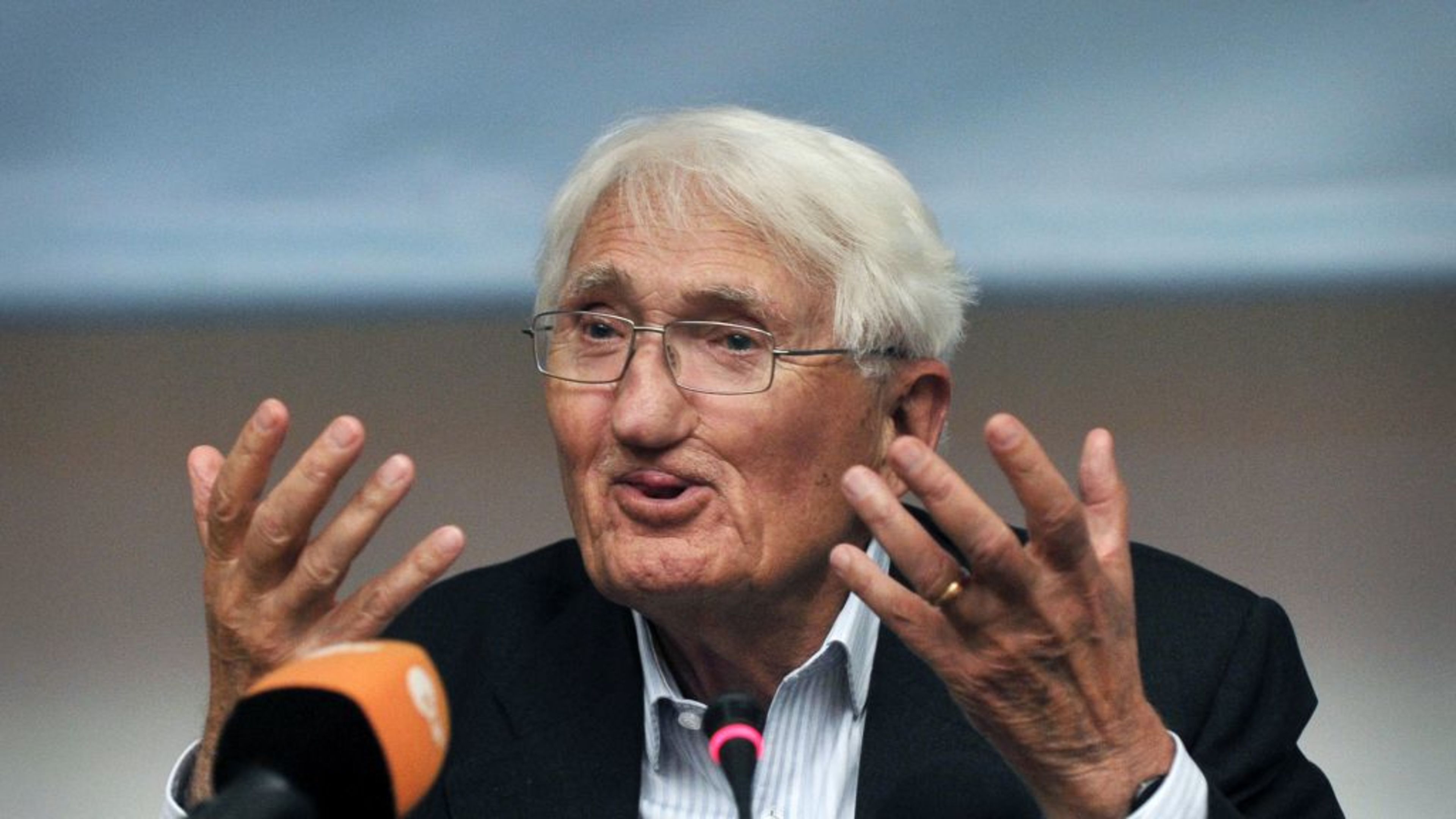
Habermas emerged from the so-called Frankfurt School, which linked its philosophical and sociological ideas to Karl Marx and figures such as Sigmund Freud. The Frankfurt School was a pioneer and source of ideas for the 1968 revolution, and Habermas later broke with the movement.
The German philosopher’s willingness to take religious thought seriously — rare among secular philosophers of his stature — made him a valued interlocutor for Catholic thinkers.
In a statement Saturday, Bishop Heiner Wilmer, SCJ, chairman of the German Bishops’ Conference, commemorated the late thinker’s dialogue with Joseph Ratzinger.
“With Jürgen Habermas’ death, an exceptional philosopher leaves us,” Wilmer declared. “The breadth of his thinking and the visionary power to build bridges between philosophy and religion will remain.”
He added: “Unforgettable is his dialogue with Joseph Ratzinger, which showed that theology cannot exist without philosophy and philosophy cannot exist without theology. We will not forget the power of his intellectual achievement.”
The two thinkers discussed the “dialectical foundations of secularization” at the Catholic Academy of Bavaria in Munich in 2004. At that time, the later Pope Benedict XVI was still a cardinal serving as prefect of the Congregation for the Doctrine of the Faith.
Habermas, who maintained that the Enlightenment was an “unfinished project” that could be corrected through improved communication, found himself opposite a Bavarian prelate and theologian who maintained that the natural law tradition offers the surest path to overcoming the “pathologies of reason” and the twin dangers of political and religious fanaticism.
The Catholic weekly Die Tagespost noted in a March 14 obituary that their meeting demonstrated that the supposed opposition between enlightened reason and religious faith need not end in enmity. Both recognized the necessity of a mutual learning process, seeing the conversation itself as its own reward.
“Habermas, who described himself as ‘religiously unmusical,’ recognized in Christianity an important source of moral intuitions,” Henry C. Brinker wrote in the newspaper. “And the later pope drew out hidden resonances in Habermas that the philosopher himself probably did not suspect.”
If you value the news and views Catholic World Report provides, please consider donating to support our efforts. Your contribution will help us continue to make CWR available to all readers worldwide for free, without a subscription. Thank you for your generosity!
Click here for more information on donating to CWR. Click here to sign up for our newsletter.

So, was Habermas a Catholic? Was he a Christian at the end of his life? Did he have a religious conviction or did his allegiance remain to the ‘philosophes’?
The significance of the dialogue is that Habermas was not a Catholic nor even a Christian—and sometimes was referred to as “the pope of Secularism.” And yet, there was a one-on-one conversation without false synthesis.
HABERMAS called for secular society to give more space to religious conviction, while Ratzinger maintained that the survival of a free state depends ultimately upon the underlying and universal natural law.
RATZINGER: “The natural law has remained (especially in the Catholic Church) the key issue in dialogues with the secular society and with other communities of faith in order to appeal to the reason we share in common and to seek the basis for a consensus about the ethical principles of law in a secular, pluralistic society [….] The idea of the natural law presupposed a concept of nature in which nature and reason overlap [!], since nature itself is rational [….]” (Jurgen Habermas/ Joseph Ratzinger, “The Dialectics of Secularization: On Reason and Religion,” Ignatius, 2006,” p. 69).
The German Bishop Heiner WILMER would do well to explain to Der Synodal Weg (which he has inherited by succeeding Bishop Batzing) this grounding in natural law as compared to, say, the hyper-secularized and even perverse agenda of synodality in Germania.
More challenging, still, is the task of affirming the universal natural law and the “overlap” of faith and reason, to the alternative universe of Islamic culture. A culture that replaces this overlap or coherence with the mutual divorce of theology from philosophy (that is, the “two truths”). And, with the contradictory fluidity of “abrogation,” under a totally inscrutable (that is, non-Trinitarian) and fatalistic Allah. In his compact but very readable references to other cultures, RATZINGER says such as this: “Islam has defined its own catalogue of human rights, which differ from the Western catalogue” (indeed!).
Respectful farewell to internationally renowned German philosopher Herr Juergen Habermas.
Habermas was referenced as an authority in communication by Alasdair MacIntyre in his study of discursive language in After Virtue. Habermas would grasp concepts developed in the process of communication rather than bringing metaphysical principles, natural law as vectors for productive discussion.
Habermas was on a journey of ideas whereas as Ratzinger can be distinguished as a man of teleology, the moral ends of human behavior. The human act as distinct from transitory intellectual concepts and the world of ideas.