

We live in a hard time for young men in our country. It’s a time that too often seems to feed the worst male instincts, from weakling drone to selfish bully. Becoming a mature Christian man can be a demanding task. But history can be a useful teacher.
Some 900 years ago, in A.D. 1118–19, a small group of men came together in Jerusalem to form a religious community. They were pilgrims. The First Crusade had retaken the city from Muslim rule in 1099. The men, who were all from Europe’s knightly order, had come looking for a life of common prayer and service. They got both, but not in the way they intended.
Having trained as warriors, the men had certain skills. As knights, they came from respected families with important connections. At the time, the roads leading to Jerusalem and other holy sites were infested with brigands and Muslim raiders who would rob, rape, murder, or abduct many of those making the journey. The Christian rulers of the city needed help in protecting the travelers. The men had taken vows of poverty, chastity, and obedience to the Patriarch of Jerusalem. And their first task, under obedience, was to patrol the roads.
They began that work with nine men too poor to afford anything more than the clothes they were given by pilgrims. Twenty years later, the Holy See approved the rule of their religious community, the Poor Brothers of the Order of the Temple of Solomon—the Knights Templar. The Templars went on to become the most effective Christian fighting force in the Holy Land for nearly 200 years.
A lot of nonsense has been written about the Templars. If you want facts, read Malcolm Barber’s The New Knighthood: A History of the Order of the Temple, or the work of serious historians like Jonathan Riley-Smith or Thomas Madden. Or read St. Bernard of Clairvaux’s great reflection on the Templars, “In Praise of the New Knighthood.”
But we need to pay special attention to that expression “the new knighthood.”
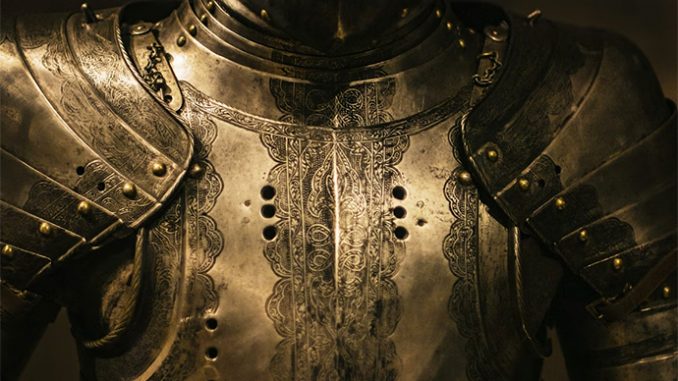
Knighthood in medieval Europe began as a profession of heavily armed male thugs—men obsessed with vanity, violence, and rape. It took the Church centuries to tame and re-channel those passions. But in the process, she provided the ideal at the core of the Templars: to build a new order of new Christian men, skilled at arms, living as brothers, committed to prayer, austerity, and chastity, and devoting themselves radically to serving the Church and her people, especially the weak. And the astounding thing is how often and how fruitfully this ideal of “a new knighthood” was embraced, pursued, and actually lived by the brothers, rather than abused.
My point is this: C.S. Lewis described Christianity as a “fighting religion.” He meant that living the Gospel involves a very real kind of spiritual warfare; a struggle against the evil in ourselves and in the world around us. Our first weapons should always be generosity, patience, mercy, forgiveness, an eagerness to listen to and understand others, a strong personal witness of faith, and speaking the truth unambiguously with love.
But at the same time, justice and courage are also key Christian virtues. And they have a special meaning in the life of the Christian man.
Men need a challenge. Men need to test and prove their worth. Men feel most alive when they’re giving themselves to some purpose higher than their own comfort. This is why young men join the Marines or Rangers or SEALs. They do it not despite it being hard, but exactly because it’s hard; because it has a personal cost; because they want to be the best and earn a place among brothers who are also the very best. In like manner, men joined the early Capuchins and Jesuits not to escape the world but to engage and convert the world by demanding everything a man had—every drop of his energy, love, talent, and intelligence—in service to a mission bigger and more important than any individual ego or appetite.
This is why the ideal of knighthood can still have such a strong hold on the hearts and imaginations of men. Men are hard-wired by nature and confirmed by the Word of God to do three main things: to provide, to protect, and to lead—not for their own sake, not for their own empty vanities and appetites, but in service to others.
Men are meant to lead in a uniquely masculine way. The great saint of the early Eastern Church, John Chrysostom, described every human father as the bishop of his family. All fathers are, in that sense, bishops. And every father shapes the soul of the next generation with his love, his self-mastery, and his courage—or the lack of them.
So what does that mean for today? It means that the world needs faithful Catholic men with a hunger to be saints. The role of a Catholic husband and father—a man who sacrifices his own desires, out of love, to serve the needs of his wife and children—is the living cornerstone of a Christian home. Barring a miraculous change in our culture, the Church in this country will face a hard road in the next 20 years. So men need the friendship of real brothers in the Lord—other men who are living examples of justice, courage, and self-mastery—to be the disciples and leaders God intends them to be.
“The new knighthood” that St. Bernard once praised has never really disappeared. It’s new and renewed in every generation of faithful Catholic men. And the rules of a genuinely new knighthood—all 22 of them—were written down 500 years ago by the great Catholic humanist, Erasmus of Rotterdam, in his book, The Manual of a Christian Knight. It’s a dense text for the modern reader, but here’s the substance of what he says:
Rule 1: Deepen and increase your faith.
Rule 2: Act on your faith; make it a living witness to others.
Rule 3: Analyze and understand your fears; don’t be ruled by them.
Rule 4: Make Jesus Christ the only guide and the only goal of your life.
Rule 5: Turn away from material things; don’t be owned by them.
Rule 6: Train your mind to distinguish the true nature of good and evil.
Rule 7: Never let any failure or setback turn you away from God.
Rule 8: Face temptation guided by God, not by worry or excuses.
Rule 9: Always be ready for attacks from those who fear the Gospel and resent the good.
Rule 10: Always be prepared for temptation. And do what you can to avoid it.
Rule 11: Be alert to two special dangers: moral cowardice and personal pride.
Rule 12: Face your weaknesses and turn them into strengths.
Rule 13: Treat each battle as if it were your last.
Rule 14: A life of virtue has no room for vice; the little vices we tolerate become the most deadly.
Rule 15: Every important decision has alternatives; think them through clearly and honestly in the light of what’s right.
Rule 16: Never, ever give up or give in on any matter of moral substance.
Rule 17: Always have a plan of action. Battles are often won or lost before they begin.
Rule 18: Always think through, in advance, the consequences of your choices and actions.
Rule 19: Do nothing—in public or private—that the people you love would not hold in esteem.
Rule 20: Virtue is its own reward; it needs no applause.
Rule 21: Life is demanding and brief; make it count.
Rule 22: Admit and repent your wrongs, never lose hope, encourage your brothers, and then begin again.
Maleness is a matter of biology. It just happens. Manhood must be learned and earned and taught. So our prayer today and every day should be that God will plant the seed of that new knighthood in the hearts of every Christian man—and make them the kind of “new men” our families, our Church, our nation, and our world need.
(Editor’s note: This essay was published originally on the “What We Need Now” site and appears here with kind permission.)
If you value the news and views Catholic World Report provides, please consider donating to support our efforts. Your contribution will help us continue to make CWR available to all readers worldwide for free, without a subscription. Thank you for your generosity!
Click here for more information on donating to CWR. Click here to sign up for our newsletter.

Leave a Reply