


In April 2023, Mattel began selling a new Barbie that had the features of a young woman with Down syndrome. At the time, I thought this was a great step forward for little girls who could see in a plastic playmate features they shared.
The doll was received enthusiastically, raved about in the media, and sold quickly. I wrote an article sharing my enthusiasm and received several media requests for interviews to discuss my reaction. As the father of five daughters who all cherished their Barbie time as they were growing up, and as the father of a younger son born with Down syndrome, I thought the addition of this Barbie to their Fashionista Line was a good move.
Now Mattel has released an autistic Barbie, and I am not so eager to enthusiastically support this one. I did a little searching online and discovered that my ambivalence is shared by others.
Is it because autism seems so highly politicized right now, with Secretary Kennedy vowing to turn over all stones until a cause is discovered? We know the reported incidence of autism in the U.S. has skyrocketed at an alarming rate. In 2000, the CDC reported that the condition was shared by only about 1 in 150 eight-year-olds. But the most recent data tells us that the incidence has increased to a stunning 1 in 31. You would have to be in some form of denial not to be concerned about what factors in our environment could be causing that.
Maybe our shared ambivalence is because many people with autism do not have identifiable features like people with Down syndrome. Or maybe it is because this doll is not representative of the full spectrum of a condition that is characterized by a wide range of affectation. If you’re really going to represent autism, then you have to represent level 3 autistics, too. They have substantial support needs and may require specialized help to keep them from injuring themselves or others.
Even families with autistics are divided over how autism should be represented in the culture because of the wide variation in how it is expressed in individual persons. But the real problem many people have with the Barbie brand is that it has always been stereotypical of an idealized beauty—well, some people’s ideal, anyway.
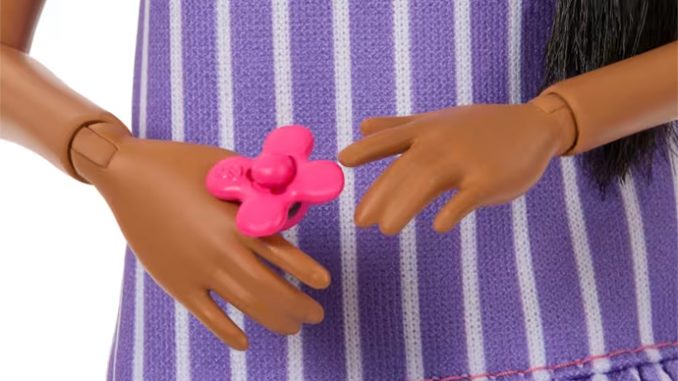
A doll can only represent visual differences, and the differences Mattel chose to work with in this doll are her accessories, but that’s not really different from other Barbies. Rather than Dr. Barbie’s stethoscope and scrubs, Autistic Barbie comes with a communication device, noise-cancelling headphones, and a fidget spinner. There are also some subtly noticeable physical representations built into her articulated elbows and wrists, a slightly averted gaze so she doesn’t have to make direct eye contact, and a loose-fitting dress to indicate sensory sensitivities. Most people would probably never notice.
Perhaps the difference in attitudes between this release and Down syndrome Barbie in 2023 is timing. In April 2023, we were just coming out of the acute phase of the COVID-19 pandemic and still reeling from the experience. We were eager to grab hold of any available feel-good moment, and Down syndrome Barbie provided one. January 2026 is a very different time. We see our country and a world in crisis, and maybe a new Barbie doll—especially one that does not represent the full spectrum of the condition—has landed at the wrong time.
This seems allegorically like a trite, first-world dodge from reality. Remember the saying that Nero fiddled while Rome burned. We are pretty good at that, too, but I do not think many people are in a fiddling good mood right now.
I sympathize with parents who may be looking at this new doll and asking why Mattel would perpetuate an idealized stereotype of a high-functioning autistic woman while they struggle to get through every day, supporting an adult child they deeply love who is severely impaired by autism. I encourage you to read my friend Maria Maffucci’s reflection about how much her 31-year-old son struggles, while she hopes that a “mother’s love is enough to truly comfort and reassure her child.”
A cute little plastic thing in pretty clothes wearing noise-cancelling headphones does not quite fit Maria’s, and so many others’, reality.
I’m sorry to throw a wet blanket on this one. I’m sincerely happy for anyone who finds joy in this doll, and for all the little girls who feel like they now have a companion to play with who is just like them. I know there can be comfort in that. Let’s just not forget that Barbie has never represented reality, and I don’t think she was ever supposed to.
Her primary purpose is to be a plaything, and not a device to convey a profound and troubling social reality. I suppose we should just let her be what she is and not grant her more importance than that.
If you value the news and views Catholic World Report provides, please consider donating to support our efforts. Your contribution will help us continue to make CWR available to all readers worldwide for free, without a subscription. Thank you for your generosity!
Click here for more information on donating to CWR. Click here to sign up for our newsletter.

Leave a Reply