


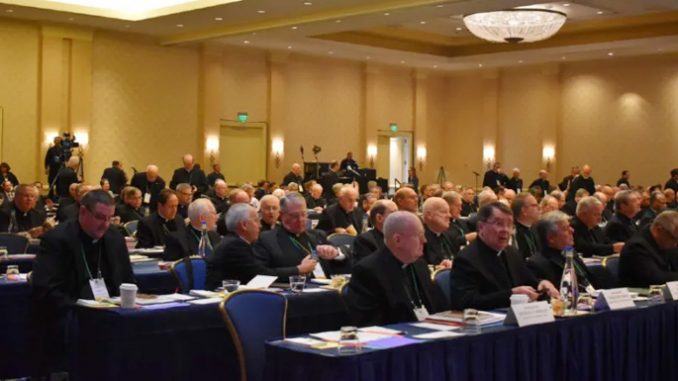
In the prescient 1980s BBC comedy series Yes, Prime Minister, Prime Minister Jim Hacker must choose the next Anglican bishop of Bury St. Edmunds. His choice is between an atheist and a socialist. The prime minister’s adviser dryly observes, “It’s interesting, isn’t it? That politicians want to talk about moral issues, and bishops want to talk about politics.”
Catholics may notice a similar pattern today.
While bishops are entrusted with teaching binding Catholic moral principles, the prudential application of those principles in political and military affairs properly belongs to the laity, and clerical overreach into contingent judgments risks obscuring that essential distinction.
By virtue of ordination, popes, bishops, and priests are the principal custodians of Catholic doctrine and moral teaching. This is an inherent dignity conferred by Holy Orders. The laity, by virtue of Baptism, bears responsibility for applying those principles to the concrete circumstances of political, economic, and social life. This inherent dignity also carries with it a weighty responsibility.
For this reason, absent clear, sufficient, and compelling evidence of grave injustice, Catholic bishops and priests should respect the proper role of the laity and exercise restraint in the political sphere. Allowing for limited overlap, the clergy do not orchestrate the prudential judgments required of the laity, who must weigh contingent facts, competing goods, and uncertain outcomes. Lay Catholics bear this burden daily, mindful that circumstances and intentions cannot render an intrinsically evil act good, yet also aware that not every political decision involves an act of intrinsic evil.
Archbishop Timothy Broglio has joined many lay Catholics and non-Catholics in expressing concern about aspects of President Trump’s foreign policy. Here is an excerpt from a recent news article:
The archbishop told the BBC’s Sunday that U.S. troops “could be put in a situation where they’re being ordered to do something that’s morally questionable” if deployed to Greenland to carry out Trump’s annexation threats. He continued to suggest that it might be “very difficult” for a soldier or a marine or a sailor by himself to disobey an order” that “within the realm of their own conscience it would be morally acceptable to disobey.” He also insinuated that the Trump administration did not choose “the proper way and the moral way to respond to these situations,” in reference to both U.S. military strikes in the Caribbean Sea and Eastern Pacific as well as military annexation threats to Greenland.
The archbishop appears here to invoke familiar elements of Catholic moral tradition, including just-war doctrine and the primacy of conscience properly formed by Church teaching. Few Catholics would object to those principles as such. Yet the optics include the articulating and applying moral principles in reference to specific instances, even suggesting that the archbishop himself—not Church teaching—is granting the requisite moral permission.
To illustrate the concern, one might consider a parallel application of similar language to other regions of the world. Would an American bishop suggest that a potential military intervention in the Middle East—whether involving Iran, Iraq, Israel, or Saudi Arabia—would likely place service members in a situation where disobedience would be “within the realm” of conscience?
If the remarks concerning Greenland are intended primarily as statements of principle, then they would appear to apply broadly to nearly any contemporary military operation undertaken by any nation. Yet one can easily imagine an outburst of indignation if appearances suggested that an American archbishop opposed, for example, American attacks on Iran.
Except in cases where violations of justice are manifest, grave, and supported by clear evidence—such as the moral certitude surrounding the crimes of Nazi Germany—statements by the clergy that move from principle toward implied application risk encroaching upon the rightful responsibility of the laity. Identifying Christian moral principles is relatively straightforward; applying them faithfully in uncertain situations is far more challenging.
The graces of Holy Orders do not confer superior competence in prudential matters. Nor is a prelate in a position to grant personal permission for a person’s valid prudential decisions. Indeed, the Church has long recognized the need for a division of responsibility between the teaching office of the hierarchy and the practical judgment exercised by the laity in secular affairs. This distinction preserves the integrity of the Church’s moral witness and acknowledges the innumerable choices available to the laity in applying Christian principles.
Moral principles are universal regardless of geography, political alignment, or media attention. Bishops and priests best preserve their authority by exercising intellectual discipline—clearly distinguishing binding Church teaching from personal judgment, and moral doctrine from contingent application.
A brief restatement of relevant Catholic principles may help clarify the proper framework for evaluating such questions:
Military personnel must follow a well-formed conscience. “A human being must always obey the certain judgment of his conscience” (CCC 1790). “Man has the right to act in conscience and in freedom so as personally to make moral decisions” (CCC 1782). Military personnel may refuse laws or commands that are unjust: “The citizen is obliged in conscience not to follow the directives of civil authorities when they are contrary to the demands of the moral order” (CCC 2242). Soldiers and sailors must refuse to obey immoral orders.
Moreover, “Public authorities should make equitable provision for those who, for reasons of conscience, refuse to bear arms; these are nonetheless obliged to serve the human community in some other way” (CCC 2311).
At the same time, the authority to wage war does not belong to individuals or private groups. “The evaluation of these conditions for moral legitimacy belongs to the prudential judgment of those who have responsibility for the common good” (CCC 2309).
Clerics may speak as citizens on prudential political questions, but they should generally refrain from taking sides. Public partisanship both divides the faithful, where good Catholics may disagree, and confuses moral authority with political opinion.
Bishops in particular have a solemn obligation before God to teach authentic Catholic doctrine and moral principles that require assent. Amen. The faithful laity can take it from there.
If you value the news and views Catholic World Report provides, please consider donating to support our efforts. Your contribution will help us continue to make CWR available to all readers worldwide for free, without a subscription. Thank you for your generosity!
Click here for more information on donating to CWR. Click here to sign up for our newsletter.

Thank you Father Pokorsky!
Distinction between the mission of the clergy and the political responsibilities of the laity exists, although there’s overlapping when the mission of one is impeded or dependent on the responsibility of the other.
Theoretically then the two differ in kind, although not always in application. Fr Pokorski would agree that the moral order supersedes the civil order. There are bound to be instances when a public policy crosses the line of moral probity. Granted to Fr Pokorski that decisions require prudential judgment, that the lay professional has access to data not available to the cleric. Nevertheless, prudence means the deliberation of a moral act, that which is not limited to one or the other laity or clergy, rather to all in pursuit of justice.
Fr Pokorski agrees there’s limited overlap, and it is here that the access to details presumed to be held by the layman places him in the better position to make a prudent judgment. Although there are instances when the cleric [or the ordinary layman] may have sufficient apprehension to question the morality of actions, and here I refer to the killings in Minneapolis. The question raised [by me for instance] couldn’t restraint have been the more ethical option?
Insofar as foreign policy and the use of force and intimidation, the threat of war and invasion may, conceivably be justly questioned by Archbishop Broglio. If we are urged by previous pontiffs to admonish, perhaps sanction politicians for their stance on abortion there is in that the recognition. Insofar as war is used as foreign policy, or simply perceived as such, the Military Archbishop can offer a moral judgment if not opinion based on a reasonably coherent possession of facts – rather than an overwhelming preponderance of evidence. Reasonable certitude in making a moral judgment suffices. I submit this for discussion.
For further discussion in respect to prudent judgment, we must distinguish between a legal definition of justice, that is, legal justification and moral justification. An example I submit is the Covid crisis, when government gave strict orders to remain home, that churches should be closed. Although liquor stores were permitted to remain open.
During the crisis military personnel who refused the ‘vaccine’ were dismissed. Those dismissals were reversed during another administration. Some pastors refused the government restriction and hierarchal compliance and continued to serve the people and provide the sacraments. Were they legally or morally vagrant?
Looks like the balance has been put aright by a fellow member of the clergy.
My experience with the military was three years active duty Army infantry, 12 years chaplain under the Military Archdiocese. If anyone would have access to military commanding officers and a sense of policy issues it would be Archbishop Broglio, who spends 200 days per year visiting all 220 military bases in the U.S, and around the world.
Protocol would have him meet personally with each base commander, attend dinner with commander and officers including military chaplains. My intent here was to bring attention to exceptions to the general rule of expertise discussed by Fr Pokorski.
Fr. Pokorsky has a knack for zeroing in on the critical questions that most people miss and providing the perfect answers.
An excellent and timely article. Thank you.
Father Pokorsky very shrewdly notes that Trump’s bluffs to invade Greenland have elicited more clear condemnations from Bishop Brogilio and his colleagues than the more likely attacks against Iran that may occur in the very near future. For that matter, the bishops have been very muted on the Middle Eastern wars of recent decades. I can only imagine why that may be.
This is a well thought out essay, supported by appropriate authoritative references-one that I will definitely bookmark.
Unfortunately, I suspect most Bishops will merely resent it, if they are even made aware of it.
As a member of the laity, I cannot force Bishops to confine themselves to their proper role, but I will not fund these ultra vires vainglories that usurp the pewsitters’ prerogatives.
The unmooring of the episcopacy from proper authority can be demonstrated in microcosm by the actions of the long time Bishop of the diocese of my youth, Timlin of Scranton. For decades, Timlin mishandled cases of moral turpitude among the priests. The public revelation of his conduct forced Bishop Bambera to act and restrict his public ministry.
On November 12, 2018, Timlin defied Bambera’s order by attending the United States Conference of Catholic Bishops general assembly in Baltimore. On February 25, 2020, Timlin again defied Bambera by attending the installation mass of archbishop Nelson J. Pérez, dressed in episcopal attire. A spokesperson for the Archdiocese of Philadelphia confirmed that it had invited Timlin to the mass in spite of the order.
The unasked and unanswered question about why Philly didn’t respect Bambera’s order is whether Francis knew of Timlin’s defiance and approved it. Why didn’t they go all out and invite Roger Mahoney-also under restrictions while they were at it-an episcopal ordination is chump change compared to overseeing a papal interment.
As for Broglio, for years, I have made a modest annual contribution to Arch Mil. Broglio took it upon himself to opine publicly on a hypothetical action that did not even occur, and it’s not his call to wax eloquent and foment mutiny for hypotheticals.
My contribution will go elsewhere this year.
And so the clergy ought to stay in their own lane. Gone are the days when men like Robert Drinan S.J. had the temerity to have political ambitions and occupy a seat in Congress.
As I’ve said in other instances, priests and bishops should have a great many things to occupy their attention putting their own ecclesial house in order. But when clerical life too often becomes more about sex, power and money, rather than service, they far too easily cross lanes into oncoming traffic.
Well said. Thank you, Father.
This is exactly the article that I have been hoping for on this subject-matter a clear, relatively brief clarification/explanation, including a pertinent example, that will help me to understand and weigh the statements that clerics, especially bishops, make about matters of public interest that involve politics. I will keep the following in mind:
“Clerics may speak as citizens on prudential political questions, but they should generally refrain from taking sides. Public partisanship both divides the faithful, where good Catholics may disagree, and confuses moral authority with political opinion.
“Bishops in particular have a solemn obligation before God to teach authentic Catholic doctrine and moral principles that require assent. Amen. The faithful laity can take it from there.”
Amen!
It may be slowly fading in Leo’s papacy, but throughout the Francis reign one had the distinct impression that the issues that mattered the most to the Church were immigration, climate change and, for a few years, Covid vaccinations. There has not been much respect granted for points of view that differ from those of the hierarchy, either. Bishops have pushed their usually poorly thought-out political views onto the laity for my entire life, but during the Francis papacy it got taken to a new level.
What is particularly scandalous is the way they implicitly present these personal or collective opinions as being official church teaching. When pressed, all but the most brazen feel forced to admit that their pronouncements are not binding
I cannot help but laugh at the idea that Archbishop Broglio, whose job is to tend to a flock of chaplains who have the spiritual health of their flock as their focus, and to speak to high-ranking military officials. If any bishop is authorized to speak to Caesar on the morality of military endeavors, surely it is this man.
Perhaps Fr. Pokorsky should take his own advice, and ask CWR to remove this article.
After all the hard work the good father has done denouncing U.S. aid to the suffering people (including the suffering Church) in Ukraine, he cannot then expect to be taken seriously when he denounces priests who aren’t him from denouncing the idea of the U.S. attacking an ally over a block of ice.
CWR is a fine publication, but every now and then a bit of dross gets through.
“but every now and then a bit of dross gets through.”
Such as your comment.
Mr. Rebel,
I am truly awed by the intellectual heft and substance of your comment, see the weaknesses in my argument, and have donned sackcloth and ashes.