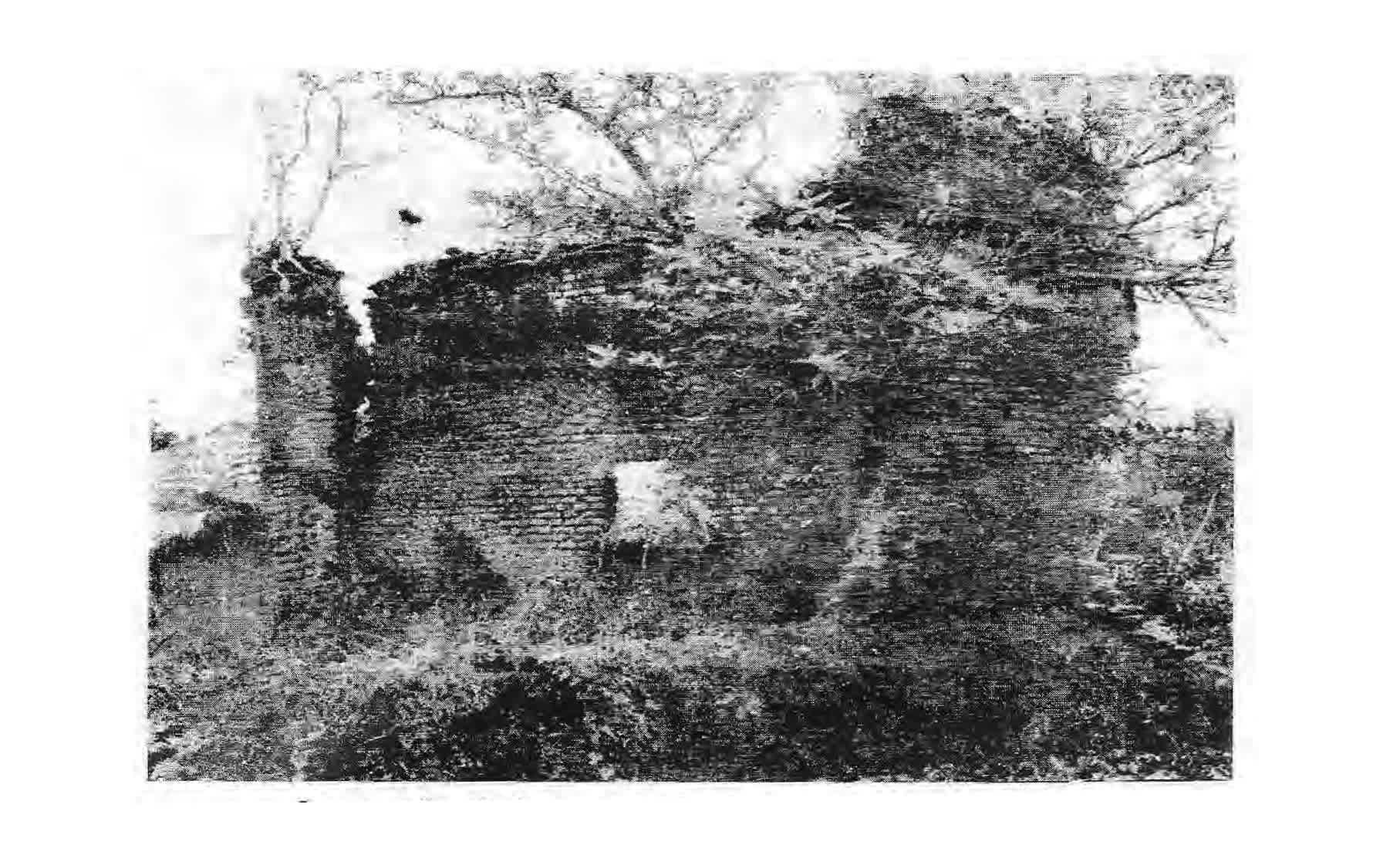
A garden now occupies the site of Bangladesh’s first Catholic church at Iswaripur in Satkhira district. Portuguese Jesuits dedicated the Church of the Holy Name of Jesus here on Jan. 1, 1600. | Credit: Milon Munda
Jan 10, 2026 / 07:00 am (CNA).
A financial crisis has halted the Catholic Church’s efforts to reclaim the site of Bangladesh’s first church, leaving the 426-year-old foundation in Satkhira occupied and unpreserved.
Two Portuguese Jesuit priests — Father Francesco Fernandes and Father Domingo de Sousa — built the country’s first church at Iswaripur in the Sundarbans Forest area in the present-day southern Satkhira district. They dedicated it on Jan. 1, 1600, as the Church of the Holy Name of Jesus.
The priests built the church with the permission and funding of the then-Raja (King) Pratapaditya. At the time, many Portuguese soldiers worked under Pratapaditya and worshipped at the church.
The church no longer exists, and a Muslim family has since settled on the land. However, the district’s official website still preserves its history online.
According to the Bangladesh government’s website, many Portuguese soldiers serving in Pratapaditya’s army contributed funds for the church’s construction. Additionally, Pratapaditya assisted in building the place of worship for Christians in his capital, with construction completed in December 1599.
“The bishop took the initiative to take over the site on behalf of the Catholic Church and offered to pay for it, but those living there did not agree. The then-bishop did not pursue it further for some reason,” said Father Philip Mondal, who oversees the Khulna Diocese’s land in the area.
The late Bishop Michael D’Rozario, who led the Khulna Diocese from 1970 to 2005, was the first to attempt to save the church site. Mondal noted he is unsure if the bishop sought administrative assistance at that time.
“But now, to take over this place, we need the support of the administration and a lot of money, which the Khulna Diocese cannot provide,” Mondal told CNA.
However, the priest believes that with government backing and external financial support, the Church in Bangladesh could reclaim this historically unique site.
Christians make up less than 1% of Bangladesh’s 170 million people, a tiny minority in the predominantly Muslim country. The Catholic community, with approximately 400,000 members, is the single-largest Christian group.
Members of the Muslim and Hindu majority often regard Christians highly for their significant contributions to education, health, and social development. Christian missionaries also contributed historically to the Bengali language, promoting its colloquial and simplified form.
Lay Catholics are urging the Church to establish at least a small chapel on the site to preserve its history.
“We have only read in books that the first church in Bangladesh was in Iswaripur, but now when we go there, we do not find any trace of it. It cannot be that the history of a religion has been erased,” Praveen Mondal, 34, a Catholic, told CNA.
He believes that Christianity and its first church are inextricably linked, making the preservation of this memory a major responsibility for the Church.
CNA spoke to Rashed Hossain, a top government land officer in the area, about the site.
“It is true that the first church was established here, but now that church does not exist. However, we need to see how the people who live there now came to own the land,” Hossain told CNA.
He added that if the Church makes a formal request to the government, officials will “look into the matter seriously.”
If you value the news and views Catholic World Report provides, please consider donating to support our efforts. Your contribution will help us continue to make CWR available to all readers worldwide for free, without a subscription. Thank you for your generosity!
Click here for more information on donating to CWR. Click here to sign up for our newsletter.
The faithful gather at the site of Father Arul Das’ death in the Jamboni jungle on Sept. 2, 2024. / Credit: Anto Akkara
Bangalore, India, Sep 10, 2024 / 11:15 am (CNA).
More than 4,000 Catholics on Sept. 2 assembled in the remote Jamboni jungle to mark the 25-year observance of the death of 33-year-old Father Arul Das of the Balasore Diocese, who was shot and pierced with arrows in his thatched chapel-house during the early hours of Sept. 2, 1999.
“Father Arul very closely followed the life of Jesus. Like Jesus as a good shepherd, Father Arul too tried to be a good shepherd for the people of this locality,” said Balasore Bishop Varghese Thottamkara in his sermon at the jubilee Mass.
Along with the bishop, over 50 priests and hundreds of nuns from different parts of the sprawling diocese and beyond were present at the celebration at which the clergyman was hailed as a martyr.
Thousands gather at the site of Father Arul Das’s death in the Jamboni jungle on Sept. 2, 2024. Credit: Anto Akkara
“Father Arul was a priest of Christ. He came to serve the faithful of Balasore, especially of the Ho tribe people,” Thottamkara said.
“Through his life-giving witness he gives the best example for us. The blood of the martyrs is the seed of the Church,” the prelate added.
“While only 18 Ho families had embraced Christian faith in Jamboni at the death of Father Arul in 1999, the number has swelled to over 400 in Jamboni mission area now,” Father Varghese Puthumattam, who has compiled the biography of the missionary, told CNA.
Arul became involved with the Ho tribals in the jungle region when he was assigned as a deacon for pastoral duty at the challenging mission. Even a quarter-century later, the outpost lacks electricity and proper roads.
After his ordination in 1993, he was posted in the area and went to neighboring Jharkhand to learn the Ho language. The priest launched full-fledged work among the tribe, walking through the jungles without motorable roads to reach out to locals, many of them illiterate.
“We had to carry even bicycles on the shoulders to cross rocky and slushy terrains and streams,” Puthumattam remembered, recounting the challenging mission work undertaken with Arul.
While camping in his hut church at the remote Jamboni village, Arul was killed by a gang led by Hindu fundamentalist Dara Singh when the latter was on the run after having committed a triple murder in January 1999.
“Christian faith has taken deep roots among our people because of the martyrdom of Father Arul,” Durga Singh Godsara told CNA. Godsara is a catechist and was one of the first converts that Arul helped lead to the Church.
After Arul was killed, Godsara recounted what one of his fellow converts told him: “I will give up as it is dangerous and they would kill us too.”
“But I told him we have to die for the faith our guru [master] has taught us. Later I prayed with him; he got healed and he went to live 20 more years,” Godsara said.
“Our people have deep faith in the healing power of Father Arul that they bring the sick to this spot and get instant healing,” he added.
“We routinely hear ‘the blood of the martyrs is the seed of the Church.’ It has been literally fulfilled in Jamboni,” Sister Elizabeth Rani told CNA.
“I came here for the first anniversary in 2000. What an amazing development has taken place over the years with the thousands of Ho people embracing the Christian faith,” said Rani, who belongs to the Congregation of St Anne.
“‘Arul’ in our language [Tamil] means ‘blessing,’ and I am happy — he has indeed become a blessing to the Ho tribals,” the nun added.
“Our people were enthusiastic about the historic occasion,” Father Francis Xavier Singh, vicar of Holy Rosary Parish of Bagdapha that comprises the Jamboni area, told CNA.
“They worked voluntarily through the night to prepare the lunch for more than 4,000 people,” he added.
Thottamkara told CNA that there “is indeed a growing popular devotion to Father Arul.” The bishop noted that several miraculous healings have been reported by the Ho tribe.
“The diocese will set up committees to document and scrutinize these to decide how to take these up further,” Thottamkara said.
Dhaka, Bangladesh, Feb 5, 2020 / 06:14 pm (CNA).- The High Court in Bangladesh has asked the government to justify its continued allowance of prenatal gender detection technology, which opponents are seeking to ban in the name of gender equality and th… […]
A reconstruction of an ancient church recently discovered in Armenia. The newly discovered church measures about 100 feet across and is shaped like an octagon with “cruciform annexes oriented east-west and north-south,” according to Achim Lictenberger, who noted the discovery of a similar structure from a slightly later period found in Abchazia (Sebastopol). / Credit: AGAP
Washington, D.C. Newsroom, Oct 24, 2024 / 08:00 am (CNA).
A team of German and Armenian researchers made a groundbreaking discovery last week of an ancient church in Armenia dating back to the fourth century, making it the oldest documented church in Armenia, which is considered the first Christian nation in the world.
In an email correspondence with CNA, co-directors of the project Achim Lichtenberger and Torben Schreiber of the University of Münster and Hayk Gyulamiryan of the Armenian Academy of Sciences explained the significance of the discovery made by the team at the site of the ancient city of Artaxata. The project’s fourth co-director, Mkrtich H. Zardaryan, could not be reached for comment by the time of publication.
Historic roots of Christianity in Armenia
“Being the first country which adopted Christianity at the state level, and where the apostles Thaddeus and Bartholomew preached Christianity in the early first century, this discovery is a very important fact for Armenians,” Gyulamiryan told CNA, further stating that “the findings are among the most important in Armenia in recent decades.”
Lichtenberger also emphasized the site’s particular importance, as the church was discovered near the monastery of Khor Virap, where Gregory the Illuminator had been kept in prison before he converted the Armenian king Tiradates III to Christianity in the fourth century.
The monastery of Khor Virap and Ararat in Armenia. Credit: AGAP
As Gyulamiryan stated, although the roots of Christianity may be traced back to the time of the apostles in Armenia, it was not until 301 that Christianity was proclaimed the official religion of Armenia.
According to tradition, Armenia’s conversion is attributed to St. Gregory the Illuminator, a Christian evangelist and convert from Zoroastrianism who miraculously cured the nation’s pagan king of a peculiar “illness” after no other pagan priest was able to do so.
The widely-adopted story of how Armenia became Christian draws from a mythical history promulgated by the fifth-century author Agathangelos, the Armenian researcher explained.
As the legend goes, the pagan king of Armenia had become fascinated by the beauty of St. Hripsime, a nun who had fled with her abbess and community from persecution in Rome. The king offered to marry and make her queen, but Hripsime refused and was able to ward off the king’s advances through miraculous strength.
After the king ultimately had Hripsime and her community killed, historians claim he was “turned into a wild boar who tore at his own flesh” and could not be cured by any priests of pagan or Zoroastrian temples who attempted the feat.
Eventually, the king’s sister persuaded him to appeal to St. Gregory, whom the king had imprisoned for the past 15 years. Once St. Gregory was released, he cured the king of his “disease” and converted him and the entire royal family to the Christian faith.
Artaxata, where these events are believed to have taken place, is “a major place related to early Christianity in Armenia,” Lichtenberger told CNA.
St. Gregory is revered both in the Orthodox Armenian Apostolic Church and in the Catholic Church traditions. In 2005, Pope John Paul II erected a 19-foot statue of St. Gregory in the north courtyard of St. Peter’s Basilica in Vatican City.
The excavation area of the archeological site where the remains of an ancient church were found in Armenia. Credit: AGAP
The discovery
The newly-discovered church measures about 100 feet across and is shaped like an octagon with “cruciform annexes oriented east-west and north-south,” according to Lichtenberger, who noted the discovery of a similar structure from a slightly later period found in Abchazia (Sebastopol).
Although the Araxata site was previously discovered, Lichtenberger told CNA that the church had been buried underground and gone undiscovered until the team carried out its magnetic prospections and excavations this past spring.
The researchers confirmed in September the age of the church to be from about 350 A.D. using radiocarbon dating techniques on a series of samples taken from a wooden platform belonging to the original construction of the building.
Ahead of the autumn excavations this year, Gyulamiryan told CNA he remembered thinking that the team “should confidently dig up the next chapter of the history of Armenia.”
The massive mortar wall of the recently discovered ancient church believed to be the oldest in Armenia. Credit: AGAP
According to Lichtenberger, the radiocarbon date from the wooden samples corresponded with pottery shards that were also discovered inside the church and with “the overall construction technique of the building using substantial amounts of mortar.”
“In the center of the church we encountered significant amounts of marble decoration that suggest that this part was prominently adorned,” he said. Interestingly, the German researcher noted that the state of the building upon discovery indicated that it had perhaps met a hostile end.
“The building was heavily destroyed (maybe intentionally),” he wrote, “the marble construction smashed, parts of the floor tiles removed, the roof set on fire, and all was buried in a huge collapse of roof tiles and burnt roof beams.”
However, according to Lichtenberger, there are no primary literary sources that correspond to the church, as “literary sources only relate to a seventh-century A.D. church in Artaxata.”
By contrast, while the Armenian literary tradition attests that the oldest church in the country is the Etchmiadzin Cathedral, Lichtenberger noted, “archeological evidence from this place does not date back to the mid-fourth century A.D.”
“This does not mean that Etchmiadzin is younger than the Artaxata church, it only means that the Artaxata church provides earlier archaeological evidence,” he added. “Therefore we assume that the Artaxata church is the oldest archaeologicallyattested church in Armenia.”
The Etchmiadzin Cathedral, which Armenian literary tradition attests is the oldest church in the country. But Achim Lichtenberger says this “does not mean that Etchmiadzin is younger than the Artaxata church, it only means that the Artaxata church provides earlier archaeological evidence. Therefore we assume that the Artaxata church is the oldest archaeologically attested church in Armenia.” Credit: Madalaine Elhabbal
Future of the project
Schreiber shared with CNA in another email chain that analysis of data collected from the site will play a significant role in future archeological measures.
“The interaction of the excavation results, the geophysical survey, and the scientific investigations (natural sciences) will keep us busy in the coming year,” Schreiber said. “However, we are certain that these measures will provide us with a very comprehensive picture of this extraordinary and important find.”
Excavations in the ancient ruins of a church recently discovered in Armenia, the oldest Christian nation in the world. Credit: AGAP
The research team from the University of Münster and the Armenian Academy of Sciences have been at the Artaxata site since 2018 and have also made other noteworthy discoveries, including an unfinished Roman aqueduct, a Hellenistic sanctuary, and the remains of an Urartian settlement, according to Lichhtenberger.
The team of researchers also includes 10 students from the German university along with various internal and external specialists who consulted with the team on different groups of materials at the site, including animal and human bones, plants, or “archaeobotanical” matter, marble, plaster, pottery, and roof tiles — “of which we found a lot,” Lichtenberger said.
“We will continue the work of the Armenian-German Artaxata Project in the future,” he told CNA.
Leave a Reply
