

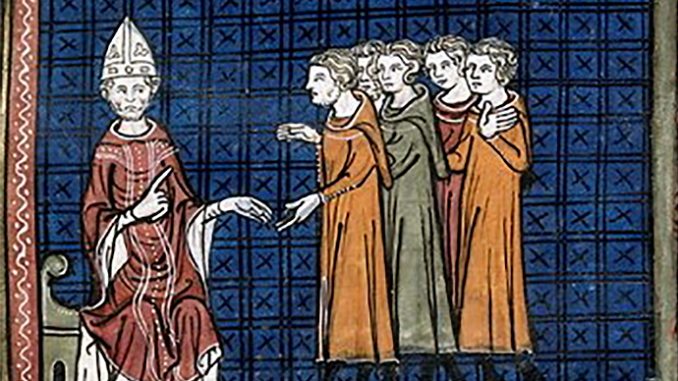
Divorced saints? How can that be? Catholics are more likely to hear edifying stories about pious wives like St. Catherine of Genoa or Elizabeth Canori-Mora, who stayed with wicked husbands until they prayed their erring spouses into repentance. They’re unlikely to hear about cases like St. Godeleva’s where abuse ended in murder. This article will look at saints involved in divorce to show that Catholics in the past had to face challenges of a kind commonly assumed to be modern.
First, a note about the word “divorce”. It comes from the Latin divortium—“a separation,” especially “divorce, the ending of a marriage.” Divortium is the legal term in canon law, from the Middle Ages down to the 1917 Pio-Benedictine Codex Iuris Canonici. Canonists say “decree of nullity” rather than “annulment;” there is no corresponding Latin noun. Some of the cases below cover actual civil divorces terminating marriages. But the medieval dissolutions of marriage cited here—also called divorces—were actually canonical declarations that a marriage never existed. These decrees had both ecclesiastical and civil effect because, in that era, the Church controlled marriage.
The early Church and the first millennium
Our first subject is St. Fabiola (d. 399), a wealthy Roman aristocrat. Girls of her class were typically married off at puberty to much older men. Presumably, this is what happened to Fabiola. Unfortunately, her husband proved so dissolute even by the prevailing double standards for men that Fabiola divorced him. (Despite the triumph of Christianity, Roman law still permitted no-fault divorce on demand by either spouse.) Then Fabiola married a more congenial young man, but he soon died. Repenting of her illicit marriage, Fabiola submitted to a long, humiliating stint of public penance. Once reconciled with the Church, she devoted herself to charitable works, including hands-on service to the sick and poor. Visiting the Holy Land, Fabiola decided not to join the troupe of pious matrons gathered around St. Jerome. She returned to her Roman charities, dying there a decade before the Visigoths sacked the Eternal City.
After barbarian invaders conquered the western half of the Roman Empire, the Church spent the next five centuries evangelizing and re-evangelizing Europe. One delicate issue was persuading newly converted peoples to give up polygamy and divorce2. Although the Franks under Clovis were the first new nation to choose Catholic Christianity in 495, their ruling Merovingian dynasty continued to acquire and discard women at will. St. Radegund (d. 587), fifth of seven wives to Chlotar I, managed to leave her murderous husband and had their union dissolved by taking religious vows. The Church recognized this option as an alternative to divorce.
Christianity was better established by the time the Carolingians replaced the Merovingians in 751. But Charlemagne (d. 814), who does not count as a saint because an antipope canonized him, divorced one wife and kept concubines without censure. For political reasons, the papacy was more relieved than otherwise when the Emperor sent his Lombard spouse away and remarried.
Matters turned out otherwise in 855 when Charlemagne’s great-grandson Lothair II tried to repudiate his new wife, Theutberga, in favor of his old mistress Waldrada. He accused her of incest with her brother, an immoral young abbot, because that sin was an invalidating impediment. Two synods of bishops decided in Lothair’s favor, ordered Teutberga to enter a convent, and allowed his marriage to Waldrada. Theutberga then appealed to St. Nicholas I the Great (d. 867), who was the last powerful pope of the Dark Ages. A dozen years of threats and excommunications followed as Nicholas tried to force Lothair to part with Waldrada. At one point, he commanded Theutberga to remain in the marriage even if this cost her life to defend the principle of indissolubility. Eventually, Lothair yielded to the next pope, was restored to the sacraments, and died in 869. Theutberga survived him by six years.
An era of reform
After the year 1000, the Church’s Age of Lead and Iron gave way to an era of reform. One aspect of this process was greater attention paid to enforcing canon law, including marriage rules. Claiming jurisdiction over all marriages, the papacy found anathema and interdict keen weapons to enforce its will.
But with multiple collections of canons available and no single uniform Code, the simple restrictions against marrying close kin taken from the Book of Leviticus and Roman civil law had gotten entangled with Germanic definitions of kinship, a confusion helped along by forged documents. The degree of consanguinity was now calculated by the number of generations from a common ancestor. Initially, marriage was forbidden with one’s sibling, then with a first cousin, then with a third cousin. But, the eleventh century, the degree of consanguinity was calculated by the number of generations from a common ancestor. Thus, Western Christians were prohibited from marrying their sixth or, to be absolutely sure, their seventh cousins. The principle of affinity barred them from marrying their in-laws within the same seven degrees. (This also applied to comparable connections formed outside of marriage.) But zealous canonists spun the web of restrictions ever tighter: secondary affinity forbade marriage with a spouse’s own in-laws within four degrees; tertiary affinity extended that to the in-laws of those in-laws to the second degree; and quaternary affinity excluded unions with the family of a mother’s first husband or paramour within four degrees.
Although dispensations were possible, the strict application of these onerous rules would have made it almost impossible for anyone to contract a valid marriage. But enforcement was often capricious and generally limited to policing upper-class morals. No one was threatening the marital arrangements of serfs. Churchmen now had the power to interfere with unapproved alliances, while laymen had excuses to dissolve unsatisfactory unions. As we will see, complex restrictions invited abuse.
In about 1051, years before conquering England, William of Normandy raised a storm of controversy by marrying his cousin Matilda of Flanders. Pope St. Leo IX (d. 1054) had forbidden this because they were too closely related. The specific objections are unclear, although William’s uncle, the Archbishop of Rouen, declared: “They shall not riot in a bed of incest.” Normandy was laid under interdict until the Archbishop of Canterbury negotiated a settlement. William and Matilda did penance and donated twin abbeys at Caen, as well as a spare daughter to be the abbess at one of them. Order was restored, and the royal couple enjoyed a happy and surprisingly faithful marriage, becoming the ancestors of every present European monarch.
Leo IX could not keep William and Matilda apart; a later pope, Bl. Eugenius III (d. 1153) could not keep another royal couple together. In 1149, Eugenius had tried to reconcile Louis VII of France and Eleanor of Aquitaine, forbidding their union to be dissolved “under any pretext whatsoever.” Nevertheless, French bishops gave them a divorce three years later for consanguinity in the sixth degree. Eleanor speedily wed her cousin Henry of Anjou—the future Henry II of England—despite being more closely related to him than to Louis. All three parties were descended from twice-divorced Robert II of France, nicknamed “the Pious” (d. 1031).
Further conflicts and challenges
As the twelfth century rolled on and popes grew ever keener to enforce marriage rules, prickly conflicts between canon law and political necessity arose in the Iberian Peninsula. Because the rulers of these small kingdoms could not easily find foreign spouses, they often married within the prohibited degrees. Almost a dozen royal marriages were dissolved in this region, while two others could have been challenged if the papacy had wished.
The most interesting of these cases starts with Theresa of Portugal, who married her first cousin, Alfonso IX of Leon, in 1191. Pope Celestine III objected, but the spouses would not part. They were excommunicated, and Leon was laid under interdict. Five years later, the more powerful Alfonso VIII of Castile pressured the King of Leon to replace Theresa with his daughter Berengaria. The Castilian princess, granddaughter of Henry II and Eleanor of Aquitaine, had previously had an unconsummated marriage to a German prince ended by the Holy See. Theresa left for a convent.
No papal sanctions were employed against Theresa’s sister Malfada, married to Berengaria’s brother Henry I of Castile, who died too young to consummate their union, or to her brother Alfonso II, who was married to Berengaria’s sister Urraca. The latter king’s plans for a major campaign against the Moors seem to have earned him an exemption.
Unfortunately, Rome had not known that the new rulers of Leon were almost as closely related as the previous ones. Newly elected Innocent III, the papal monarch par excellence, ordered this “incestuous” marriage dissolved in 1198, applying the now familiar penalties. Although pleas from Leon’s bishops won a reprieve from his interdict after a year, Innocent scorned the royal children as an “incestuous brood” and proclaimed them illegitimate. In 1204, Berengaria yielded and promised to separate from Alfonso. Money persuaded the pope to reverse himself and legitimize their four children.
But this was not the end of the story. Theresa and Berengaria negotiated an agreement to make the latter’s son king of both Leon and Castile. Theresa’s own daughters were persuaded to become nuns. Ferdinand III, the son who took the united throne, overturned Innocent’s denunciation by becoming a saint as well as the best all-around king to rule in Iberia (d.1252). Theresa (d. 1125), Malhada (d. 1256), and their third sister Sancha (d.1229), who had taken vows rather than wed, were beatified and remain popular in Portugal to this day.
Strange cases and upheaval
Ironically, it was Pope Innocent, a strict canonist who regarded leniency as “detestable weakness,” who cut through the tangle of marriage impediments at Lateran IV in 1215. This Church council reduced both consanguinity and affinity impediments: “let the prohibition of conjugal union be restricted to the fourth degree now and ever after.” All other categories of affinity were abolished.
These sensible rules should have reduced marital disputes; instead, they reversed their polarity. Instead of searching for kinship links to dissolve wedlock, elites sought dispensations to establish it. Sometimes they wed first, rectified later. Little by little, the four-degree barrier was breached.2 In 1412, Thomas of Lancaster, Duke of Clarence, received a papal dispensation—the first of its kind in Church history—to marry his uncle’s widow Margaret Holland, to whom he was related in the second and third degrees of consanguinity and the second degree of affinity. Margaret, by her previous marriage, was to become the great-great-grandmother of King Henry VIII.
Of course, there were still other grounds for seeking divorce, which brings us to an exceptionally cruel and cynical medieval case. To protect his son from a rival line of heirs, the “Spider King” Louis XI of France forced his second cousin, Louis, Duke of Orleans, to marry his daughter Jeanne in 1476. (Their families were hostile: the duke’s grandfather had been murdered for having an affair with the king’s grandmother.) Lame, hunchbacked, and short of stature, Jeanne was judged incapable of bearing children, which proved to be the case. But finding consolation in religion, the princess patiently endured her husband’s harsh treatment. She even saved him from execution after he had rebelled against her brother, who was now ruling France as Charles VIII.
But when Charles died without heirs in 1498, Orleans became King Louis XII and wanted a new, young wife. He sued for divorce, but not on the obvious grounds of consanguinity, which he was curiously unable to document. (He also may have feared that he was not actually his father’s son.) Instead, Louis claimed that their marriage had never been consummated. His disgusting lies appalled Jeanne, who fought against his suit. Nevertheless, the Borgia Pope Alexander VI ruled in favor of Louis on account of defective consent because he said he had been pressured into the marriage with death threats. Louis promptly married Charles’s widow, Anne of Brittany. Following her death in 1514, he wed Henry VIII’s young sister Mary before succumbing three months later.3
Jeanne accepted the pope’s decision, promised to pray for Louis, and retired with the consolation title Duchess of Berry. Already a member of the Third Order of St. Francis, she now had the opportunity to fulfill a lifelong dream by founding a contemplative religious order dedicated to the Annunciation of the Blessed Virgin Mary. Helped by her spiritual director, Jeanne wrote a rule and saw it approved by the same pope who had ended her marriage. She built the monastery and took vows there in 1504, three months before she died. Her order, known as the Annonciades, still exists.
But within a few years, the Reformation overturned the Catholic understanding of marriage. The Reformers, denying that it was a sacrament, transformed it from a religious covenant to a civil contract. Consequently, they allowed divorce in the modern sense for serious cause and permitted remarriage.4 Divorce policy in all Western and Western-derived legal systems derives from these changes, despite Catholic resistance.
Let us end as we began with a civil divorce involving a (future) saint. Joseph—originally Ira—Dutton was born in Vermont in 1846. He served with distinction in the Union Army as a quartermaster and in supervising graves registration. Against the advice of friends, he married Louise Headington in 1866. But as predicted, she proved unfaithful and deserted him a year later. After reconciliation attempts failed, he drank heavily until 1876. He divorced her in 1881 but felt called to do penance for his “lost decade.”
Ira entered the Catholic Church in 1883 and took the name Joseph in honor of his favorite saint. After testing a vocation with the Trappists of Gethsemani Abbey in Kentucky for twenty months, he made his way to Hawaii in 1886 to assist St. Damien Veuster at the leper colony on Molokai. St. Damien had already contracted the leprosy that would kill him in 1889. Refusing any compensation, Joseph managed the men’s part of the colony for the next 44 years while St. Marianne Cope and her nuns served the women after 1890. They transformed the settlement into model care facilities.
Admirers worldwide mourned Joseph’s death in a Honolulu hospital on March 27, 1931. The diocesan cause for his canonization opened in 2022 and sent its documentation to Rome in 2024. This “brother to everybody” has been officially proclaimed a Servant of God.
Regrettable patterns, important lessons
In conclusion, what can we learn from these examples? One regrettable pattern is the capricious and politically motivated intrusion by ecclesiastics. While laying heavier and heavier burdens on laymen, they eased them only sometimes in specially favored cases. (Compare complaints today about laxity in American marriage tribunals.) The Church’s canon laws on marriage are much simpler these days. But it is still essential that they remain theologically sound, clearly expressed, and justly enforced.
Although spouses in times past may not have expected the same degree of emotional fulfillment in marriage as we do, marital failure still hurts. Whether divortium meant divorce or annulment, families were disrupted, spouses were humiliated, and children lost contact with parents—the same kinds of tragedies seen today. The saints profiled here—Fabiola, Radegund, Theresa, Ferdinand, Jeanne, and Joseph—refused to see themselves as doomed, much less damned. Instead, they turned their predicament into an opportunity to serve others. That is a lesson for everyone in every state of life, whether divorced, widowed, married, single, or in religious vows.
Endnotes:
1 Although only Western cases are considered here, St. Vladimir/Volodymyr of Kiev/Kyiv (d.1015) is a dramatic example of this. Upon conversion, he dismissed his five wives and numerous concubines, was rewarded with the hand of a Byzantine princess, and became of ancestor of many later royals, including the present King of England.
2 In 1361, Edward the Black Prince of England wed his too-close cousin Joan the Fair Maid of Kent before buying a papal dispensation to regularize it. A French nobleman’s request to marry his brother’s widow had been denied in 1392, but another was permitted to wed his deceased wife’s sister in 1417.
3 Mary’s next husband, Charles Brandon, had also been through a questionable divorce. Did knowledge of his brother-in-law’s experience subliminally influence Henry VII? Was it a condign punishment that the blood of all four men mentioned in this section soon went extinct in the male line?
3Although Henry VIII’s marital escapades (and their cost to saints) are too well known to examine here, he actually shed his first and fourth wives by annulment rather than legal divorce.
If you value the news and views Catholic World Report provides, please consider donating to support our efforts. Your contribution will help us continue to make CWR available to all readers worldwide for free, without a subscription. Thank you for your generosity!
Click here for more information on donating to CWR. Click here to sign up for our newsletter.

My grandparents were cousins but Protestants, so nobody thought much about it. At least back in the day that was a very common thing when people traveled less and everyone in rural communities were related to each other in some way.
and they didn’t have TV was one reason, I was told
I’ve been asked about not having a TV, too Mr knowall. If I had a dollar for every time someone asked me that question when they learned we had 8 children…🙄
Divorce 1. is against the Natural Law and 2. contemns the teaching of Christ.
There are some valid reasons for divorce, which seem to be indicated in St. Fabiola’s and St. Radegund’s cases (adultery and abuse; canon law also recognizes spousal abandonment as a reason). Turns out committing mortal sins against marriages is really bad for the marriage (!!!), and in some cases can remove the other spouse’s obligations to live life in common.
There are no such valid reasons for remarriage with an existing bond, which is why St. Fabiola had to do years of penance for that.
There are no reasons for divorce. They may be reasons for living separately. Catherine of Aragon took the course of living separately.
Living separately can be left to God for him to cause the problems to be ameliorated.
It can be said of Henry VIII that he committed divorce against Catherine in his heart FIRST; such is in accord with what Christ says about interior motions. And she would have seen that. Then he made it known in THE MOST scandalous manner.
Divorce is an attack on natural law and if you are in sacramental marriage divorce is a grave sin against Christ and His Body.
Do please note carefully what I say. An attack on natural law; you may not be a Christian believer and still it is not just a personal affect.
Divorce is a civil action that the Catechism explains can protect child custody and inheritance rights. But it doesn’t dissolve a sacramental marriage. It only protects the custody of children and property under secular laws.
Divorce is not only a legal problem, but also a corruption of law.
I recall posting out similar perspective on divorce, here at CWR already before this essay from Sandra Miesel.
Presently, they are “correcting” things not needing correcting and failing to notice other things needing specific Catholic approaches and reformulation.
Among other consequences you end up with mishmash historical reviews like this one from Sandra Miesel -all due respect.
The Church obliges no-one to divorce. She can not oblige anyone to divorce. She warns against it . You divorce at your own risk.
Spouses who need to protect their children and assets can use civil divorce laws to enable that. It’s spelled out in the Catechism and is not sinful under those circumstances.
Divorce is a regretable last resort but I know parents who have come home to find their children gone and their bank account empty. Without legal custody established in the court that’s what can happen. But again, divorce is a civil remedy. It doesn’t nullify or dissolve a sacramental marriage.
“Civil divorce laws” all have to be undone and the right things put in place.
I’m sticking with the Catechism, Mr. Galy. In the next world we won’t need civil laws to protect parental rights but in this fallen world we do.
When the hammer falls on those bad laws you could be the first to change your mind who knows. Let us pray the hammer slams down on them like a hurtling anvil arriving to its rest; so that you will not be frightened off so easily when it happens.; and you can find merit in new considerations between memory and the future.
“Catherine of Aragon took the course of living separately.”
Catherine was given no choice in the matter.
But she signed her last letter, writen to Henry VII as she was dying, “Katharine the Quene”
Henry VIII, obviously. Sorry.
Doesn’t look like sainthood has anything to do with one’s life before conversion if we look at that of the thief on the cross who apparently skipped purgatory.
The Church does not lead, teach or say you can commit abortion and homosexual acts and theft, when you’re not converted yet.
Also, she does not lead, teach or say, you can do those things when you’re not converted yet if they were legal to do at the time.
The Church does not say you can lead, teach or say that it is ok to legalize them.
“But within a few years, the Reformation overturned the Catholic understanding of marriage. The Reformers, denying that it was a sacrament, transformed it from a religious covenant to a civil contract.”
.
Honestly, it appears the Catholic clergy and Catholic civil leaders were already acting as if marriage were simply a civil matter, and “the Reformers” were simply codifying what was already being practiced.
.
This is very sad history.
The irony was that Luther said marriage was a civil affair only, while Henry Tudor (ghost)wrote A Defense of The Seven Sacraments only to ignore it when his personal ambition and concupiscence met his prior position. Tudor pursued Lutherans and well as Catholics, and yet became unintentional allies of the deformation of marriage.
They both ruined things that were valid, I think. In Luther’s case, his cleric vocation.
The Church made Henry VIII Defender of the Faith. It seems that subsequent English monarchs are taking this title to themselves on some basis not made known publicly, whether the award was to the Crown in perpetuity or it somehow devolves through the heredity aspect of the compact between the Church of England and Parliament.
Henry VIII’s moves were designed to secure and finally bolster the supremacy of the Crown which he felt had suffered too much “loss” in preceding centuries. As it turned out, what he did played the Crown into the supremacy of Parliament.
And yes, he ruined his marriage and deeply offended his wife, the Lord and society. With all the lasting consequences.
He failed to discipline and censure many with whom he came into contact including the burgeoning Huguenots and precursors to Puritans.
He protected and fostered corrupt officials and a terrible Cardinal.
He murdered those loyal to him and to what would have been his best purposes.
What we see in Henry VIII is manliness gone over to evil. A man who scoured history to fuel hatreds who still today is idolized as providential.
Ecclesial [marital] history at its best. Tumultuous, enlightening, and head spinning. Perhaps a premonition that as much as I wished I decided not to marry [except priesthood is a form of marriage with God].
Re-read our Lord on divorce in the Gospel. It is not all in one place and its separated parts speak to different things. Here it is the Kingdom, there it is the Decalogue.
Divorce, for everyone, converted or unconverted, is its own kind of evil and prohibited across the whole spectrum of history, whomsoever and whomsoever. Subject of due inquiry.
What is the point of this essay?
It comes across as rambling-rambly-rambly indicating that divorce “could be acceptable” in so many words and it could be saying that “therefore” ecclesiastics mustn’t lay heavier and heavier burdens on lay people. Sandra Miesel could have written the exact or similar things before the Francis Pontificate first synod, or during, or, as now, subsequent; and same could be supposed for writing it around AL, they seem all matched.
After AL the issue could be in a closed status position so that her essay would be meant to spread the conceptions in AL. The doors have been thrown open on irregular situations, some to be doomed and some to be accommodated ….. inclusive of divorce.
Where did I say that divorce could be acceptable? I’m a child of divorce myself and well aware of its pain. The point of the essay was twofold: to survey the often burdensome canon law rules that made it difficult to contract a marriage valid in the eyes of the Church but easy to find an excuse for an annulment. Secondly, I want to give examples of how saints dealt with the termination of their marriages. “Divortium” in canon law, right down to the Pío-Benedictine Code of 1917, meant “annulment”. The latter word doesn’t appeal in older canons. Pagan antiquity had actual civil divorce, a concept revived by the Reformation. The Catholic Middle Ages had much-abused annulment rules.
Now how many will know such without you having said it explicit as now; and that they prove -prove toward- what I am “holding to” in what I do indeed say. Aside from me that is. Yet then still you are throwing around that word divorce in the essay too loosely. (As I offer this in light tone and manner ISOLATED on a cliffside precipice after a terrible storm got exhausted and went home!)
Aha! You DID NOT pay sufficient attention to my previous commenting in CWR!!!
Everybody refers to Henry VIII’s case against Catherine of Aragon as a “divorce.”” But what he wanted from Rome was a declaration that their marriage had never been valid in the first place because she had previously been married to his brother and the dispensation for that had been ambiguous. He claimed her previous marriage had been consummated but she said not. Henry avoided having to address the issue of Catherine’s virginity under oath. Henry expected a favorable decision (as his brothers-in-law had gotten) but not getting that after years of papal dithering, he conveniently decided that Rome had no authority over the issue and made himself head of his own church.
Catherine did not decide to live apart. Henry had her cruelly confined in an unhealthy remote manor until she died, never allowed to see their daughter again. Catherine was demanding to remain queen and fought to preserve Mary’s legitimacy so she could inherit the throne. Catherine and Henry’s conjugal life had ended years before he became involved with Anne Boleyn, more likely by his decision than hers. He already had two or three illegitimate children. (When Prince William becomes king, a direct descendant of Henry VIII will finally take the throne of England-or so it appears.)
Paragraph one: ummm, what?
“Aha! You DID NOT pay sufficient attention to my previous commenting in CWR!!!”
Neither she nor anyone else is obliged to read everything you’ve ever posted here, much less take the time and effort to memorize it.
Bless you, you have a good fight in you.
Fascinating piece Sandra! Thanks!
‘ The published midterm report also includes some troubling language, not official in Church documents, but on the lips of many of the synod participants. Phrases such as, “sacramental fullness doesn’t exclude the possibility of recognizing positive elements even in imperfect forms.” The example given was “…whether there are positive elements in irregular marriages. The Synod Fathers make the point that when a civil marriage is stable, shows deep affection and care for children, then the Church should work to accompany it toward Sacramentality.” ‘
https://www.catholicworldreport.com/2014/10/13/the-midterm-report-the-divorce-over-divorce/
Getting a “civil law divorce” in order to be separated requires making false oaths; which is not open to Catholics and for that matter not open for anyone. Some jurisdictions carry civil law annulment or recognition by law of nullity and this is the required standard of legality for both Catholics and non-Catholics and the required standard of legality for legality itself and, if you wish, “for Caesar”; and moreover, it is the required witness from Christians.
Saying the Henry VIII “only wanted a nullity” and it could “therefore” be questionable that what he did was “really not a divorce” where he was not treated “justly” and, further, that Catherine’s “failure to divorce him” was self-indulgent velleity and brooding not taking advantage of the “new laws”, is called adding scandal to Henry VIII’s scandal. The ambiguity in Sandra Miesel’s propositions and tones with things “not said anywhere” is NOT how problematic subjects of divorce and Henry VIII get addressed.
In fact and in Church teaching Catherine remained faithful. She accepted her terms of marriage without diminution and was free to do so. She will be made a saint for it.
How does obtaining a civil divorce to protect the custody of children & property involve “false oaths”?
Remarriage following divorce is a different conversation. Every Catholic separated through civil divorce without an annulment is expected to remain faithful to their marriage. And perhaps some of those are saints.
1. How does lying under oath about being divorced get to be not a false oath?
2. When does the law ever provide one course of action to allow you to use it by lying to get a part result.
3. And yet more, our Lord didn’t say no to divorce however if you want custody you could divorce.
4. It’s not only Henry VIII who wanted divorce, a mortal sin; it’s the Devil that wanted it instituted in order to build up falsehoods and hold Catholics and everyone hostage.
5. Catholics letting everyone down since we have the burden to bring Christ but so many want what Henry VIII has to offer.
6. It’s not as though the law can’t address issues of custody etc., without anything doing for divorce. Why all the stubbornness on divorce -Henry VIII’s mollycoddle.
7. Catherine Aragon took the bull by the horns and defended the marriage as a mark of grace and honour, now there’s a Christian woman of substance and power.
I’m sorry Mr. Galy, I’m not understanding your comments. No one should commit perjury. That’s not required in seeking a civil divorce or in any other civil action to protect one’s children & inheritance.
Please see the Catechism:
2383 The separation of spouses while maintaining the marriage bond can be legitimate in certain cases provided for by canon law.176 If civil divorce remains the only possible way of ensuring certain legal rights, the care of the children, or the protection of inheritance, it can be tolerated and does not constitute a moral offense.
You quoting something that has to get changed, mrscracker. Source of error and unsupprotable.
Well, I’m staying with the Catechism of my Church Mr Galy.
God bless!
When you swear under oath to the divorce “family court” that you mean to divorce but you intend not to divorce, in law it’s called false oath and perjury. You’re spellbound by a wicked use of the legal system. Many people are accepting it because it is suited to their purposes in marrying; but the Church is meant to witness to the truth not their way of life and manner of “reconciling”.
And of course many have tread the path you are protecting and what I say contradicts them and defenses and defensiveness such as yours own.
Perhaps you are commenting from another part of the world Mr. Galy? There seems to be a failure to communicate that civil divorce does *not* end a sacramental marriage. There are no false oaths involved in seeking to protect parental & property rights.
Our US civil laws aren’t perfect but praise God we have that system to protect us & the Catechism to guide us. I try to follow both.
Anyone curious about the ins and outs of Henry VIII v. Catherine of Aragon should consult The Matrimonial Trials of Henry VII by canonist Henry Ansgar Kelly. (I have.) Allow me to repeat, what Henry sought from Rome was a declaration of nullity on his union with Catherine, something canon law at that time–and into the 20th Century–called a “divortium” but we call an annulment. All the medieval cases I cited were actually annulments obtained because of ridiculously harsh rules about consanguinity and affinity. The Church did sometimes force settled, happy couples to end their marriages if these rules were infringed, as happened to the parents of St. Ferdinand of Castile. Politics was often involved in the granting or denying of divortia or dispensations from these rules. The severe regulations that the Church imposed in the 11th and 12th Centuries were trimmed back to reasonable standards by Lateran IV in 1215 then these were nibbled away so that by the 17th Century, not only were close cousin marriages–including double first cousins–permitted, but royals could even marry their brothers’ daughters. Not exactly consistent marital discipline. . . . In the Dark Ages, Merovingian kings added and subtracted wives at will without interference by the Church. Likewise, not a peep when Charlemagne sent his Lombard wife away. But within a century, a pope demanded that a princess stay with a husband wanted to kill her in order to Make a Statement about Indissolubility. Which historical policy shall we copy? The current Code of Canon Law strikes a reasonable document: declarations of nullity where appropriate, civil divorce permitted for serious cause but no valid Catholic marriage can be dissolved to allow remarriage–abuses by marriage tribunals not withstanding.
Why are you trying to exonerate Henry VIII and position Catherine as a posturer/imposture/acrobat and playing victim? What the ordinary plain recounting of Henry VIII’s story tells everyone, on its own face and details, is just what it was and remains; plainly asserted and upheld by wayward countrymen and historical following.
The hand already descended from the clouds and wrote it on the wall. A man gone sour on his wife making the whole world pay for it and building alliances and monied and “noble” classes on it down through generations. Pure devilry.
You also are clearly now state what is in effect another flaw in your essay, trying to show through superficial comparing of affinity cases that divorce is justifiable and/or indistinguishable from nullity.
Your essay further fails to establish a right groundwork, so that a) it ends up suggesting -seeming to indicate- that there is historical confusion in the Church on account of nullity that would be better served by divorce, which is contrary to faith; and b) it proceeds to take a purely historical surveying of affinity cases to try to yield some kind of golden thread across all issues, as if that is automatically a right correlation or conjunction of matters.
Nobody reading the details of Henry VIII’s “Great Matter” could come away with a favorable view of the King. How is a statement of historical reality “exoneration”? Or an attempt to justify divorce from a valid Catholic marriage? His route to removing Catherine in order marry Anne Boleyn was through a suit to establish the nullity of his union with Catherine. Not getting what he wanted, he made himself Head of the Church of England to get rid of Catherine and later, Anne herself prior to her execution.
Declarations of nullity are not “divorce” and have always been part of Church law. In fact, annulments for affinity are still given. (Rudy Giuliani got one for marrying his second cousin without a dispensation.) There are many other accepted grounds for which the Church annuls marriages, for example “force and fear,” invoked in the Consuelo Vanderbilt case. What about Pauline and Petrine privileges?
Is there a language problem here? I’m not to to bother arguing further, Mr. Galy.
Not arguing with anyone, just making a few points.
Our Lord said divorce was not there “from the beginning”, Matt. 19:8. Divorce was not part of the plan of Creation and is not part of the plan of Redemption. We are obliged to use this word divorce only in the context assigned by our Lord. Divorce is sin against marriage, infidelity whether with adultery or not. A married couple can commit divorce without -irrespective of- actual physical separation and/or “legal decree” (legalized decree); sin is the nub of the issue.
The unconverted too know very well that divorce is a realm of unnaturalness and guile.