


Baltimore, Maryland, Nov 11, 2025 / 14:26 pm (CNA).
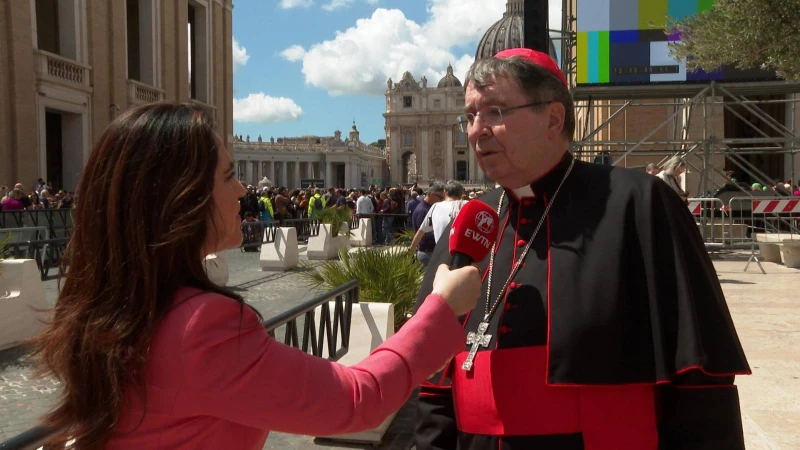
Apostolic Nuncio Cardinal Christophe Pierre told bishops at the 2025 United States Conference of Catholic Bishops’ (USCCB) Fall Plenary Assembly that the Second Vatican Council is “the key to understanding what Church we are called to be today and the reference point for discerning where we are headed.”
The French-born prelate has served as the Vatican’s nuncio, or chief diplomat, to the U.S. since 2016. He spoke Nov. 11 at the bishops’ fall assembly in Baltimore highlighting the message of Vatican II and its mission of evangelization, education, and unity.
In his address Pierre asked the bishops a two-part question: “Where have we been and where are we going?” Pope Leo XIV, in his new apostolic letter on education, asks the same question as he “urges education and communities to ‘raise your eyes’ and ‘know how to ask yourselves where you are going, and why,’” Pierre said.
“This act of questioning, of examining the direction of our journey, is an essential part of Christian discernment,” Pierre said. “It’s something that every bishop must do when thinking about the Church and trusting in his care, and it’s something that we must do in our shared journey as shepherds of the Catholic Church in the United States.”
Two days after his election, Pope Leo told the cardinals: “I would like us to renew together today our complete commitment to the path that the universal Church has now followed for decades in the wake of the Second Vatican Council.”
Pierre detailed multiple aspects that the Second Vatican Council offers to the bishops and the world today. It serves as “the self-description of the Church for our age.” In the words of popes John Paul II and Benedict XVI, it was “the great grace bestowed on the Church in the 20th century.”
“The council offered us not a new faith but a new way of describing and living the one faith in the modern world,” Pierre said. “The vision of the council was a vision for the future — a prophetic orientation toward a world that was only beginning to take shape.”
“When the council fathers issued those texts, the churches were still full; the effects of secularization had not yet become deeply visible. Many of the realities that the council intuited had not yet manifested themselves in the life of the world or of the Church.
“For this reason, the council’s documents were not fully understood in their time. They were not a description of where the Church stood but a map drawn for the territory into which she was being sent.”
“Today, that territory is our daily experience,” Pierre said. “We now inhabit the world that the council foresaw — a world marked by profound cultural shifts, technological change, and a secularized mindset that challenges faith at its roots. Now is the time to unfold the council’s map and walk its path — to rediscover in those texts the light and courage needed to navigate this moment with fidelity and creativity.”
Pierre: Vatican II continues its path from Francis to Leo XIV
“When asked about a Third Vatican Council, Pope Francis replied that the time is not ripe, because we are still laboring to fully implement the second. His pontificate was marked not by innovation for its own sake but by a call to live more fully the vision of the council.”
“In his first apostolic exhortation Dilexi Te, which Francis had begun, the Holy Father’s reference point continues to be Vatican II, this time as it addresses our mission among the poor. Recalling Pope Paul VI, who said that ‘the ancient parable of the good Samaritan served as the model for the council’s spirituality,’ Leo writes: ‘I am convinced that the preferential choice for the poor is a source of extraordinary renewal both for the Church and for society.’”
“He says that ‘the Second Vatican Council represented a milestone in the Church’s understanding of the poor in God’s saving plan.’”
Catholic education and evangelization
The nuncio detailed Catholic education and ecclesial renewal. Vatican II’s “teaching on worship, the mystery of the Church, the Word of God, and dialogue with the world converge in one vision: a Church rooted in faith, animated by hope, and engaged with humanity through love.”
Gravissimum Educationis remains “a sure guide,” Pierre said. “It affirmed the right of every person to an education ordered to truth and dignity, the role of parents as first educators, and the inseparable bond between faith and reason in forming the whole person.”
“Pope Leo now develops that heritage, urging educational communities to be builders of bridges, not walls — allowing reconciliation and peacemaking to become ‘the method and content of learning.’”
Leo urges “educational communities not just to impart skills but to heal relationships, form consciences, and choose not what is convenient but what is just,” Pierre said.
Catholic education remains one of the great “success stories” and “enduring strengths” of the Church in the United States, Pierre said. “Vatican II did not create this educational mission, but it gave it a new horizon: calling Catholic education to look outward, to engage a rapidly changing world, and to form disciples ready to bring the Gospel into new cultural and social contexts.”
Catholic education “continues to be a radiant witness of evangelizing hope; where it is neglected or narrowed, the light grows dim,” Pierre said. It “offers a window into the wider story of how the council’s teaching has been received across the Church in this country.”
Mission of the bishops
“If we embrace this full inheritance of Vatican II — the educational, pastoral, and social dimensions alike — the Church in the United States can continue to be what she has so often been: a leaven within this nation, a sign of hope that transcends division, and a servant of the common good grounded in the dignity of every human being.”
Bishops have “a call to represent the Church of the council,” Pierre said. “In our priesthood and episcopal vocation, we are called to be men of communion — pastors who walk with the people of God rather than standing apart.”
Bishops have a mission in evangelization and ecumenism, and in their engagement with public life, he said. Bishops “are not chaplains to parties or distant commentators but shepherds who bring the breadth of Catholic social teaching into civic discourse in a way that transcends partisanship.”
Pierre once again asked the bishops: “Where have we been, and where are we going?”
“The council is not behind us; it stands before us, the map for our journey,” Pierre said. “We are a Church rooted in the grace of the Second Vatican Council; a Church still receiving and embodying its vision; a Church sent forth in unity, as disciples and shepherds, bringing hope, joy, and mercy to a world in need.”
“The council’s documents continue to form us and guide our discernment of this moment,” Pierre said. “Pope Leo XIV now carries that same vision forward, interpreting it anew for the world of today.”
“If we walk faithfully with him, we will be the Church the council envisioned: a pilgrim people, a sacrament of communion, a beacon of hope, and a servant of the poor — drawing, even now, new maps of hope for the generations to come,” the nuncio concluded.
If you value the news and views Catholic World Report provides, please consider donating to support our efforts. Your contribution will help us continue to make CWR available to all readers worldwide for free, without a subscription. Thank you for your generosity!
Click here for more information on donating to CWR. Click here to sign up for our newsletter.


It sounds forward looking and dynamic, but then “ask yourselves where you are going, and why,” (Apostolic Nuncio Cdl Pierre). Where and how evokes something new [is it the latest from Study Group 9?].
Placing my mind in that of a USCCB member [imagination is a wonderful thing] there are myriad directions, interpretations of suggestions. Confined to the documents of VatII there aren’t, unless I’m mistaken, specific designations aside from good generalizations to engage our world.
Cardinal Pierre sounds more like a motivational counselor encouraging small business owners [corporations don’t need to know how to be successful]. The bishops have definitive diocesan boundaries. Why not grasp something tangible like the great bishops Augustine, Athanasius, Borromeo.
These men knew where they were going and why because they lived and preached the Gospels. When was the last time the reader recalls his bishop touring the Diocese preaching Christ, explaining doctrine?.
USCCB + NUNCIO = Men in search of a mission.
Actually, an encouraging message from the papal nuncio, and maybe even a mid-course correction after past decades and the past dozen years. I mean, a re-grounding in the Documents of the Second Vatican Council…
For decades Pope Benedict distinguished between the “real” council of the Documents and the “virtual” council of the media and the detached “spirit” of the council. Ever since the 1985 Extraordinary Synod [a real synod!] of Bishops which among other things, urged “…a new, more extensive and deeper knowledge of the Council. This can be attained above all through a new diffusion of the documents themselves” (Suggestion #6).
An assembly that was judged “necessary [….] in order to avoid divergent interpretations” (St. John Paul II, “Continuing the Work of Vatican II,” Dec. 7, 1985).
As for the floated notion of a Vatican III (above), now perhaps we’re being disabused of the notion that the Council can be procedurally replaced (?) by a self-referential, mixed company, ongoing, and incestuous Synod on Synodality (say what?). A Council or a distinct synod of bishops are one thing, a non-governing and consultative “ecclesial assembly” would be another.
In 2001-2004 yours truly served on a very credible archdiocesan pastoral council. During a break at one of the dozen listening sessions I found a reputable 1970ish priest at a round table actually studying the Documents (the Abbott edition, 1967)….said he, “there’s some very interesting material here; we never had any of this [!] in the seminary.” Look around at the current “mess,” and begin to wonder how many bishops today (some with red hats) attended such seminaries…
SUMMARY: A concise, readable and timely piece is “The Extraordinary Synod—1985: Message to the People of God,” St. Paul Editions, ISBN 0-8198-2316-3p, printed in the U.S.A. by the Daughters of St. Paul, 50 St. Paul’s Ave., Boston MA 02130.
Dear Holy Father and Prelates the last 60 years have shown a decline in belief of the True presence of our Lord in the most Blessed Sacrament. As a catechist for over the last 35 years of the 60 in question I can tell you to the dismay of my heart most of the children and their families have no clue, even after instruction that their duty is to follow the precepts of the Church. Attendance at Mass is no longer seen as a duty owed to God,but rather a an occasional gathering when convince allows. Sacraments are not the instruments of Grace but a social status. So sadly one might say that the last 60 years have not shown much of a growth in the Church but rather a decline. So I would pray that the place that we are going will be to the restoration of Faith in the hearts of Men!
Only two types of people still praise Vatican II: the liberal “catholic” who finds in it justification for his every disordered belief and action, and the professional theologian anxious for an “imprimatur” to increase book sales. Oh, and then there are Vatican bureaucrats…
Not your best TJW.