


ACI Prensa Staff, Nov 6, 2025 / 18:29 pm
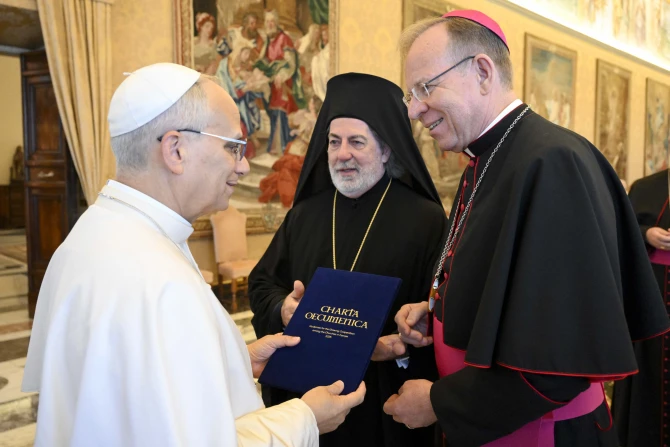
Pope Leo XIV received in a Nov. 6 audience the members of the Council of European Bishops’ Conferences (CCEE, by its Spanish acronym), the Ecumenical Council of Churches (CEC), and the representatives of the Christian Churches of Europe, who met in Rome to sign the updated “Charta Œcumenica.”
Signed in 2001 by the presidents of the Conference of European Churches (CEC) and the CCEE, the Ecumenical Charter has been the cornerstone of European ecumenical cooperation for more than two decades. The revised version seeks to address contemporary challenges and reflect the changing realities of European society and Christianity.
The revision process, initiated in 2022, was led by a joint working group of the CEC and the CCEE. To this end, input from churches and ecumenical organizations throughout Europe was considered for the purpose of ensuring that the updated text responds to current ecumenical needs.
The updated version was signed on Nov. 5 by Archbishop Gintaras Grušas of Vilnius, Lithuania, the president of the CCEE, and by Greek Orthodox Archbishop Nikitas Loulias of Thyateira and Great Britain.
Challenges on the ecumenical journey
During the meeting at the Apostolic Palace, the Holy Father emphasized that “the challenges Christians face on the ecumenical journey are constantly evolving,” and for this reason, it has been necessary to reexamine the situation in Europe.
Loulias, president of the CEC, explained to ACI Prensa, CNA’s Spanish-language news partner, after the audience with the Holy Father that “the world has changed” and that the realities of 25 years ago are not the same as those of today.
“Now there is the problem of migration, and how to treat migrants and the laws related to it. Also, how to confront nationalism, populism, ideas based on prejudice and hate, and what we, as Christians, preach: peace,” he emphasized.
The pope also noted in his address the importance of “constant and careful” discernment while lamenting that many Christian communities in Europe “feel increasingly like a minority.”
In this context, he recalled that new peoples are arriving in Europe that must be welcomed and listened to, promoting dialogue, harmony, and fraternity, particularly “amid the clamor of violence and war, whose echoes resound throughout the continent.”
“In all these situations,” the pope continued, “the grace, mercy, and peace of the Lord are truly vital, because only divine help will show us the most convincing way to proclaim Christ in these changing contexts.”
The pontiff referred to the ecumenical document as a “testimony to the willingness of the Churches of Europe to look at our history with the eyes of Christ” and noted that “the synodal path is ecumenical, just as the ecumenical path is synodal.”
In this regard, he emphasized that the new Ecumenical Charter “highlights the common path undertaken by Christians of different traditions in Europe, capable of listening to one another and discerning together in order to proclaim the Gospel more effectively.”
Sharing a common vision
Furthermore, Pope Leo highlighted that one of the most remarkable achievements of the review process has been “the ability to share a common vision on contemporary challenges and to establish priorities for the future of the continent while maintaining a firm conviction in the enduring relevance of the Gospel.”
In this regard, Loulias commented to ACI Prensa on the progress made on the path of ecumenism, emphasizing that “a hundred years ago, we didn’t even speak to each other.”
Although he acknowledged that challenges and problems still exist, especially due to language differences, he noted that this update “has allowed us to come together, cooperate, work together, respect one another, exchange thoughts and ideas, and recognize the values we share.”
At the end of his address, the Holy Father also expressed his desire to proclaim to all the peoples of Europe that “Jesus Christ is our hope, because he is both the path we must follow and the ultimate destination of our spiritual pilgrimage.”
Loulias referred to Pope Leo XIV as “a very humble, very thoughtful, and very kind man. We discussed various topics, and of course, I asked him to pray for peace during our private conversation.”
“As an Orthodox Christian and as a representative of the Ecumenical Patriarchate, I am proud to have been part of this process. Now the pope is preparing to travel to Istanbul to meet with the ecumenical patriarch [Bartholomew I]; these are significant signs of what is happening,” he said.
This story was first published by ACI Prensa, CNA’s Spanish-language news partner. It has been translated and adapted by CNA.
If you value the news and views Catholic World Report provides, please consider donating to support our efforts. Your contribution will help us continue to make CWR available to all readers worldwide for free, without a subscription. Thank you for your generosity!
Click here for more information on donating to CWR. Click here to sign up for our newsletter.

Fellow pilgrims on a common journey finding ways and means to encourage and support one another is good for togetherness and on-going-ness.
I’ve had it with acronyms.
CeeCeeEeeEee is not a word. Give me the Spanish. It will actually mean something that I can wrap my brain around.
Note to Carl: Kindly give me a contact for the editor(s) of Catholic News Agency.
He scores big with a Greek Orthodox Archbishop, with a good number of faithful Catholics [today faithful has a variety of interpretations here I simply referenced in line with Apostolic tradition] their opinion is on hold [as were the heralded Papal Posse].
Ecumenism is good. Religious equanimity not. As Roman Catholic [Roman called Latin although Latin ignominiously under suppression], whatever rite including Ukrainian, Syro-Malabar, Maronite, Melkite we’re compelled to acknowledge Jesus Christ as our unique savior, the indissolubility of the marriage bond, a compatible devotion to the Blessed Virgin Mary [to clear the waters as delineated in Carl Olson’s article The DDF Marian document relies on poor argumentation, reveals double standard].
Additionally, the so called red herring, the absolutely essential Filioque Clause, the Holy Spirit flowing out from Christ and the Father to the world]. I would add to them the complete human nature of Christ including a human will as well as a divine will. These doctrines cannot be compromised if we are to, and must retain our Catholicity.
Tendency in the Church since 2013 and Pope Francis has been the mitigation of Catholic Doctrine and the doctrine of principles of an intrinsic nature either good or evil. Moral principles of intrinsic evil and intrinsic evil nature have been mitigated with exaggerated principles of mitigation particularly since 2013 and the trend to date has been reinforced under Leo XIV.
In particular the LGBT Jubilee Rome march and celebration of Mass in St Peter’s. The recent Italian Conference of Bishops document on full inclusion of LGBT into the life of the Church. The first abomination has been partly corrected by an exorcism; the second so far has been given tacit approval by Pope Leo.
Our Church requires prayers and sacrifice, a willingness for honest questioning.