


Rome, Italy, Nov 2, 2025 / 12:40 pm
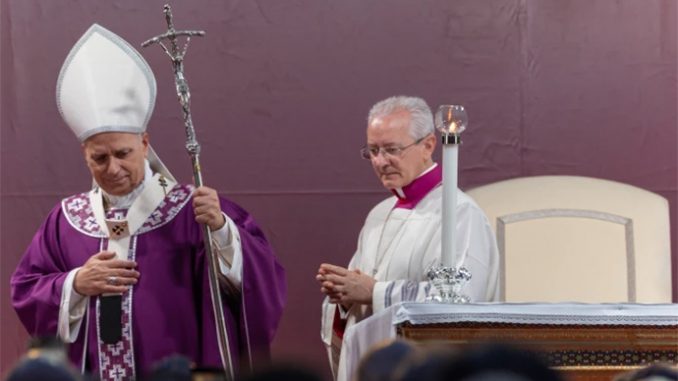
Celebrating Mass for the Commemoration of All the Faithful Departed at Rome’s Verano Cemetery, Pope Leo XIV invited Catholics to contemplate death “not so much as a recollection of the past, but above all as a hope for the future.”
The pope said the Christian vision of death is not one of despair or nostalgia but of confident expectation rooted in the resurrection of Christ. “Our Christian faith, founded upon Christ’s Paschal mystery, helps us to experience our memories as more than just a recollection of the past but also, and above all, as hope for the future,” he said in his homily.
He encouraged the faithful not to remain “in the sorrow for those who are no longer with us,” but instead to look forward “towards the goal of our journey, towards the safe harbor that God has promised us, towards the unending feast that awaits us.”
“This hope for the future brings to life our remembrance and prayer today,” the pope continued. “This is not an illusion for soothing the pain of our separation from loved ones, nor is it mere human optimism. Instead, it is the hope founded on the Resurrection of Jesus who has conquered death and opened for us the path to the fullness of life.”
Pope Leo emphasized that love is the key to this journey. “It was out of love that God created us, through the love of his Son that he saves us from death, and in the joy of that same love, he desires that we live forever with him and with our loved ones,” he said.
He urged Christians to anticipate eternal life by practicing charity in their daily lives. “Whenever we dwell in love and show charity to others, especially the weakest and most needy, then we can journey towards our goal, and even now anticipate it through an unbreakable bond with those who have gone before us.”
“Love conquers death,” he said simply. “In love, God will gather us together with our loved ones. And, if we journey together in charity, our very lives become a prayer rising up to God, uniting us with the departed, drawing us closer to them as we await to meet them again in the joy of eternal life.”
Concluding his homily, the pope invited those mourning loved ones to turn to the Risen Christ as their sure source of comfort and promise. “Even as our sorrow for those no longer among us remains etched in our hearts, let us entrust ourselves to the hope that does not disappoint,” he said. “Let us fix our gaze upon the Risen Christ and think of our departed loved ones as enfolded in his light.”
“The Lord awaits us,” he added. “And when we finally meet him at the end of our earthly journey, we shall rejoice with him and with our loved ones who have gone before us. May this promise sustain us, dry our tears, and raise our gaze upwards toward the hope for the future that never fades.”
This story was first published by ACI Prensa, CNA’s Spanish-language news partner. It has been translated and adapted by CNA.
If you value the news and views Catholic World Report provides, please consider donating to support our efforts. Your contribution will help us continue to make CWR available to all readers worldwide for free, without a subscription. Thank you for your generosity!
Click here for more information on donating to CWR. Click here to sign up for our newsletter.

Not sure if this was the Pope entire speech but it would be nice if he mentioned purgatory and the need to pray for our loved one’s and other souls in purgatory. But I guess we all go to heaven straight away now days.
Our parish priest did better.
Does our Church call for prayers for souls in purgatory anymore pope Leo? I guess the Lord awaits everyone and we will all rejoice with him at the end of our earthly journey. How about the final judgment?
I read the entire homily at the link provided in the article. Apart from offering one’s acts of charity as a prayer (whether or not done in the name of Christ), not a word of fidelity to the faith, not a word of caution; just this:
“Let us fix our gaze upon the Risen Christ and think of our departed loved ones as enfolded in his light. Let us allow the Lord’s promise of eternal life to resound in our hearts. He will destroy death forever. Indeed, he has already conquered it, opening for us the way to eternal life by passing through the valley of death during his Paschal mystery. Thus, united to him, we too may enter and pass through the valley of death. The Lord awaits us, and when we finally meet him at the end of our earthly journey, we shall rejoice with him and with our loved ones who have gone before us. May this promise sustain us, dry our tears, and raise our gaze upwards toward the hope for the future that never fades.”
The Lord awaits us. This promise has no caveats or “fine print.” When I think of the implications of what has passed at the Vatican in the last couple weeks, I begin to suffocate a little. Better to keep the eyes on the Tabernacle …
Oh, the fact that the Lord awaits us is not in question. What is in question is the “rejoicing” part. We will all appear before Him in judgement.
Well, Leo DID just name Newman a Doctor of the Church, and Newman wrote this (https://www.newmanreader.org/works/verses/gerontius.html) regarding the experience of death for a soul about to enter Purgatory.
We are all fellow pilgrims joyfully marching together to our cherished destination.
Amoris Laetitia says that “no one can be condemned forever.” –297
Why would you place much stock in the comment from the man who signed off on that document but never did display much knowledge of the Catholic religion?
Cajetan, if all are joyfully marching to their destination, there are lots of deluded persons in need of evangelization before the final denouement. Let’s get busy doing what Christ asked us to do.
While it is indeed an impoverishment that Pontiff Leo missed an opportunity to talk about praying for the forgiveness of sins of the faithful departed, Dante’s Purgatorio from his Divine Comedy provides what I found to be a sublime account of the human need for persevering in prayer for our purification from the burdens of our sins.
I was first inspired to read the Divine Comedy by a family member who said he read The Inferno and considered it great literature, but on the simple say so of “literature professors,” dismissed and refused to read the Purgatorio and the Paradiso. So much for the “open minds” of certain “academic experts.”
All I can say is that I am glad I read all 3, and I am sorry that my family member shutters his mind to such a wondrous work of art.
I will offer 4 things about the sights and sounds and lessons of The Purgatorio, that are among the treasure house of jewels stored inside by Dante, to encourage any reader to pick up the Divine Comedy (I bought the recent translation by the Catholic literary scholar Anthony Esolen) and read the whole work:
1. The opening of the Purgatorio is one of the most beautiful descriptions of the sun at dawn that a person could ever conjure, when after climbing out of the cavern of Hell, and near suffocating in its “dead air,” Dante and Virgil feel a breath of fresh air ahead of them, and they look up and see the light ahead of them, and then they see the sun for the first time, and Esolen gives you the Italian verse, side-by-side with his English translation: “Dolce color d’oriental zaffiro….”
2. Shortly after, they see more than a hundred souls teaming aboard a boat, that glides over the water, piloted by angel, toward the shore of the island mountain of Purgatory, and Dante hears the “happy souls” singing with one voice the chant from the Psalm: “When out of Egypt Israel came….”
3. It is at Purgatory where Virgil cannot enter, and so he gives Dante over to Beatrice, the beautiful young woman who Dante loved in life, but who died young, and who is given the task of escorting Dante up the mountain of Purgatory, and then the privilege of leading him from Purgatory to Paradise. You learn something, from Beatrice and her journey with Dante, of a surprising and painful thing that Dante is faced with confessing.
4. And at the summit of Mount Purgatory, Dante’s lyrics astonish you with the simple result that explains why souls can finally do what they were naturally created to do.
Read The Divine Comedy, and enjoy it all, including the beautiful path of from Purgatory to Paradise.
My pastor preached on the blessing of Purgatory and how we must not limit our prayers for the holy souls to today or this month even, but to every day of the year. We had the catafalque in the sanctuary before the foot of the altar as a visual reminder of the very same. I don’t think it’s fitting to commemorate the Holy Souls on Sunday, so I was happy to attend the 21st Sunday after Pentecost yesterday (Nov 2nd) & All Souls Day today (Nov 3). Honestly, something feels unfitting & perhaps even offensive to celebrate All Souls Day on a Sunday (& even over two days!! insofar as the anticipated Mass of Sunday this past Saturday evening was supposedly required to be the All Souls Day Mass). Please help me with the math. Sunday is generally dedicated to the Lord, perhaps one of his mysteries, or major saints like the Blessed Virgin Mary or the Apostles Peter & Paul. But here All Saints Day got ended early, liturgically, to focus on All Souls Day. The Novus Ordo Missae’s ordo (calendar) is, I assume, the first in Church history to follow this methodology. I’m eager to learnt the actual history here, but I’m assuming it’s only in the last 55 years that the Church has entertained this arrangement: drop the Sunday in favor of All Souls Day…and likely to hear that all souls go to heaven, just be sure to hope and it will be true.
Jamie,
According to the “old” rubrics if the Holy Souls falls on Sunday, it should be celebrated on November 3. Indeed, nobody does funerals on Sunday, and it felt odd to have that kind of a mass on Sunday.
Death is hope for the future for souls in purgatory whom we are called to pray for. The saints in heaven do not need our prayers. We need theirs.
The last two Popes seem to speak in riddles and enigmas. Everything is open to interpretation. My advice to this papacy: Speak infrequently and when you do speak with clarity and in full conformity with the Magisterium.