


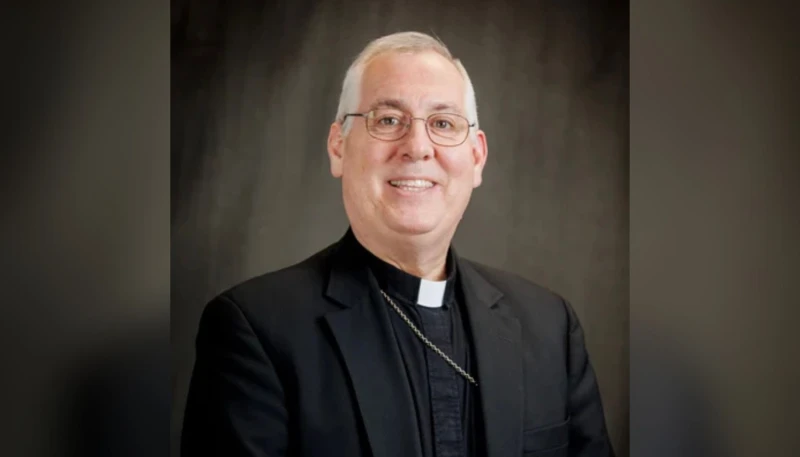
Vatican City, Oct 20, 2025 / 09:44 am (CNA).
Pope Leo XIV on Monday named Bishop Mark O’Connell, an auxiliary bishop of Boston, the next bishop of the Diocese of Albany, New York.
O’Connell, a canon lawyer, succeeds the 77-year-old Bishop Edward B. Scharfenberger, who has been bishop of Albany since 2014 and whose resignation was accepted by Pope Leo on Oct. 20.
The 61-year-old O’Connell has served the Archdiocese of Boston as an auxiliary bishop since 2016. He has also been vicar general and moderator of the curia since December 2022.
The Diocese of Albany serves approximately 300,000 Catholics in the capital city of New York state and the surrounding area.
Scharfenberger announced earlier this year that the diocese will undergo a planning initiative in response to a “financial and maintenance crisis” that could result in the closure of up to one-third of its 126 parishes.
O’Connell was born in Toronto, Ontario, Canada, on June 25, 1964, to American parents. His family moved back to the United States when he was 12. He earned a bachelor’s degree in English and philosophy from Boston College before studying for the priesthood.
He was ordained a priest for the Archdiocese of Boston in 1990. In 2002, he was awarded a doctorate in canon law from the Pontifical University of the Holy Cross in Rome. Upon returning to Boston, he became part of the canonical affairs staff of the archdiocese. From 2007 to 2018 he was judicial vicar.
He also served as a senior consulter to the Canon Law Society of America from 2009 to 2012 and was part of the faculty of St. John’s Seminary and the Pope St. John XXIII National Seminary in Weston, Massachusetts.
O’Connell also has experience in radio. As a priest, he was the co-host of a daily radio program, “The Good Catholic Life,” broadcast in Boston from 2011 to 2014.
In 2021, O’Connell voted against a motion of the U.S. bishops’ conference to begin drafting a teaching document on the Eucharist.
He revealed in a July 25, 2025, statement that he believed the Eucharistic document would lead to greater polarization. O’Connell published his statement in the bulletin of St. Theresa Parish in North Reading, Massachusetts, as a response to a parishioner’s question about denying Communion to pro-abortion politicians.
In written responses to CNA’s questions after the publication of his letter, O’Connell said he saw the discussion of denial of Communion to certain public figures as focusing too heavily on abortion, to the detriment of other issues.
If you value the news and views Catholic World Report provides, please consider donating to support our efforts. Your contribution will help us continue to make CWR available to all readers worldwide for free, without a subscription. Thank you for your generosity!
Click here for more information on donating to CWR. Click here to sign up for our newsletter.


“O’Connell said he saw the discussion of denial of Communion to certain public figures as focusing too heavily on abortion, to the detriment of other issues.”
Yet another apostate bishop for the US Church. What a shame. Albany deserves better. Before Scharfenburger, there was Bishop Hubbard who got married in a civil ceremony. Perhaps someday the Church will return to the Catholic faith.
Well suited to follow the Francis I, Cdl Cupich, Leo XIV lineage. Where will accommodation take us if not the devaluation of the very reason we’re called to priesthood. To witness to what Christ and the Apostles taught.
The disappointment is confirmed with every passing day.
Bishop O’Connell is a highly intelligent man who works well with people. His canon law background and personal humility will be important in the very difficult work awaiting him in Albany. I am a bit surprised that he accepted the nomination. He’s a very self-effacing fellow. To brand him an apostate is ludicrous and beyond uncharitable.
Very simply: He insufficiently appreciates the gravity of abortion and the sanctity of the Eucharist. Who cares that he has a degree in Canon Law?
At a time when dioceses everywhere are being distilled into fewer parishes (Boston losing one third of its 126 parishes), what better time to teach the Eucharistic nature of the Catholic Church? As contrasted with the Lutheran redefinition as a confederation of “communities” with local leaders and rooted only in gospel values (while the Gospels witness, instead, directly to Jesus Christ as the Incarnation).
But, Pope Benedict clarified two different and concurrent abuses of the Eucharist:
FIRST: “In fact, the terminological shift from ‘Church’ to ‘community’ reveals more convincingly, perhaps, than is revealed anywhere else the inner process of the Reformation’s transposition of the structure of faith. For Luther, Church means community, whereas the Church as ‘successio,’ as the unity of binding tradition in a sacramental and personal form, loses for him here theological content. At best, she becomes an instrument, and organization […]; the organized and sacrally clothed obstacle to the ‘gospel’ (by which he means, not the four Gospels or the Bible as such, but the message of justification as the central concept of Holy Scripture).”
[In contrast with some literature from the Orthodox Churches, Benedict retained both a Eucharistic and a juridical Church. Yes, in each celebration of the Eucharist, the local assembly] “has the whole Lord; in the sacrament, it thus has also the whole Church and IS the whole Church. The Church is wholly present in the eucharistic assembly, that is, in every local assembly; to this, the ‘universal Church’ can add nothing more, for there is nothing ‘more’ than the eucharistic assembly.”
But SECOND: “To celebrate the Eucharist means to enter into union with the universal Church [!]—that is, with the one Lord and his one Body […] The outward sign that one cannot manipulate the Eucharist at will and that it belongs to the universal Church is the ‘successio apostolica’ [Apostolic Succession]: it means that no group can constitute itself a church but ‘becomes’ a church only by being received as such by the universal Church [….] Catholicity…is a central inner dimension of the very mystery of the Eucharist” (“Catholicity as the Formal Principle of Christianity” in “Principles of Catholic Theology”, Ignatius, 1987).
Reorganized parishes must not become community lifeboats. Might it be that rather than a Francis II, Pope Leo XIV is navigating doubly troubled waters? Yes, catastrophic moral issues (pro-abortion politicians presenting themselves for Communion), but also the risk of disrupted local parishes (not communities) drifting further from the Apostolic Succession—without which we have no universal Eucharist. Local pastors are, firstly, extensions of their bishops.
SUMMARY: About the Church within the Eucharist, and the Eucharist within the Church—as a canon lawyer, is Leo intent on maintaining unity instead of the “mess” inherited from Francis? The Albany appointment is also a canon lawyer.
Wishing Bishop the Reverend Mark O’Connell and his flock divine blessings.