

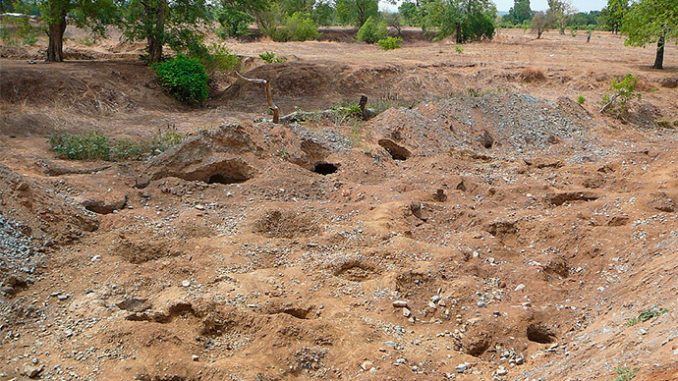
The Catholic bishops in Ghana have warned that the government risks being complicit in the “ecocidal tragedy of monumental proportions” if it fails to act swiftly and decisively on illegal gold mining, known locally as ‘galamsey’.
Ghana solidified its position as Africa’s top gold producer in 2022, with production surging by 32% to approximately four million ounces. Gold is the cornerstone of the nation’s mining sector, contributing over 93% of its mineral revenue in 2019, far outpacing other resources such as manganese and bauxite.
Yet, this official boom is undercut by galamsey, or illegal mining, which supports nearly 4.5 million people. In 2016, this dark side of the gold rush cost the state an estimated $2.3 billion in smuggled gold, depriving the state of vital revenue.
During a high-level engagement on Friday, October 3, Catholic Bishops in Ghana addressed a statement to President John Dramani Mahama, painting a disquieting picture of the environmental impacts of illegal gold mining in the West African country.
“The evidence is stark: mercury and arsenic levels in some communities exceed safe limits by hundreds of times. Rivers, soils, and crops are contaminated; over half a million farmers have been displaced; and children are already bearing the scars of toxic exposure. Our water, our food security, and the very future of our nation are at stake,” the bishops said.
They noted that God’s mandate for man to care for the environment “is not a license for reckless exploitation but a sacred trust for the common good.”
“Yet, our rivers, forests, and farmlands now bear witness to a profound betrayal of this mandate,” the clerics noted.
“The Pra, Ankobra, Birim, Offin, Ayensu, and other once-pristine rivers are now laced with mercury and toxic effluents. Some have ceased to flow downstream, while others, like the Ayensu, show turbidity levels so extreme—32,000 NTU [Nephelometric Turbidity unit] compared to the Ghana Water Company’s maximum treatment threshold of 2,500 NTU—that they defy purification. Once-verdant forests lie stripped to barren scars, while fertile farmlands are rendered sterile, punctured by deadly pits,” they explained.
They said the damage had gone from being just an environmental issue to also becoming a health and human rights emergency.
Environmental advocate Francisca Dommetieru Ziniel told CWR in an e-mail interview that creation “is a gift from God and not just a resource to be exploited, but a sacred trust to be nurtured and protected.”
The Coordinator of the Catholic Youth Network for Environmental Sustainability in Africa (CYNESA) in Ghana said that the destruction caused by illegal mining (galamsey) goes beyond “economics and politics as it is a direct affront to the Creator.”
She said what’s happening in Ghana is not just environmental damage but a systematic desecration of God’s handiwork.
Recalling Pope Francis’ encyclical, Laudato Si’, which “reminds us that the cry of the earth and the cry of the poor are one and the same,” Ms.Ziniel noted that “when we poison our rivers, strip our forests, and pollute our land all in the name of looking for gold, the earth resources, we are not only violating nature, but are sinning against the Creator, future generations and against the poorest among us who depend directly on the land and rivers for their survival. “
“In this sense, environmental destruction becomes a spiritual crisis emanating from a failure of stewardship, a breakdown of our relationship with God, our neighbor, and creation itself,” she told CWR.
She said the degradation of the environment in Ghana is also a matter of justice for the most vulnerable.
“It is the poor, the rural farmers, the children drinking contaminated water, and the women walking miles for clean water who bear the brunt of this destruction. They are displaced from their lands, stripped of their livelihoods, and left to face health crises that they did not create,” Ms. Ziniel told CWR.
In her work leading campaigns for CYNESA Ghana, Ms. Ziniel has seen the true price of environmental neglect. It is measured in the bodies of children suffering from mercury poisoning, in fertile fields that now lie barren, and in families shattered by desperation.
“This is not just environmental damage but an exploitation of the most vulnerable,” she told CWR. “If our faith means anything, it must compel us to act in solidarity with these communities and demand accountability and justice.”
She noted that the Church cannot afford to stay on the sidelines of the worsening damage to the environment. “We are called not only to preach but to act,” she said, explaining that “advocacy is crucial, but it must be paired with bold, realistic action and demands.”
“We must monitor environmental abuses, document the injustices, and protest where necessary,” Ziniel declared, calling for a more active Church leadership.
She urged Catholics to mobilize every level—parishes, youth groups, and the lay faithful—to take full ownership of the environmental crisis. But this responsibility, she added, is not only about confrontation. The Church must also be at the forefront of building a better future by helping to implement sustainable alternatives that empower communities through ecological education, support reforestation, and partner with policymakers for just and lasting change.
“At CYNESA Ghana, we see the Church as a bridge between moral conviction and civic action and also a trusted and a credible institution that can help people move from concern to concrete steps,” Ziniel said. “The faithful must see that protecting creation is not an optional extra but central to our mission as disciples.”
Ziniel described how her spiritual life is the bedrock of her activism, providing both the anchor in the storm and the compass for her methods.
“Activism, especially in a context like illegal mining (galamsey), is indeed messy,” Zaniel admits. “It often feels like fighting a tidal wave with a bucket.” But where others might see prayer as a retreat from the front lines, she sees it as the very source of her endurance.
“But prayer and liturgy are not distractions from this work,” she insists; “they are my anchor.”
This spiritual foundation is what allows Ziniel to confront the immense challenges without burning out. For her, the Eucharist “provides the necessary nourishment, strength and courage especially when it becomes overwhelming,” while praying the Rosary and seeking the intercession of the Virgin Mary “brings about a sense of calmness, peace and clarity.”
This deep reliance on faith profoundly shapes her approach to advocacy. It moves her beyond mere opposition to a more transformative vision.
“We are not called to destroy the people and institutions that we disagree with,” she explains, “but to transform unjust systems with love and truth.”
“It is not enough to condemn,” she continues, “but we must also suggest alternatives, lead in example through actions, educating and inspiring others.”\
Face with such a daunting challenge, Ziniel finds hope “in the many young people of Ghana leading various campaigns and advocacies for the environment.” She notes that there is a new generation that is “rising up to say, enough is enough.”
She sees this hope in the resilience of affected communities, in farmers who replant after their land is destroyed, and in mothers who organize clean water campaigns.
“And most importantly,” she asserts, “I find hope in our faith, the promise that God is with us in this struggle as the resurrection reminds us that no evil, no matter how entrenched, has the final word.”
“If we remain faithful, if we act together, justly and love mercy, we will see change,” she concludes, “not because the fight is easy, but because we walk it with God.”
Moving beyond general condemnation, the Ghana Catholic Bishops’ Conference has presented President Mahama with a specific, actionable blueprint to dismantle the illegal mining networks they describe as a “cancer” afflicting the nation.
These include imposing a state of emergency, the visible prosecution of high-level offenders named in official reports, and the creation of promised fast-track courts for swift justice.
“Our people must see that no one is above the law, and that economic expediency cannot outweigh the sacred right to clean water, safe food, and a healthy environment,” the clerics said in the letter addressed to the country’s President.
“To delay is to risk complicity in what is fast becoming an ecocidal tragedy of monumental proportions,” they added.
They noted that history won’t measure President Mahama’s leadership by words alone, but also by “the protection you secure for generations yet unborn.”
If you value the news and views Catholic World Report provides, please consider donating to support our efforts. Your contribution will help us continue to make CWR available to all readers worldwide for free, without a subscription. Thank you for your generosity!
Click here for more information on donating to CWR. Click here to sign up for our newsletter.

The “Drill baby drill “ mentality of many deniers! Should the Bishops keep quiet ? Do they have a right or place to speak out in the public forum? Is it a matter of right and left or right and wrong? I’m listening! 👂
What would this have to do with “climate change ” questioning?
It’s about mercury and arsenic pollution. Cleaning up pollution should be something we can all agree on.
Exploiting the environement with care to preserve it springs from the love of God who bequeathed it us, and fear of separating ourselves from His love.
Catholicism can help respond to this cult-ural and ecological disaster via Love and Reverence for the Blessed Sacrament from which Care of God’s Creation can flow.
For without transcendance man is locked in the immanence of his existence, separating himself from his essence as a child of God and behaving unchecked by his conscience.
Exposition of the blessed sacrament could thus help resolve the cult-ural problem behind the ecologically devastating decisions and actions, as man loves and fears the Lord present before him and above him.
The article below sums up the failure of our leaders, past and present to tackle and deal decisively the menance of galamsey. It’s a laudable move but too late……
Galamsey: A National Tragedy Betraying Future Generations
Illegal mining—popularly known in our local parlance as *galamsey*—has become one of the gravest national crises of our time. What was once the pride of Ghana—lush green lands, fertile soils, and clean rivers—is being destroyed before our very eyes, with devastating consequences for human health, agriculture, and the environment.
Across the country, rivers that once gave life to entire communities have turned into poisonous streams of red and milky liquid, unfit for drinking or even irrigation. Food crops grown on contaminated lands are now laden with heavy metals, slowly poisoning our people and threatening future generations. Fisherfolk can no longer rely on our rivers, farmers are losing their livelihoods, and ordinary citizens are forced to spend their meagre income on buying safe drinking water—all because of the reckless and selfish actions of a few, enabled by the silence or complicity of many.
But who is to blame for this tragedy? The responsibility lies squarely on the shoulders of Ghana’s leaders—past and present. Successive governments have failed to enforce laws with the firmness and consistency required. Too often, political expediency and short-term gains have been placed above the long-term survival of the nation. Traditional authorities, who are custodians of the land, have in many cases looked the other way or even facilitated illegal mining for personal benefit. Religious leaders, whose moral voices should have guided the nation, have remained disturbingly quiet. Civil society has raised alarms but has not sustained the pressure needed to bring about meaningful change.
And perhaps most insulting of all, we have allowed foreigners—particularly Chinese nationals—to destroy our rivers and lands with impunity. This is not only an environmental crime but an affront to Ghana’s dignity and sovereignty. Can a Ghanaian go to China and pollute rivers with mercury and cyanide? The very thought is unimaginable. Why, then, have we accepted such a situation in our own country?
The truth is simple: galamsey is not just about illegal mining; it is about leadership failure. It is about the betrayal of the trust placed in those who were supposed to safeguard our natural heritage for generations yet unborn. If immediate, drastic, and uncompromising action is not taken, Ghana may soon become a nation where clean water is a luxury, where fertile soil is a memory, and where our children inherit a poisoned land.
The time for excuses is over. Leaders at all levels—government, traditional, religious, and civil society—must rise above self-interest and act decisively. Laws must be enforced without fear or favour. Those in positions of authority who turn a blind eye to this destruction must be held accountable. And as citizens, we must demand nothing less than urgent action to save our rivers, lands, and people from this preventable disaster.
Galamsey is not just an environmental issue—it is a national security threat, a moral crisis, and an assault on the future of Ghana. Enough is enough.
By: Tony Parker Danso,
Concerned citizen
Cell: +245 96 665 1157
E-mail: tonyparkerdanso@yahoo.com