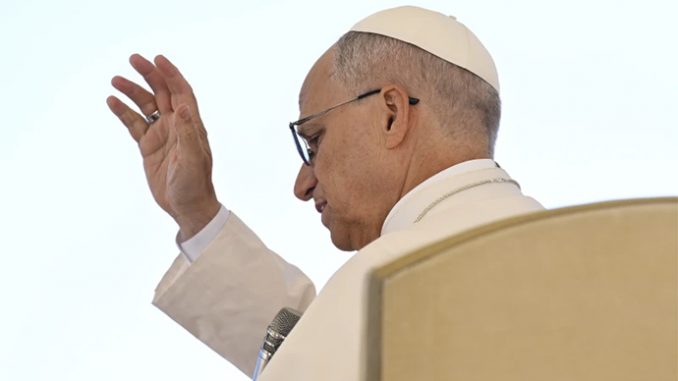
Pope Leo XIV blesses pilgrims in St. Peter's Square during an audience for the Jubilee of Hope on Oct. 4, 2025. (Credit: Vatican Media)
Vatican City, Oct 9, 2025 / 06:01 am (CNA).
In the first major document of his pontificate, Pope Leo XIV writes that the poor are not only objects of charity, but evangelists who can prompt us to conversion through their example of weakness and reliance on God.
“The poor can act as silent teachers for us, making us conscious of our presumption and instilling within us a rightful spirit of humility,” Leo writes in Dilexi Te (“I have loved you”), released by the Vatican on Thursday. “The elderly, for example, by their physical frailty, remind us of our own fragility, even as we attempt to conceal it behind our apparent prosperity and outward appearance. The poor … remind us how uncertain and empty our seemingly safe and secure lives may be.”
The pontiff quotes his predecessor throughout the document, which was first drafted during the previous pontificate and draws heavily on Pope Francis’ first apostolic exhortation, Evangelii Gaudium, on the joy of the Gospel. An apostolic exhortation is one of the most authoritative genres of papal teaching, typically focused on the pastoral application of doctrine.
Christ’s whole life is an example of poverty, Leo writes, and the Church, if it wants to belong to Christ, must give the poor a privileged place.
“For Christians, the poor are not a sociological category, but the very ‘flesh’ of Christ,” he writes. “The Lord took on a flesh that hungers and thirsts, and experiences infirmity and imprisonment.”
Inherited from Pope Francis
Leo signed the exhortation on Oct. 4, the feast of St. Francis of Assisi, who is traditionally known as Il Poverello (“the Little Poor Man”).
The pontiff explains at the beginning of the document that he received it as an inheritance from Pope Francis, who was working on it during the final months of his life.
The document traces the Church’s perennial teaching on the poor, drawing on the Old and New Testaments, the practice of the early Christian community, the writings of Church Fathers and Doctors, the lives of the saints, the documents of the Second Vatican Council, and the magisterium of the popes since St. John XXIII.
Leo also commends the example of contemplative and active religious orders throughout history that have helped the poor with healthcare, food, shelter, and education.
“Every movement of renewal within the Church has always been a preferential concern for the poor. In this sense, her work with the poor differs in its inspiration and method from the work carried out by any other humanitarian organization,” he writes.
Technological progress has not eradicated poverty, which only continues to appear in diverse forms, the pope writes. He defines the poor to include the incarcerated, victims of sexual exploitation, those affected by the degradation of the environment, and immigrants.
“The Church, like a mother, accompanies those who are walking. Where the world sees threats, she sees children; where walls are built, she builds bridges,” he says. “And she knows that in every rejected migrant, it is Christ himself who knocks at the door of the community.”
Lack of material and spiritual care
Leo denounces prejudices that he says can lead Christians to neglect their duty to the poor.
“There are those who say: ‘Our task is to pray and teach sound doctrine’ [and argue] that it is the government’s job to care for [the poor], or that it would be better not to lift them out of their poverty but simply to teach them to work,” he writes.
Sometimes “pseudo-scientific data are invoked to support the claim that a free-market economy will automatically solve the problem of poverty,” or that the rich can enact more effective solutions, the pope writes.
Leo condemns such views as worldly and superficial, and “devoid of any supernatural light.”
Dilexi Te also emphasizes the spiritual needs of the poor, arguing that those are more important than the material, yet often ignored by the Church.
It is not a question of “providing for welfare assistance and working to ensure social justice. Christians should also be aware of another form of inconsistency in the way they treat the poor. In reality, “the worst discrimination which the poor suffer is the lack of spiritual care,’” the pope writes, quoting Pope Francis.
Leo ends his exhortation by emphasizing the duty of almsgiving, which he claims has fallen out of fashion, even among believers.
“Almsgiving, however modest, brings a touch of pietas [“piety”] into a society otherwise marked by the frenetic pursuit of personal gain,” he says, adding that, though it will not be the solution to poverty in the world, it will touch our hearts.
“Our love and our deepest convictions need to be continually cultivated, and we do so through our concrete actions,” he continues. “Remaining in the realm of ideas and theories, while failing to give them expression through frequent and practical acts of charity, will eventually cause even our most cherished hopes and aspirations to weaken and fade away. For this very reason, we Christians must not abandon almsgiving. It can be done in different ways, and surely more effectively, but it must continue to be done. It is always better at least to do something rather than nothing.”
If you value the news and views Catholic World Report provides, please consider donating to support our efforts. Your contribution will help us continue to make CWR available to all readers worldwide for free, without a subscription. Thank you for your generosity!
Click here for more information on donating to CWR. Click here to sign up for our newsletter.
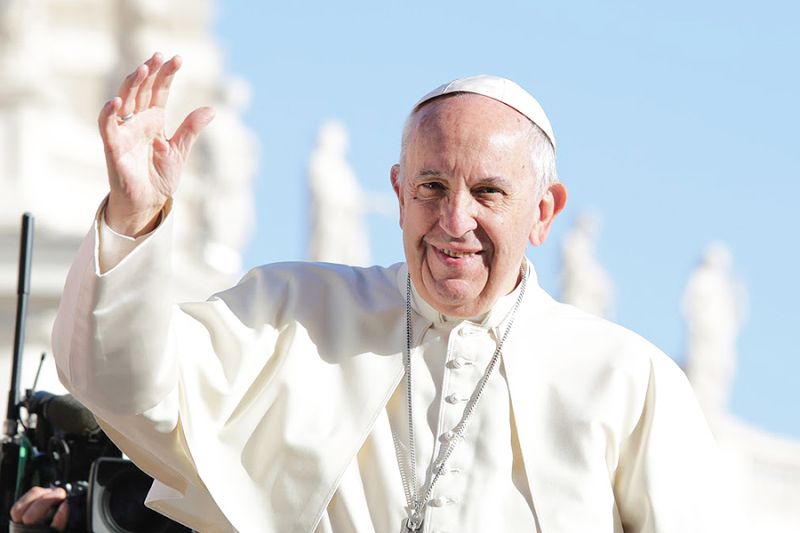
Pope Francis at the general audience in St. Peter’s Square, Oct. 5, 2016. / Daniel Ibanez/CNA.
Washington, D.C. Newsroom, Mar 13, 2023 / 13:15 pm (CNA).
Today marks the 10th anniversary of the election of Pope Francis as the 265th successor of St. Peter. Here is a timeline of key events during his papacy:
2013
March 13 — About two weeks after Pope Benedict XVI steps down from the papacy, Cardinal Jorge Bergoglio is elected pope. He takes the papal name Francis in honor of St. Francis of Assisi and proclaims from the central balcony of St. Peter’s Basilica: “Let us begin this journey, the bishop and people, this journey of the Church of Rome, which presides in charity over all the Churches, a journey of brotherhood in love, of mutual trust. Let us always pray for one another.”
March 14 — The day after he begins his pontificate, Pope Francis returns to his hotel to personally pay his hotel bill and collect his luggage.
July 8 — Pope Francis visits Italy’s island of Lampedusa and meets with a group of 50 migrants, most of whom are young men from Somalia and Eritrea. The island, which is about 200 miles off the coast of Tunisia, is a common entry point for migrants who flee parts of Africa and the Middle East to enter Europe. This is the pope’s first pastoral visit outside of Rome and sets the stage for making reaching out to the peripheries a significant focus.
Pope Francis gives the Wednesday general audience in St. Peter’s Square on Oct. 2, 2013. . Elise Harris/CNA.
July 23–28 — Pope Francis visits Rio de Janeiro, Brazil, to participate in World Youth Day 2013. More than 3 million people from around the world attend the event.
July 29 — On the return flight from Brazil, Pope Francis gives his first papal news conference and sparks controversy by saying “if a person is gay and seeks God and has goodwill, who am I to judge?” The phrase is prompted by a reporter asking the pope a question about priests who have homosexual attraction.
Nov. 24 — Pope Francis publishes his first apostolic exhortation Evangelii gaudium (The Joy of the Gospel). The document illustrates the pope’s vision for how to approach evangelization in the modern world.
2014
Feb. 22 — Pope Francis holds his first papal consistory to appoint 19 new cardinals, including ones from countries in the developing world that have never previously been represented in the College of Cardinals, such as Haiti.
March 22 — Pope Francis creates the Pontifical Commission for the Protection of Minors. The commission works to protect the dignity of minors and vulnerable adults, such as the victims of sexual abuse.
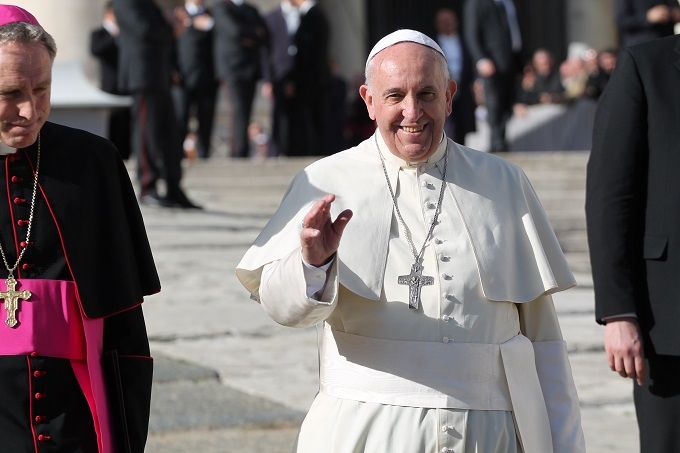
Pope Francis greets pilgrims during his general audience on Nov. 29, 2014. Bohumil Petrik/CNA.
Oct. 5 — The Synod on the Family begins. The bishops discuss a variety of concerns, including single-parent homes, cohabitation, homosexual adoption of children, and interreligious marriages.
Dec. 6 — After facing some pushback for his efforts to reform the Roman Curia, Pope Francis discusses his opinion in an interview with La Nacion, an Argentine news outlet: “Resistance is now evident. And that is a good sign for me, getting the resistance out into the open, no stealthy mumbling when there is disagreement. It’s healthy to get things out into the open, it’s very healthy.”
2015
Jan. 18 — To conclude a trip to Asia, Pope Francis celebrates Mass in Manila, Philippines. Approximately 6 million to 7 million people attend the record-setting Mass, despite heavy rain.
March 23 — Pope Francis visits Naples, Italy, to show the Church’s commitment to helping the fight against corruption and organized crime in the city.
May 24 — To emphasize the Church’s mission to combat global warming and care for the environment, Pope Francis publishes the encyclical Laudato si’, which urges people to take care of the environment and encourages political action to address climate problems.
Pope Francis at a Wednesday general audience in St. Peter’s Square on June 17, 2015. Bohumil Petrik.
Sept. 19–22 — Pope Francis visits Cuba and meets with Fidel Castro in the first papal visit to the country since Pope John Paul II in 1998. During his homily, Francis discusses the dignity of the human person: “Being a Christian entails promoting the dignity of our brothers and sisters, fighting for it, living for it.”
Sept. 22–27 — After departing from Cuba, Pope Francis makes his first papal visit to the United States. In Washington, D.C., he speaks to a joint session of Congress, in which he urges lawmakers to work toward promoting the common good, and canonizes the Franciscan missionary St. Junípero Serra. He also attends the World Meeting of Families in Philadelphia, which focuses on celebrating the gift of the family.
Oct. 4 — Pope Francis begins the second Synod on the Family to address issues within the modern family, such as single-parent homes, cohabitation, poverty, and abuse.
Oct. 18 — The pope canonizes St. Louis Martin and St. Marie-Azélie “Zelie” Guérin. The married couple were parents to five nuns, including St. Therese of Lisieux. They are the first married couple to be canonized together.
Dec. 8 — Pope Francis’ Jubilee Year of Mercy begins. The year focuses on God’s mercy and forgiveness and people’s redemption from sin. The pope delegates certain priests in each diocese to be Missionaries of Mercy who have the authority to forgive sins that are usually reserved for the Holy See.
2016
March 19 — Pope Francis publishes the apostolic exhortation Amoris laetitia, which discusses a wide variety of issues facing the modern family based on discussions from the two synods on the family. The pope garners significant controversy from within the Church for comments he makes in Chapter 8 about Communion for the divorced and remarried.
April 16 — After visiting refugees on the Greek island of Lesbos, Pope Francis allows three Muslim refugee families to join him on his flight back to Rome. He says the move was not a political statement.
Pope Francis at the General Audience in St. Peter’s Square, Feb. 24, 2016. Daniel Ibanez/CNA.
July 26–31 — Pope Francis visits Krakow, Poland, as part of the World Youth Day festivities. About 3 million young Catholic pilgrims from around the world attend.
Sept. 4 — The pope canonizes St. Teresa of Calcutta, who is also known as Mother Teresa. The saint, a nun from Albania, dedicated her life to missionary and charity work, primarily in India.
Sept. 30–Oct. 2 — Pope Francis visits Georgia and Azerbaijan on his 16th trip outside of Rome since the start of his papacy. His trip focuses on Catholic relations with Orthodox Christians and Muslims.
Oct. 4 — Pope Francis makes a surprise visit to Amatrice, Italy, to pray for the victims of an earthquake in central Italy that killed nearly 300 people.
2017
May 12–13 — In another papal trip, Francis travels to Fatima, Portugal, to visit the Shrine of Our Lady of Fatima. May 13 marks the 100th anniversary of the first Marian apparition to three children in the city.
July 11 — Pope Francis adds another category of Christian life suitable for the consideration of sainthood: “offering of life.” The category is distinct from martyrdom, which only applies to someone who is killed for his or her faith. The new category applies to those who died prematurely through an offering of their life to God and neighbor.
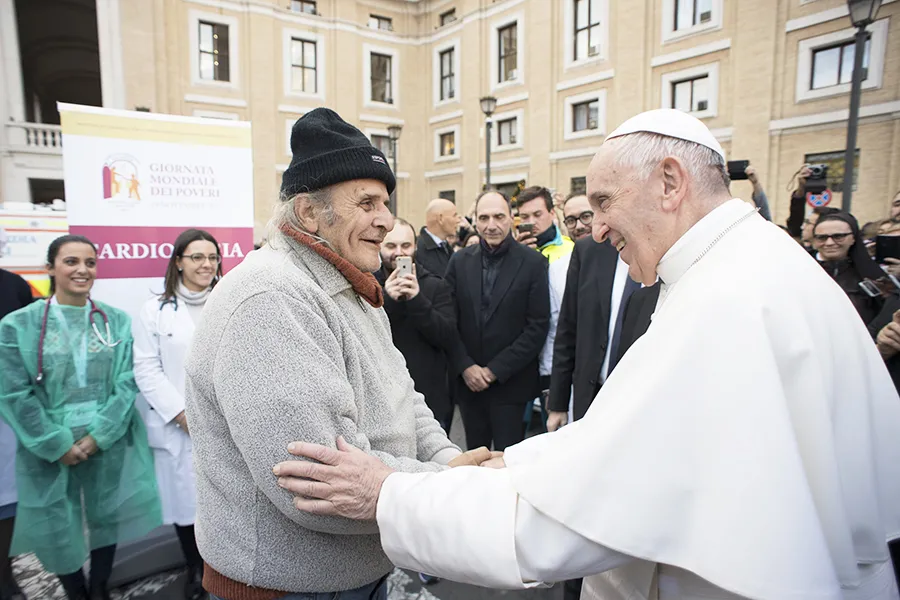
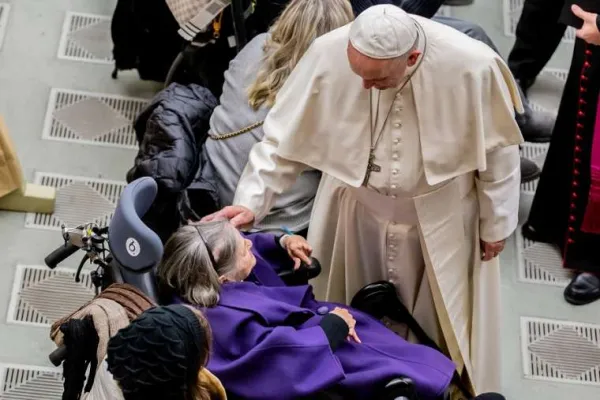
Pope Francis greets a participant in the World Day of the Poor in Rome, Nov. 16, 2017. L’Osservatore Romano.
Nov. 19 — On the first-ever World Day of the Poor, Pope Francis eats lunch with 4,000 poor and people in need in Rome.
Nov. 27–Dec. 2 — In another trip to Asia, Pope Francis travels to Myanmar and Bangladesh. He visits landmarks and meets with government officials, Catholic clergy, and Buddhist monks. He also preaches the Gospel and promotes peace in the region.
2018
Jan. 15–21 — The pope takes another trip to Latin America, this time visiting Chile and Peru. The pontiff meets with government officials and members of the clergy while urging the faithful to remain close to the clergy and reject secularism. The Chilean visit leads to controversy over Chilean clergy sex abuse scandals.
Aug. 2 — The Vatican formally revises No. 2267 of the Catechism of the Catholic Church, which concerns the death penalty. The previous text suggested the death penalty could be permissible in certain circumstances, but the revision states that the death penalty is “inadmissible.”
Aug. 25 — Archbishop Carlo Viganò, former papal nuncio to the United States, publishes an 11-page letter calling for the resignation of Pope Francis and accusing him and other Vatican officials of covering up sexual abuse including allegations against former Cardinal Theodore McCarrick. The pope initially does not directly respond to the letter, but nine months after its publication he denies having prior knowledge about McCarrick’s conduct.
Aug. 25–26 — Pope Francis visits Dublin, Ireland, to attend the World Meeting of Families. The theme is “the Gospel of family, joy for the world.”
Pope Francis at the 2018 World Meeting of Families in Ireland. . Daniel Ibanez/CNA.
Oct. 3–28 — The Synod on Young People, the Faith, and Vocational Discernment takes place. The synod focuses on best practices to teach the faith to young people and to help them discern God’s will.
2019
Jan. 22–27 — The third World Youth Day during Pope Francis’ pontificate takes place during these six days in Panama City, Panama. Young Catholics from around the world gather for the event, with approximately 3 million people in attendance.
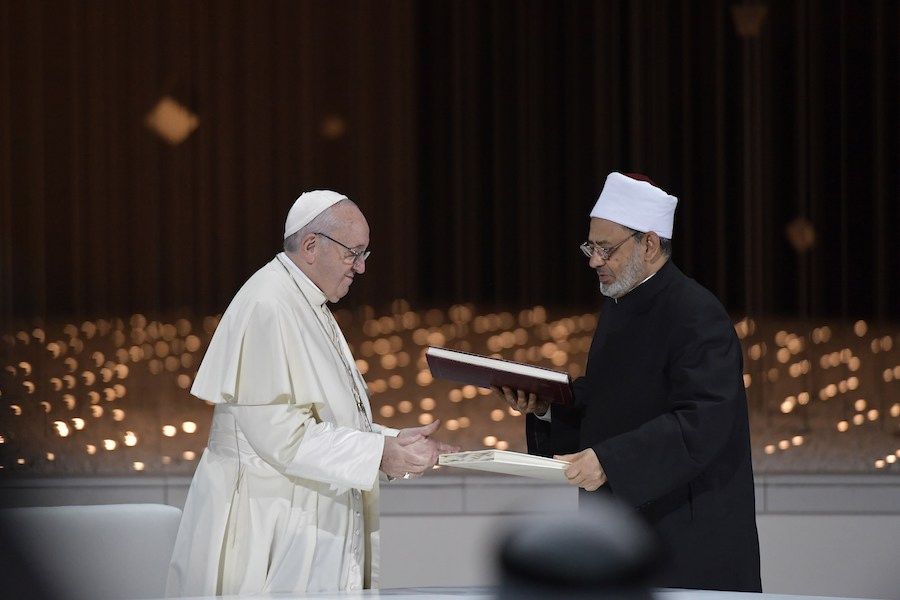
Feb. 4 — Pope Francis signs a joint document in with Sheikh Ahmed el-Tayeb, the grand imam of Al-Azhar, in Abu Dhabi, United Arab Emirates, titled the “Document on Human Fraternity for World Peace and Living Together.” The document focuses on people of different faiths uniting together to live peacefully and advance a culture of mutual respect.
Pope Francis and Ahmed el-Tayeb, grand imam of al-Azhar, signed a joint declaration on human fraternity during an interreligious meeting in Abu Dhabi, UAE, Feb. 4, 2019. Vatican Media.
Feb. 21–24 — The Meeting on the Protection of Minors in the Church, which is labeled the Vatican Sexual Abuse Summit, takes place. The meeting focuses on sexual abuse scandals in the Church and emphasizes responsibility, accountability, and transparency.
Oct. 6–27 — The Church holds the Synod of Bishops for the Pan-Amazon region, which is also known as the Amazon Synod. The synod is meant to present ways in which the Church can better evangelize the Amazon region but leads to controversy when carved images of a pregnant Amazonian woman, referred to by the pope as Pachamama, are used in several events and displayed in a basilica near the Vatican.
Oct. 13 — St. John Henry Newman, an Anglican convert to Catholicism and a cardinal, is canonized by Pope Francis. Newman’s writings inspired Catholic student associations at nonreligious colleges and universities in the United States and other countries.
2020
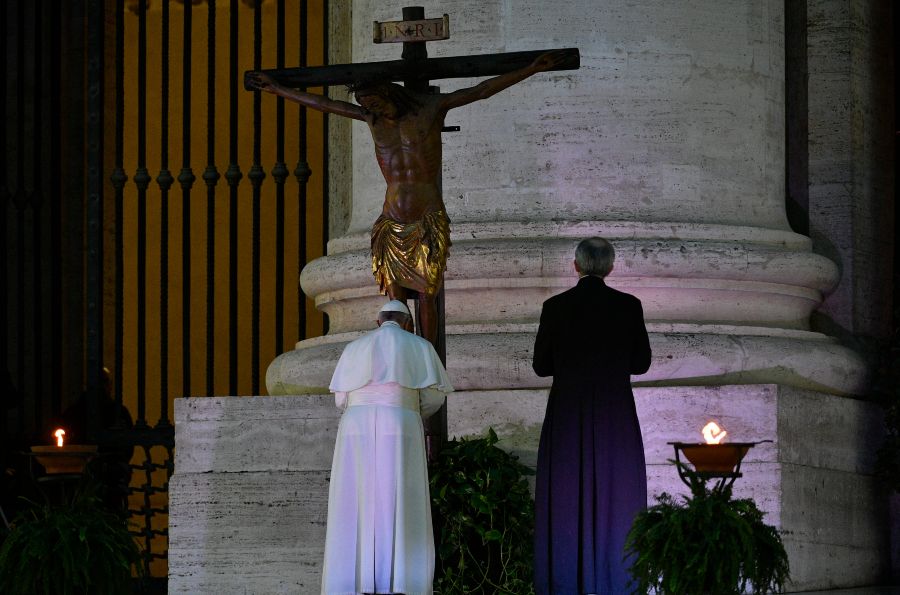
March 15 — Pope Francis takes a walking pilgrimage in Rome to the chapel of the crucifix and prays for an end to the COVID-19 pandemic. The crucifix was carried through Rome during the plague of 1522.
March 27 — Pope Francis gives an extraordinary Urbi et Orbi blessing in an empty and rain-covered St. Peter’s Square, praying for the world during the coronavirus pandemic.
Pope Francis venerates the miraculous crucifix of San Marcello al Corso in St. Peter’s Square during his Urbi et Orbi blessing, March 27, 2020. Vatican Media.
2021
March 5–8 — In his first papal trip since the start of the COVID-19 pandemic, Pope Francis becomes the first pope to visit Iraq. On his trip, he signs a joint statement with Grand Ayatollah Ali al-Sistani condemning extremism and promoting peace.
July 3 — Cardinal Giovanni Angelo Becciu, who was elevated to the College of Cardinals by Pope Francis, is indicted in a Vatican court for embezzlement, money laundering, and other crimes. The pope gives approval for the indictment.
July 4 — Pope Francis undergoes colon surgery for diverticulitis, a common condition in older people. The Vatican releases a statement that assures the pope “reacted well” to the surgery. Francis is released from the hospital after 10 days.
July 16 — Pope Francis issues a motu proprio titled Traditionis custodes. The document imposes heavy restrictions on the celebration of the Traditional Latin Mass.
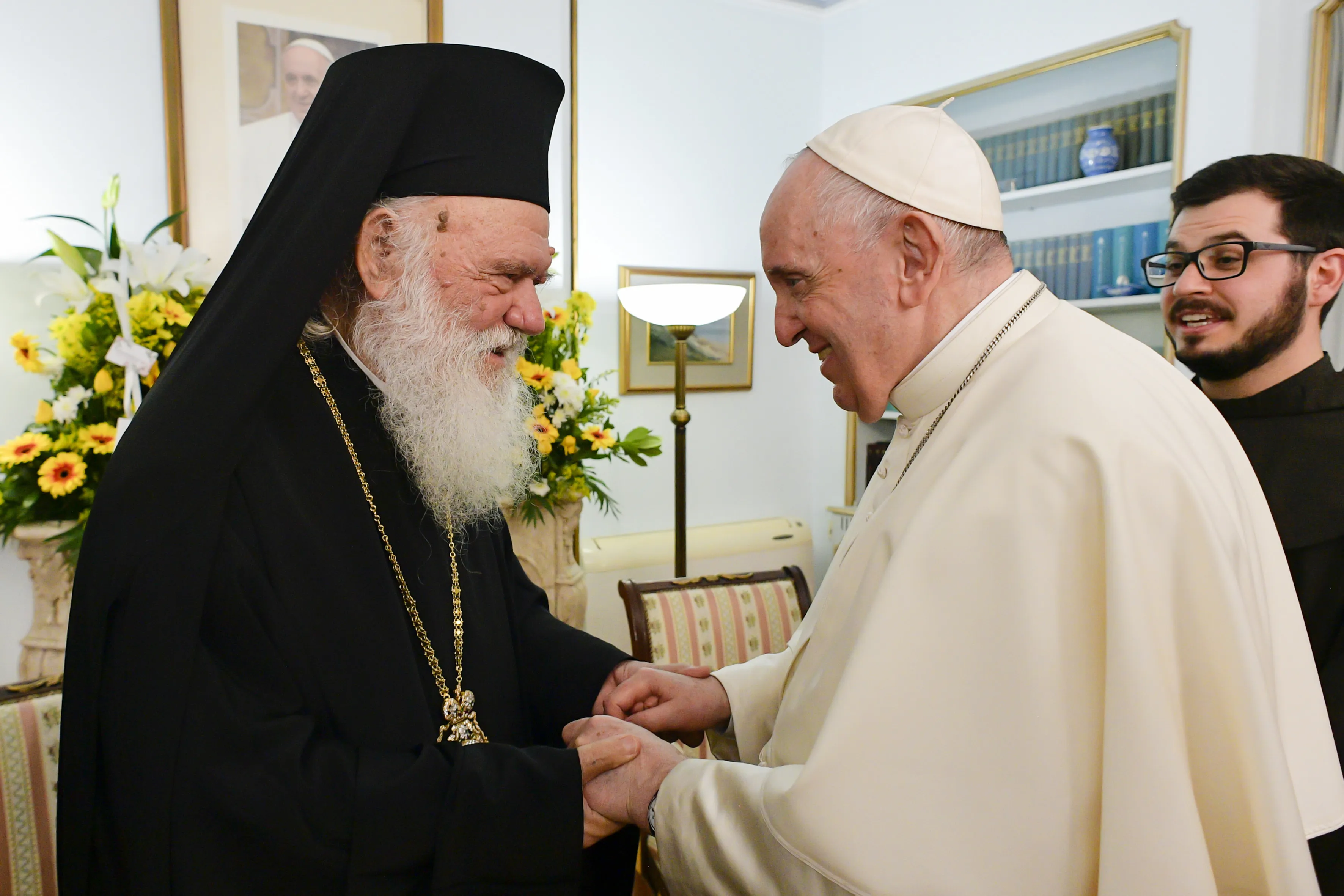
Dec. 2–6 — The pope travels to Cyprus and Greece. The trip includes another visit to the Greek island of Lesbos to meet with migrants.
Pope Francis greets His Beatitude Ieronymos II in Athens, Greece on Dec. 5, 2021. Vatican Media
2022
Jan. 11 — Pope Francis makes a surprise visit to a record store in Rome called StereoSound. The pope, who has an affinity for classical music, blesses the newly renovated store.
March 19 — The pope promulgates Praedicate evangelium, which reforms the Roman Curia. The reforms emphasize evangelization and establish more opportunities for the laity to be in leadership positions.
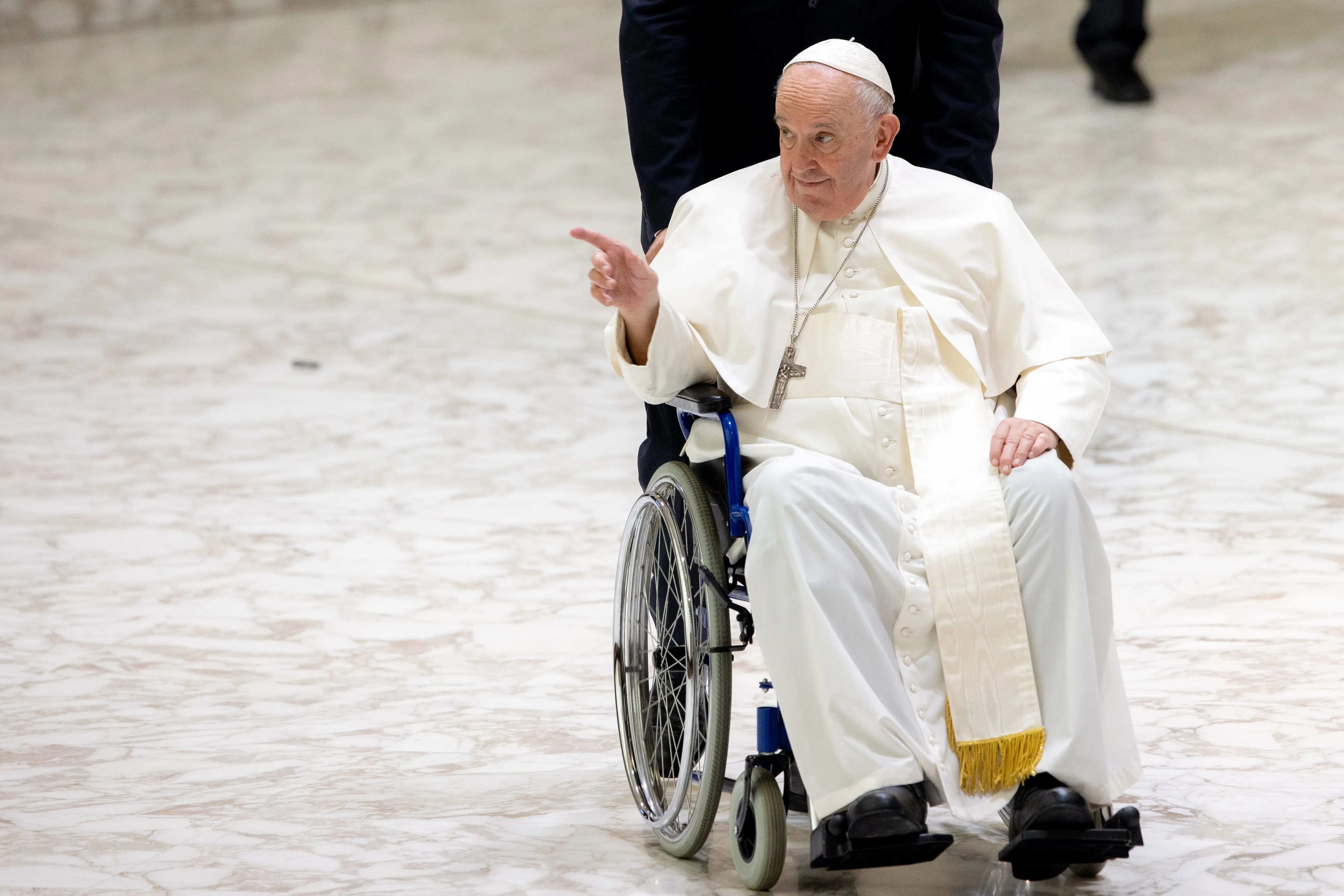
May 5 — Pope Francis is seen in a wheelchair for the first time in public and begins to use one more frequently. The pope has been suffering from knee problems for months.
Pope Francis greeted the crowd in a wheelchair at the end of his general audience on Aug. 3, 2022. Daniel Ibanez/CNA
July 24–30 — In his first papal visit to Canada, Pope Francis apologizes for the harsh treatment of the indigenous Canadians, saying many Christians and members of the Catholic Church were complicit.
2023
Jan. 31–Feb. 5 — Pope Francis travels to the Democratic Republic of Congo and South Sudan. During his visit, the pope condemns political violence in the countries and promotes peace. He also participates in an ecumenical prayer service with Anglican Archbishop of Canterbury Justin Welby and Moderator of the Church of Scotland Iain Greenshields.
Pope Francis prays with journalists on a papal flight August 14, 2014. / Alan Holdren/CNA
CNA Newsroom, Jul 30, 2022 / 03:09 am (CNA).
Pope Francis has agreed with the view that the forced removal of Indigenous children from their families and … […]
Vatican City, Jan 30, 2020 / 06:00 am (CNA).- Warning of the modern tendency to judge human life on the basis of utility rather than dignity, Pope Francis Thursday urged the need to protect the lives of the smallest and most vulnerable.
“A society deserves the title of ‘civilized’ … if it recognizes the intangible value of human life,” Pope Francis said Jan. 30 in a meeting with the Vatican Congregation of the Doctrine of Faith (CDF).
“The current socio-cultural context is progressively eroding awareness of what makes human life precious. In fact, it is increasingly evaluated on the basis of its efficiency and usefulness, to the point of considering ‘rejected lives’ or ‘unworthy lives’ as those which do not meet this criterion,” the pope warned.
Pope Francis applauded the CDF for dedicating its plenary assembly to the topic of care for the terminally and critically ill.
“Around the patient it is necessary to create a real platform of human relationships while promoting medical treatment, open to hope, especially in those borderline situations,” he said.
The dignity of each person “imposes a duty to never abandon anyone,” Francis said.
“Human life, because of its eternal destination, retains all its value and dignity in all conditions, including precariousness and fragility, and as such is always worthy of the utmost consideration,” he said.
“When illness knocks on the door of our life, the need to have someone looking us in the eye, holding our hand, showing his tenderness and taking care of us, like the Good Samaritan of the Gospel parable,” Pope Francis said.
Hospices can be places where terminally ill people are accompanied by qualified medical, psychological, and spiritual support to live with dignity, comforted by the closeness of their loved ones, the pope said.
“I hope that these centers will continue to be places where ‘therapy of dignity’ is practiced with commitment, thus nurturing love and respect for life,” he added.
The Congregation for the Doctrine of the Faith is the Vatican department responsible for protecting and promulgating the doctrine of the Catholic Church. It is headed by Cardinal Luis Ladaria Ferrer, S.J., and consultors include cardinals, bishops, priests, canon lawyers, and lay theologians.
Pope Francis congratulated the CDF for its publication of the document “What is Man? An Itinerary of Biblical Anthropology” by the Pontifical Biblical Commission last December.
The CDF is currently reviewing the rules for delicta graviora (the most serious crimes) outlined in the “Sacramentorum sanctitatis tutelage”, a motu proprio issued by John Paul II in 2001 on safeguarding the sanctity of the sacraments, particularly the Eucharist and confession.
“I urge you to continue firmly in this task, to offer a valid contribution in an area in which the Church is directly involved in proceeding with rigor and transparency in protecting the sanctity of the sacraments and the human dignity violated, especially of the little ones,” the pope told the CDF.
“Christian doctrine is not a rigid and closed system in itself, but neither is it an ideology that changes with the passing of the seasons; it is a dynamic reality which, remaining faithful to its foundation, is renewed from generation to generation and is summed up in a face, a body and a name: the Risen Jesus Christ,” Pope Francis said.
Mixed thoughts run through the mind taking in all of Leo XIV’s glorification of the poor. True the Franciscan love and especially identification with the poor, as we find the cabbage eaters OFM Capuchins is commendable. But these men like Padre Pio lived in relative poverty. That was their mode of glorification of the poor surrendering all to possess all in Christ.
That the poor are elevated to doctors of the Church is a stretch. Although not all poor are saints simply because of their poorness. Many need our teachings, often some tough love. As Paul said if they don’t work don’t feed them. Pope Leo addresses that as misguided arrogance. Is it? Give all we can. That includes our intelligent assessment of justice and rectification.
I agree with you. First, I do not understand why the poor should have “a privileged place” in society. To me (an egalitarian) no one should. Poor (and others) must be simply helped to live a dignified life. It has been done for centuries by the Church; it is happening now as well. But there is one peculiar problem of our time: the Church now is being restricted by the state in HOW she can help. Pope Leo says nothing about, for example, state governments forcing Catholic medical care to provide abortions or teaching institutions to accept “LGBTQ ideology” or do other things which are against Church’s conscience.
But of course, how can PL speak of that if he himself appears to be a tool for injection of the anti-Christian values into the Church? This is why I have an impression of his message to be strangely reminiscent of a politician who proclaims “the hegemony of proletarians”. Of course, proletarians/poor are being used, as always.
Yes. There’s a disordinate focus on the poor, inclusive of migrants, the abject, to the virtual exclusion of the fullness of Christ, who is the revelation of our perfect humanness.
He speaks of the poor as the flesh of Christ as if poverty is his incarnation. Poverty is a condition not a revelation that defines Christianity, as such a form of false reverence.
a Since the Pope loves “immigrants” so much he could start by ending the Vatican’s harsh punishments of those illegally entering the Pope’s realm:
Vatican Promises Stiff Penalties for Illegal Aliens Crossing its Border https://www.breitbart.com/europe/2025/01/16/vatican-promises-stiff-penalties-for-illegal-aliens-crossing-its-border/
b Given the enormous wealth that he now controls, the Pope could start by investing much of it to create businesses that produce good useful things at lower prices or good food at lower prices and hire the poor to work in those businesses. That will help the poor and everyone far more than his pontification. And it will make the poor gain self-esteem by making them independent of those who provide “charity” for them. According to Market Place, the wealth he now serendipitously (he did not work to make any of it…) controls is immense: “The wealth of the Catholic Church is difficult to determine definitively due to its decentralized structure and lack of centralized financial reporting. Estimates vary widely, but the Church’s collective assets are substantial. One assessment suggests the Catholic Church has at least $73 billion in assets, based on media reports and financial statements, though it likely holds billions more. This figure includes vast holdings of real estate, investments, and priceless art, with the Church’s property globally spanning nearly 277,000 square miles—roughly the size of Texas.”
I also had mixed emotions reading Leo’s message. While I certainly agree with his statement “the worst discrimination which the poor suffer is the lack of spiritual care”. I can’t help but think of how many poor brothers and sisters could have been helped with the billions, Billions of dollars spent on legal fees because of the recent church scandals.
In drawing from Evangeli Gaudium (2013), Pope Leo wisely does NOT repeat the ambivalent, exploitable, italicized and superimposed (?) four “principles”:
FIRST, “realities are more important than ideas,” possibly risking/enabling concrete NOMINALISM?
SECOND, “time is greater than space,” possibly risking/enabling amnesiac HISTORICISM against “backwardists”?
THIRD, “unity prevails over conflict,” possibly risking/enabling harmonizing/word-game CLERICALISM as in Fiducia Supplicans?
FOURTH, “the whole is greater than the part,” possibly endangering Subsidiarity and enabling plebiscite GLOBALISM?
And, Leo also DOES include spiritual poverty, as understood earlier by Pope John Paul II who wrote in Centesimus Annus (1991):
“This [preferential] option [for the poor] is not limited to material poverty, since it is well known that there are many other forms of poverty, especially in modern society–not only economic but cultural and spiritual poverty as well [….] [Despite ‘technological and economic progress’] In the countries of the West, different forms of poverty are being experienced by groups which live on the margins of society, by the elderly and the sick, by the victims of consumerism, and even more immediately by so many refugees and migrants. In the developing countries, tragic crises loom on the horizon unless internationally coordinated measures are taken before it is too late” (n. 57).
“Leo ends his exhortation by emphasizing the duty of almsgiving, which he claims has fallen out of fashion, even among believers.”
Well, when the government conscripts forty, fifty or more percent of your income, there isn’t much to give. When people are tempted to avoid or delay marriage or parenting because their productive efforts are conscripted to others and you are working long hours or multiple jobs, there should be some consideration given to those in those circumstances.
Thank you. That’s a good point.
The state has become the almsgiver using our tax dollars to fund social welfare programs. And not very efficiently either.
I enjoyed it. I like Pope Leo’s writing style. Meaty but not too filling. Glad he tied all into the poverty of Our Lord. It was a great way to launch and fitting on the feast day of St. Francis, the Poverello. Emphasis on the Poor Christ is crucial for our day. The organized patristic quotes were great. Leo seemed to get the best out of Franciscus. Am looking forward to bringing the document to prayer.
But when is he going to apologize to the Catholic faithful for backing Cupich’s dumb decision to give an award to a pro-abort Catholic politician? When?
“There are those who say: ‘Our task is to pray and teach sound doctrine’ [and argue] that it is the government’s job to care for [the poor], or that it would be better not to lift them out of their poverty but simply to teach them to work,” he writes.
In all my conversations with Catholics and non-Catholics, I have never met a person who has articulated this point of view. I don’t wish to be critical of Leo, who is still finding his footing, but I’m hoping this assertion is a holdover in the doc from his predecessor.
I guess they never taught the evils of the “strawman fallacy” at Villanova. From what I’ve heard from a friend who also attended there-I’m not surprised.
TPR:A “strawman” is an apt image for the Franciscan and Leonine Pontificates. In fact, in the Spirit of Halloween, some creative soul ought to whip up an IA image of a Pope in costume as a scarecrow. It would be fitting since these Popes love unique symbols – like Pachamamas and blocks of ice.
I have nothing more to give to the poor because I have become poorer than the poor, because I was victimized by the poor.
I am an 82-year-old widow, a naturalized US citizen for over 50 years, from a poor country. I have a “special need” adult son who can’t hold a job, so he’s dependent on me. Sometimes, in his frustration, he mistreats me. But that’s another story.
The only things I had after my husband died was a small pension and a house. Half of the house I rented to a poor migrant family, but during the Covid’s eviction moratorium, they were allowed not to pay rent. I supported that family for 2-1/2 years, during which all my savings were spent. The government did reimburse me for their arrears, but at the same time, it increased my property tax by 100%. It took another six months of rent-free living for my tenants who did not want to leave the premises until I sued them for eviction (which was not cheap.)
I had to cancel my life insurance, health insurance, and all automatic payments and borrowed money to cover the tax. (I could not afford to challenge the government assessment because I didn’t have the money for a private assessor and a tax lawyer.)
My bank account balance plummeted to zero. Have you ever had a zero balance on your bank account? It was a nightmare.
I sold my house as-is, at half the price of the government assessment and paid my debts. My son and I lived in and out of motels for three months, and now we’re living in a trailer park. I don’t know how long we will last with the little money I gained from selling the house.
After Covid, when the state government was processing application claims for reimbursement of unpaid rent, I went to Catholic Charities to ask for their help because it has been designated by the government to process the claims. Catholic Charities turned me down because I was not eligible for help because my tenants and I had the same address. I had to hire a lawyer to help me, and that was not cheap.
I have mostly forgiven my poor tenants for what they did to me. But each time I see the illegal immigrants being treated better than American citizens with their necessities, I feel bad. My confessor helped console me by saying, “Sometimes, God tolerates injustices.”
I don’t know why, but I feel very bad reading Pope Leo’s exhortation. I wish I knew why. I suddenly felt like crying.
But when is he going to apologize to the Catholic faithful for backing Cupich’s dumb decision to give an award to a pro-abort Catholic politician? When??
Trying to send this a second time.People who laud illegals as “great people”, ” hard workers”, “family types”,etc, miss the point, probably intentionally. Whether or not they are nice doesnt matter. That isnt the issue. They broke the law. And many keep on breaking the law after they arrive because of their illegal status. They often get paid in cash and dont pay taxes. As recent horrific accidents show, they sometimes drive without a drivers license, understanding English road signs, and without insurance. They often use fake ID. They put unwanted pressure on our schools and medical services, injuring the US Citizens, often children, who badly need those services themselves. They take American jobs. And please spare me the old whine they are jobs Americans won’t so. Americans DID those jobs before we were inundated with illegals who will work for a pittance. Twenty years ago my landscaper, house painter and roofer were ALL Americans!! Americans WILL do those jobs if paid a decent wage.
I am sorry that these folks face daunting issues in their own nations. But they are indeed the responsibility of the nation of their birth. We have our OWN poor and needy to care for, without illegals competing for scarce resources here. How many MORE millions of them would be here if Biden (or Harris) had been re-elected?? Enough to damage the country permanently. This is not personal. This is about quality of life for Americans, and indeed, our survival as a nation where law is respected.
I find the Bishop’s constant carping about the poor illegals to be unjust and wearisome. And I find this pope to be a big disappointment on this issue too. Flights of fantasy are all very nice until someone has to pay the bills. Do they have any idea how many BILLIONS of people would attempt to come here if they could?
And finally, whatever happened to respecting the law and rendering to Caesar??? I dont recall Jesus ever suggesting flouting the law, or physically attacking local authorities charged with keeping the peace. Wasnt it He who directed the apostles to find the fish with a coin in its mouth specifically to pay the required tax and thus OBEY the law? Laws are needed to help to keep civil order. It is not up to the illegals to decide which of our laws they will obey or ignore. To allow that decision to anyone, no matter how “nice” or “hard-working”, is to invite chaos and the eventual breakdown of civilization. No thanks. Come legally or not at all. Its OUR choice, not theirs.
We have enabled those people to break the law LJ. Previous administrations gave migrants the message that our back door was unofficially open and even provided a script to request asylum for those who turned themselves in.
I 100% agree that the border should be secured but we need to find a way to utilize those who have been a benefit to their communities and kept out of trouble. Especially those brought here as children.As a taxpayer I don’t want my money used to fly a hotel’s housekeeper back to Honduras or El Salvador. Find her a visa or residency status and let’s move forward.
US citizens can work hard and be dependable but that’s becoming less so in the service industry.
Mrs C, we tried that before–amnesty. I think it was under Reagan. It only encouraged people to come illegally. If they are here illegally, they must return and go through legal channels.
(I will admit, that the Federal Gov’t should do it’s part by making the system more streamlined and efficient.)
Indeed LJ. They broke the law. Should not be rewarded in any way (yes as Reagan did by giving amnesty to millions; see how much that helped to deter the invasion) any more than any other law breaker. What we do not tolerate in our own houses we should not tolerate in our country. How many of us would not call the police to expel a mother and a child who entered our house through a door we left open and made herself at home in the living room or basement or utility room or kitchen? This mother is very nice and a good mother, and she may offer to clean the house while living in our living room. See what the Pope does with illegal aliens who enter HIS realm:
Vatican Promises Stiff Penalties for Illegal Aliens Crossing its Border https://www.breitbart.com/europe/2025/01/16/vatican-promises-stiff-penalties-for-illegal-aliens-crossing-its-border/
I strive to carefully consider the points raised in Pope Leo’s recent letter, Dilexi Te, regarding our Christian responsibility to the poor. This subject naturally brings a measure of cautious thought, as the practical application of our faith in this area requires a nuanced understanding of Scripture.
The first reference point is in John 12:1-8. In this passage, Mary of Bethany anoints Christ’s feet with expensive oil and perfume. Judas Iscariot objects, arguing that the perfume, valued at a year’s wages, should have been sold and the proceeds given to the poor. However, our Savior’s response to Judas, “You will always have the poor with you, but you will not always have me”. This is essential context of my thoughts.
This event illustrates that not every valuable possession must be dedicated solely to poverty relief. The focus on the poor, while paramount, does not automatically supersede all other forms of devotion, charity, or sacred use. The discussion of our duty to the poor, therefore, must be approached with a complete understanding of scriptural teaching, recognizing that “sell all we have and give to the poor” is not the beginning and end of the matter for every follower in every circumstance.
Another papal exhortation that has a lot of words but no real solutions other than the usual conviction of free market economies as “evil” (my word and not his). More often than not the Pope’s fail to offer a solution, should be move to socialism as a solution or is it simply communism which unfortunately is also hateful of God. What is the solution? I am confused, should Catholics, Christians following Jesus give all to the Church as detailed in Acts when followers sold their property and gave to the new Church to share? We the flock that Pope Leo shepherds is waiting for his answer and solution to that which he (and Pope Francis) detail as bad/evil/wrong.
I haven’t read the text, but this article’s summary seems to project positive points. I liked the Pope’s reminder that the poor need sound doctrine and spiritual care as well as material help. That’s often forgotten by liberal-minded people. I also liked the way he refused to accept contemporary economic orthodoxy, which asserts that economics is a self-contained system that does not have to do with morality directly.
The poor are neither more or less virtuous than others. As my grandmother said: “Being poor is nothing to be ashamed of, but neither is it something to be proud of.”
This reads as a regurgitation of Latino Liberation Theology that addresses the poor’s economic poverty to the exclusion of the spiritual poverty. How much has the Modern Church compromised her treatment of the poor due to financial resources being compromised to settle the litigation resulting from aberrant sexual behavior tolerated (if not encouraged) within the priesthood? All we know is the Modern Church wants more money from the laity and the federal government with little to no transparency nor accountability. For many one cannot, should not trust what cannot and shall never be verified. The modern administrative Church should welcome 3rd Party audits in all honesty prepared to give their testimonies that they are great stewards of the purse strings to which they have been entrusted with by God.
I am deeply offended by El Paso Bishop Mark Seitz’ ambush of the pope by bringing to him bundles of letters and a video from aliens who break US immigration law but now claim to be victims of that law.
More specifically, the letters complain that Trump is the villain, without understanding that the president did not make the law – he is simply enforcing it.
I like the pope’s exhortation about the poor, but he does not distinguish between legal immigrants and the illegal aliens. He says the Church “knows that in every rejected migrant, it is Christ himself who knocks at the door of the community.” With his veiled criticism of the US immigration system, you can see that it’s the illegal aliens that the pope gives preferential option to. He is almost encouraging people to break the law.
If illegal immigrants are the “face of Christ” that the pope says in his exhortation, what about the legal ones? The legal ones follow US immigration law, show respect to the host country and its sovereignty, but are made to wait in line for decades to be let in (up to 20 years) while the illegals, until recently, broke in like an invading army – by the caravans – waving their flags and giving the one-finger salute to citizens and legals.
They overwhelm the system and elbow aside those who have been waiting in the legal immigration line. They complain about the broken immigration system, but it’s them that broke the system.
We’ve seen pictures and videos of the insulting, invading caravans, yet those pictures were not what Bishop Seitz showed the pope. No, of course, not.
What the illegals did and even now doing – with their temerity to bring their complaints to the pope – is the real slap on the face of Christ. They lie – they broke through the back door and expect the householders to make them co-owners of the house. Isn’t that a sin against the Seventh Commandment?
God help me. I am so angry, I could cry. Is it a sin not to agree with the pope on this exhortation?
I found it very useful. I think this is very important aspect as a Christian. It is the beginning of his office and Pope will be writing many more letters and books regarding what the Catholic Church stands for. That’s the mission we all of have. The poor are the people whom we see Jesus as Mother Theresa says. We need them and they need us. Thank you very much for this Missionary thought.






Mixed thoughts run through the mind taking in all of Leo XIV’s glorification of the poor. True the Franciscan love and especially identification with the poor, as we find the cabbage eaters OFM Capuchins is commendable. But these men like Padre Pio lived in relative poverty. That was their mode of glorification of the poor surrendering all to possess all in Christ.
That the poor are elevated to doctors of the Church is a stretch. Although not all poor are saints simply because of their poorness. Many need our teachings, often some tough love. As Paul said if they don’t work don’t feed them. Pope Leo addresses that as misguided arrogance. Is it? Give all we can. That includes our intelligent assessment of justice and rectification.
I agree with you. First, I do not understand why the poor should have “a privileged place” in society. To me (an egalitarian) no one should. Poor (and others) must be simply helped to live a dignified life. It has been done for centuries by the Church; it is happening now as well. But there is one peculiar problem of our time: the Church now is being restricted by the state in HOW she can help. Pope Leo says nothing about, for example, state governments forcing Catholic medical care to provide abortions or teaching institutions to accept “LGBTQ ideology” or do other things which are against Church’s conscience.
But of course, how can PL speak of that if he himself appears to be a tool for injection of the anti-Christian values into the Church? This is why I have an impression of his message to be strangely reminiscent of a politician who proclaims “the hegemony of proletarians”. Of course, proletarians/poor are being used, as always.
Yes. There’s a disordinate focus on the poor, inclusive of migrants, the abject, to the virtual exclusion of the fullness of Christ, who is the revelation of our perfect humanness.
He speaks of the poor as the flesh of Christ as if poverty is his incarnation. Poverty is a condition not a revelation that defines Christianity, as such a form of false reverence.
a Since the Pope loves “immigrants” so much he could start by ending the Vatican’s harsh punishments of those illegally entering the Pope’s realm:
Vatican Promises Stiff Penalties for Illegal Aliens Crossing its Border
https://www.breitbart.com/europe/2025/01/16/vatican-promises-stiff-penalties-for-illegal-aliens-crossing-its-border/
b Given the enormous wealth that he now controls, the Pope could start by investing much of it to create businesses that produce good useful things at lower prices or good food at lower prices and hire the poor to work in those businesses. That will help the poor and everyone far more than his pontification. And it will make the poor gain self-esteem by making them independent of those who provide “charity” for them. According to Market Place, the wealth he now serendipitously (he did not work to make any of it…) controls is immense: “The wealth of the Catholic Church is difficult to determine definitively due to its decentralized structure and lack of centralized financial reporting. Estimates vary widely, but the Church’s collective assets are substantial. One assessment suggests the Catholic Church has at least $73 billion in assets, based on media reports and financial statements, though it likely holds billions more. This figure includes vast holdings of real estate, investments, and priceless art, with the Church’s property globally spanning nearly 277,000 square miles—roughly the size of Texas.”
I also had mixed emotions reading Leo’s message. While I certainly agree with his statement “the worst discrimination which the poor suffer is the lack of spiritual care”. I can’t help but think of how many poor brothers and sisters could have been helped with the billions, Billions of dollars spent on legal fees because of the recent church scandals.
In drawing from Evangeli Gaudium (2013), Pope Leo wisely does NOT repeat the ambivalent, exploitable, italicized and superimposed (?) four “principles”:
FIRST, “realities are more important than ideas,” possibly risking/enabling concrete NOMINALISM?
SECOND, “time is greater than space,” possibly risking/enabling amnesiac HISTORICISM against “backwardists”?
THIRD, “unity prevails over conflict,” possibly risking/enabling harmonizing/word-game CLERICALISM as in Fiducia Supplicans?
FOURTH, “the whole is greater than the part,” possibly endangering Subsidiarity and enabling plebiscite GLOBALISM?
And, Leo also DOES include spiritual poverty, as understood earlier by Pope John Paul II who wrote in Centesimus Annus (1991):
“This [preferential] option [for the poor] is not limited to material poverty, since it is well known that there are many other forms of poverty, especially in modern society–not only economic but cultural and spiritual poverty as well [….] [Despite ‘technological and economic progress’] In the countries of the West, different forms of poverty are being experienced by groups which live on the margins of society, by the elderly and the sick, by the victims of consumerism, and even more immediately by so many refugees and migrants. In the developing countries, tragic crises loom on the horizon unless internationally coordinated measures are taken before it is too late” (n. 57).
“Leo ends his exhortation by emphasizing the duty of almsgiving, which he claims has fallen out of fashion, even among believers.”
Well, when the government conscripts forty, fifty or more percent of your income, there isn’t much to give. When people are tempted to avoid or delay marriage or parenting because their productive efforts are conscripted to others and you are working long hours or multiple jobs, there should be some consideration given to those in those circumstances.
Thank you. That’s a good point.
The state has become the almsgiver using our tax dollars to fund social welfare programs. And not very efficiently either.
I enjoyed it. I like Pope Leo’s writing style. Meaty but not too filling. Glad he tied all into the poverty of Our Lord. It was a great way to launch and fitting on the feast day of St. Francis, the Poverello. Emphasis on the Poor Christ is crucial for our day. The organized patristic quotes were great. Leo seemed to get the best out of Franciscus. Am looking forward to bringing the document to prayer.
But when is he going to apologize to the Catholic faithful for backing Cupich’s dumb decision to give an award to a pro-abort Catholic politician? When?
Never
MrsHess: Sad but true.
“There are those who say: ‘Our task is to pray and teach sound doctrine’ [and argue] that it is the government’s job to care for [the poor], or that it would be better not to lift them out of their poverty but simply to teach them to work,” he writes.
In all my conversations with Catholics and non-Catholics, I have never met a person who has articulated this point of view. I don’t wish to be critical of Leo, who is still finding his footing, but I’m hoping this assertion is a holdover in the doc from his predecessor.
I guess they never taught the evils of the “strawman fallacy” at Villanova. From what I’ve heard from a friend who also attended there-I’m not surprised.
TPR:A “strawman” is an apt image for the Franciscan and Leonine Pontificates. In fact, in the Spirit of Halloween, some creative soul ought to whip up an IA image of a Pope in costume as a scarecrow. It would be fitting since these Popes love unique symbols – like Pachamamas and blocks of ice.
I have nothing more to give to the poor because I have become poorer than the poor, because I was victimized by the poor.
I am an 82-year-old widow, a naturalized US citizen for over 50 years, from a poor country. I have a “special need” adult son who can’t hold a job, so he’s dependent on me. Sometimes, in his frustration, he mistreats me. But that’s another story.
The only things I had after my husband died was a small pension and a house. Half of the house I rented to a poor migrant family, but during the Covid’s eviction moratorium, they were allowed not to pay rent. I supported that family for 2-1/2 years, during which all my savings were spent. The government did reimburse me for their arrears, but at the same time, it increased my property tax by 100%. It took another six months of rent-free living for my tenants who did not want to leave the premises until I sued them for eviction (which was not cheap.)
I had to cancel my life insurance, health insurance, and all automatic payments and borrowed money to cover the tax. (I could not afford to challenge the government assessment because I didn’t have the money for a private assessor and a tax lawyer.)
My bank account balance plummeted to zero. Have you ever had a zero balance on your bank account? It was a nightmare.
I sold my house as-is, at half the price of the government assessment and paid my debts. My son and I lived in and out of motels for three months, and now we’re living in a trailer park. I don’t know how long we will last with the little money I gained from selling the house.
After Covid, when the state government was processing application claims for reimbursement of unpaid rent, I went to Catholic Charities to ask for their help because it has been designated by the government to process the claims. Catholic Charities turned me down because I was not eligible for help because my tenants and I had the same address. I had to hire a lawyer to help me, and that was not cheap.
I have mostly forgiven my poor tenants for what they did to me. But each time I see the illegal immigrants being treated better than American citizens with their necessities, I feel bad. My confessor helped console me by saying, “Sometimes, God tolerates injustices.”
I don’t know why, but I feel very bad reading Pope Leo’s exhortation. I wish I knew why. I suddenly felt like crying.
But when is he going to apologize to the Catholic faithful for backing Cupich’s dumb decision to give an award to a pro-abort Catholic politician? When??
Trying to send this a second time.People who laud illegals as “great people”, ” hard workers”, “family types”,etc, miss the point, probably intentionally. Whether or not they are nice doesnt matter. That isnt the issue. They broke the law. And many keep on breaking the law after they arrive because of their illegal status. They often get paid in cash and dont pay taxes. As recent horrific accidents show, they sometimes drive without a drivers license, understanding English road signs, and without insurance. They often use fake ID. They put unwanted pressure on our schools and medical services, injuring the US Citizens, often children, who badly need those services themselves. They take American jobs. And please spare me the old whine they are jobs Americans won’t so. Americans DID those jobs before we were inundated with illegals who will work for a pittance. Twenty years ago my landscaper, house painter and roofer were ALL Americans!! Americans WILL do those jobs if paid a decent wage.
I am sorry that these folks face daunting issues in their own nations. But they are indeed the responsibility of the nation of their birth. We have our OWN poor and needy to care for, without illegals competing for scarce resources here. How many MORE millions of them would be here if Biden (or Harris) had been re-elected?? Enough to damage the country permanently. This is not personal. This is about quality of life for Americans, and indeed, our survival as a nation where law is respected.
I find the Bishop’s constant carping about the poor illegals to be unjust and wearisome. And I find this pope to be a big disappointment on this issue too. Flights of fantasy are all very nice until someone has to pay the bills. Do they have any idea how many BILLIONS of people would attempt to come here if they could?
And finally, whatever happened to respecting the law and rendering to Caesar??? I dont recall Jesus ever suggesting flouting the law, or physically attacking local authorities charged with keeping the peace. Wasnt it He who directed the apostles to find the fish with a coin in its mouth specifically to pay the required tax and thus OBEY the law? Laws are needed to help to keep civil order. It is not up to the illegals to decide which of our laws they will obey or ignore. To allow that decision to anyone, no matter how “nice” or “hard-working”, is to invite chaos and the eventual breakdown of civilization. No thanks. Come legally or not at all. Its OUR choice, not theirs.
We have enabled those people to break the law LJ. Previous administrations gave migrants the message that our back door was unofficially open and even provided a script to request asylum for those who turned themselves in.
I 100% agree that the border should be secured but we need to find a way to utilize those who have been a benefit to their communities and kept out of trouble. Especially those brought here as children.As a taxpayer I don’t want my money used to fly a hotel’s housekeeper back to Honduras or El Salvador. Find her a visa or residency status and let’s move forward.
US citizens can work hard and be dependable but that’s becoming less so in the service industry.
Mrs C, we tried that before–amnesty. I think it was under Reagan. It only encouraged people to come illegally. If they are here illegally, they must return and go through legal channels.
(I will admit, that the Federal Gov’t should do it’s part by making the system more streamlined and efficient.)
Excellent points, mrscracker. Spot on in your analysis and conclusions.
A voice of reason. Thanks for your thoughtful and accurate analysis.
Indeed LJ. They broke the law. Should not be rewarded in any way (yes as Reagan did by giving amnesty to millions; see how much that helped to deter the invasion) any more than any other law breaker. What we do not tolerate in our own houses we should not tolerate in our country. How many of us would not call the police to expel a mother and a child who entered our house through a door we left open and made herself at home in the living room or basement or utility room or kitchen? This mother is very nice and a good mother, and she may offer to clean the house while living in our living room. See what the Pope does with illegal aliens who enter HIS realm:
Vatican Promises Stiff Penalties for Illegal Aliens Crossing its Border
https://www.breitbart.com/europe/2025/01/16/vatican-promises-stiff-penalties-for-illegal-aliens-crossing-its-border/
I strive to carefully consider the points raised in Pope Leo’s recent letter, Dilexi Te, regarding our Christian responsibility to the poor. This subject naturally brings a measure of cautious thought, as the practical application of our faith in this area requires a nuanced understanding of Scripture.
The first reference point is in John 12:1-8. In this passage, Mary of Bethany anoints Christ’s feet with expensive oil and perfume. Judas Iscariot objects, arguing that the perfume, valued at a year’s wages, should have been sold and the proceeds given to the poor. However, our Savior’s response to Judas, “You will always have the poor with you, but you will not always have me”. This is essential context of my thoughts.
This event illustrates that not every valuable possession must be dedicated solely to poverty relief. The focus on the poor, while paramount, does not automatically supersede all other forms of devotion, charity, or sacred use. The discussion of our duty to the poor, therefore, must be approached with a complete understanding of scriptural teaching, recognizing that “sell all we have and give to the poor” is not the beginning and end of the matter for every follower in every circumstance.
Another papal exhortation that has a lot of words but no real solutions other than the usual conviction of free market economies as “evil” (my word and not his). More often than not the Pope’s fail to offer a solution, should be move to socialism as a solution or is it simply communism which unfortunately is also hateful of God. What is the solution? I am confused, should Catholics, Christians following Jesus give all to the Church as detailed in Acts when followers sold their property and gave to the new Church to share? We the flock that Pope Leo shepherds is waiting for his answer and solution to that which he (and Pope Francis) detail as bad/evil/wrong.
“I am confused, should Catholics, Christians following Jesus give all to the Church as detailed in Acts”.
Diocesan bankruptcies and the problems at the Vatican Bank suggest otherwise.
I haven’t read the text, but this article’s summary seems to project positive points. I liked the Pope’s reminder that the poor need sound doctrine and spiritual care as well as material help. That’s often forgotten by liberal-minded people. I also liked the way he refused to accept contemporary economic orthodoxy, which asserts that economics is a self-contained system that does not have to do with morality directly.
The poor are neither more or less virtuous than others. As my grandmother said: “Being poor is nothing to be ashamed of, but neither is it something to be proud of.”
This reads as a regurgitation of Latino Liberation Theology that addresses the poor’s economic poverty to the exclusion of the spiritual poverty. How much has the Modern Church compromised her treatment of the poor due to financial resources being compromised to settle the litigation resulting from aberrant sexual behavior tolerated (if not encouraged) within the priesthood? All we know is the Modern Church wants more money from the laity and the federal government with little to no transparency nor accountability. For many one cannot, should not trust what cannot and shall never be verified. The modern administrative Church should welcome 3rd Party audits in all honesty prepared to give their testimonies that they are great stewards of the purse strings to which they have been entrusted with by God.
I read the letter. All I can say is, that was a waste of a good half hour.
There is no one more poor than the preborn child in the womb targeted for abortion.
There is no immigrant more needy than the preborn child who is not allowed to travel safely from his mother’s womb to the world.
There is no one more in need of human mercy and compassion than the preborn child whom others would rather destroy than help.
The poorest among us, the immigrants most in need of our help, and the ones who most need our mercy and compassion are preborn children.
“You did it to me.” — Jesus
I am deeply offended by El Paso Bishop Mark Seitz’ ambush of the pope by bringing to him bundles of letters and a video from aliens who break US immigration law but now claim to be victims of that law.
More specifically, the letters complain that Trump is the villain, without understanding that the president did not make the law – he is simply enforcing it.
I like the pope’s exhortation about the poor, but he does not distinguish between legal immigrants and the illegal aliens. He says the Church “knows that in every rejected migrant, it is Christ himself who knocks at the door of the community.” With his veiled criticism of the US immigration system, you can see that it’s the illegal aliens that the pope gives preferential option to. He is almost encouraging people to break the law.
If illegal immigrants are the “face of Christ” that the pope says in his exhortation, what about the legal ones? The legal ones follow US immigration law, show respect to the host country and its sovereignty, but are made to wait in line for decades to be let in (up to 20 years) while the illegals, until recently, broke in like an invading army – by the caravans – waving their flags and giving the one-finger salute to citizens and legals.
They overwhelm the system and elbow aside those who have been waiting in the legal immigration line. They complain about the broken immigration system, but it’s them that broke the system.
We’ve seen pictures and videos of the insulting, invading caravans, yet those pictures were not what Bishop Seitz showed the pope. No, of course, not.
What the illegals did and even now doing – with their temerity to bring their complaints to the pope – is the real slap on the face of Christ. They lie – they broke through the back door and expect the householders to make them co-owners of the house. Isn’t that a sin against the Seventh Commandment?
God help me. I am so angry, I could cry. Is it a sin not to agree with the pope on this exhortation?
I found it very useful. I think this is very important aspect as a Christian. It is the beginning of his office and Pope will be writing many more letters and books regarding what the Catholic Church stands for. That’s the mission we all of have. The poor are the people whom we see Jesus as Mother Theresa says. We need them and they need us. Thank you very much for this Missionary thought.