

I’ll cut right to the chase: Paul Kingsnorth is among the three or four best writers I have encountered in the last decade. And his latest book, Against the Machine, published late last month, is worthy proof. More on that in a moment. Meanwhile, anyone wanting a quick taste of Kingsnorth’s thought can find it in the brief video (15 minutes) here. His more extensive talks and interviews are—justly—all over the internet, including a long and compelling conversation with another superb writer, the philosopher and neuroscientist Iain McGilchrist.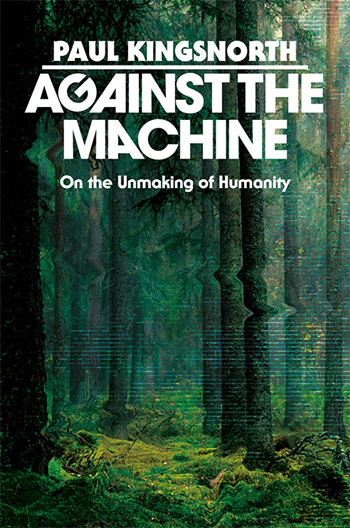
My own interview with Kingsnorth, conducted two years ago, can be found here. The man’s range is impressive. His 2015 novel The Wake, written in a “shadow tongue” of hybrid Old and Modern English, is a terrific story of doomed, pagan, Anglo-Saxon resistance to the Norman invasion of England in the 11th century. His Abbey of Misrule Substack is a treasure house of good material, from tranquil reflections on nature and saints to urgent cultural criticism. As a writer, Kingsnorth has the uncommon gift of delivering deep content in an elegant style, with simple clarity.
And his personal story compounds the appeal of his work. A former environmental activist with no religious convictions, he migrated through Wicca and Buddhism as an adult, finally converting to Christianity in 2020. He was baptized in the Orthodox Church in 2021. His faith now informs nearly everything he writes.
And that brings us back to his latest book.
Against the Machine is rooted in, and expanded from, two years of preliminary essays perfecting the author’s ideas. Briefly put, it’s a penetrating critique of the Faustian, machine-addicted, tech-heavy culture of illusions we have woven around ourselves over the past 300 years, a cocoon of shiny artifice that now threatens to smother and supplant the humanity of its creators.
As Kingsnorth notes in his opening pages, “There has never been any unitary organization of Western culture apart from that of the Christian Church”—a religious framework which gave everyday life a purpose and grounding for social cohesion. “Behind the ever-changing pattern of Western culture,” he writes, “there was a living faith which gave Europe a certain sense of spiritual continuity, in spite of all the conflicts and divisions and social schisms that marked its history.”
That day has now passed. And he adds that
when a culture built around such a sacred order dies, then there will be upheaval at every level of society, from the level of politics right down to the level of the soul. The very notion of an individual life will shift dramatically. The family structure, the meaning of work, moral attitudes, the very existence of morals at all, notions of good and evil, sexual mores, perspectives on everything from money to work to nature to kin to responsibility to duty: everything will be up for grabs.
Today, predictably, as Christianity recedes in the West, “We [moderns]—at least if we are among the lucky ones—have every gadget and website and storefront and exotic holiday in the world available to us,” but we’re lacking the two things that we most desperately need: meaning and roots. As a result, we’re adrift in a time that the author presents as “The Great Unsettling.” It’s the fruit of our own short-sighted appetites and vanities, personified most vividly in our elites.
Kingsnorth is far from the first writer to describe our current conditions. Nor is he the first to use The Machine as a metaphor for today’s spiritual unrest and growing technological threats to our humanity. E.M. Forster wrote his prophetic short story, “The Machine Stops,” nearly 120 years ago. But Kingsnorth brings a unique blend of passion, past experience, a wealth of sources, and persuasive logic to his telling of the tale.
The author borrows a line from the American social theorist, Craig Calhoun, to suggest his own guiding spirit: a kind of “reactionary radicalism.” In Kingsnorth’s approach, this is not a political ideology. It operates outside the familiar left-right conflicts. It is “radical” in the original sense of the word: getting to the roots; in this case, the roots of what it means, and what we need, to be human.
It consists of “an active attempt at creating, defending or restoring a moral economy built around the four Ps.” These include, first, the past, where a culture comes from, its history, and ancestry. The second is people, who a culture is: a communitarian sense of being a distinct “people.” The third is place, where a culture is, its sense of home and belonging, nature in its local beauty and particular manifestation. Fourth and finally is prayer, where a culture is going, its religious tradition and destiny, its understanding of God or the gods.
Machine culture bulldozes all these elements of a healthy, human-scaled reality into a globalized, consumption-driven homogeneity. In the process, it provides material abundance while sucking the soul from Creation. Kingsnorth does not argue that technology is inherently bad. On the contrary, its many positives are obvious, starting with the computer he uses to write. But when we allow it to become a form of idolatry—as it now is in the “developed,” postmodern world—the idol eats its worshippers.
I find it impossible to pick a favorite chapter in the text. Too many are too good: A Thousand Mozarts, Want Is the Acid, Come the Black Ships, You Are Harvest, Kill All the Heroes, The Abolition of Man (and Woman), What Progress Wants, and others. But the final chapter—The Raindance – is perhaps the most important because it offers a path forward; not an easy one, but one that, in seemingly dark times, invariably works:
I have come to the end now, and here is what I think: that the age of the Machine is not after all a hopeless one. Actually, it is the time we were born for. We can’t leave it, so we have to fully inhabit it. We have to understand it, challenge it, resist it, subvert it, walk through it on towards something better. If we can see what it is, we have a duty to speak the words to those who do not yet see, all the while struggling to remain human. People, place, prayer, the past. Human community, roots in nature, connection to God, memories passed down and on. These are the eternal things.
In the end, we’re not powerless. No Christian is ever powerless. The only revolution that matters is the one we conduct in our own hearts; the choice to actually know and live and act on the faith we claim to believe, whatever the cost.
When that happens, the world begins to change. God, in his own time, handles the rest.
Against the Machine: On the Unmaking of Humanity
By Paul Kingsnorth
Penguin Random House, 2025
Hardcover, 368 pages
If you value the news and views Catholic World Report provides, please consider donating to support our efforts. Your contribution will help us continue to make CWR available to all readers worldwide for free, without a subscription. Thank you for your generosity!
Click here for more information on donating to CWR. Click here to sign up for our newsletter.

Thank you. Greatly appreciate your writing as well.
We are never hopeless with Christ, but soulless oligarchs own this world. It is likely that those of us who opt out of transhumanism will be put on reservations. Perhaps it will let us live naturally until it finds a planet for us. More likely, AI Auschwitz. Contemplation is not optional. Pray and stay Catholic.
“The peace of God, which passes all understanding, will keep your hearts and your minds in Christ Jesus.” (Philippians 4:7)
Was behind a car with bumper sticker “When I die just throw my body in the trash.” We know what he thinks of himself but what must he think of others? Sentient garbage.
Excellent.
There’s something more vital that Kingsnorth overlooks. What is it the kept culture advancing toward cohesion prior to Christianity: We can assume it was natural law, inherent within all Mankind.
Whereas at this moment in human history we’ve rejected the essence of humanness Christ [natural law is a reflection of the eternal law that centers in Christ], whose doctrine articulated the very cultural unifying principles, which is why Mankind is hurtling into the pit of chaos and darkness.
Maier offers the solution, a return to Christianity. Our difficulty is Catholicism, the Catholic Church the last bulwark of truth is disintegrating as it continues to modify its claims seeking to become amenable to what is its bane.
Should read, What is it [that] kept culture advancing…
Thank you Father. Ifeel I speak for many when I describe myself as spiritually homeless. There is only one message that matters, the truth of Christ. Somehow the RCC seems to suggest that is old hat. Climate change, gays and trans are what counts. No matter how much senior churchmen may beg to differ I think the covid debacle pointed to a sad fact. Suddenly Mass was no longer important, keeping safe was all that mattered. A life long Catholic I have never returned to weekly Mass. I say my readings and find myself more connected than I ever did attending a Mass said by a priest who genuinely did not appear to be a believer. Perhaps if I had access to a priest like yourself it would be different, but here in Ireland, where priests closed the churches, even for private prayer it all feels a.little suspect and not at all spiritual.
Even the very worst priest still has the power to administer the Sacraments. The longer we stay away from the Sacraments the weaker we become & easier prey to discouragement or despair. That’s exactly where the devil wants us to be.
There are a lot of things to be unhappy about in the Church it’s true, but I believe the tide is turning. Please go back to Mass ASAP. Jesus is waiting for you there. God bless!
You’ll be in my prayers Matilda especially during Mass. You may consider developing a personal devotion to the real presence of Christ in the Holy Eucharist. Receive him when you can.
Despite the inadequacy of the priest, despite his being a disbeliever the words of consecration through the power of God bring his Son to us. In Christ’s Love Fr Peter.
Paul Kingsnorth’s reflections bring to mind Cardinal Kurt Koch’s recent observation that “in modern anthropology, the question of the essence of man has been replaced by its answer through human action.” Man no longer asks who he is; he defines himself by what he produces. As Cardinal Ratzinger warned, once reason is reduced to mere calculation, it ceases to ask about truth and good, and becomes a tool for control. Morality is no longer rationally deduced but technically managed; ethics gives way to efficiency.
My former teacher Stephan Kampowski noted how Ratzinger foresaw the crisis we now face in transhumanism and artificial intelligence. He saw that “the inability to accept imperfection” breeds a desire for a perfect society guaranteed not by ethos or virtue but by mechanisms — systems of social engineering meant to “mechanically guarantee freedom and justice.” This, Ratzinger understood, is the beginning of the end of freedom: the replacement of conscience by code, spontaneity by programming.
In a homily titled “God Has Names” (1973), Ratzinger interpreted the beast of the Apocalypse, which bears only a number, as the symbol of a humanity stripped of personal identity. “The beast is the number and makes us a number,” he wrote. “To make man a number means to treat him as a replaceable part of a great machine.” When man becomes computer-readable, what cannot be digitised — his freedom, his mystery, his soul — becomes invisible. Function replaces face. Calculation replaces compassion. What is not measurable is deemed unreal.
In that sense, Kingsnorth’s Against the Machine and Ratzinger’s prophetic theology converge: both discern the same Gnostic temptation to transcend the limits of creaturehood through power, to exchange grace for domination. Yet both also glimpse hope — that even in this “age of the Machine,” it is still possible to rediscover our true measure, which lies not in function but in relation, not in number but in name.
To resist the machine is not to reject technology, but to refuse idolatry — to remember, as Kingsnorth beautifully says, that “people, place, prayer, and the past” remain the eternal things. And beyond them, the eternal Name that calls each of us — not as a function, but as a person.
Perhaps it’s an elaboration upon machiavellianism? Overlaid in tech and modernity, then.
Much obliged for the review! I confess I was quite unfamiliar with Mr. Kingsnorth’s work.
As is, my copy of this book just came in today, and I very much look forward to reading it for myself.