
Vatican City, Jun 4, 2018 / 06:37 am (CNA/EWTN News).- One month after Vatican and German delegates met in Rome to discuss a proposal put forward by German bishops to allow Protestant spouses in inter-denominational marriages to receive the Eucharist in certain circumstances, Pope Francis has rejected it.
In a letter dated May 25 and addressed to Cardinal Reinhard Marx, archbishop of Munich and president of the German bishops conference, Cardinal-elect Luis Ladaria SJ, the Vatican’s top authority on matters of doctrine, said the text of the German proposal “raises a series of problems of considerable importance.”
The letter was published June 4 on the blog of Veteran Vatican journalist Sandro Magister.
The Holy See press office has confirmed the authenticity of the letter, which was also sent to members of the German delegation who attended a May 3 meeting between German prelates and Vatican official on the topic in Rome, including Cardinal Rainer Maria Woelki, archbishop of Cologne; Bishop Felix Genn of Münster; Bishop Karl-Heinz Wieseman of Speyer; Bishop Rudolf Voderholzer of Regensburg and Bishop Gerhard Feige of Magdeburg.
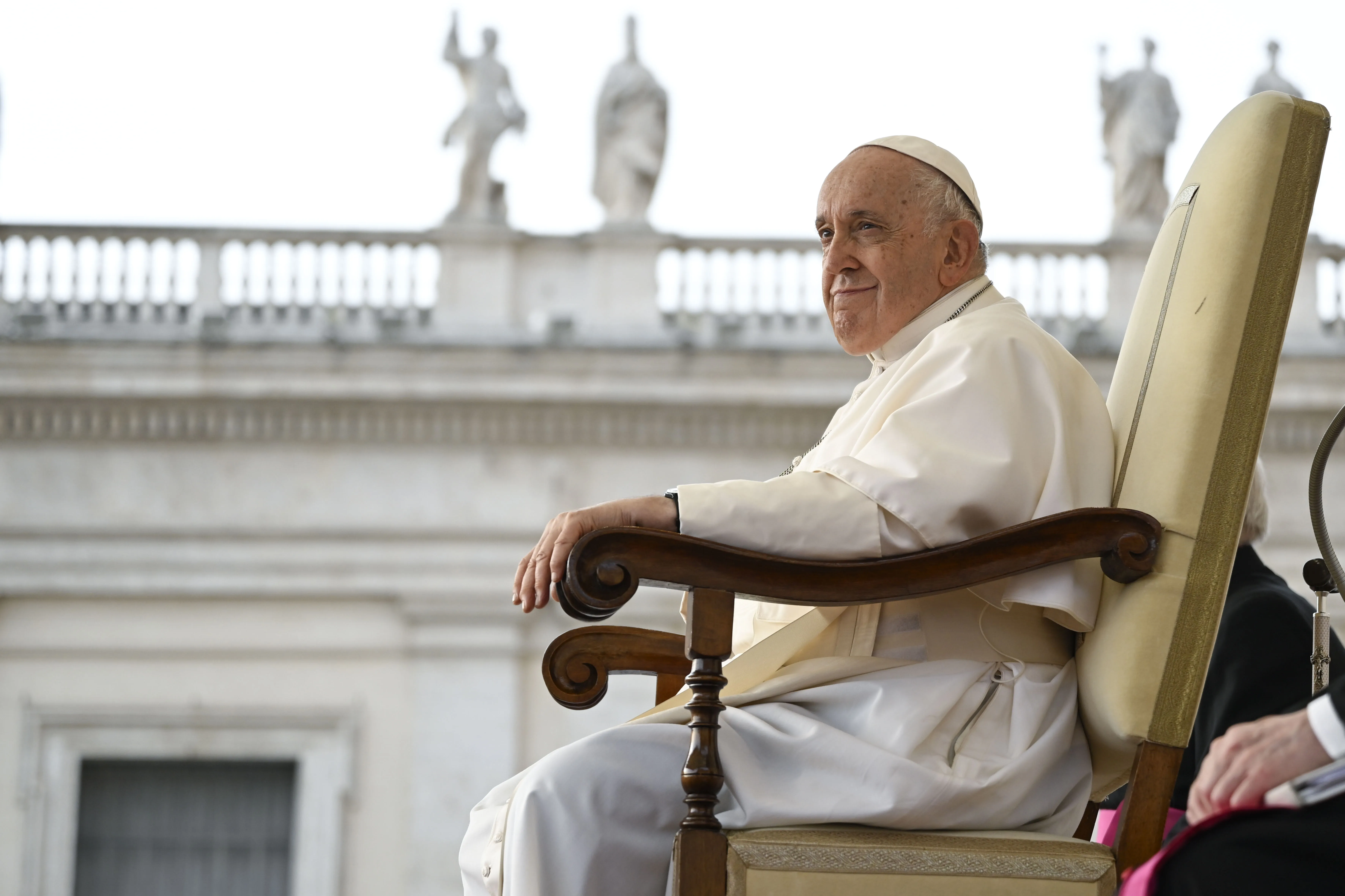
After speaking with Pope Francis about the matter in light of the May 3 discussion, Ladaria said the pope “came to the conclusion that the document is not mature enough to be published,” and cited three main reasons for the decision.
First, Ladaria stressed that admission to Communion of Protestant spouses in inter-confessional marriages “is a topic that touches the faith of the Church and has relevance for the universal Church.”
Allowing non-Catholics to receive the Eucharist, even in certain limited conditions, would also have an impact on ecumenical relations with other Churches and ecclesial communities “which should not be underestimated.”
Finally, he said the question of Communion is a matter of Church law, and cited canon 844 of the Code of Canon Law, which deals with access to the Sacraments of the Catholic Church.
Specifically, canon 844 states that “Catholic ministers administer the sacraments licitly to Catholic members of the Christian faithful alone, who likewise receive them licitly from Catholic ministers alone,” apart from a number of exceptions spelled out in the canon.
These exceptions include allowing non-Catholic Christians to receive the sacraments of Confession, the Eucharist, and the Anointing of the Sick by non-Catholic ministers in churches where these sacraments are valid “whenever necessity requires it or true spiritual advantage suggests it, and provided that danger of error or of indifferentism is avoided.”
Catholic ministers, the canon says, can also administer these sacraments licitly on members of Eastern Churches that are not in full communion with Rome, “if they seek such on their own accord and are properly disposed.”
The canon says this is also valid “for members of other Churches which in the judgment of the Apostolic See are in the same condition in regard to the sacraments as these Eastern Churches.”
For non-Catholic Christians unable to approach a minister from their own confession, the canon says they are able to receive these sacraments only “if the danger of death is present or if, in the judgment of the diocesan bishop or conference of bishops, some other grave necessity urges it.”
However, to receive the sacraments they must seek reception “on their own accord, provided that they manifest Catholic faith in respect to these sacraments and are properly disposed.”
The canon concludes underlining that in the case of the exceptions, “the diocesan bishop or conference of bishops is not to issue general norms except after consultation at least with the local competent authority of the interested non-Catholic Church or community.”
In his letter to Cardinal Marx, Ladaria noted that while there are “open questions” in some sectors of the Church in regards to the interpretation of canon 844, “the competent dicasteries of the Holy See have already been charged with producing a timely clarification of these questions at the level of the universal Church.”
However, he said it would be left up to diocesan bishops to judge when there is a “grave impending need” regarding the reception of the sacraments.
Ladaria, who was recently tapped by Pope Francis to get a red hat in a consistory later this month, heads the Vatican’s Congregation for the Doctrine of the Faith.
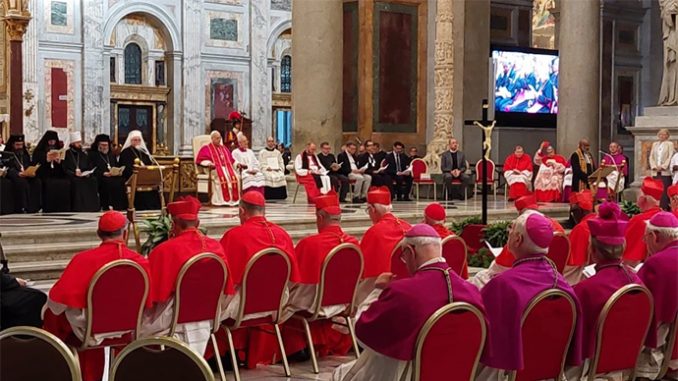
His letter to German prelates follows a May 3 meeting on the topic of inter-communion between a delegation of German bishops and members of Vatican dicasteries to discuss whether the question of inter-communion for non-Catholic spouses in inter-denominational marriages could be decided at a local level, or whether it needed Vatican intervention.
The meeting was called after reports, later denied by the German bishops’ conference, came out saying the Vatican’s Congregation for the Doctrine of the Faith had rejected a proposal by the German bishops to publish guidelines allowing non-Catholic spouses of Catholics to receive the Eucharist in certain limited circumstances.
In February, Cardinal Marx had announced that the German bishops conference would publish a pastoral handout explaining that Protestant spouses of Catholics “in individual cases” and “under certain conditions” could receive Holy Communion, provided they “affirm the Catholic faith in the Eucharist.”
Marx’s statement concerned a draft version of the guidelines, which was adopted “after intensive debate” during a Feb. 19-22 general assembly of the conference.
After Marx’s announcement on the inter-communion proposal, several German prelates appealed to the Vatican for clarification. Specifically, they wrote to the Congregation for the Doctrine of the Faith, the Council for Promoting Christian Unity and the Council for Legislative Texts.
Signatories, who did not consult Cardinal Marx before writing the letter, included: Archbishop Ludwig Schick of Bamberg; Bishop Gregor Hanke of Eichstätt; Bishop Konrad Zdarsa of Augsburg; Bishop Stefan Oster of Passau; Bishop Rudolf Voderholzer of Regensburg; Bishop Wolfgang Ipolt of Görlitz and Cardinal Rainer Maria Woelki, archbishop of Cologne.
None of the signatories, apart from Cardinal Woelki, were present for the May 3 meeting at the Vatican, which was held at the Vatican.
Members of the German delegation for the May 3 meeting also included: Cardinal Marx; Bishop Genn; Bishop Wiesemann, president of the Doctrinal Commission for the German bishops conference; Bishop Feige, president of the German bishops’ Commission for Ecumenism; Bishop Voderholzer of Regensburg, and Fr. Hans Langendörfer SJ, secretary of the German bishops conference.
On the Vatican side, the meeting was attended by: Archbishop Ladaria; Cardinal Kurt Koch, president of the Pontifical Council for Promoting Christian Unity; Msgr. Markus Graulich, undersecretary for the Pontifical Council for Legislative Texts and Fr. Hermann Geissler, who serves as a kind of office manager for the Congregation for the Doctrine of the Faith.
After the meeting, Ladaria was tasked with recounting the details of the discussion to Pope Francis. In his May 25 letter to Marx, Ladaria said he spoke to the pope about it May 11, and again May 24. It was after these discussions, he said, that Francis decided the inter-communion guidelines put forward by Cardinal Marx could not be published.
 […]
[…]





“We all bleed the same blood” or the interplay between pop songs and Synodal Truth?
Orchestral Manoeuvres in the Dark: Universal
“It doesn’t matter if you’re black or white
Or the God that you choose to pray to
It doesn’t matter about the clothes you wear
Or which creator made you
We all bleed the same blood
We all need the same love
And when we die there’s no heaven above
It’s universal, it’s universal”
Forget the Catholic English Martyrs of England and Wales. Most anglicans use the Bugnini 1970 Novos Ordo anyway…
Not for publication
My previous comment is inappropriate to the text. Please do not publish.
I have. a question. The title refers to this as an ecumenical service, and we do find them occurring frequently. There have been a number of articles recently in Catholic websites regarding relativism and indifferentism. Is it possible that ecumenical services contribute to that? We are all meeting and praying together, so what is the difference which Christian faith we belong to.
I am just asking and wondering what others might think about this.
Many years ago in my youth the Church preached against mixed marriages as a danger to the Catholic partners faith. That is no longer done to any extent.
I recall seeing in the past statistics on the percent of Catholics in a mixed marriage who leave the faith, and it varied depending on whether the husband or wife was the Catholic party. I was not able to locate those numbers today.
From Prison
At midday she will look out from the kitchen
but will not see my burnt back bent to the harvest.
She will do what she is able of my share,
except the loading – Yari will make some time . . .
When night comes, after supper,
she will bathe the children,
amuse them with games,
assure them: “Papa will be back soon.”
Should there arise a sudden storm,
she will huddle them to her in the big room:
tell them stories, sing.
Before she goes to bed,
she will fasten tight the door,
look in on Stefan, and make sure
little Nikola is warm and snugly tucked in.
They will sleep now, and she will make
the house neat for the morning.
Then she will light the lamp beside our bed
and tell the Virgin Mother of her day,
and, between cold sheets,
she will muffle her tears in the pillow . . .
And tomorrow, when my interrogators enter the cell –
the thought-police with their questions of the State –
they will demand of me the truth of my thoughts
and the names of those I know,
and test my patience and my sanity . . .
And I will be mute as a stone.