



Vatican City, Sep 8, 2025 / 09:15 am (CNA).
Vatican experts said on Monday that the two children killed in last month’s shooting at a Minneapolis church could one day be included on a list they are compiling of “new martyrs and witnesses of the faith.”
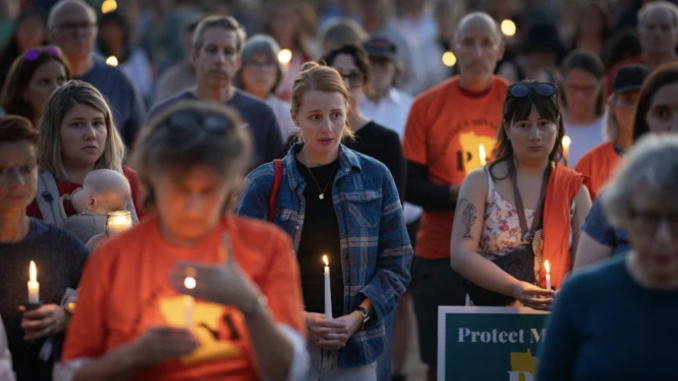
Harper Moyski, 10, and Fletcher Merkel, 8, were killed while attending a parochial school Mass at Annunciation Catholic Church on Aug. 27 — prompting some to ask whether they could be considered martyrs killed “in hatred of the faith.”
“If the diocese or other local ecclesial entities present these figures to us as witnesses of the faith, we will examine them and see if we can include them in the list,” said Archbishop Fabio Fabene, president of the Vatican “Commission of New Martyrs — Witnesses of the Faith.”
The commission, created by Pope Francis in 2023 under the Dicastery for the Causes of the Saints, is compiling an archive of the lives of Christian martyrs, both Catholic and non-Catholic, who have been killed in the new millennium.
As Fabene and other experts explained on Sept. 8, the commission’s selection criteria are not the same used by the Church to formally recognize a martyr through beatification and canonization. “They are two totally distinct things,” the archbishop said.

Andrea Riccardi, commission vice president and founder of the Community of Sant’Egidio, said the work of the commission is “to preserve stories and names in the heart of the Church, so that their memory is not lost.” Inclusion on the commission’s list of “new martyrs” does not qualify as a beatification, he said.
Riccardi and experts spoke about the Minneapolis shooting victims, in response to a reporter’s question, during a news conference to present an ecumenical prayer service to be led by Pope Leo XIV on Sept. 14.
The service, commemorating martyrs and witnesses of the faith of the 21st century, will be held at the Basilica of St. Paul Outside the Walls on the Feast of the Exaltation of the Cross — which also happens to be Leo’s 70th birthday.
Sept. 14 was chosen for the liturgy “because it is the Feast of the Exaltation of the Holy Cross,” Fabene said. “We are very happy about this [coincidence of the pope’s birthday] also to wish him a happy birthday.”
Delegates from 24 Christian churches and traditions will attend the ecumenical service, including Metropolitan Anthony Sevryuk, the chairman of the Department for External Church Relations for the Russian Orthodox Church.
The Sept. 14 event recalls a similar ecumenical liturgy held in the Colosseum during the 2000 Jubilee Year.
When Francis established the new martyrs commission in 2023, he wrote that “the martyrs ‘are more numerous in our time than in the early centuries’: they are bishops, priests, consecrated men and women, laypeople and families, who in the different countries of the world, with the gift of their lives, have offered the supreme proof of charity.”
Looking ahead to the 2025 Jubilee of Hope, Pope Francis asked the commission to compile an updated list of Christian men and women who were killed for their faith in the first quarter of the 21st century.
Experts said on Monday that their catalog, which they hope eventually to publish, consists so far of 1,640 Christians killed in different circumstances of persecution and hatred around the world.
“The heart of this work is memory,” Riccardi said. “As St. John Paul II said, the names of those who died for their faith should not be lost.”
If you value the news and views Catholic World Report provides, please consider donating to support our efforts. Your contribution will help us continue to make CWR available to all readers worldwide for free, without a subscription. Thank you for your generosity!
Click here for more information on donating to CWR. Click here to sign up for our newsletter.



To the Attention of the Pontiff Leo XIV, and the Vatican Bureaucratic Establishment, and the USCCB NGO:
It appears that you are recommending sleep-walking instead of standing up and speaking up like Christian people.
Recommendation: read this essay about the demonic violence stalking inside the Trojan Horse of your LGBTQ submission:
https://crisismagazine.com/opinion/gender-ideology-and-violence-cultural-confusion-and-the-spiritual-battle
Also, the Pontiff Leo XIV, and the Vatican Bureaucratic Establishment, and the “Re-Paganized-Jesuit-Cult,” and the USCCB NGO, are corporately responsible for inviting this demonic desecration of St. Peter’s Basilica in your re-paganized “Jubilee”:
https://x.com/LepantoInst/status/1964356537163370601
Martyrs are those who WILLINGLY sacrifice their lives. Those children murdered by that sexually confused psychotic are victims of a crime but not martyrs. Sometimes I think that it’s our Catholic Church that’s gone insane (and woke).
The Holy Innocents didn’t willingly sacrifice their lives.
I totally agree!! I am Catholic. If some nut sees me going to Mass everyday and HATES Catholics decides to shoot me in the back as I walk home, what virtue of mine is involved? Answer: NONE. If that person stopped me and threatened my life with a gun unless I renounced my faith and I refused: then maybe a martyr. And it does greatly concern me that the Church makes these kinds of statements rather liberally that diminish the power of courage based on true faith that give us all role models to live by.
As an addend: I am not positive but have reason to believe, based upon their respective funeral services, those two children who died were not Catholic. I think one was Lutheran and the other a different faith. That does not diminish in any way the tragedy of their deaths.
Absolutely! We, as Americans, should pray fervently for those children in Minnesota who were murdered in Odium Fidei.
By definition, they are truly martyrs and their innocent souls are in Heaven.
Left almost speechless I can say this: Sentimentality occupying the place of reason abandoned does not cut the mustard. We saw this boldly exhibited during the last pontificate and it appears it has now become the pharmaceutical of choice.
We require a blistering intervention.
What do the Vatican experts say about trying to prevent this type killing?
I’m certainly no expert on transgender issues or violent crimes, but I think it would be wise before drawing conclusions about mental instability and demonic influence leading to violent murderous acts by people who think they are transgender, to compare the actual percentage of trans people who plan and commit violent murderous acts with the actual percentage of non-trans people who plan and commit violent murderous acts.
And for that matter, we need to know the percentage of trans people who have never committed a violent murderous act and would be horrified at the thought of committing such an act.
I wouldn’t bet my farm on this, but I’m willing to guess that the PERCENTAGE of trans people with NO emotional or mental impairments who commit murderous acts would be similar to the PERCENTAGE of people who are NOT trans and have NO mental or emotional impairment who commit murderous acts. Perhaps the crime is committed as a result demonic influence, or perhaps it is just rage that lurks beneath the surface in straight and in LGBTQ+ people, as well as straight people.
Of course, there is also the question of whether transgenderism occurs strictly because of demonic influence–are there studies and stats about this? From what I have read, many transexuals were treated by a parent (often a single mother) as the opposite sex that they were born as. E.g. a single mother really wanted a girl, but she gave birth to a boy and decided from his birth that this child is really a girl and raises the child as a girl rather than a boy.
If anyone has a reliable authority who has published studies and statistics, I would be pleased to see a posting or a link to the studies. Thank you.
What percentage of people who believe they’re in the wrong body have no psychological or emotional issues? I’d be willing to bet my little farm that it’s 0.0%.
I think you are defending the indefensible here. People who think they are the opposite sex are psychologically disturbed individuals. Their degree of pathology varies somewhat, but the thinking and behavior are pathological nonetheless. At this point, it’s better to assume that transgender people are potentially dangerous than to err on the side of understanding.