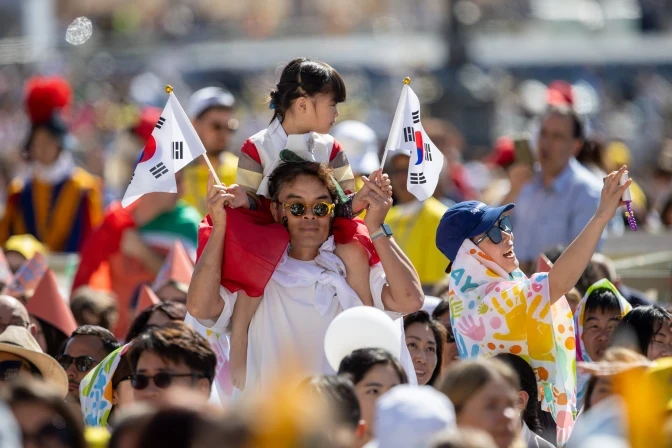
Young people participate in the Mass for the first World Children’s Day in May 2024. / Credit: Daniel Ibáñez/EWTN News
ACI Prensa Staff, Aug 13, 2025 / 12:20 pm (CNA).
Pope Leo XIV has decided that the Pontifical Committee for World Children’s Day should be incorporated within the Dicastery for the Laity, the Family, and Life, whose prefect is Cardinal Kevin Farrell.
A rescript published by the Holy See Press Office on Aug. 13 announced the Holy Father’s recent decision, which he made after a meeting on Aug. 6 with Archbishop Edgar Peña Parra, substitute for general affairs of the Vatican Secretariat of State.
On Dec. 8, 2023, Pope Francis established World Children’s Day, organized by the Dicastery for Culture and Education, saying it would be celebrated worldwide May 25–26, 2024.
On May 25 last year, thousands of children from 77 countries around the world met with the Argentine pope at Rome’s Olympic Stadium. Together, they heard various testimonies and the youngest children also had the opportunity to ask the Holy Father questions.
In November 2024, Francis established the Pontifical Committee for World Children’s Day and appointed as its president Father Enzo Fortunato, who is also director of communications for St. Peter’s Basilica and head of the press office of St. Francis of Assisi Basilica.
The next World Children’s Day will be celebrated in Rome in September 2026.
This story was first published by ACI Prensa, CNA’s Spanish-language news partner. It has been translated and adapted by CNA.
If you value the news and views Catholic World Report provides, please consider donating to support our efforts. Your contribution will help us continue to make CWR available to all readers worldwide for free, without a subscription. Thank you for your generosity!
Click here for more information on donating to CWR. Click here to sign up for our newsletter.
Pope Francis waves during the weekly general audience in the Vatican’s Paul VI Hall on Dec. 28, 2022. / Credit: Vatican Media.
Vatican City, Dec 28, 2022 / 10:30 am (CNA).
Pope Francis Wednesday published a message on St. Francis de Sales, a saint who teaches us that “devotion [to God] is meant for everyone, in every situation.”
The pope’s apostolic letter, titled Totum amoris est, or “Everything Pertains to Love,” was published on Dec. 28, the 400th anniversary of St. Francis de Sales’ death in 1622.
The title comes from the preface of the Swiss saint’s book “Treatise on the Love of God,” in which he wrote that “In Holy Church, everything pertains to love, lives in love, is done for love and comes from love.”
St. Francis de Sales was a priest and bishop who taught against Protestant heresies and encouraged holiness in all people, no matter their vocation. He is known for his spiritual writings, including two books that are still widely read today: “An Introduction to the Devout Life” and “Treatise on the Love of God.” In 1877, he was proclaimed a Doctor of the Church.
“On this anniversary of the fourth centenary of his death, I have given much thought to the legacy of Saint Francis de Sales for our time,” Pope Francis said in his apostolic letter. “I find that his flexibility and his far-sighted vision have much to say to us.”
“Today he bids us set aside undue concern for ourselves, for our structures and for what society thinks about us, and consider instead the real spiritual needs and expectations of our people,” the pope noted.
Saint Francis de Sales, painted by Francisco Bayeu y Subías. Wikimedia (CC0)
Commenting on St. Francis de Sales’ teachings, Pope Francis said “devotion is meant for everyone, in every situation, and each of us can practice it in accordance with our own vocation.”
“As Saint Paul VI wrote on the fourth centenary of the birth of Francis de Sales, ‘Holiness is not the prerogative of any one group, but an urgent summons addressed to every Christian: “Friend, come up higher” (Lk 14:10). All of us are called to ascend the mountain of God, albeit not each by the same path.’”
“Devotion,” Paul VI said, quoting St. Francis, “must be practiced differently by the gentleman, the craftsman, the chamberlain, the prince, the widow, the young woman, the wife. Moreover, the practice of devotion must be adapted to the abilities, affairs and duties of each.”
False Devotion
In his letter, Pope Francis reflected on what St. Francis de Sales called “false devotion” and its relevance for our spiritual lives today.
Saint Francis de Sales. Kelson / Wikimedia (CC0)
“Francis’ description of false devotion is delightful and ever timely. Everyone can relate to it, since he salts it with good humor,” the pope explained.
De Sales wrote: “Someone attached to fasting will consider himself devout because he doesn’t eat, even though his heart is filled with bitterness; and while, out of love for sobriety, he will not let a drop of wine, or even water, touch his tongue, he will not scruple to drench it in the blood of his neighbor through gossip and slander. Another will consider himself devout because all day long he mumbles a string of prayers, yet remains heedless of the evil, arrogant and hurtful words that his tongue hurls at his servants and neighbors. Yet another will readily open his purse to give alms to the poor, but cannot wring an ounce of mercy from his heart in order to forgive his enemies. Another still will pardon his enemies, yet never even think of paying his debts; it will take a lawsuit to make him do so.”
“All these,” Pope Francis said, “of course, are perennial vices and struggles, and they lead the saint to conclude that ‘all these fine people, commonly considered devout, most surely are not.’”
True Devotion
The pope explained that St. Francis de Sales taught that true devotion, instead, is found in “God’s life dwelling within our hearts.”
“True and lively devotion presupposes the love of God; indeed, it is none other than a genuine, and not generic, love of God,” the saint said.
Saint Francis de Sales giving Saint Jeanne de Chantal the rule of the order of the Visitation /. null
Pope Francis said: “In Francis’ lively language, devotion is ‘a sort of spiritual alertness and energy whereby charity acts within us or, we act by means of it, with promptness and affection.’ For this reason, devotion does not exist alongside charity, but is one of its manifestations, while at the same time leading back to it.”
“Devotion is like a flame with regard to fire: it increases the intensity of charity without altering its quality,” the pope said, adding a quote from St. Francis de Sales, who said: “Charity is a spiritual fire that, when fanned into flame, is called devotion. Devotion thus adds nothing to the fire of charity but the flame that makes charity prompt, active and diligent, not only in the observance of God’s commandments but also in the exercise of his divine counsels and inspirations.”
“Understood in this way, devotion is far from something abstract,” the pope said. “Rather, it becomes a style of life, a way of living immersed in our concrete daily existence. It embraces and discovers meaning in the little things: food and dress, work and relaxation, love and parenthood, conscientiousness in the fulfillment of our duties. In a word, it sheds light on the vocation of each individual.”
Love
Pope Francis also reflected on St. Francis de Sales’ teachings on love as “the first act and principle of our devout or spiritual life.”
Mosaic of Sales on the exterior of St. Francis de Sales Oratory in St. Louis, Missouri. RickMorais / Wikimedia (CC BY-SA 4.0)
“The source of this love that attracts the heart is the life of Jesus Christ,” he explained. “‘Nothing sways the human heart as much as love,’ and this is most evident in the fact that ‘Jesus Christ died for us; he gave us life through his death. We live only because he died, and died for us, as ours and in us.’”
“These words are profoundly moving; they reveal not only a clear and insightful understanding of the relationship between God and humanity, but also the deep bond of affection between Francis de Sales and the Lord Jesus,” the pope said. “The ecstasy of life and action is no abstract reality, but shines forth in the charity of Christ that culminates on the cross. That love, far from mortifying our existence, makes it radiate with extraordinary brightness.”
King Charles III and Charles Edward Stuart (better known as “Bonnie Prince Charlie”). / Credit: Adam Schultz, Public domain, via Wikimedia Commons; Allan Ramsay, Public domain, via Wikimedia Commons
Vatican City, May 2, 2017 / 11:33 am (CNA/EWTN News).- Traditional solutions to the problem of poverty typically take a top-down welfare approach, focused on fulfilling a person’s most basic needs, such as food and shelter – but which don’t address the issue of societal participation and inclusion.
The plenary session of the Pontifical Academy of Social Sciences, held at the Vatican April 28-May 2, aimed to find solutions which promote inclusion for the otherwise marginalized, especially the poorest in society.
“All of the 20th century, and the end of the 19th century, the response to the poorest of the poor was to provide them with absolute basic necessities, such as the workhouse, food, clothes,” said Margaret Archer, president of the Academy of Social Sciences.
“This is not enabling them to participate in society; at best, only to survive. Life is about more than just simple survival. Welfare is a top-down solution. So this was the motive for the conference on participation,” she said.
Archer, who spoke to journalists at a press conference May 2, said the question of how to go about helping “the poorest of the poor” is a “major challenge” for social theory.
“When you have a population of extreme poverty, what do you do? You give them welfare. The Pope doesn’t want the simplistic solution of just giving them money, because it doesn’t last forever anyway,” she said.
The academy’s plenary session, titled “Towards a participatory society: new ways for social and cultural integration,” discussed the wide-ranging topic of societal exclusion, which can manifest in different ways in different parts of the world.
In addition to the poor and economically disadvantaged, it also can include migrants and refugees, religious minorities, and those with disabilities.
In some parts of the world, an initial exclusion can end up leading to more and worsening issues, said Paulus Zulu, a professor at the University of Natal. In Africa, for example, he said there is “a crisis of representative democracy.”
This is one of the major causes of a lack of social participation, he explained. And when this happens to too great an extent, it frequently leads to excluded populations seeking inclusion or existence elsewhere, one of the reasons behind migration, especially economic migration.
In their meetings, the group discussed alternative ways to bring about “global social change in the direction of inclusivity and fraternity,” Archer said, one solution being through Church support of non-governmental organizations.
Pope Francis sent a message to the academy on April 28 encouraging them in their plenary session and urging them, according to the Church’s social doctrine, to find “ways to apply in practice fraternity as the governing principle of the economic order.”
“Fraternity allows people who are equal in their essence, dignity, freedom, and their fundamental rights to participate differently in the common good according to their capacity, their plan of life, their vocation, their work, or their charism of service,” he said.
“From the beginning of my pontificate, I wanted to point out that ‘in our brother lies the permanent extension of the Incarnation for each of us’ (Evangelii Gaudium, 179). In fact, the protocol we are judged by is based on brotherhood: ‘All you did to one of these least brothers of mine, you did to me’ (Mt. 25:40).”
“Even though we live in a world where wealth abounds, many people are still victims of poverty and social exclusion,” Francis continued.
“The Gospel Proposal: ‘Seek first the Kingdom of God and its justice, and all these things will be added to you’ (Mt 6:33) has been and is still a new energy in history that tends to arouse fraternity, freedom, justice, peace and dignity for all.”
Concluding, he quoted from Benedict XVI’s encyclical, Caritas in Veritate, saying: “To the extent that the Lord will succeed in reigning in us and among us, we will be able to participate in divine life and we will be one to the other ‘instruments of his grace, to pour out the mercy of God and to weave nets of charity and fraternity.’”
Cardinal Kevin Farrell…whatever his considerable merits, the dark spot is that he lived with former cardinal McCarrick for six years without noticing anything peculiar. “Not once did I even suspect…” he said (of what is widely reported to have been an open secret). Maybe so…
But, with optics in mind, Farrell is now past the retirement age of 77 years, so maybe soon, even within the next month, someone with a more attentive demeanor can take his place over an event having to do with children. https://www.catholicnewsagency.com/news/263519/who-is-cardinal-farrell-the-camerlengo-and-a-key-figure-in-the-papal-transition
