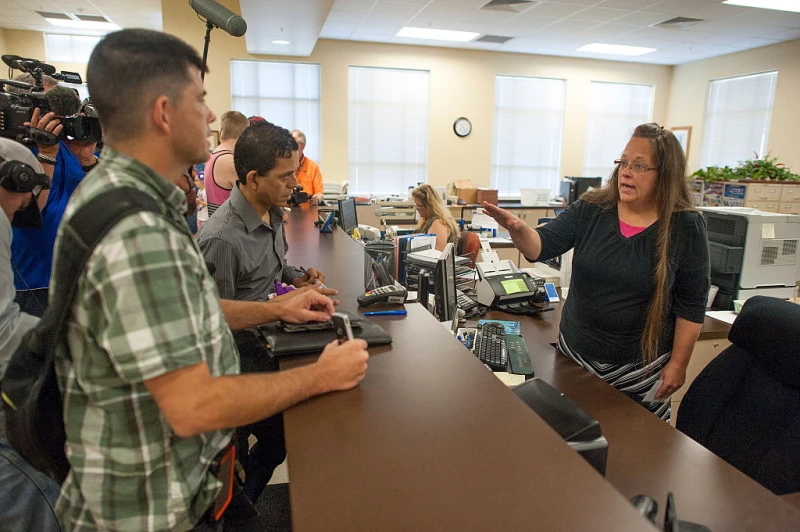
Kim Davis (at right) is pictured here in 2015, when she served as clerk of the courts in Rowan County, Kentucky. Citing a sincere religious objection, Davis refused to issue marriage licenses to same-sex couples in defiance of a U.S. Supreme Court ruling. / Credit: Ty Wright/Getty Images
Washington, D.C. Newsroom, Jul 31, 2025 / 08:00 am (CNA).
Kim Davis, who was the Rowan County clerk from 2015 through 2019, has petitioned the country’s highest court to reconsider the 2015 Obergefell v. Hodges ruling, which legalized same-sex civil marriages nationally.
That year, the court’s 5-4 decision found that same-sex couples have a constitutional right to legally recognized marriages under the 14th Amendment’s equal protection clause.
Davis’ filing also asks the court to consider her request to use a First Amendment defense against civil lawsuits that stemmed from her refusal to issue those marriage licenses. She was found liable for violating the constitutional rights of same-sex couples whose marriage licenses she refused to certify and ordered to pay them hundreds of thousands of dollars.
At the time, Davis had requested a religious accommodation that would have allowed her to continue her job without issuing marriage licenses to same-sex couples. Gov. Matt Bevin, who assumed office in December of that year, signed an executive order accommodating Davis, which allowed clerks to remove their names from marriage licenses issued by the office.
Still, because Davis was denied civil immunity and denied the ability to use a First Amendment defense in court, she remains liable for those damages. She is represented in court by Liberty Counsel, a Christian legal nonprofit.
Liberty Counsel Chairman Mat Staver said in a statement that Davis’ ongoing case shows why the country’s Supreme Court “should overturn the wrongly decided … opinion” on same-sex marriage. He argued that the ruling “threatens the religious liberty of Americans who believe that marriage is a sacred union between one man and one woman.”
“A person cannot stand before the court utterly defenseless while facing claims of emotional distress for her views on marriage,” Staver said.
“Yet, that is the result of Obergefell, which led these courts to strip Davis of any personal First Amendment defense,” he continued. “Obergefell cannot just push the First Amendment aside to punish individuals for their beliefs about marriage. The First Amendment precludes making the choice between your faith and your livelihood. The high court now has the opportunity to finally overturn this egregious opinion from 2015.”
The lawsuit argues that in the same way the First Amendment “provides a defense to private business owners … for refusing to violate their religious convictions” regarding same-sex civil marriages, the Supreme Court should recognize it “likewise provides an individual a defense to application of state laws that require her to speak a message concerning same-sex marriage that is inconsistent with her religious beliefs.”
It adds that there is “no sound constitutional basis” to treat a public official acting in his or her individual capacity any differently than a nonpublic official: “To do so would mean government officials surrender certain constitutional rights at their swearing-in ceremonies. That cannot be right.”
Although same-sex marriage has been the law of the land for the past decade, there have been some recent efforts to push back on the ruling.
Just this year, lawmakers in at least five states introduced resolutions that called on the court to overturn its same-sex marriage ruling. Two resolutions passed their state’s lower chamber but did not get through their state’s senate. The other three failed earlier in the process. Lawmakers in at least four states introduced proposals to create a new category of a “covenant marriage,” which is reserved for one man and one woman.
A May Gallup poll found that 68% of Americans support same-sex civil marriages. This is down from a height of 71% in 2022 and 2023 after there was a slight decrease two years in a row. Only 41% of Republicans support same-sex civil marriages, which is down from highs of 55% in 2021 and 2022.
If you value the news and views Catholic World Report provides, please consider donating to support our efforts. Your contribution will help us continue to make CWR available to all readers worldwide for free, without a subscription. Thank you for your generosity!
Click here for more information on donating to CWR. Click here to sign up for our newsletter.
“What’s the Eucharist?” Kent Shi, a 25-year-old Harvard graduate student, asked that question when he attended eucharistic adoration for the first time. The answer put him on a path to conversion. / Julia Monaco | CNA
Cambridge, Massachusetts, Apr 16, 2022 / 09:03 am (CNA).
One convert’s journey to Catholicism began with an invitation to an ice-cream social.
Another says he instantly believed in the Real Presence the moment someone explained what the round object was that everyone was staring at during eucharistic adoration.
For a third, the poems of T.S. Eliot — and a seemingly random encounter with a priest on a public street — led to deeper questions about truth and faith.
Their paths differed but led them to the same destination: St. Paul’s Catholic Church in Cambridge, Massachusetts, where they are among 31 people set to be fully initiated into the Catholic Church during the Easter vigil Mass on Saturday, April 16.
That number of initiates is a record high for St. Paul’s, a nearly century-old Romanesque-style brick church whose bell tower looms over Harvard Square.
A scheduling backlog caused by the COVID-19 pandemic is partly responsible for the size of this year’s group of catechumens (non-baptized) and candidates (baptized non-Catholics.) But Father Patrick J. Fiorillo, the parochial vicar at St. Paul’s, believes there’s more to it than that.
“There’s definitely a significant segment of people who started thinking more deeply about their lives and faith during COVID-19,” Fiorillo said. “So, coming out of Covid has given them the occasion to take the next step and move forward.”
Fiorillo is the undergraduate chaplain for the Harvard Catholic Center, a chaplaincy based at St. Paul’s for undergraduate and graduate students at Harvard University and other academic institutions in the area. This year, 17 of the 31 initiates are Harvard students.
“Everybody assumes that, because this is the Harvard Catholic Center, that everybody here is very smart and therefore has a very highly intellectual orientation towards their faith,” Fiorillo told CNA.
“That is definitely true of some people. But I would say the majority are not here because of intellectually thinking their way into the faith. Some are. But the majority are just kind of ordinary life circumstances, just seeking, questioning the ways of the world, and just trying to get in touch with this desire on their heart for something more,” he said.
Fiorillo says welcoming converts into the Church at the Easter vigil is one of the highlights of his ministry.
“It’s an honor. It gives me hope just seeing all this new life and new faith here. So much in one place,” he said.
“When I tell other people about it, it gives them hope to hear that many young people are still converting to Catholicism, and they’re doing it in a place as secular as Cambridge.”
Prior to the Easter vigil, CNA spoke with five of St. Paul’s newest converts. Here are their stories:
‘This is what I’ve been looking for’
Katie Cabrera, a 19-year-old Harvard freshman, told CNA that she was excited to experience the “transformative power of Christ through his body and blood” at Mass for the first time at the Easter vigil.
A native of Dorchester, Massachusetts, she said she was baptized as a child and comes from a family of Dominican immigrants. Her father, who grew up in an extremely impoverished area, lacked a formal education, but always kept the traditions of the Catholic faith close to him in order to persevere in difficult times.
Her father’s love for her and his Catholic faith deeply inspired Cabrera, and served as an anchor for her faith throughout her life.
Growing up, however, Cabrera attended a non-denominational church with her mother. Because she felt the church’s teachings lacked an emphasis on God’s love and mercy, Cabrera eventually left.
“Even though I Ieft, I always knew that I believed in God,” Cabrera said. “So, I was at a place where I felt kind of lost, because I always had that faith, but I didn’t know what to do with it.”
“There was a void that existed in my heart,” says Katie Cabrera, a Harvard undergraduate student. She discovered what was missing when she started to get involved with the Harvard Catholic Center. Courtesy of Katie Cabrera
After she arrived at Harvard, she accepted a friend’s invitation to attend an ice-cream social at the Harvard Catholic Center — “and that was like, sort of, how it all started,” she told CNA.
Once she was added to the email list for the center’s events, she felt a “calling” that she “really wanted to officially become Catholic” after many difficult years without a faith community.
Catholic doctrine about the sacraments was no hurdle for Cabrera, as she credits Fiorillo with explaining the faith well.
“There was a void that existed in my heart,” she said. “As soon as Father Patrick started teaching about marriage and family, theology of the body, and the sacraments, I was like, ‘This is what I’ve been looking for my whole life.’”
‘What’s the Eucharist?’
“What is that thing on the thing?”
Kent Shi laughs when he recalls how perplexed he was the first time he attended eucharistic adoration at St. Mary’s of the Assumption in Cambridge.
Someone helpfully explained that what Shi was looking at was the Eucharist displayed inside a monstrance.
“What’s the Eucharist?” he wanted to know.
For many non-Catholics considering entering the Catholic Church, the Real Presence can be a major obstacle. But Kent Shi, a Harvard graduate student, says that once the Eucharist was explained to him, he instantly believed. Julia Monaco | CNA
For many non-Catholics considering entering the Catholic Church, the Real Presence can be a major obstacle.
Not Shi. He says that once the Eucharist was explained to him that day, he instantly believed.
Shi, 25, told CNA that he considered himself an agnostic for most of his life, meaning he neither believed nor disbelieved in God.
Between his first and second years as a graduate student in Harvard’s Kennedy School of Government, however, he accepted Christ and started attending services at a Presbyterian church.
One day in the summer of 2021, a crucifix outside St. Paul’s that Shi says he “must have passed multiple times a week for months and never noticed” caught his eye, and deeply moved him.
Shortly after, he accepted a friend’s invitation to attend eucharistic adoration at St. Mary’s even though he “didn’t know what adoration meant.” Unaware of what he was about to walk into, Shi asked a friend what the dress code was for adoration. His friend replied, “Respectful.”
And so, respectfully dressed in a button-down shirt and slacks, Shi sat in the front row with his friend, only a few feet from the monstrance. That’s when the questions began.
It wasn’t long after that encounter that Shi began attending Mass at St. Paul’s and the parish’s RCIA (Rite of Christian Initiation for Adults) program. Shi asked CNA readers to pray for him and his fellow RCIA classmates.
“There’s a lot of prodigal sons and daughters here, so we would very much appreciate that,” he said, “especially me.”
Poetry and art opened the door
For Loren Brown, choosing to attend a secular university like Harvard proved to be “providential.”
The 25-year-old junior from La Center, Washington, said he comes from a “lapsed” Catholic family and wasn’t baptized.
He didn’t think much about the faith until the spring semester of his freshman year, when, he says, Catholic friends of his “began to question my lack of commitment to faith.”
Later, when students were sent home to take classes virtually due to the pandemic, he had time to reflect and began to read some of the books they’d recommended to him. The poetry of T.S. Eliot (his favorite set of poems being “Four Quartets”) and the “Confessions” by St. Augustine, in particular, “pulled me towards the faith,” he said.
Brown describes his conversion as a “gradual process” which backed him into a “logical corner.” But a chance meeting with a priest also played a pivotal role.
One day in the summer of 2021 while walking back to his dormitory he encountered a man wearing a priestly collar outside St. Paul’s Church on busy Mount Auburn Street.
It was Father George Salzmann, O.S.F.S., graduate chaplain of the Harvard Catholic Center.
“He asked me how I was doing, what I was studying, and we immediately found a common interest in St. Augustine,” Brown told CNA.
“You know, there’s this great window of St. Augustine inside St. Paul’s and you should come see it,” Brown remembers the gregarious priest telling him. Salzmann wound up giving Brown a brief tour of the church, which was completed in 1923.
Harvard undergraduate student Loren Brown describes his conversion to Catholicism as a “gradual process” which backed him into a “logical corner.” But a chance meeting with a priest also played a pivotal role. Courtesy of Loren Brown
The next week, Brown found himself sitting in a pew for his first Sunday Mass at St. Paul’s. He hasn’t missed a Sunday since, a routine that ultimately led him to join the RCIA program that fall.
Brown says he now realizes that coming to Harvard was about more than majoring in education.
“What I wanted out of Harvard has completely changed,” he said. “Instead of an education that prepares me for a job or a career, I want one that forms me as a moral being and a human.”
‘I can’t do this alone. Please help me.’
Verena Kaynig-Fittkau, 42, is a German immigrant who came to the U.S. 10 years ago with her husband to do her post-doctoral research in biomedical image processing at Harvard’s engineering school.
The couple settled in Cambridge, where they had their first child. Two subsequent pregnancies ended in miscarriage, however. That second loss was overwhelming for Kaynig-Fittkau, who says she was raised as a “secular Lutheran” without any strong faith.
“It broke me and a lot of my pride and made me realize that I can’t do things by myself,” she told CNA.
She found herself on knees one Thanksgiving, pleading with God. “I can’t do this alone,” she said. “Please help me.”
She says God answered her prayer by introducing her to another mother, who she met at a playground. She was a Christian who later invited Kaynig-Fittkau to attend services at a Presbyterian church in Somerville, Massachusetts.
In that church, there was a lot of emphasis on “faith alone,” she said. But Kaynig-Fittkau, who now works for Adobe and is the mother of two girls, kept questioning if her faith was deep enough.
A YouTube video about the Eucharist by Father Mike Schmitz sent Verena Kaynig-Fittkau on a path toward converting to Catholicism. Courtesy of Verena Kaynig-Fittkau
Then one day she stumbled upon a YouTube video titled “The hour that will change your life,” in which Father Mike Schmitz, a Catholic priest from the Diocese of Duluth, Minnesota, known for his “Bible in a Year” podcast, speaks about the Eucharist.
Intrigued, she began watching similar videos by other Catholic speakers, including Father Casey Cole, O.F.M., Bishop Robert Barron, Matt Fradd, and Scott Hahn, each of whom drew her closer and closer to the Catholic faith.
Familiar with St. Paul’s from her days as a Harvard researcher and lecturer, she decided to attend Mass there one day, and made an appointment before she left to meet with Fiorillo.
When they met, Fiorillo answered all of her questions from what she calls “a list of Protestant problems with Catholicism.” She entered the RCIA program three weeks later.
Recalling her first experience attending eucharistic adoration, she said it felt “utterly weird” to be worshiping what she describes as “this golden sun.”
A conversation with a local Jesuit priest helped her better understand the Eucharist, however. Now she finds that spending time before the Blessed Sacrament is “amazing.”
“I am really, really, really excited for the Easter vigil,” Kaynig-Fittkau said. “I can’t wait, I have a big smile on my face just thinking about it.”
The rosary brought him peace
Another catechumen at St. Paul’s this year is Kyle Richard, 37, who lives in the Beacon Hill neighborhood of Boston and works in a technology startup company downtown.
Although he grew up in a culturally Catholic hub in Louisiana, his parents left the Catholic faith and joined a Full Gospel church. Richard said he found the church “intimidating,” which led him eventually to leave Christianity altogether.
When Richard was in his mid-twenties, his father battled pancreatic cancer. Before he died, he expressed a wish to rejoin the Catholic Church. He never did confess his sins to a priest or receive the Anointing of the Sick, Richard recalls sadly. But years later, his non-believing son would remember his father’s yearning to return to the Church.
“I kind of filed that away for a while, but I never really let it go,” he said.
While Kyle Richard’s father was dying from pancreatic cancer, he returned to the Catholic faith, which made a lasting impression on his non-believing son. Courtesy of Kyle Richard
Initially, Richard moved even farther away from the Church. He said he became an atheist who thought that Christianity was simply “something that people used to just soothe themselves.”
Years later, while going through a divorce, he had a change of heart.
Feeling he ought to give Christianity “a fair shot,” he began saying the rosary in hopes of settling his anxiety. The prayer brought him peace, and became a gateway to the Catholic faith.
Before long, he was reading the Bible on the Vatican’s website, downloading prayer apps, and meditating on scripture.
A Google search brought him to St. Paul’s. Joining the RCIA program, he feels, was a continuation of his father’s expressed desire on his deathbed more than a decade ago.
“I think he would be proud, especially because he was born on April 16th and that is the date of the Easter vigil,” he said.
Washington, D.C. Newsroom, Aug 1, 2023 / 10:20 am (CNA).
Two pro-life pregnancy centers and an institution that supports those centers are suing Vermont state officials over a new law that could land them tho… […]
Washington D.C., Apr 4, 2019 / 11:40 am (CNA).- Archbishop Wilton Gregory made an uncompromising commitment to transparency during his introduction to the faithful of Washington, DC, at a press conference Thursday.
“First of all, I believe that the only way I can serve this local archdiocese is by telling you the truth,” said Gregory at his formal introduction as the next Archbishop of Washington on April 4.
Gregory’s appointment, which was first reported by CNA last week, was officially announced by the Vatican on Thursday.
The new archbishop pledged to be transparent and open in all matters, even when that means that he may admit that sometimes he is not entirely sure of something.
“Transparency includes sharing what you do know, and it also acknowledges that ‘that’s not something that I’m sure of’ or ‘I simply don’t know,’” he said. But, Gregory noted, “I will always tell you the truth as I understand it.”
Greogry’s pledge comes as the archdiocese is still reeling from the recent laicization of its former leader, Theodore McCarrick. McCarrick was removed from the clerical state in February after being found guilty of numerous grave offenses, including the sexual abuse of minors and adults. McCarrick led the archdiocese from 2000 until 2006.
McCarrick resigned from the College of Cardinals in July 2018 after allegations of sexual abuse of minors became public. Since then, it was revealed that multiple dioceses had paid settlements to men alleging sexual misconduct by McCarrick while they were studying in seminaries.
None of McCarrick’s abuse allegations date from his time in Washington.
The revelations about McCarrick’s conduct prompted questions about what his successor in Washington, Cardinal Donald Wuerl, knew about the allegations and what, if anything, he did in response. Over the last months of his tenure in Washington, following CNA reports that he first heard allegations against McCarrick in 2004, Wuerl subsequently had to clarify what he knew, when he knew it, and when he, apparently, forgot it.
Wuerl’s resignation was accepted by the Vatican in October 2018. Since then, he has served as the apostolic administrator of the archdiocese. He was present Thursday at the press conference, and introduced Gregory as someone with exemplary pastoral abilities, intellectual gifts, and leadership skills.
In response to a question from the Washington Post, Gregory praised Wuerl, but also acknowledged that his predecessor had made mistakes, for which he has atoned.
“I know [Wuerl] is a gentleman, he works very hard for the Church, he acknowledges he’s made mistakes,” said Gregory.
“That’s a sign of the integrity of the man.”
Gregory said that if a situation ever arises where he would have to account for a mistake made by Wuerl, he would do that. The archbishop decried a culture of clericalism that resulted in what he called a “circling of the wagons” to protect members of the clergy and prevent accountability by bishops.
“I think this moment has shown the folly of that approach to episcopal governance and episcopal collegiality,” said Gregory.
Gregory also spoke about his time leading the United States Conference of Catholic Bishops from 2001 until 2004, at the beginning of the sexual abuse crisis in the American Church. He said that during his time as president of the USCCB he was able to meet with Pope St. John Paul II, and he informed him about the extent of the crisis in the United States.
“[The Pope] looked at me and says ‘are you sure?’,” Gregory recounted. “I said ‘Holy Father, I am sure, and there is more.'”
It was this experience, Gregory explained, that will set the tone for his time again leading an institution grappling with a serious crisis.
“I walked away from my time as president knowing this one thing: that I told them the truth as best as I could. And that’s what I will do with the Archdiocese of Washington.”
We read: “A May Gallup poll found that 68% of Americans support same-sex civil marriages.”
In 1955 a Gallup poll showed that a majority of Americans in the East (72%), Midwest (61%), and West (77%) favored desegregation of schools. On December 1 of the same year Rosa Parks refused to give up her seat on a bus in Montgomery, Alabama, to a white passenger, which led to her arrest. This act of defiance, though not the first instance of such resistance, is widely credited with sparking the Montgomery Bus Boycott and becoming a pivotal moment in the Civil Rights Movement.
As with Rosa Parks and the 14th Amendment on civil rights, so now Kim Davis and the First Amendment right to religious liberty.
So, what are we really talking about here? That someone like Ms. Davis brought this case forward says everything one needs to know about the state of 21st-century marriage. Davis vowed before her community and God “’til death us do part…” three times. Or is it more? I can’t keep track. She became pregnant with a child fathered by someone other than her then-“current” husband at least once. Couldn’t a more appropriate stone-caster be found?
I am unaware of any annulments granted to Ms. Davis, and tbh it’s none of my business. Civil marriage between two consenting adults can be a private matter, or whatever the couple wishes it to be. Sacramental marriage offered by communities of faith is the concern of those congregations. SCOTUS only has purview of the former, not the latter. Pre-Cana curricula does much to illuminate a couple’s perspective prior to taking vows. If the Church wants to strengthen Catholic marriages, should divorce and weddings at City Hall be tolerated?
If a person wants to participate in a sacrament, by all means, provide a path. Since Obergfell, SS couples mainly seek what is available to them. A CIVIL contract. Building stable families with civil and legal protections is in the common interest, as are the civil and legal protections of divorce. Some communities of faith provide the sacrament. Within Judaism, the Reform and Reconstructionist movements have issued statements or allow same-sex marriage. Some Christian denominations that allow same-sex marriage include the Presbyterian Church (USA), the Alliance of Baptists, the Disciples of Christ, and the Evangelical Lutheran Church in America. The United Church of Christ, the Episcopal Church, and the Unitarian Universalist Association also recognize same-sex marriage. Whether it is recognized by the government then becomes a question of “freedom of religion.”
Same-sex marriage is an oxymoronic term.
We read: “A May Gallup poll found that 68% of Americans support same-sex civil marriages.”
In 1955 a Gallup poll showed that a majority of Americans in the East (72%), Midwest (61%), and West (77%) favored desegregation of schools. On December 1 of the same year Rosa Parks refused to give up her seat on a bus in Montgomery, Alabama, to a white passenger, which led to her arrest. This act of defiance, though not the first instance of such resistance, is widely credited with sparking the Montgomery Bus Boycott and becoming a pivotal moment in the Civil Rights Movement.
As with Rosa Parks and the 14th Amendment on civil rights, so now Kim Davis and the First Amendment right to religious liberty.
So, what are we really talking about here? That someone like Ms. Davis brought this case forward says everything one needs to know about the state of 21st-century marriage. Davis vowed before her community and God “’til death us do part…” three times. Or is it more? I can’t keep track. She became pregnant with a child fathered by someone other than her then-“current” husband at least once. Couldn’t a more appropriate stone-caster be found?
I am unaware of any annulments granted to Ms. Davis, and tbh it’s none of my business. Civil marriage between two consenting adults can be a private matter, or whatever the couple wishes it to be. Sacramental marriage offered by communities of faith is the concern of those congregations. SCOTUS only has purview of the former, not the latter. Pre-Cana curricula does much to illuminate a couple’s perspective prior to taking vows. If the Church wants to strengthen Catholic marriages, should divorce and weddings at City Hall be tolerated?
If a person wants to participate in a sacrament, by all means, provide a path. Since Obergfell, SS couples mainly seek what is available to them. A CIVIL contract. Building stable families with civil and legal protections is in the common interest, as are the civil and legal protections of divorce. Some communities of faith provide the sacrament. Within Judaism, the Reform and Reconstructionist movements have issued statements or allow same-sex marriage. Some Christian denominations that allow same-sex marriage include the Presbyterian Church (USA), the Alliance of Baptists, the Disciples of Christ, and the Evangelical Lutheran Church in America. The United Church of Christ, the Episcopal Church, and the Unitarian Universalist Association also recognize same-sex marriage. Whether it is recognized by the government then becomes a question of “freedom of religion.”