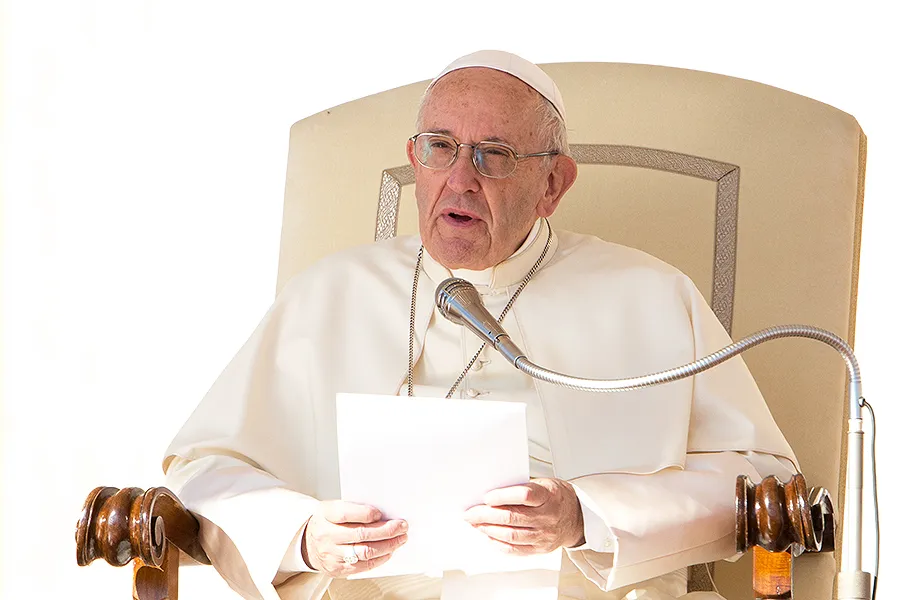
Vatican City, Nov 16, 2017 / 03:05 pm (CNA/EWTN News).- In a message to medical professionals Thursday, Pope Francis said that when it comes to end-of-life care, treatments should always be based on human dignity and with the patient’s best interests in mind.
He also stressed that the various medical options provided must avoid the temptation either to euthanize a patient or to pursue disproportionate treatments which do not serve the integral good of the person.
When it comes to caring for those at the end of their earthly life, “it could be said that the categorical imperative is to never abandon the sick,” the Pope said Nov. 16.
The anguish of being faced with our human mortality and the difficult decisions we have to make “may tempt us to step back from the patient,” he said, but cautioned that is the stage when we are most called to show love, closeness, and solidarity.
Each person – whether they are a parent, child, sibling, doctor or nurse – must give in their own way, he said, and even though there is not always a guarantee of healing or a cure, “we can and must always care for the living, without ourselves shortening their life, but also without futilely resisting their death.”
In this sense, he pointed to the importance of palliative care, “which is proving most important in our culture, as it opposes what makes death most terrifying and unwelcome – pain and loneliness.”
Pope Francis offered his words in a message sent to participants in the World Medical Association’s Nov. 16-17 European Meeting on End-of-Life Questions, organized in collaboration with the Pontifical Academy for Life.
The Pope said “greater wisdom” is needed today when it comes to end-of-life care, “because of the temptation to insist on treatments that have powerful effects on the body, yet at times do not serve the integral good of the person.”
The increase in the “therapeutic capabilities of medical science” have made it possible to eliminate various diseases, improve health and prolong a person’s life, he said, noting that while these are certainly positive developments, there is now also the danger “to extend life by means that were inconceivable in the past.”
“Surgery and other medical interventions have become ever more effective, but they are not always beneficial: they can sustain, or even replace, failing vital functions, but that is not the same as promoting health.”
Referencing a speech given by Venerable Pius XII to anaesthesiologists and intensive care specialists in 1957, Francis said that “there is no obligation to have recourse in all circumstances to every possible remedy” for an illness, and that in specific cases, “it is permissible to refrain from their use.”
“Consequently, it is morally licit to decide not to adopt therapeutic measures, or to discontinue them, when their use does not meet that ethical and humanistic standard that would later be called ‘due proportion in the use of remedies,’” referencing the Congregation for the Doctrine of the Faith’s 1980 Declaration on Euthanasia.
The key element of this criterion, according to the CDF, is that it considers “the result that can be expected, taking into account the state of the sick person and his or her physical and moral resources.”
This “makes possible a decision that is morally qualified as withdrawal of ‘overzealous treatment’,” the Pope said.
“Such a decision responsibly acknowledges the limitations of our mortality, once it becomes clear that opposition to it is futile.” He quoted the Catechism in saying that “here one does not will to cause death; one’s inability to impede it is merely accepted.”
“This difference of perspective restores humanity to the accompaniment of the dying, while not attempting to justify the suppression of the living,” he said.
“It is clear that not adopting, or else suspending, disproportionate measures, means avoiding overzealous treatment; from an ethical standpoint, it is completely different from euthanasia, which is always wrong, in that the intent of euthanasia is to end life and cause death.”
When it comes to concrete clinical situations, Pope Francis noted that various factors come into play that are not always easy to evaluate, and to determine whether a medical intervention is proportionate or not, “the mechanical application of a general rule is not sufficient.”
“There needs to be a careful discernment of the moral object, the attending circumstances, and the intentions of those involved.”
Francis emphasized that when caring for any given patient, decisions must be made in light of human dignity. “In this process, the patient has the primary role,” he added.
“The patient, first and foremost, has the right, obviously in dialogue with medical professionals, to evaluate a proposed treatment and to judge its actual proportionality in his or her concrete case, and necessarily refusing it if such proportionality is judged lacking. That evaluation is not easy to make in today’s medical context, where the doctor-patient relationship has become increasingly fragmented and medical care involves any number of technological and organizational aspects.
Compounding this difficulty, the Pope said, is the “growing gap” in healthcare opportunities, which he said is due to “the combination of technical and scientific capability and economic interests.”
What this means, then, is that sophisticated and costly treatments are increasingly available to “ever more limited and privileged segments” of the population. This then raises questions regarding sustainable healthcare delivery and “a systemic tendency toward growing inequality in health care.”
This tendency, Francis said, “is clearly visible” on a global level, especially when comparing different continents. However, he noted this is also seen within wealthier countries, where access to healthcare “risks being more dependent on individuals’ economic resources than on their actual need for treatment.”
In this context, as it relates to both clinical practice and medical culture in general, “the supreme commandment of responsible closeness must be kept uppermost in mind,” he said.
Given the complexity of issues surrounding end-of-life care and the moral and ethical questions they raise, the Pope said democratic societies must address them “calmly, seriously and thoughtfully,” in a way open to finding agreeable solutions whenever possible, including on the legal level.
“On the one hand, there is a need to take into account differing world views, ethical convictions and religious affiliations, in a climate of openness and dialogue. On the other hand, the state cannot renounce its duty to protect all those involved, defending the fundamental equality whereby everyone is recognized under law as a human being living with others in society.”
Special attention must be paid to the vulnerable, who need help when it comes to defending their own interests, he said, noting that if this “core of values essential to coexistence” is weakened, then “the possibility of agreeing on that recognition of the other which is the condition for all dialogue and the very life of society will also be lost.”
Healthcare legislation must adopt this “broad vision and a comprehensive view” of what will most effectively promote the common good in each concrete case, he said, and closed by offering his prayer for the discussion.
“I also trust that you will find the most appropriate ways of addressing these delicate issues with a view to the good of all those whom you meet and those with whom you work in your demanding profession.”
 […]
[…]







Romano Guardini foresaw one of the defining perils of modernity: man’s technological power would exceed his moral strength, and without spiritual growth to match it, he would be consumed by the very forces he unleashes.
Paul VI recognised that this dominion now extends not only over nature, but over man himself—his body, psyche, society, and even the mystery of life’s transmission. We no longer generate life; we produce it. The person becomes an object, fashioned by will and technique.
This unfolds within a culture of individualism and moral nihilism, where the criterion of the good is no longer objective truth but subjective self-determination. Relativism follows: if nothing is absolutely true, then everything is permitted—so long as it is willed. The person is reduced to a self-enclosed individual, cut off from relational truth. Freedom degenerates into solipsism.
Secularism completes this inversion: man lives as if God does not exist. Every natural or divine bond is now seen as an oppressive limit. The self becomes sovereign—and vulnerable to manipulation.
At root, this is an epistemological crisis. As Benedict XVI warned, reason has shrunk into a positivist shell, acknowledging only what can be measured and controlled. Spirit, value, meaning—these are exiled to the private realm, without public claim.
The result is a mutilated reason, unable to grasp the whole of human experience. Dignity, while often invoked, is detached from creation and reduced to the subject’s will. Body and soul are severed. Man is disincarnated, and the body becomes mere matter to be shaped or discarded at will. This is the gnostic anthropology now championed as liberation.
In this view, even invasive manipulation—surgical, hormonal, aesthetic—is not alienation but a creative act, an assertion of sovereign identity. The more unnatural, the more expressive of “authentic” selfhood. It is a reversal of creation: the body, once image of God, is now raw material; the will is the new demiurge.
We stand before a fundamental choice: either reality precedes and questions us—or we claim the right to redefine it, to recreate moral law and human nature itself. This modern revolution began with the fracture of reason (Ockham, Luther), continued through the Enlightenment’s rejection of divine law, and now culminates in gender ideology, where nature is seen as cultural invention.
The path forward begins with the rediscovery of reason enlarged by faith—what Benedict called “broad reason.” And with hope: the Eucharistic Lord reigns, and the Marian prophecies, from Fatima onward, promise the restoration of a moral and divine order. This is not merely resistance but evangelisation: to proclaim again the truth of the human person, made in the image of God.
The fact that Cardinal Eijk is a member of the Pontifical Academy for Life is reason for hope.
We read about: “International Chair of Bioethics Jérôme Lejeune, taking place in Rome from May 30–31. The theme of this year’s conference is ‘The Splendor of Truth in Science and Bioethics’.”
A most refreshing allusion to the encyclical, “The Splendor of the Truth” (St. John Paul II, “Veritatis Splendor,” 1993). https://www.vatican.va/content/john-paul-ii/en/encyclicals/documents/hf_jp-ii_enc_06081993_veritatis-splendor.html
Four key splendors:
“A separation, or even an opposition, is thus established in some cases between the teaching of the precept, which is valid and general, and the norm of the individual conscience, which would in fact make the final decision [not moral judgment] about what is good and what is evil. On this basis, an attempt is made to legitimize so-called ‘pastoral’ solutions contrary to the teaching of the Magisterium, and to justify a ‘creative’ hermeneutic according to which the moral conscience is in no way obliged, in every case, by a particular negative precept [‘thou shalt not…’]” ( n. 56).
“The relationship between faith and morality [!] shines forth with all its brilliance in the unconditional respect due to the insistent demands of the personal dignity of every man, demands protected by those moral norms which prohibit without exception [!] actions which are intrinsically evil” (n. 90).
“The Church is no way the author or the arbiter [synodality?] of this [‘moral’] norm” (n. 95).
“This is the first time, in fact, that the Magisterium of the Church [!] has set forth in detail the fundamental elements of this [‘moral’] teaching, and presented the principles for the pastoral discernment necessary in practical and cultural situations which are complex and even crucial” (n. 115).
“So we see that the gender discussion was very strong, you know, a few years ago,” he said. “They were almost pushing gender theory in society, culture, and also educational programs at elementary schools.”
By “they”, we can know through both Faith and reason, you count among the atheist materialist over population alarmist globalist , residing physically within The Catholic Church, attempting to create a counterfeit magisterium , with a counter church , and a counterfeit Papacy, that claims “If there is a union of a private nature, there is neither a third party, nor is society affected”, ipso facto deny ing The Unity Of The Holy Ghost, The Spirit Of Perfect Divine Eternal Love Between The Father And His Only Begotten Son, Who Proceeds From Both The Father And His Only Begotten Son, ipso facto denying our Call to be “Temples of The Holy Ghost” and thus our Call to Holiness, ipso facto denying The Divinity of The Most Holy Blessed Trinity, Father, Son, And Holy Ghost, and thus ipso facto placing oneself in a state of apostasy. This sentence alone is all the evidence one needs to recognize that Jorge Bergoglio was Baptized, but was certainly not converted and thus in communion with Christ and His One, Holy, Catholic, And Apostolic Church prior to his election to The Papacy.
Jorge Bergoglio’s “refusal of submission to the supreme pontiff or of communion with the members of the Church subject to him“, was evident, prior to his election to the Papacy, when his heresy was manifested and made public ,in his book, On Heaven And Earth, on page 117, when he stated, in regards to same sex sexual relationships and thus same sex sexual acts, “If there is a union of a private nature, there is neither a third party, (No Holy Ghost?),nor is society affected. Now, if the union is given the category of marriage, there could be children affected. Every person needs a male father and a female mother that can help shape their identity.”
Jorge Bergoglio defected from The Catholic Church , prior to his election to The Papacy, by denying sin done in “private” relationship is sin, denying The Sanctity of the marital act within The Sacrament of Holy Matrimony, and that we, who are Baptized Catholic, are Called to be, “Temples of The Holy Ghost”. (God’s Universal Call To Holiness), and thus deny The Unity of The Holy Ghost, making it appear as if it is Loving and Merciful to desire that we or our Beloved remain in our sin, and not desire to overcome our sinful inclinations and become transformed by accepting Salvational Love, God’s Gift of Grace and Mercy. If it were true that it is Loving and Merciful that we desire that we or our beloved remain in our sin and not desire to overcome our disordered inclination , and become transformed through Salvational Love, God’s Gift of Grace and Mercy, we would have no need for our only Savior, Jesus The Christ.
If Pope Leo is not aware, he must be made aware, as to deny The Unity Of The Holy Ghost (Filioque), The Perfect Divine Eternal Love Between The Father And His Only Begotten Son, Is To Deny The Divinity Of The Most Holy Blessed Trinity, which is apostasy.
Jesus’ Death is The Perfect Sacrifice Of Perfect Divine Eternal Love , atoning for our sins, and makes reconciling us to God now possible, creating The Bridge from Death to Life Everlasting with The Most Holy Blessed Trinity. There is only one Bridge to Heaven, “No one can come to My Father, except Through Me”.
Let us not forget that Pope Benedict addressed all the issues of the atheist materialistic overpopulation alarmist globalists and their ilk, who are attempting to subsist within The Catholic Church , establish a counterfeit magisterium, and a counterfeit papacy in communion with those whose agenda, is not to serve Christ, but to serve the UN’s Agenda for Sustainable Development, a global plan that is anti Christ, because it ipso facto denies God, The Ordered Communion Of Perfect Complementary Divine Eternal Love, In The Unity Of The Holy Ghost, Is The Author Of Love, Of Life, And Of Marriage, rendering onto the UN, what belongs to God, and thus illuminating the fact that the UN Declaration is, in essence pagan at its core.
“When the freedom to be creative becomes the freedom to create oneself, then necessarily the Maker Himself is denied and ultimately man too is stripped of his dignity as a creature of God, as the image of God at the core of his being. The defence of the family is about man himself. And it becomes clear that when God is denied, human dignity also disappears. Whoever defends God is defending man.” – Pope Benedict’s Christmas Address 2012
ND
About this comment. Is this the sixth time you’ve posted it, or only the fifth? And what does it have to do with Pope Leo XIV?
The study of the mind reveals a diverse spectrum of conditions where individuals hold strong convictions about their identity that diverge significantly from typical understanding. These can range from believing one is a famous person (historical figures like Jesus Christ or even aliens), to experiencing multiple personalities, or identifying as an animal (“furries”), a god, or even the opposite sex. The term “gender theory,” while referring to an academic framework, is sometimes mistakenly applied in discussions of these complex identity issues. It’s crucial to distinguish between academic theories and conditions where the mind may be experiencing a form of confusion, potentially akin to what occurs in conditions like schizophrenia.
I do not favor using or supporting the supposed “academic” field of gender theory. The conversation identity issues and confusion.
Thanks be to God for a voice of reason within the Vatican. Let’s hope he is one of many under the new pontificate. The culture shift in the US has been helped along by a new administration that sees it for what it is and rather than shoving it down our throats they have pulled on the reins.
P.S. The Pillar has an interview with Cardinal Eijk.
Daniel in the Lion’s Den that is today’s Netherlands.
There was another interview recently where he explained how the Netherlands got to where it is today.
P.P.S. Cardinal Eijk: I don’t give up – The Pillar, Oct. 30, 2023.
I am no champion for the LGBTQ “community”, but I ask, can we injure those whom we consider “evil”? I have a concern that our approach to “converting” LGBTQs is isolating them and perpetuating violence against them. My “holy” Italian Catholic neighbor disowned my good high school friend, her son, when he “came out” at age 18. He moved to another state.
Recently, DOD Secretary Hegseth was ordered to “isolate TG military soldiers to remove them.” Then, after an investigation, the TGs were found to be excellent military officers. When I was a Naval officer at the Bureau of Naval Personnel, an operator showed me two sets of discharge cards. I asked, Why are there two stacks. He said, “one is queers who will receive undesirable discharges.” I ordered him to remerge the cards.
LOrd save my soul.
“I am no champion for the LGBTQ “community”, but I ask, can we injure those whom we consider “evil”?”
Yet you constantly defend and excuse the LGBT lobby in your posts. Not very self-aware. Speaking the truth and allowing LGBT people to experience the consequences of their sin is not injury or evil. Stop defending the indefensible.
“Yet you constantly defend and excuse the LGBT lobby in your posts.” Your recall is amazing. Please tell me when I said anything relative to the LGBTQ lobby? My campaign to protect all life remains firm. My cruelly disowned close friend remains in my mind.
Remember, Jesus said while protecting the harlot from a raging all-male crowd, saying, “let HE who is without sin cast the first stone.” Basically, he means to HAKEN, we need more introspection.
morganD:
#1. We (the Catholic Church) do NOT consider anyone evil. We do say, as a Church, that certain acts are intrinsically evil. There are no persons who are unredeemable. None!
#2. When someone engages in persistent sin, despite efforts to counsel him or her, there comes a point in the relationship when to maintain the relationship pretending there is no sin, would be to do that person harm. Just because someone says their feelings are “hurt” because you cannot condone evil practices they are engaged in, does NOT mean you aren’t doing the most loving thing for them in those circumstances.
I saw this shared by Martina Navratilova about gender confused men competing in women’s sports:
“Gender ideology is male entitlement peddled as progressive.”
DiogenesRedux. I said I was no champion of LGBTQ. But I see weakness in our approach to evangelism.
You might remember when former Minnesota congresswoman, Michelle Bachman and her husband Marcus opened a “conversion therapy clinic” called “Pray the Gay away.” It was open only to men.
Times: The therapists at Bachmann & Associates aren’t very good at turning gay people straight.
The clinic was closed by authorities because they did not keep the required documents showing patient results.
I feel that our dogma does not address the potential pain inflicted by the isolation of Gays. Perhaps we might use a more holistic approach.
Thanks.