Priest celebrating the traditional Latin Mass at the church of St Pancratius, Rome (Image: Thoom/Shutterstock)
The Diocese of Charlotte, North Carolina will significantly restrict the practice of the Traditional Latin Mass, limiting it to a single chapel in what Bishop Michael Martin OFM Conv. said is a bid to “promote the concord and unity of the Church.”
Martin issued a statement on Friday announcing the new policy, directing that the ancient liturgy would henceforth be celebrated in an as-yet-unnamed chapel in the town of Mooresville.
Martin in his statement said the measure was meant to bring the Charlotte diocese in line with Pope Francis’ 2021 motu proprio Traditionis Custodes, which greatly restricted the Latin Mass “in defense of the unity of the Body of Christ.”
The pope said at the time that he was saddened that the celebration of the extraordinary form was characterized by a rejection of the Second Vatican Council and its liturgical reforms. To doubt the Council, he said, is “to doubt the Holy Spirit himself who guides the Church.”
Martin on Friday noted that his predecessor, Bishop Peter Jugis, requested an extension on the directive in order to prepare for the transition. The extension expires this year, Martin noted, and he is “now ready to finish the diocese’s implementation of the norms established.”
Starting on July 8, no parish churches will be permitted to celebrate the Traditional Latin Mass in the diocese, Martin said. In accordance with Traditionis Custodes, the bishop said he was “designating a chapel in the diocese” that will be permitted to use the Roman Missal of 1962 and where “faithful adherents may gather for the celebration of the Eucharist” only on Sundays and Holy Days of Obligation.
“A priest of the diocese will be appointed as chaplain, to be responsible for celebrating two Sunday Masses and Holy Day Masses using the 1962 Roman Missal at this site,” the bishop said.
“Those who are interested in participating in the Eucharistic celebration in this form will remain active members of their current parishes, where they may continue receiving the sacraments,” he added.
Citing the Gospel of John, Martin expressed hope that the new rule “will further ‘promote the concord and unity of the Church’ among the People of God in the Diocese of Charlotte so that, as Jesus prayed to His Father, we ‘may all be one’.”
If you value the news and views Catholic World Report provides, please consider donating to support our efforts. Your contribution will help us continue to make CWR available to all readers worldwide for free, without a subscription. Thank you for your generosity!
Click here for more information on donating to CWR. Click here to sign up for our newsletter.
Los Angeles, Calif., May 14, 2019 / 04:56 pm (CNA).- Bishops in California announced May 14 a new program to compensate victims of clerical sexual abuse, through which any person sexually abused as a minor by a diocesan priest can apply for compensation— no matter when the abuse occurred.
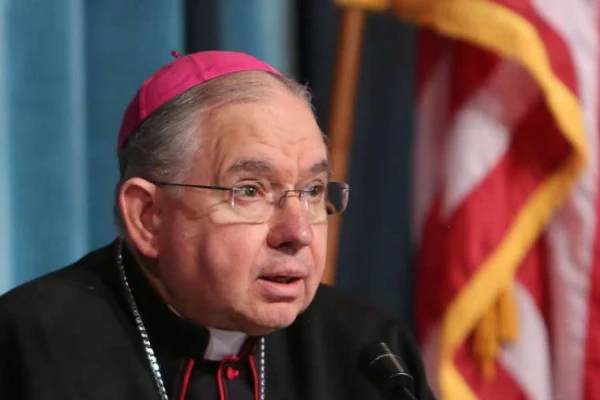
“We have been providing pastoral care and financial support for victim-survivors here in the Archdiocese for many years. We will continue to do so,” Archbishop Jose Gomez of Los Angeles said in a letter accompanying the announcement.
“But we also understand that some victim-survivors are reluctant to come to the Church for assistance. Our hope with this new program is to give these people a chance to seek redress and healing through an independent program.”
The new program applies to six of California’s 13 Catholic dioceses— Los Angeles, Sacramento, San Bernardino, San Diego, Orange, and Fresno. These six dioceses represent 80% of California’s Catholics, the announcement asserts.
The protocol for the program is still in draft form, so victims are not yet able to file claims, but a website dedicated to the program will be launched soon, spokesperson Amy Weiss told CNA.
Survivors can elect to enter this program as an alternative to pursuing their claims against the Church in court, the announcement notes. Victims will have to submit a claim form along with any supporting evidence.
Victims need not have a lawyer and there is no fee to participate; settlements for fully completed claims are to be paid within 90 days.
“Those harmed many years ago and barred from filing lawsuits because of civil statutes of limitations will be eligible to make claims under this new program,” the announcement says.
“Also, because this program has no proof-of-citizenship requirement, undocumented immigrants who may have been abused are also eligible to make claims.”
The program applies only to diocesan priests. Claims against members of religious orders active in California, or against deacons or laypeople, are not eligible. Victims who have previously entered into a settlement agreement resolving the claim of sexual abuse against a diocesan priest are also not eligible.
The bishops began been working with mediators Kenneth Feinberg and Camille Biros in November 2018 to develop the program. Feinberg and Biros will have full control over the amount of compensation each victim gets and the diocese will not be able to appeal their decision.
Feinberg is an attorney and mediator who led the Sept. 11 victims’ fund and was involved in overseeing a compensation program in the wake of the Aurora, Colo. theater shooting in 2012. He and Biros recently led the creation of abuse victims compensation programs in New Jersey, Colorado, and Pennsylvania. They also administer the Archdiocese of New York’s Independent Reconciliation and Compensation Program, which began in Oct. 2016.
Former California governor Gray Davis, and Maria Contreras-Sweet, former administrator of the U.S. Small Business Administration, are among the members of the independent oversight board overseeing the fund.
California’s diocese have paid out nearly $1.5 billion in settlements to survivors of sexual abuse in the past two decades alone, the announcement says. Safeguards diocese have implemented to protect children have included training on abuse prevention and reporting, and stricter background checks and reporting requirements.
“As a result, new cases of sexual misconduct by priests involving minors are rare today in the Catholic Church in California. Nonetheless, the Bishops undertake this program in their continued efforts to provide avenues for victim-survivors of abuse to receive assistance to continue their healing,” the announcement concludes.
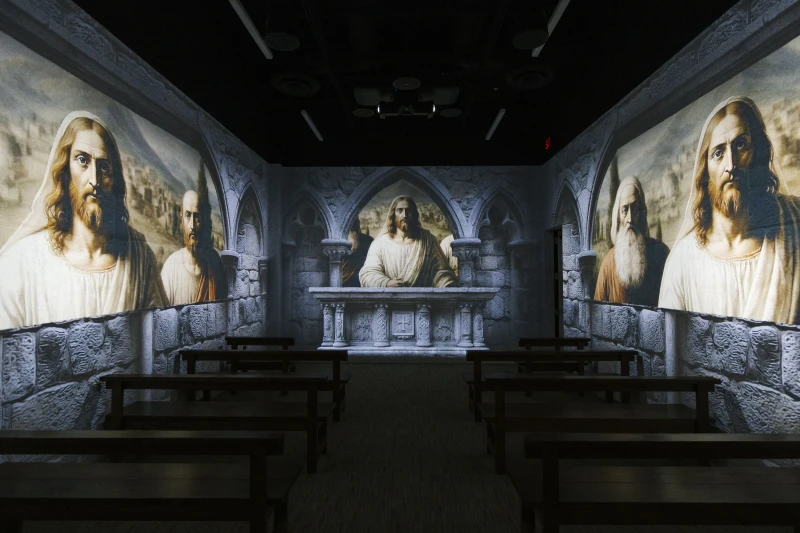
“The Shroud of Turin: An Immersive Experience,” a $5 million, 10,000-square-foot museum on the chancery campus of the Diocese of Orange in Southern California opened to visitors on Nov. 19, 2025. / Credit: Everett Johnson, Diocese of Orange
Los Angeles, California, Nov 19, 2025 / 16:53 pm (CNA).
“The Shroud of Turin: An Immersive Experience,” a $5 million, 10,000-square-foot museum on the chancery campus of the Diocese of Orange in Southern California, opened to visitors Wednesday.
The museum is presented by Papaian Studios in partnership with the Diocese of Orange and Othonia Inc., an international team of specialists dedicated to exploring and sharing the mystery of the Shroud of Turin.
The 90-minute experience introduces visitors to the life, death, and resurrection of Jesus Christ, with a special focus on the Shroud of Turin, which many believe to be the burial cloth of Christ.
The 90-minute experience at the new Shroud of Turin museum on the chancery campus of the Diocese of Orange in California introduces visitors to the life, death, and resurrection of Jesus Christ, with a special focus on the Shroud of Turin, which many believe to be the burial cloth of Christ. Credit: Diocese of Orange
Inspired by the advanced technology incorporated in “Van Gogh Exhibition: The Immersive Experience” and the “Immersive King Tut,” the museum features 360-degree projection-room theaters as well as shroud replicas, interactive kiosks, a life-sized corpus, and a variety of artwork.
Jason Pearson of FiveHive Studios, which offers AI special effects and animation services, is a Catholic convert who worked with Othonia, a team of shroud specialists, to design the museum. Among his movie credits is Mel Gibson’s 2004 “The Passion of the Christ.” He has long had an interest in the shroud and has been a volunteer guide at the Shroud Center of Southern California located at the Santiago Retreat Center, also in the Diocese of Orange.
“Using technology on display like that of the Van Gogh or King Tut exhibits, we’re doing things that have never been done before,” Pearson told CNA.“Whether it be Jesus walking on water or through the streets of Jerusalem, or in the tomb at the moment of the Resurrection, we make use of sound and projections so that the visitor feels like he’s going back into a time machine and experiencing these things himself.”
“The Shroud of Turin: An Immersive Experience” located at the Christ Cathedral campus in the Diocese of Orange, California, opened to visitors on Nov. 19, 2025. Credit: Everett Johnson, Diocese of Orange
The museum is designed for everyone, Pearson continued, even those who have no religious background at all.
Located on the second floor of the campus’ Richard H. Pickup Cultural Center, the museum has three theater rooms. Using surround sound and images, including on the floor, the first room introduces the visitor to the person of Jesus Christ through presentation of 12 stories from his life, but each one is selected to show Christ’s connection to the supernatural (e.g. the Transfiguration). The next introduces the visitor to the shroud itself, including proof of its authenticity and what it tells us about the sufferings of Christ. The third is devoted to the Resurrection leading the viewer to ponder a pointed question: Who do you believe the man on the shroud is?
The third theater exits into the museum area, which includes displays of reproductions of items that were part of the passion of Christ, including a flagellum (whip), the crown of thorns and nails, as well as a reproduction of what the tomb of Christ might have looked like.
The new Shroud of Turin museum uses AI and 360-degree tech to explore Christ’s life and resurrection. Credit: Everett Johnson, Diocese of Orange
Other exhibits include an AI presentation of Secondo Pia (1855–1941) who, while photographing the shroud in 1898, discovered that its negative image offered a clearer image of the man on the shroud with a detail in his face that could not been seen by the naked eye. Another traces the history of the iconography of Christ, demonstrating how accurate, when comparing it to the shroud image, many of the icons were. And, one compares the Sudarium of Oviedo, or the facial cloth that covered Christ’s face after his death, to the image on the shroud.
Pearson hopes that the museum will be a prototype for additional shroud museums in different regions of the country. Inquiries have been made about establishing shroud museums from places as far away as Kuala Lumpur in Malaysia.
One portion of the museum is dedicated to the science of the shroud, and two kiosks allow visitors to ask questions of a digital Father Robert Spitzer, who has extensively researched the shroud over the past 20 years. Credit: Everett Johnson, Diocese of Orange
One portion of the museum is dedicated to the science of the shroud, and two kiosks allow visitors to ask questions of a digital Father Robert Spitzer, who has extensively researched the shroud over the past 20 years. Spitzer, who has an office at Christ Cathedral, noted that he was pleased with the museum’s opening. “It gets the pedagogy right, it’s biblically accurate, and they tell me the visual imagery is amazing.” (Spitzer has gone blind in recent years.)
He continued: “And while we welcome anyone, we especially hope many young people will come to learn about the shroud and lead many to come to know more deeply the person of Jesus Christ.”
Nora Creech is on the leadership team of Othonia and helped develop content for the museum. “We want people to come with an open mind, explore, and ask questions. We want them to ask, ‘Who is the man of the shroud?’” she said.
One special target group of the museum, Creech said, is younger people, “many of whom have not been brought up with knowledge of who Jesus is. That is why we seek first to introduce people to Jesus so that they will become interested in his burial shroud.”
Pearson agreed and related the story of two young women who visited the Shroud Center and began weeping, asking: “Why hasn’t anyone told us about him?”
But while the shroud is important in showing us what Jesus suffered, Creech continued, we also need the Church and the Scriptures “to learn why he suffered.”
Auxiliary Bishop Timothy Freyer blesses the new Shroud of Turin museum on the chancery campus of the Diocese of Orange in Southern California, opened to visitors Wednesday, Nov. 19, 2025. Credit: Kaylee Toole, Diocese of Orange
Orange Auxiliary Bishop Timothy Freyer, who played a key role in bringing the museum to Christ Cathedral, noted that his favorite feature was the reproduction of the crown of thorns, which, contrary to most artistic renditions, was actually shaped like a helmet or cap. He continued: “I’ve been impressed with the entire exhibition. It is very engaging, and I believe it will be an important tool in helping visitors come to know Christ better.”
Also among those excited to see the opening of the museum was Gus Accetta, a physician who has devoted much of his free time to studying the shroud. In 1996, he founded the Shroud Center in Huntington Beach, since relocated to the Santiago Retreat Center and welcoming 25,000 visitors annually.
“It’s a wonderful exhibit,” he said. It not only looks at the shroud but the whole life of Christ, of which the shroud is just a part.”
A crown of thorns from the “Shroud of Turin: An Immersive Experience,” a $5 million, 10,000-square-foot museum on the chancery campus of the Diocese of Orange in Southern California. The museum opened to visitors on Nov. 19, 2025. Credit: Diocese of Orange
The Shroud of Turin experience will be on display at Christ Cathedral at least through 2030. The museum is located on Christ Cathedral campus, 12141 Lewis St., Garden Grove, California, a few miles away from Disneyland and the Anaheim Convention Center. For more information, visit the website www.theshroudexperience.com.
New York City, N.Y., Oct 20, 2017 / 04:01 pm (CNA).- In a rare political speech on Thursday, former president George W. Bush had blunt words for America: Remember your identity or lose your freedom.
Bush spoke Oct. 19 at the at the “Spirit of Liberty: At Home, In The World” event at the Lincoln Center in New York.
Almost nine years removed from the nation’s highest political office, Bush offered a reflection on the current state of the country. At the heart of his reflection was a diagnosis – and a powerful wake up call:
“We have seen our discourse degraded by casual cruelty. At times, it can seem like the forces pulling us apart are stronger than the forces binding us together. Argument turns too easily into animosity. Disagreement escalates into dehumanization. Too often, we judge other groups by their worst examples while judging ourselves by our best intentions – forgetting the image of God we should see in each other.”
Bush’s words ring true in a country still deeply divided one year after a contentious presidential election that polarized families, friends, and neighbors. In a recent Wall Street Journal/NBC News survey, 80 percent of respondents categorized the U.S. as “mainly divided” or “totally divided.”
From birth control to gun control, from questions of undocumented immigrants to NFL players kneeling during the national anthem, America is fractured. And that division has become vitriolic, manifesting itself in insults spewed across comment boxes and hostile clashes in the media.
After exploring a litany of symptoms – from bigotry and nativism to fake news and gang violence – Bush offered his remedy for the polarization plaguing America: “we need to recall and recover our own identity. Americans have a great advantage: To renew our country, we only need to remember our values.”
But in a country so divided, what are our values?
In his address to the United States Congress in September 2015, Pope Francis laid out a set of values that he thinks define America at its best.
“A nation can be considered great when it defends liberty as (Abraham) Lincoln did, when it fosters a culture which enables people to ‘dream’ of full rights for all their brothers and sisters, as Martin Luther King sought to do; when it strives for justice and the cause of the oppressed, as Dorothy Day did by her tireless work, the fruit of a faith which becomes dialogue and sows peace in the contemplative style of Thomas Merton,” the Pope said.
Catholics have an important role to play in shaping the values that define society. Deus Caritas Est, the first encyclical of Pope Benedict XVI, teaches, “The direct duty to work for a just ordering of society is proper to the lay faithful.”
The U.S. bishops, in their document, Forming Consciences for Faithful Citizenship, note, “This duty is more critical than ever in today’s political environment.” While there may be a temptation for retreat or discouragement, the bishops say, this is actually “a time for renewed engagement.”
In the early Church, Christians stood out from the rest of the Roman Empire. They took care of orphans and widows. They founded hospitals and schools. They cared for the poor. They didn’t work on Sundays. They loved their enemies.
Today, the U.S. Church is called to stand out, too. In a nation torn apart and confused about its own identity, people are exhausted from fighting and weary from talking past one another without ever being heard. People are looking for a better way.
Amid the political and social turmoil, Catholics can offer that better way. They can offer what the bishops describe as “a different kind of political engagement: one shaped by the moral convictions of well-formed consciences and focused on the dignity of every human being, the pursuit of the common good, and the protection of the weak and the vulnerable.”
And they can do it by engaging with others civilly, by creating the “culture of encounter” that Pope Francis refers to so often.
This lesson is critical for America’s future. Will the next generation be raised in a culture of encounter, or in what Bush describes as a culture of “casual cruelty,” marked with animosity and dehumanization? Bush notes with urgency that “our young people need positive role models” because “bullying and prejudice in our public life sets a national tone, provides permission for cruelty and bigotry, and compromises the moral education of children.”
George W. Bush is right. America does need to return to her values. But first she needs to figure out what they are. And Catholics can help lay the groundwork for that, by working to create a society where people can dialogue without fear, where they discuss their different views without being attacked or demonized, ultimately a society where people can encounter truth.
As we approach the one-year mark after the most contentious election in recent history, Catholics have an opportunity to show Christian charity in their interactions with others. It’s a small gesture. But it could be the first step in helping people recognize, as the former president put it, “the image of God we should see in each other.”
Bishop Martin do you not know that Francis is no longer with us??? Talking about unity and conformity, the Latin Mass DELIVERS ON THIS!! If he hopes to show that he is in dialogue with one or two Mass offerings to the Latin Mass ahearents, his largess is frankly parsonmonius!
Really? Has it escaped the Bishop’s notice that Frances is dead and we have a new Pope? It is not yet apparent that Pope Leo will follow in the footsteps of the late Pope and stamp out the Latin Mass. It might be smarter to sit this one out for a bit. Maybe it has also escaped his attention that the bulk of vocations and conversions have been coming from those with a conservative life perspective. That would be something to encourage I believe. Indeed an excess of enthusiasm for Post Vatican II ideas is largely why the convents and seminaries are empty. Note to the Bishop: If it ain’t broke, don’t fix it.
The Mass prayed reverently and respectfully (albeit not in Latin) is available at Ordinariate churches. For both laity and the priest celebrating the Holy Sacrifice the prayer of the Mass is said facing ‘ad orientem.’ I’m afraid, however, that the Church will have to suffer along with Bergoglian-appointed bishops for awhile.
I recommend to the Catholics living in Charlotte who have a preference for the Holy Sacrifice of the Mass prayed in Latin to give NO CONTRIBUTION AT ALL to their parish, diocese and Peter’s Pence, CCHD, CRS, CCUSA, etc. Instead, write a check to a reputable Catholic missionary (and if you don’t know one, I’ll be glad to send you a priest’s name in Guatemala and his bank number to wire money to.)
To seminarians for the Diocese of Charlotte, I’d recommend you give serious consideration to transferring to an orthodox religious order like the Dominicans.
I live in a state where two archbishops in adjoining dioceses “allow” the TLM. I have FOUR beautiful, beautiful churches where I can attend, all in easy driving distance.
It is so cruel and unfair that by the mere chance of geography, Catholics are deprived of the Mass that for centuries every saint, every attendee at Vatican II, etc. went to as if it were something shameful.
Pope Leo has put two modernized “sisters” (one with a degree in psychology) in charge of ALL the orders of monks, brothers, priests, sisters and nuns of the whole planet. Not a good start. If he doesn’t do something about the irrational limiting of the TLM (while not limiting ANY other form, such as the Anglican or Dominican), then my “cautiously optimistic” will turn to something much sadder.
What will the Bishop say when there are crowds of people outside the Chapel who want to get in but can’t because there is no room, while there is PLENTY of room at a Novus Ordo Church?
They don’t care. They lack religious Faith and a willingness to be open to what God might be telling them by preferences for the TLM. They are too busy promoting the evilness of synods that dictate to God what God has to accept and think from now on by those who now treat God as their subordinate.
Why now?
I am under the impression that Pope Leo was chosen in large part because he is seen as someone who will restore unity to the Church.
Get with the program, folks!
And he will restore unity to the church by forcing out the conservatives and trads. That was Francis’ idea, and Leo has pledged to advance Francis’ agenda right down the line.
The current pope has declared publicly on at least two occasions that his immediate predecessor is already in heaven. Are we in store for another “santo subito”?
For details, see an article in The Catholic Thing, titled “Where Is Pope Francis?” by Sebastian Morello. The first paragraph states that Leo XIV recently made the statement on X, and that it was the third time he stated it. I vaguely recall he said it first either on the day of his election or on the following day. I wish I could be more specific, but when I read Morello’s article this morning, I knew I’d heard or read the statement at least once before. There’s also an article in “The WM Review” titled “Leo Doubles Dow on Conviction that Francis Is in Heaven.” I hope this helps.
P.S. I know nothing about the “WM Review” and my citing its publication of an article on the subject is in no way intended to suggest I agree with or even respect its positions on matters Catholic.
Thanks Ken. Will check it out. Good to know.
Hi Ken,
At TCT, philosopher Sebastian Morello, reports that Leo has said three times that Francis is in heaven. He rebuts that statement. His reasoning is worth a view.
I thought the same thing…why now? Maybe he’s new? Trying to establish himself? Any way it goes, Pope Leo needs to address this issue sooner than later.
My thought, too…why now? Is he new? trying to establish or assert himself? Pope Leo needs to do something about this sooner than later or things will only get worse. What’s wrong with providing both forms of the Mass? So much for unity. I
Here comes the Latin, here comes the Latin. There are no empty pews so why cling to the tried and true practices of past… Hint: watering down the brand can be a mistake.
I hear what other posters are thinking and saying, but…we’re not in Charlotte, and we don’t know what has prompted this. I know that some will assume that the Bishop just “hates the Latin Mass” or perhaps he’s just “on a power trip.”
But for all we know, this Latin Mass could be having some negative effect on Charlotte Catholics; e.g., it’s draining good and orthodox Novus Ordo parishes of members, volunteers, and monies, or even more serious, it’s “dividing the Church” into two camps who oppose each other rather than working together to spread the Gospel of Jesus Christ. Division is dangerous for Catholics and may drive them away from “church” entirely.
It could also be driving less traditionally-minded Catholics into the Protestant non-denominational churches that have dynamic preaching (not necessarily deep or “correct” but at least it’s in American English!) and contemporary music, a lively and active youth group, great children’s ministries and clubs, and many opportunities for the members to serve God in various community charitable outreaches.
Just some thoughts, and since I’m not in Charlotte, I could be way wrong about all of them. But I still don’t think we should try to draw conclusions until we know “the full story” from those who live there and know “the rest of the story.”
Mrs. Whitlock – my comment disappeared so I am trying again – apologies if it is duplicated. But I DO know people there. It is a vibrant community and has been for a long time. None of what you say is true.
1) TLM homilies ARE in ENGLISH – just saying otherwise makes the rest of your “speculations” suspect.
2) I go to a Novus Ordo church mostly, but my TLM church has all kinds of clubs, ministries, charitable outreach, and a vibrant youth group.
3) Absolutely NO ONE is being “driven” to a Protestant church because a TLM mass exists, as there are FAR FAR more Novus Ordo churches EVERYWHERE. Why on earth would you say that?
4) Contemporary music is a sticking point. My kids and their friends specifically said they felt “patronized” by having to listen watered down 70s elevator music and pop tunes. They can hear that everywhere, day and night, but the only chance to hear the HUGE variety of beauty handed down through the ages, from medieval chant to Renaissance to Baroque to modern, from Palestrina and de Victoria to the 20th century and Messiaen and more, has been at a TLM.
I am sorry, but these “speculations” are disingenuous.
Benay,
Your Item No. 4 exemplifies my experience. My introduction to the NO was as a young ‘tween.’ All us youngsters were keen at the idea and looked forward with excitement to this new Mass.
Well. Without doubt, we felt ‘played.’ We were embarrassed, chagrined, somehow betrayed, definitely uncomfortable, and we snickered. Row after row of teens in the pews were glancing sideways at one the new row, and snickering. It seemed as if the church, the adults, were trying so very hard to become teens. And FAILING. If you’ve ever seen a middle-aged mother flirting with her teen daughter’s boyfriend, you get the notion.
Yes, some speculations are disingenuous, inane, vapid, boring, stultifying, and downright stunning, reflecting a sad form of stupid.
Protestants don’t have the Eucharist, so if current CINO don’t believe and want more entertainment let them leave (and I’m not judging them in the least) It’s not surprising considering the surveys on what Catholics actually believe. In spirit, they may have already left the church.
There’s also a cease and desist in Detroit: Archdiocese of Detroit: Parishes must cease Traditional Latin Mass celebrations by July 1
Have you ever attended a Latin Mass? The homilies are in English. Missals are bilingual. The Lectionary readings are read in both Latin and in English. Occasionally the Recessional song is in English.
You say that the Latin Mass could be having a negative effect on Catholics in Charlotte. Seriously, do you expect us to believe that? Do you not believe that a Mass is a Mass is a Mass? HOW, exactly can a Latin Mass be harmful or hurt anyone? The Latin Mass was the dominant form of Catholic worship for over 400 years. You would argue against that history as bearing any fruit?
“e.g., it’s draining good and orthodox Novus Ordo parishes of members, volunteers, and monies,”
So? Then have the Latin Mass offered at those parishes as well.
“It could also be driving less traditionally-minded Catholics into the Protestant non-denominational churches that have dynamic preaching (not necessarily deep or “correct” but at least it’s in American English!)”
The homily is in the vernacular even at Latin Messes. And anybody who would leave the Holy Sacrifice of the Mass for shallow and incorrect preaching has a lot more problems than Latin.
“and contemporary music,”
Ah, yes, contemporary music, also known as nauseating tripe.
“a lively and active youth group, great children’s ministries and clubs, and many opportunities for the members to serve God in various community charitable outreaches.”
None of those have anything to do with whether the Mass is in Latin or not.
So… if the orthodox Novus Ordo parishes have a substantial number of parishioners who prefer the TLM, such that a nearby TLM drains them to a detrimental extent of “members, volunteers, and monies”, probably there are a sufficient number of parishioners to justify a TLM parish – or at least a TLM AT the parish.
I don’t believe there’s much in the way of data regarding whether more children and teens tend to stay in the Church from the TLM than the NO. As such, I think we should probably leave it up to the parents to decide, rather than randomly closing their home churches and uprooting their families.
IF TLM parishes are driving less traditionally-minded Catholics to Protestant churches, then they are only driving the dumb ones there. NO parishes are widely available in the Charlotte diocese. I can find no information claiming that any of them are offered in Latin or ad orientem, so there shouldn’t be too much to offend Protestant sensibilities, although I expect there is still plenty to offend Protestant theological beliefs.
Is the idea that good, orthodox NO parishes can only be run by forcing TLMers to attend the NO? Do you really think NO types are that ubiquitously awful?
If I were to ban even something so inconsequential as non-vanilla ice cream flavors, or require everyone in the country to use only Microsoft’s operating system, the uproar would be immense. As it stands, there is very little division over either subject. Banning things that are good, wholesome, and sanctifying does not prevent division, it induces it.
Mrs. Sharon, we have two parishes in our diocese that offer the TLM every Sunday and on several weekdays. Those parishes also offer the NO Mass. Everyone gets along. No one is “poaching ” parishioners.
To be fair, I’ve found some TLM Mass goers more susceptible to certain conspiracy narratives and I’ve encountered NO Mass attendees who are less concerned with Church teaching. I hope Pope Leo’s influence and goodwill will encourage the TLM folks to dispense with the suspicions and NO people to take the Catechism more seriously. Especially regarding marriage and family issues.
mrscracker: Being upset over thousands of episodes. over half a century, of Catholic prelates publicly stating ridiculous falsehoods about the Catholic religion is not a case of “susceptibility to certain conspiracy narratives.”
Those aren’t the same conspiracies I was thinking about Mr Baker. I’ve heard some really bizarre stuff over the past couple years. I hope that situation will improve going forward. Please God.
Your thinking is in reverse to think persecuting traditional Catholic liturgy will drive traditionallists towards Protestantism. The reason Catholics who are Catholic desire to remain Catholic, even if the episcopate doesn’t care about Catholicism, is from having witnessed the Protestantization of Catholicism.
This difference of wanting the Latin mass and leaving the true everlasting church of all ages, the Mystical Body of Christ, to offer up and labor in the eternal Church to build her up, or to leave Christ’s body to join those who CONDEMN and SLANDER the true church and are not in unity with Holy Church. We are called to gather and labor in the Church, not to scatter, and the Holy Spirit flees, YOU ARE NOT TO CONDEMN THE CHURCH AND YOUR BROTHERS, you lack all charity. There is one Christ and one Church now and forever. Do they want the mass in Latin or separate themselves, accepting all the lies there, “only the priest can touch the holy host but you munch it and eat it all up (That is not touching it?). Thank you Lord, you gave us a holy Pope and we will have unity because you are a merciful GOD! Without love you will not enter the Kingdom!
The pope said at the time that he was saddened that the celebration of the extraordinary form was characterized by a rejection of the Second Vatican Council and its liturgical reforms. To doubt the Council, he said, is “to doubt the Holy Spirit himself who guides the Church.”
Aside from the blasphemous premise, the charge was and is unsubstantiated. Bergoglio claimed to have surveyed the bishops, but never released the results, almost certainly because he didn’t find the sort of widespread episcopal opposition he was looking for.
Yours truly recalls at least a summary of the survey results, posted by someone, and reporting that half of respondents showed some concern about TLM while the other half were indifferent or even supported TLM…
AND that 80 percent of bishops didn’t respond at all! So, likely a statistically invalid survey skewed by those with an ax to grind?
My speculation at the time was that most bishops simply do not have time for governance-by-survey and ignored the insider/operatives in charge, or else did not even know about it. Was the “survey” mailed individually (!) or, instead, simply posted on the national bishops’ conference websites–which probably are not the first thing that bishops look at in the morning, or anytime later in the day?
The 1962 Missal should no longer be used. Vatican II mandated that the liturgical books be revised. The bishop made the correct decision. Roman Catholic parishes should be unified in liturgical form: the post-conciliar liturgical form. The new Mass can be celebrated in Latin with Gregorian chant. There is no need for the pre-conciliar Mass, whose ritual expression of post-conciliar ecclesiology is deficient. It should be phased out and eventually discontinued and then formally abrogated.
We read, There is no need for the pre-conciliar Mass, whose ritual expression of post-conciliar ecclesiology is deficient.
Exactly, the ecclesiology and theology of the two liturgies are different.
The 1962 missal perfectly expresses the Catholic faith, the new mass, well….
Vatican 2 mandated that the books be revised. It did not mandate that the ordinary be sliced and diced, or that the Propers be partly thrown out and most of the rest cut to pieces. The Council Fathers, when presented with the Novus Ordo, were horrified.
By all means, point me to a Novus Ordo celebrated in Latin, with Gregorian chant, in the dioceses of, say, Fargo, Little Rock, and Evansville. Since it’s presumably so easy to find.
Roman Catholic parishes are not unified in liturgical form, and won’t be even without the TLM. You see, the Council of Trent kept all the liturgical forms older than 300 years, which included the Rite of Braga, the Mozarabic Rite, the Sarum Rite, and the Ambrosian Rite, in addition to the Rites of various religious orders, such as the Dominicans, Carthusians, Premonstratensians, and Cistercian Rites. These are all still in use as well.
Then of course in modern times we have the Anglican Use, which is basically the Sarum Rite, in English, with some changes since the English “Reformation”. But contrary to your opinion, it was established AFTER the Council, according to pre-conciliar ritual tradition.
Unity of liturgical form is not a Latin Church thing. There’s nothing to indicate that it has ever been done before.
As for deficiency in post-conciliar ecclesiology, I’m fairly confident that was never the reasoning for reforming the Roman Missal. It would be grounds for also demanding the similar revision of every Eastern Catholic rite, which was not only not envisioned by the Council, but clearly spoken against, in Orientalis Ecclesiarium.
Traditionis Custodes (TC) contradicts your first sentence, “The 1962 Missal should no longer be used.”
Article 2, TC states: “It belongs to the diocesan bishop, as moderator, promoter, and guardian of the whole liturgical life of the particular Church entrusted to him, to regulate the liturgical celebrations of his diocese. Therefore, it is his exclusive competence to authorize the use of the 1962 Roman Missal in his diocese,…”
haha… you left out “…according to the guidelines of the Apostolic See” in your citation. Cherry picking.
You also left out this from the accompanying letter: “It is up to you [bishops] to proceed in such a way as to return to a unitary form of celebration, and to determine case by case the reality of the groups which celebrate with this Missale Romanum.”
So every bishop is required to proceed to a unitary form of celebration according to the Vatican 2 Mass, which means gradually ceasing the TLM. Any permissions for the TLM are temporary, provisional, and a concession, not a right nor a permanent arrangement.
hahahaha. The laugh is on you, Mr. Walker. The pope has no authority to outrightly do away with any rite which has developed according to apostolic tradition. Further, it has always been the domain of the bishops to oversee and regulate liturgy in their individual dioceses. The pope has such authority in the diocese of Rome. The pope has the canonical authority to supervise and rule liturgy but the functions have never been defined.
Have you never wondered why the Latin Rite developed over 1400 years, why it continued to exist after Paul VI abolished it, and continues today to exist despite Francis’ efforts to suppress it by such as TC?
The Pope’s reasoning is circular in Article 2 when my quote and your cherry-picked addendum are put together. The circular reasoning is nonsensical, and it had to be this way to be consistent with the Magisterium as it was handed on to Francis.
The pope’s letter has no binding canonical authority and is meaningless. The bishop has the right to regulate liturgy in his diocese, and the Pope has no right to abolish any liturgy derived organically from apostolic tradition. Read Gamber.
Mr Walker, our diocese has plans for a permanent TLM parish and the property for that has been purchased. Currently the TLM is offered on Sundays and weekdays in 2 of our parishes.
The TLM isn’t going away here.
There’s not a competition between liturgies. I love the TLM but it’s not a deal breaker for me. We need to quit the bickering and division and our bishops need to assist in that also.
When people feel demeaned and the liturgy they’re attached to is suppressed they can begin to listen to other voices than their shepherds.
What you’re ignoring is that a pope, and what he delegates to prelates, does not have the authority to ever eliminate the TLM without incurring excommunication upon himself. This was made a permanent part of the Deposit of Faith by Pius V.
Miss Dorothy, with respect unity doesn’t translate to uniformity
Catholic means universal. We have many rites and liturgies, but One Faith. That’s a beautiful thing.
“Roman Catholic parishes should be unified in liturgical form: the post-conciliar liturgical form.”
Following your logic, Rome must also abolish all other Liturgies – Eastern Catholic Rites, Mozarabic Rite, etc. You are calling to abolish the very phenomena which makes the Catholic Church universal: different liturgical traditions are harmoniously glorifying God under the same roof (of the same Church) so to speak. Latin Mass belongs to that house. To abolish it is to impoverish the Catholic Church.
From an Eastern Orthodox point of view (I am an Orthodox), the liturgical rite cannot be mandated from above because it has never been created “from above”. The Liturgy (Mass) has developed from the Old Testament worship (just like Our Lord prayed the Psalms and also the prayers of the Passover during His Last Supper – note that even He did not “abolish” ancient liturgy but used it, to fulfill the promise of God). Various forms of Christian Liturgy (Mass) had slowly developed over centuries, acquiring particular character of different places and cultures. It is the whole Church (the whole body of people) that created the Liturgy. It is a slow and organic process. If the Latin Mass served as an expression of faith of the Church for centuries, it cannot be “prohibited”. Only heresies and errors are prohibited because they are contrary to faith.
Since TLM or Mozarabic or Liturgy of St John Chrysostom or of St James are a true liturgical expression of the Catholic faith, they cannot be “abolished”. To abolish them is to abolish a correct expression of a faith and it is absurd.
Or as Joseph Cardinal Ratzinger said: “It seems to me most important that the Catechism, in mentioning the limitation of the powers of the supreme authority in the Church with regard to reform, recalls to mind what is the essence of the primacy as outlined by the First and Second Vatican Councils: The pope is not an absolute monarch whose will is law, but is the guardian of the authentic Tradition, and thereby the premier guarantor of obedience. He cannot do as he likes, and is thereby able to oppose those people who for their part want to do what has come into their head. His rule is not that of arbitrary power, but that of obedience in faith. That is why, with respect to the Liturgy, he has the task of a gardener, not that of a technician who builds new machines and throws the old ones on the junk-pile. The “rite”, that form of celebration and prayer which has ripened in the faith and the life of the Church, is a condensed form of living tradition in which the sphere which uses that rite expresses the whole of its faith and its prayer, and thus at the same time the fellowship of generations one with another becomes something we can experience, fellowship with the people who pray before us and after us. Thus the rite is something of benefit which is given to the Church, a living form of paradosis — the handing-on of tradition.”
I guess the Bishop of Charlotte doesn’t consider the Eastern Catholics to be one with us. Not only is his decision foolish, it is vindictive. And I suspect he wants to show Pope Leo that more diocese have implemented Bergoglio’s restrictions, embarrassed as Roche, Cupich et al are that only a minority had done so until now. Oh, the games we play. It’s sad that he made this move after the pope started his papacy with a call to unity. Shame on him.
More outright evil by our lying bishops. They are angry that their illegal immigration money scam is in danger, and now they are lashing out at faithful Catholics wherever they can find them.
My impression is that the new Pope gives to others what they want to hear (to the conservatives – a prayer in Latin, to the liberals – PF’s legacy etc.). If I am not mistaken, it will be worse for the Church than PF’s reign.
It was sad for me to observe a wild excitement of “the trads” about Pope Leo’s wearing a traditional garb and using Latin. It is very naïve. Such signalling has no real implications. Only bold actions of a decisive change in accord with Our Lord are the real thing.
Pope Leo then has a choice: either he will follow PF’s cause trying to “please” the more conservative part of the Church or he will begin acting as a true Vicar of Christ, doing everything in accord with Him and not anyone else. I am not feeling hopeful but I allow the possibility of the second choice.
Pope Leo cannot serve both “the course of PF” and of Christ because they are opposite vectors, in essence. He will not manage to combine both.
I think the excitement over Leo wearing traditional garb, using Latin, and being a canon lawyer, are related to the fact that he is at least somewhat obedient to custom, does not seem to have an instinctive rejection of older things, and is aware that arbitrary rule is a bad thing.
That can be expected to restrain a variety of harmful actions. You are right that they cannot, by themselves, restrain all of them. There’s no substitute for seeking the Face of the Lord. As yet, I don’t think there’s clear evidence that Pope Leo is not doing that (as you say, signalling has no real implications – either way), and I think Catholics in general have an admirable desire to give the Holy Father the benefit of the doubt.
“Pope Leo then has a choice: either he will follow PF’s cause trying to “please” the more conservative part of the Church…”
What evidence do you have that PF was even remotely interested in “pleasing” the conservative wing if the church? Is this a typo? PF was a progressive and a psuedo-marxist. He catered to the left and attacked traditional believers.
I agree, and I am not really a traditionalist, although I have sympathies for traditionalism.
Pope Francis did not seem interested in pleasing the more conservative wing of the Church, in fact, the impression I got is that he saw them as a problem, maybe THE problem, “Backwardists,” etc. Whatever gestures Pope Leo is making toward restoring traditional Cathoic practices, it is not inspired by anything Francis did or said.
“What evidence do you have that PF was even remotely interested in “pleasing” the conservative wing if the church? Is this a typo?”
Probably it is a missing coma and a few words. I will rephrase:
“Pope Leo then has a choice: either he will follow PF’s cause, WHILE also trying to “please”/TO KEEP HAPPY the more conservative part of the Church or he will begin acting as a true Vicar of Christ, doing everything in accord with Him and not anyone else.”
Why not assume the best, hope for the best and turn a new page?
I for one will absolutely give Pope Leo the benefit of doubt. That’s the very least expected from Christians.
No, benefit of doubt is not in any way required of Christians. No man has a right to be a public coward. And any Church leader who doesn’t see the need to renounce what effectively became moral nihilism out of the mouth and actions of Francis, is already beginning to sell out the Faith. The victims of sin matter, every day, and the Francis agenda included trivalizing sin before the whole world.
I believe my Catechism instructs us to first assume the best intentions in others. It’s a part of charity.
I asked my computer’s AI component. Though ‘she’ would be verbose, I’ll be brief. Matthew 7:1 was mentioned. Ideas of judging truth in charity, prudence, wisdom, and faith resulting from uncertainty were mentioned.
“When we evaluate situations or the actions of others, we are to do so with care, compassion, and a guarded recognition of our own imperfections. As Jesus’ exhortation “Judge not, that you be not judged” (cf. Matthew 7:1) reminds us, the act of judging others in haste overlooks the fullness….” and the obscure and mysterious crypts of the human heart. “Consequently, the call to charity both informs and restrains every act of judgment, ensuring that our moral assessments lead toward healing and reconciliation rather than condemnation.”
Also, St. Thomas Aquinas defines rash judgment more succinctly in his Summa Theologica: “When the human intellect lacks certainty, as when a person, without any solid motive, forms a negative judgment on some doubtful or hidden matter, it is called judgment by suspicion or rash judgment.”
Fr. John Hardon’s Modern Catholic Dictionary defines rash judgment: “Unquestioning conviction about another person’s bad conduct without adequate grounds for the judgment. The sinfulness of rash judgment lies in the hasty imprudence with which the critical appraisal is made and in the loss of reputation that a person suffers in the eyes of the one who judges adversely.”
I’m sorry , but this entire issue is beyond ridiculous.
Bergoglio said that the different religions throughout the world are all paths to God, in the way different languages are different ways of speaking the truth.
He said it is God’s will that the different religions exist.
And yet he couldn’t tolerate the Catholic Mass as it’s been said for some 1,900 years?
How does that make sense?
And how does the Latin Mass cause anyone to disdain Vatican II? If we want people to see the good in Vatican II, we should have parishes sponsor Vatican II appreciation seminars.
Promoting Vatican II by suppressing the Catholic Mass is like getting people to floss regularly by limiting their ability to watch TV.
Some people, among far too many crazies, retain the ability to think; thank you! I’ll pray for you to keep it going. I’m turning on my TV now; thank God the Marxists don’t yet control EVERYTHING.
Catholic Bishops, including Cardinals like “His Eminence” Roche, and the like-minded French Bishops (now publicly persecuting the Pilgrims of Chartres), and the late Pontiff Francis, who persecute faithful Catholic people who desire the traditional Mass exhibit disgusting and wicked behavior.
It seems that this is their true creed: “Everything that I personally reject deserves to perish.”
meiron’s comments are very educational. What is the “Current” Latin Mass?
Very educational and up-to-date. Good starting point for debate or enlightenment.
Patrick A. Schmiedeler
Thank you, Patrick, for esteeming my comments, but I am no expert, no Doctor of Sacred Theology. Perhaps CWR Editor Carl Olson could call upon a few experts and print a few articles for our edification. Do you want to know statistics, history, controversies, theology? Do you want to find a Latin Mass to attend?
I read a lot, and I love the Latin Mass. I am fortunate to have near me (actually a 45-minute 1-way drive) a private parish operated by the Priestly Fraternity of St. Peter, a Church sanctioned (JPII) apostolate whose charism and constitutions are ordered to the Sacrifice of the Mass in the Tridentine rite. You can google them.
Do you like to read? What shall I recommend for you? I especially like a chapter called “The Case for the Latin Mass” in von Hildebrand’s book, “The Charitable Anathema” because he well defines and discusses the virtue of reverence. The Latin Mass both teaches and calls it forth. “The most elementary gesture of reverence is a response to being itself…It is a recognition of the inner consistency and positiveness of being….Reverence gives being the opportunity to unfold itself; to, as it were, speak to us, to fecundate our minds. Therefore, reverence is indispensable to any adequate knowledge of being. The depth and plenitude of being, and above all its mysteries, will never be revealed to any but the reverent mind.”
An internet search for the value of the Mass in the ‘dead’ Latin language can reveal why the worship of God expressed in ‘dead’ language can enhance man’s full and ACTIVE PARTICIPATION in the life of God’s grace. Do we really need to speak to God with many English words in unison with our neighbors or do we need to individually seek and LISTEN to Him more? I and many other TLM adherents believe He is more readily found in listening for Him while beseeching His participation in our lives as we participate in His, particularly as He hung upon the cross for our salvation. The sacrifice of the Cross at the Sacrifice of the Mass is boldly put in relief at the TLM. We are in communion with our brothers through and because, with, and in His sacrifice. He is first, foremost, and always for us. He exists AS and IS Love.
Somewhat tangential but germane concepts can be read in Josef Pieper’s “Abuse of Language–Abuse of Power.” (Ignatius Press). “…word and language form the medium that sustains the common existence of the human spirit….if the word becomes corrupted, human existence itself will not remain unaffected and untainted. ” (p. 15). Do we need to understand exactly what words we say in prayer? Do we need to put names to the many confused emotions or states of being that we have when we contemplate Our Lord? Indeed, Romans 8:26 tells that the Holy Spirit translates our prayer and God knows without our saying anything what we need.
Finally, Gamber’s “The Reform of the Roman Liturgy: Its Problems and Background” overviews what happened to the liturgy as a result of VCII.
I wish you well in your quest. I hope I’ve been helpful and sorry for being verbose. Feel free to ask me or Carl Olson for more specifics.
What makes the 1962 Missal so uniquely special? Why not go back further—to the pre-1955 liturgical books, the Missal of 1262, or even the Sarum Rite? The ongoing search for a “purer” liturgy among traditionalists increasingly feels like a never-ending purity spiral.
I absolutely support the idea that the Mass should be celebrated reverently and prayerfully. Priests should, as the saying goes, “do the red and say the black.” But that same spirit of fidelity should apply to the laity as well— particularly when it comes to obedience to their bishops and to the Holy See. Catholics aren’t called to retreat into isolated enclaves but to be part of the life of the local Church.
The Novus Ordo is both beautiful and doctrinally sound. I’m frankly weary of seeing it disparaged — treated as somehow “less than” simply because it doesn’t conform to a narrow set of aesthetic preferences. Too often, traditionalist criticism of the ordinary form seems less about theology and more about taste — and with that comes a kind of selective obedience that undermines ecclesial unity.
C.S. Lewis spoke to this phenomenon in The Screwtape Letters, where a senior demon advises a junior demon:
“Surely you know that if a man can’t be cured of churchgoing, the next best thing is to send him all over the neighbourhood looking for the church that ‘suits’ him until he becomes a taster or connoisseur of churches. … The search for a ‘suitable’ church makes the man a critic where the Enemy wants him to be a pupil.”
That warning rings just as true today. The Mass — regardless of form — is not a product to be judged, but a mystery to be entered with humility and obedience.
With your moniker, one would think that you’d understand the appeal of the TLM: The Carthusian order reports: The Carthusians have preserved their own rite of Mass, which dates back to the 11th-12th centuries, and which has a monastic origin but is a branch of the Roman rite….The community participates in this Eucharistic liturgy through Gregorian chant, interior prayer and communion. The community prostrates itself in adoration during the consecration.
In my experience and base of knowledge, today’s ordinary Catholics who seek the beauty, reverence, silence, and mystery of liturgy in the TLM do not clamor for those missals you reference. Where do you get your information? Who has been reported to quest for an ever more pure liturgy? Who, pray, sir? Seriously.
Finally, which comments have disparaged the NO? I understand how, without
careful reading, someone could misconstrue, on its face, my 3:21 pm comment of yesterday. But a reader would note that the teens snickered in relation to Benay’s Item No. 4: MUSIC.
Ok. Who and where here is disparaging the NO? It seems to me that the predominant disparagers here oppose the UA and that they have do so according to the erroneous, uncharitable, and cruel non-pastoral principles which the papacy of Francis put into effect. Why classify those principles thus? Are they based on anything other than the will of the pope and his henchmen? If you disagree, I and others surely look forward to arguments of fact, truth, and substance. Full stop. Period.
A) The Carthusians did reform their liturgy after Vatican II.
B) My previous comment was a bit tongue-in-cheek, but there really is significant debate among traditionalists regarding the use of older liturgies. Just search “pre-1955 Holy Week” and you’ll quickly see how deep the disagreements run. Arguments over which Breviary is the “most authentic” are also common—it’s an ongoing and seemingly endless debate/fixation.
C) Many traditionalists are openly critical of the Novus Ordo. From figures like Archbishop Lefebvre, who famously referred to it as a “bastard rite,” to scholars like Dr. Peter Kwasniewski who has advocated for its complete abandonment, there’s a broad spectrum of strong opposition, critique and often uncharitable spin against the NO. Trust me—disparagement of the ordinary form is widespread in some traditionalist circles.
D) Ultimately, it’s not for us to judge the pastoral decisions of a bishop, a successor to the Apostles. He acts with the grace of his office and sees the broader pastoral landscape in ways we cannot. The best response is to pray for him and respectfully follow his leadership.
PS: I’m not anti-TLM. I attended a FSSP parish for years. What I’m against is the sectarianism and Novus Ordo bashing often found in the TLM world.
Yeah. They ‘received’ anaphoras! What else did the Carthusians change? Please tell. Sources appreciated.
Many traditionalists? You name two. So no. I do not trust that many disparage the NO. Many think and reason that it should never have been promulgated. But disparage? That is a gutter term. The NO is a completely fabricated right, according to Benedict. Gamber argues that no pope has a right to abolish any rite, organically derived, that the Church has received from apostolic tradition. And since the TLM Roman Missal has developed from apostolic tradition and had not changed significantly for 1400 years, what pope had any right to abolish it? VCII DID NOT EVER GRANT ANY POPE ANY RIGHT TO ABOLISH OR SUPPRESS WHAT LITURGY HAD BEEN HANDED ON THROUGH THE AGES.
D) It is the right and the duty of a Catholic brother to question any prelate when the faith is believed at stake. We do not judge by disagreeing. Judgment implies punishment or administering justice. We do not do that through reason, argument, and discussion. All those we do here, but we do not judge any bishop.
1. The point is this: the Carthusians, like all religious orders with their own rite, reformed their liturgy after Vatican II in accordance with the Council and their own charism. They did not remain unchanged, nor were they exempt from the broader liturgical renewal ordered by Vatican 2 and the Holy See.
2. You asked for names—there are many, but space doesn’t permit a full list. It’s easy to find traditionalist voices critical of the Novus Ordo. In fact, your own second paragraph reflects the kind of dismissive tone commonly found in those circles.
Regarding your all-caps statement: the Pope does not need permission from a council or anyone else to modify the liturgy. As the Catechism of the Catholic Church teaches:
“The Roman Pontiff, by reason of his office as Vicar of Christ, and as pastor of the entire Church, has full, supreme, and universal power over the whole Church, a power which he can always exercise unhindered.” (CCC 882)
This authority includes changes to the liturgy. Historically, popes have exercised it many times—even after Trent. For example:
1) Pope Pius X substantially reformed the Roman Breviary and changed the structure of the Sunday liturgical calendar in 1911.
2) Pope Pius XII made significant changes to the Holy Week liturgies in 1955, including the Easter Vigil and Good Friday ceremonies.
So yes, the “Tridentine” Mass evolved, and popes made those changes with legitimate authority.
Finally, Catholic teaching affirms that the laity are to show respectful obedience to their bishops, who govern with apostolic authority.
Why? The Church entrusts diocesan bishops with significant responsibility in liturgical matters. The Code of Canon Law states:
“The diocesan bishop, in the Church entrusted to him, is the moderator, promoter, and guardian of the whole liturgical life.” (Canon 835 §1)
And more specifically:
“Within the limits of his competence, the diocesan bishop is to issue liturgical norms which must be observed in all churches of the diocese.” (Canon 838 §4)
In short, it is not the role of the laity to campaign for preferred liturgical forms in opposition to their bishop’s judgment. The Novus Ordo is a valid and orthodox form of the Roman Rite. If a bishop makes liturgical decisions for his diocese, the faithful are called to trust his pastoral care, pray for him, and follow his leadership with humility.
On your bullet point (C): Virtually all the Council Fathers and Pope Paul himself were revolted by the NO mass.
And anyone who does not take offense of the abuses the NO made inevitable ought to consider finding a different religion. This is not uncharitable. It is charitable towards the Catholic Faith and witness and the honor of God.
And no Catholic teaching calls for the laity to be obedient to bishops when their bishops promote objective evil.
Indisputable Catholic teaching holds that right is right even if no one is right, and wrong is wrong even if everyone is wrong.
The pre vatican II missal perfectly express the Catholic faith. Protestants will not attend such a liturgy. The new mass was created to accommodate our “separated bretheren”, and we can see that in its prayers and rubrics. How can the new mass accommodate Protestants and be doctrinally sound at the same time?
The NO doesn’t accommodate Protestants by teaching Protestant theology. It accommodates Protestants by de-emphasizing or excising *some* (not all) of the things that would tend to make Protestants uncomfortable (e.g. Protestants tend to put the emphasis on doctrine and emotion, so everything being in Latin tends to make them uncomfortable). Similar to how one could, in polite company, refrain from mentioning things likely to incite hate and discontent without ever telling a lie.
The NO is valid and not heretical.
Also, I have met Protestants at the TLM. Weddings, funerals, invitations from coworkers…
The Sarum Rite is not an earlier version of the Tridentine Rite, it is, rather, the English Mass which the Church in England used at the same time that she used a variety of other Latin Rites. It was basically stamped out by the English Reformation, but it is part of the heritage of English Catholics, and some are interested in it for that reason. Seeking it out is not an indication that other forms of the Latin Rite are being rejected.
It is not the TLM Mass-goers who decided to isolate the TLM from regular parishes. We generally raised objections to that nonsense.
My main objection to the NO, at this point, is that the propers and the ordinary were sliced and diced by Cardinal Bugnini, and therefore have had a great deal of Tradition removed or obscured (though of course it is still in the Church). While I will readily admit that the general absence of chant, ad orientem, incense, etc. at the NO parishes in my area plays a role, along with the violations of the Vatican’s document on liturgical abuses, even a well-celebrated NO (which for most Catholics remains a mere idea) still has a lectionary with narrowed subject matter, prayers that tend to avoid asking for mercy and basic necessities, and an ordinary designed to be didactic and more comfortable to Protestants, in part by excising prayers to and references to Saints. These are not new objections, nor are they secret; articles and books have been published on non-aesthetic aspects.
It’s not just about taste. Taste is just the only thing that non-trads seem generally likely to accept calmly, and is therefore the most peaceable place to start building bridges.
As far as Church shopping goes, if you desire a TLM, you will most likely only have one option, if that. It’s not like there’s a Sarum Rite parish in every town, and a TLM for different sensibilities in every neighborhood. Parish-shopping is only practically a possibility in the NO.
I do agree though, that the Mass is not something one should be judging and tinkering with. That is part of the reason people are going to the Mass prior to the tinkering, which doesn’t provide the priest with a menu of options to judge between. Priests don’t have to figure out what the appropriate/pleasing thing to do is, they just look up the rubric and do it. Laity can have any opinion they please, and none of the other laity will ever have to worry about it becoming a reality.
It isn’t disobedient to attend a TLM. It isn’t even disobedient to attend an SSPX TLM as a layperson. The Vatican specifically allowed it. One could ask whether it is contrary to unity to accuse others of disobedience for doing things that are expressly permitted now, and practiced by many Saints for centuries.
No one in the hierarchy need worry at all about Catholics rejecting the teachings of Vatican Council II. Why? Because if you stood at the exit of any Catholic Church after Holy Mass anywhere in world and randomly asked 10,000 Catholics to name any three teachings of Vatican Council II, anyone would quickly realize that it’s not on any Catholic’s radar screen. Let’s not kid ourselves here, an overwhelming majority of Catholics don’t believe in the Real Presence yet we should be convinced that Catholics have knowledge about the teachings of Vatican Council II. Our hierarchy is plainly out of touch.
This is a very good point. I have asked repeatedly on various forums what doctrines were developed by Vatican 2 and how, and have never gotten any answer whatsoever. Probably not going to improve your chances with a pew survey.
But I’m not sure that is actually the point. If understanding was the goal, there’s been 60 years in which the many educated people could have been explaining things. Some people seem to want an attitude of good cheer and affection regarding the Council without any botheration over actual teachings.
Vatican II is NOT a dogmatic council but pastoral. Latin Mass Communities grow more Catholics and have better Mass attendance. Missing Sunday Mass with cause is a mortal sin, but Modernists don’t believe in sin anymore. God have mercy!
“a bid to “promote the concord and unity of the Church.””
Bishop Martin appears to have a pitiably pinched, insular view of the Church. How is having every country (or linguistic region within a country) have the Mass in the local vernacular promoting unity? Instead of being able, anywhere in the world, to go to Mass and have it in the same language, one must go and hear a completely foreign language.
At least the re-translation of the Mass into English what, 10 or 15 years ago, got rid of some of the more egregious lousy translations (e.g. “pro multis” does not mean “for all”). One wonders if Bishop Martin complained bitterly about that, as well.
Leslie, you’re absolutely correct about the argument for suppressing Latin based on unity. I’ve travelled to Europe many times over the years. I can’t count the occasions in Germany, France, Italy, Czech, Austria, Switzerland, Belgium, Holland, Spain, Portugal, Sweden, Norway when as a family we sat through Masses not understanding a word of the Mass. If Latin were still the universal language of the Mass, I would have known enough to pack my Latin/English Missal. Then, the only part of the Mass I would not be able to understand would have been the homily (and in most instances, that would have been a blessing!).
Yes. Or my progressive Seattle diocesan neighborhood parish. Because the neighborhood consists of Vietnamese, Spanish, and old European people, some liturgies proceed as ‘blended,’ with the vernacular English, Spanish, and Vietnamese used separately at different parts of the liturgy.








Bishop Martin do you not know that Francis is no longer with us??? Talking about unity and conformity, the Latin Mass DELIVERS ON THIS!! If he hopes to show that he is in dialogue with one or two Mass offerings to the Latin Mass ahearents, his largess is frankly parsonmonius!
Really? Has it escaped the Bishop’s notice that Frances is dead and we have a new Pope? It is not yet apparent that Pope Leo will follow in the footsteps of the late Pope and stamp out the Latin Mass. It might be smarter to sit this one out for a bit. Maybe it has also escaped his attention that the bulk of vocations and conversions have been coming from those with a conservative life perspective. That would be something to encourage I believe. Indeed an excess of enthusiasm for Post Vatican II ideas is largely why the convents and seminaries are empty. Note to the Bishop: If it ain’t broke, don’t fix it.
The Mass prayed reverently and respectfully (albeit not in Latin) is available at Ordinariate churches. For both laity and the priest celebrating the Holy Sacrifice the prayer of the Mass is said facing ‘ad orientem.’ I’m afraid, however, that the Church will have to suffer along with Bergoglian-appointed bishops for awhile.
I recommend to the Catholics living in Charlotte who have a preference for the Holy Sacrifice of the Mass prayed in Latin to give NO CONTRIBUTION AT ALL to their parish, diocese and Peter’s Pence, CCHD, CRS, CCUSA, etc. Instead, write a check to a reputable Catholic missionary (and if you don’t know one, I’ll be glad to send you a priest’s name in Guatemala and his bank number to wire money to.)
To seminarians for the Diocese of Charlotte, I’d recommend you give serious consideration to transferring to an orthodox religious order like the Dominicans.
I live in a state where two archbishops in adjoining dioceses “allow” the TLM. I have FOUR beautiful, beautiful churches where I can attend, all in easy driving distance.
It is so cruel and unfair that by the mere chance of geography, Catholics are deprived of the Mass that for centuries every saint, every attendee at Vatican II, etc. went to as if it were something shameful.
Pope Leo has put two modernized “sisters” (one with a degree in psychology) in charge of ALL the orders of monks, brothers, priests, sisters and nuns of the whole planet. Not a good start. If he doesn’t do something about the irrational limiting of the TLM (while not limiting ANY other form, such as the Anglican or Dominican), then my “cautiously optimistic” will turn to something much sadder.
What will the Bishop say when there are crowds of people outside the Chapel who want to get in but can’t because there is no room, while there is PLENTY of room at a Novus Ordo Church?
They don’t care. They lack religious Faith and a willingness to be open to what God might be telling them by preferences for the TLM. They are too busy promoting the evilness of synods that dictate to God what God has to accept and think from now on by those who now treat God as their subordinate.
This is beyond evil. Shame on him
Why now?
I am under the impression that Pope Leo was chosen in large part because he is seen as someone who will restore unity to the Church.
Get with the program, folks!
And he will restore unity to the church by forcing out the conservatives and trads. That was Francis’ idea, and Leo has pledged to advance Francis’ agenda right down the line.
The current pope has declared publicly on at least two occasions that his immediate predecessor is already in heaven. Are we in store for another “santo subito”?
Where and when did Pope Leo XIV declare “that his immediate predecessor is already in heaven.”?
Was the idea that he/we pray and hope or that he/we know?
Please tell me where and when this was published. Thanks.
For details, see an article in The Catholic Thing, titled “Where Is Pope Francis?” by Sebastian Morello. The first paragraph states that Leo XIV recently made the statement on X, and that it was the third time he stated it. I vaguely recall he said it first either on the day of his election or on the following day. I wish I could be more specific, but when I read Morello’s article this morning, I knew I’d heard or read the statement at least once before. There’s also an article in “The WM Review” titled “Leo Doubles Dow on Conviction that Francis Is in Heaven.” I hope this helps.
P.S. I know nothing about the “WM Review” and my citing its publication of an article on the subject is in no way intended to suggest I agree with or even respect its positions on matters Catholic.
Thanks Ken. Will check it out. Good to know.
Hi Ken,
At TCT, philosopher Sebastian Morello, reports that Leo has said three times that Francis is in heaven. He rebuts that statement. His reasoning is worth a view.
https://www.thecatholicthing.org/2025/05/26/where-is-pope-francis/
Larry, that’s no Catholic thinking at all. Let me guess: You came of age in the immediate post Vatican II days – 1965-1975.
I think he might have been a bit sarcastic and not approving of the Francis agenda.
I thought the same thing…why now? Maybe he’s new? Trying to establish himself? Any way it goes, Pope Leo needs to address this issue sooner than later.
My thought, too…why now? Is he new? trying to establish or assert himself? Pope Leo needs to do something about this sooner than later or things will only get worse. What’s wrong with providing both forms of the Mass? So much for unity. I
Here comes the Latin, here comes the Latin. There are no empty pews so why cling to the tried and true practices of past… Hint: watering down the brand can be a mistake.
I hear what other posters are thinking and saying, but…we’re not in Charlotte, and we don’t know what has prompted this. I know that some will assume that the Bishop just “hates the Latin Mass” or perhaps he’s just “on a power trip.”
But for all we know, this Latin Mass could be having some negative effect on Charlotte Catholics; e.g., it’s draining good and orthodox Novus Ordo parishes of members, volunteers, and monies, or even more serious, it’s “dividing the Church” into two camps who oppose each other rather than working together to spread the Gospel of Jesus Christ. Division is dangerous for Catholics and may drive them away from “church” entirely.
It could also be driving less traditionally-minded Catholics into the Protestant non-denominational churches that have dynamic preaching (not necessarily deep or “correct” but at least it’s in American English!) and contemporary music, a lively and active youth group, great children’s ministries and clubs, and many opportunities for the members to serve God in various community charitable outreaches.
Just some thoughts, and since I’m not in Charlotte, I could be way wrong about all of them. But I still don’t think we should try to draw conclusions until we know “the full story” from those who live there and know “the rest of the story.”
Mrs. Whitlock – my comment disappeared so I am trying again – apologies if it is duplicated. But I DO know people there. It is a vibrant community and has been for a long time. None of what you say is true.
1) TLM homilies ARE in ENGLISH – just saying otherwise makes the rest of your “speculations” suspect.
2) I go to a Novus Ordo church mostly, but my TLM church has all kinds of clubs, ministries, charitable outreach, and a vibrant youth group.
3) Absolutely NO ONE is being “driven” to a Protestant church because a TLM mass exists, as there are FAR FAR more Novus Ordo churches EVERYWHERE. Why on earth would you say that?
4) Contemporary music is a sticking point. My kids and their friends specifically said they felt “patronized” by having to listen watered down 70s elevator music and pop tunes. They can hear that everywhere, day and night, but the only chance to hear the HUGE variety of beauty handed down through the ages, from medieval chant to Renaissance to Baroque to modern, from Palestrina and de Victoria to the 20th century and Messiaen and more, has been at a TLM.
I am sorry, but these “speculations” are disingenuous.
Benay,
Your Item No. 4 exemplifies my experience. My introduction to the NO was as a young ‘tween.’ All us youngsters were keen at the idea and looked forward with excitement to this new Mass.
Well. Without doubt, we felt ‘played.’ We were embarrassed, chagrined, somehow betrayed, definitely uncomfortable, and we snickered. Row after row of teens in the pews were glancing sideways at one the new row, and snickering. It seemed as if the church, the adults, were trying so very hard to become teens. And FAILING. If you’ve ever seen a middle-aged mother flirting with her teen daughter’s boyfriend, you get the notion.
Yes, some speculations are disingenuous, inane, vapid, boring, stultifying, and downright stunning, reflecting a sad form of stupid.
Protestants don’t have the Eucharist, so if current CINO don’t believe and want more entertainment let them leave (and I’m not judging them in the least) It’s not surprising considering the surveys on what Catholics actually believe. In spirit, they may have already left the church.
There’s also a cease and desist in Detroit: Archdiocese of Detroit: Parishes must cease Traditional Latin Mass celebrations by July 1
Will there be any faith when He returns?
Mrs. Sharon, I have such great respect for your always reasonable presence on these CWR comment pages.
But I feel obliged to remind you that we are talking about the Catholic Mass here.
This is the same Mass that Pope Leo celebrated in Rome upon his election as pope.
The same Mass that’s been said for nearly two thousand years.
Ask yourself: Who could possibly be in favor of suppressing the Catholic Mass?
Answering that question will give you some insight into the spirit that animated the Bergoglian papacy.
Oh, please…if he had more to say, he’d have said it. He explained himself and that’s all he’s going to say and all we need to know.
Have you ever attended a Latin Mass? The homilies are in English. Missals are bilingual. The Lectionary readings are read in both Latin and in English. Occasionally the Recessional song is in English.
You say that the Latin Mass could be having a negative effect on Catholics in Charlotte. Seriously, do you expect us to believe that? Do you not believe that a Mass is a Mass is a Mass? HOW, exactly can a Latin Mass be harmful or hurt anyone? The Latin Mass was the dominant form of Catholic worship for over 400 years. You would argue against that history as bearing any fruit?
“e.g., it’s draining good and orthodox Novus Ordo parishes of members, volunteers, and monies,”
So? Then have the Latin Mass offered at those parishes as well.
“It could also be driving less traditionally-minded Catholics into the Protestant non-denominational churches that have dynamic preaching (not necessarily deep or “correct” but at least it’s in American English!)”
The homily is in the vernacular even at Latin Messes. And anybody who would leave the Holy Sacrifice of the Mass for shallow and incorrect preaching has a lot more problems than Latin.
“and contemporary music,”
Ah, yes, contemporary music, also known as nauseating tripe.
“a lively and active youth group, great children’s ministries and clubs, and many opportunities for the members to serve God in various community charitable outreaches.”
None of those have anything to do with whether the Mass is in Latin or not.
So… if the orthodox Novus Ordo parishes have a substantial number of parishioners who prefer the TLM, such that a nearby TLM drains them to a detrimental extent of “members, volunteers, and monies”, probably there are a sufficient number of parishioners to justify a TLM parish – or at least a TLM AT the parish.
I don’t believe there’s much in the way of data regarding whether more children and teens tend to stay in the Church from the TLM than the NO. As such, I think we should probably leave it up to the parents to decide, rather than randomly closing their home churches and uprooting their families.
IF TLM parishes are driving less traditionally-minded Catholics to Protestant churches, then they are only driving the dumb ones there. NO parishes are widely available in the Charlotte diocese. I can find no information claiming that any of them are offered in Latin or ad orientem, so there shouldn’t be too much to offend Protestant sensibilities, although I expect there is still plenty to offend Protestant theological beliefs.
Is the idea that good, orthodox NO parishes can only be run by forcing TLMers to attend the NO? Do you really think NO types are that ubiquitously awful?
If I were to ban even something so inconsequential as non-vanilla ice cream flavors, or require everyone in the country to use only Microsoft’s operating system, the uproar would be immense. As it stands, there is very little division over either subject. Banning things that are good, wholesome, and sanctifying does not prevent division, it induces it.
Mrs. Sharon, we have two parishes in our diocese that offer the TLM every Sunday and on several weekdays. Those parishes also offer the NO Mass. Everyone gets along. No one is “poaching ” parishioners.
To be fair, I’ve found some TLM Mass goers more susceptible to certain conspiracy narratives and I’ve encountered NO Mass attendees who are less concerned with Church teaching. I hope Pope Leo’s influence and goodwill will encourage the TLM folks to dispense with the suspicions and NO people to take the Catechism more seriously. Especially regarding marriage and family issues.
mrscracker: Being upset over thousands of episodes. over half a century, of Catholic prelates publicly stating ridiculous falsehoods about the Catholic religion is not a case of “susceptibility to certain conspiracy narratives.”
Those aren’t the same conspiracies I was thinking about Mr Baker. I’ve heard some really bizarre stuff over the past couple years. I hope that situation will improve going forward. Please God.
Your thinking is in reverse to think persecuting traditional Catholic liturgy will drive traditionallists towards Protestantism. The reason Catholics who are Catholic desire to remain Catholic, even if the episcopate doesn’t care about Catholicism, is from having witnessed the Protestantization of Catholicism.
This makes perfect sense.
An untimely bishop invokes a deceased pope as he suppresses the Catholic Mass.
The Bergoglian legacy is here to stay.
This difference of wanting the Latin mass and leaving the true everlasting church of all ages, the Mystical Body of Christ, to offer up and labor in the eternal Church to build her up, or to leave Christ’s body to join those who CONDEMN and SLANDER the true church and are not in unity with Holy Church. We are called to gather and labor in the Church, not to scatter, and the Holy Spirit flees, YOU ARE NOT TO CONDEMN THE CHURCH AND YOUR BROTHERS, you lack all charity. There is one Christ and one Church now and forever. Do they want the mass in Latin or separate themselves, accepting all the lies there, “only the priest can touch the holy host but you munch it and eat it all up (That is not touching it?). Thank you Lord, you gave us a holy Pope and we will have unity because you are a merciful GOD! Without love you will not enter the Kingdom!
What are you talking about?
The pope said at the time that he was saddened that the celebration of the extraordinary form was characterized by a rejection of the Second Vatican Council and its liturgical reforms. To doubt the Council, he said, is “to doubt the Holy Spirit himself who guides the Church.”
Aside from the blasphemous premise, the charge was and is unsubstantiated. Bergoglio claimed to have surveyed the bishops, but never released the results, almost certainly because he didn’t find the sort of widespread episcopal opposition he was looking for.
Yours truly recalls at least a summary of the survey results, posted by someone, and reporting that half of respondents showed some concern about TLM while the other half were indifferent or even supported TLM…
AND that 80 percent of bishops didn’t respond at all! So, likely a statistically invalid survey skewed by those with an ax to grind?
My speculation at the time was that most bishops simply do not have time for governance-by-survey and ignored the insider/operatives in charge, or else did not even know about it. Was the “survey” mailed individually (!) or, instead, simply posted on the national bishops’ conference websites–which probably are not the first thing that bishops look at in the morning, or anytime later in the day?
The 1962 Missal should no longer be used. Vatican II mandated that the liturgical books be revised. The bishop made the correct decision. Roman Catholic parishes should be unified in liturgical form: the post-conciliar liturgical form. The new Mass can be celebrated in Latin with Gregorian chant. There is no need for the pre-conciliar Mass, whose ritual expression of post-conciliar ecclesiology is deficient. It should be phased out and eventually discontinued and then formally abrogated.
We read, There is no need for the pre-conciliar Mass, whose ritual expression of post-conciliar ecclesiology is deficient.
Exactly, the ecclesiology and theology of the two liturgies are different.
The 1962 missal perfectly expresses the Catholic faith, the new mass, well….
Vatican 2 mandated that the books be revised. It did not mandate that the ordinary be sliced and diced, or that the Propers be partly thrown out and most of the rest cut to pieces. The Council Fathers, when presented with the Novus Ordo, were horrified.
By all means, point me to a Novus Ordo celebrated in Latin, with Gregorian chant, in the dioceses of, say, Fargo, Little Rock, and Evansville. Since it’s presumably so easy to find.
Roman Catholic parishes are not unified in liturgical form, and won’t be even without the TLM. You see, the Council of Trent kept all the liturgical forms older than 300 years, which included the Rite of Braga, the Mozarabic Rite, the Sarum Rite, and the Ambrosian Rite, in addition to the Rites of various religious orders, such as the Dominicans, Carthusians, Premonstratensians, and Cistercian Rites. These are all still in use as well.
Then of course in modern times we have the Anglican Use, which is basically the Sarum Rite, in English, with some changes since the English “Reformation”. But contrary to your opinion, it was established AFTER the Council, according to pre-conciliar ritual tradition.
Unity of liturgical form is not a Latin Church thing. There’s nothing to indicate that it has ever been done before.
As for deficiency in post-conciliar ecclesiology, I’m fairly confident that was never the reasoning for reforming the Roman Missal. It would be grounds for also demanding the similar revision of every Eastern Catholic rite, which was not only not envisioned by the Council, but clearly spoken against, in Orientalis Ecclesiarium.
Traditionis Custodes (TC) contradicts your first sentence, “The 1962 Missal should no longer be used.”
Article 2, TC states: “It belongs to the diocesan bishop, as moderator, promoter, and guardian of the whole liturgical life of the particular Church entrusted to him, to regulate the liturgical celebrations of his diocese. Therefore, it is his exclusive competence to authorize the use of the 1962 Roman Missal in his diocese,…”
haha… you left out “…according to the guidelines of the Apostolic See” in your citation. Cherry picking.
You also left out this from the accompanying letter: “It is up to you [bishops] to proceed in such a way as to return to a unitary form of celebration, and to determine case by case the reality of the groups which celebrate with this Missale Romanum.”
So every bishop is required to proceed to a unitary form of celebration according to the Vatican 2 Mass, which means gradually ceasing the TLM. Any permissions for the TLM are temporary, provisional, and a concession, not a right nor a permanent arrangement.
hahahaha. The laugh is on you, Mr. Walker. The pope has no authority to outrightly do away with any rite which has developed according to apostolic tradition. Further, it has always been the domain of the bishops to oversee and regulate liturgy in their individual dioceses. The pope has such authority in the diocese of Rome. The pope has the canonical authority to supervise and rule liturgy but the functions have never been defined.
Have you never wondered why the Latin Rite developed over 1400 years, why it continued to exist after Paul VI abolished it, and continues today to exist despite Francis’ efforts to suppress it by such as TC?
The Pope’s reasoning is circular in Article 2 when my quote and your cherry-picked addendum are put together. The circular reasoning is nonsensical, and it had to be this way to be consistent with the Magisterium as it was handed on to Francis.
The pope’s letter has no binding canonical authority and is meaningless. The bishop has the right to regulate liturgy in his diocese, and the Pope has no right to abolish any liturgy derived organically from apostolic tradition. Read Gamber.
Mr Walker, our diocese has plans for a permanent TLM parish and the property for that has been purchased. Currently the TLM is offered on Sundays and weekdays in 2 of our parishes.
The TLM isn’t going away here.
There’s not a competition between liturgies. I love the TLM but it’s not a deal breaker for me. We need to quit the bickering and division and our bishops need to assist in that also.
When people feel demeaned and the liturgy they’re attached to is suppressed they can begin to listen to other voices than their shepherds.
What you’re ignoring is that a pope, and what he delegates to prelates, does not have the authority to ever eliminate the TLM without incurring excommunication upon himself. This was made a permanent part of the Deposit of Faith by Pius V.
Miss Dorothy, with respect unity doesn’t translate to uniformity
Catholic means universal. We have many rites and liturgies, but One Faith. That’s a beautiful thing.
“Roman Catholic parishes should be unified in liturgical form: the post-conciliar liturgical form.”
Following your logic, Rome must also abolish all other Liturgies – Eastern Catholic Rites, Mozarabic Rite, etc. You are calling to abolish the very phenomena which makes the Catholic Church universal: different liturgical traditions are harmoniously glorifying God under the same roof (of the same Church) so to speak. Latin Mass belongs to that house. To abolish it is to impoverish the Catholic Church.
From an Eastern Orthodox point of view (I am an Orthodox), the liturgical rite cannot be mandated from above because it has never been created “from above”. The Liturgy (Mass) has developed from the Old Testament worship (just like Our Lord prayed the Psalms and also the prayers of the Passover during His Last Supper – note that even He did not “abolish” ancient liturgy but used it, to fulfill the promise of God). Various forms of Christian Liturgy (Mass) had slowly developed over centuries, acquiring particular character of different places and cultures. It is the whole Church (the whole body of people) that created the Liturgy. It is a slow and organic process. If the Latin Mass served as an expression of faith of the Church for centuries, it cannot be “prohibited”. Only heresies and errors are prohibited because they are contrary to faith.
Since TLM or Mozarabic or Liturgy of St John Chrysostom or of St James are a true liturgical expression of the Catholic faith, they cannot be “abolished”. To abolish them is to abolish a correct expression of a faith and it is absurd.
Hear, hear!
Or as Joseph Cardinal Ratzinger said: “It seems to me most important that the Catechism, in mentioning the limitation of the powers of the supreme authority in the Church with regard to reform, recalls to mind what is the essence of the primacy as outlined by the First and Second Vatican Councils: The pope is not an absolute monarch whose will is law, but is the guardian of the authentic Tradition, and thereby the premier guarantor of obedience. He cannot do as he likes, and is thereby able to oppose those people who for their part want to do what has come into their head. His rule is not that of arbitrary power, but that of obedience in faith. That is why, with respect to the Liturgy, he has the task of a gardener, not that of a technician who builds new machines and throws the old ones on the junk-pile. The “rite”, that form of celebration and prayer which has ripened in the faith and the life of the Church, is a condensed form of living tradition in which the sphere which uses that rite expresses the whole of its faith and its prayer, and thus at the same time the fellowship of generations one with another becomes something we can experience, fellowship with the people who pray before us and after us. Thus the rite is something of benefit which is given to the Church, a living form of paradosis — the handing-on of tradition.”
I guess the Bishop of Charlotte doesn’t consider the Eastern Catholics to be one with us. Not only is his decision foolish, it is vindictive. And I suspect he wants to show Pope Leo that more diocese have implemented Bergoglio’s restrictions, embarrassed as Roche, Cupich et al are that only a minority had done so until now. Oh, the games we play. It’s sad that he made this move after the pope started his papacy with a call to unity. Shame on him.
More outright evil by our lying bishops. They are angry that their illegal immigration money scam is in danger, and now they are lashing out at faithful Catholics wherever they can find them.
I don’t see Pope Leo continuing the suppression of the TLM.
I do see him treading carefully so he doesn’t appear to be the anti-Francis.
My impression is that the new Pope gives to others what they want to hear (to the conservatives – a prayer in Latin, to the liberals – PF’s legacy etc.). If I am not mistaken, it will be worse for the Church than PF’s reign.
It was sad for me to observe a wild excitement of “the trads” about Pope Leo’s wearing a traditional garb and using Latin. It is very naïve. Such signalling has no real implications. Only bold actions of a decisive change in accord with Our Lord are the real thing.
Pope Leo then has a choice: either he will follow PF’s cause trying to “please” the more conservative part of the Church or he will begin acting as a true Vicar of Christ, doing everything in accord with Him and not anyone else. I am not feeling hopeful but I allow the possibility of the second choice.
Pope Leo cannot serve both “the course of PF” and of Christ because they are opposite vectors, in essence. He will not manage to combine both.
I think the excitement over Leo wearing traditional garb, using Latin, and being a canon lawyer, are related to the fact that he is at least somewhat obedient to custom, does not seem to have an instinctive rejection of older things, and is aware that arbitrary rule is a bad thing.
That can be expected to restrain a variety of harmful actions. You are right that they cannot, by themselves, restrain all of them. There’s no substitute for seeking the Face of the Lord. As yet, I don’t think there’s clear evidence that Pope Leo is not doing that (as you say, signalling has no real implications – either way), and I think Catholics in general have an admirable desire to give the Holy Father the benefit of the doubt.
“Pope Leo then has a choice: either he will follow PF’s cause trying to “please” the more conservative part of the Church…”
What evidence do you have that PF was even remotely interested in “pleasing” the conservative wing if the church? Is this a typo? PF was a progressive and a psuedo-marxist. He catered to the left and attacked traditional believers.
I agree, and I am not really a traditionalist, although I have sympathies for traditionalism.
Pope Francis did not seem interested in pleasing the more conservative wing of the Church, in fact, the impression I got is that he saw them as a problem, maybe THE problem, “Backwardists,” etc. Whatever gestures Pope Leo is making toward restoring traditional Cathoic practices, it is not inspired by anything Francis did or said.
“What evidence do you have that PF was even remotely interested in “pleasing” the conservative wing if the church? Is this a typo?”
Probably it is a missing coma and a few words. I will rephrase:
“Pope Leo then has a choice: either he will follow PF’s cause, WHILE also trying to “please”/TO KEEP HAPPY the more conservative part of the Church or he will begin acting as a true Vicar of Christ, doing everything in accord with Him and not anyone else.”
Why not assume the best, hope for the best and turn a new page?
I for one will absolutely give Pope Leo the benefit of doubt. That’s the very least expected from Christians.
No, benefit of doubt is not in any way required of Christians. No man has a right to be a public coward. And any Church leader who doesn’t see the need to renounce what effectively became moral nihilism out of the mouth and actions of Francis, is already beginning to sell out the Faith. The victims of sin matter, every day, and the Francis agenda included trivalizing sin before the whole world.
I believe my Catechism instructs us to first assume the best intentions in others. It’s a part of charity.
I asked my computer’s AI component. Though ‘she’ would be verbose, I’ll be brief. Matthew 7:1 was mentioned. Ideas of judging truth in charity, prudence, wisdom, and faith resulting from uncertainty were mentioned.
“When we evaluate situations or the actions of others, we are to do so with care, compassion, and a guarded recognition of our own imperfections. As Jesus’ exhortation “Judge not, that you be not judged” (cf. Matthew 7:1) reminds us, the act of judging others in haste overlooks the fullness….” and the obscure and mysterious crypts of the human heart. “Consequently, the call to charity both informs and restrains every act of judgment, ensuring that our moral assessments lead toward healing and reconciliation rather than condemnation.”
Also see https://www.occatholic.com/the-benefit-of-the-doubt/ and
https://catholiceducation.org/en/religion-and-philosophy/faith-certainty-and-doubt.html
Also, St. Thomas Aquinas defines rash judgment more succinctly in his Summa Theologica: “When the human intellect lacks certainty, as when a person, without any solid motive, forms a negative judgment on some doubtful or hidden matter, it is called judgment by suspicion or rash judgment.”
Fr. John Hardon’s Modern Catholic Dictionary defines rash judgment: “Unquestioning conviction about another person’s bad conduct without adequate grounds for the judgment. The sinfulness of rash judgment lies in the hasty imprudence with which the critical appraisal is made and in the loss of reputation that a person suffers in the eyes of the one who judges adversely.”
I’m sorry , but this entire issue is beyond ridiculous.
Bergoglio said that the different religions throughout the world are all paths to God, in the way different languages are different ways of speaking the truth.
He said it is God’s will that the different religions exist.
And yet he couldn’t tolerate the Catholic Mass as it’s been said for some 1,900 years?
How does that make sense?
And how does the Latin Mass cause anyone to disdain Vatican II? If we want people to see the good in Vatican II, we should have parishes sponsor Vatican II appreciation seminars.
Promoting Vatican II by suppressing the Catholic Mass is like getting people to floss regularly by limiting their ability to watch TV.
Insane.
Some people, among far too many crazies, retain the ability to think; thank you! I’ll pray for you to keep it going. I’m turning on my TV now; thank God the Marxists don’t yet control EVERYTHING.
Catholic Bishops, including Cardinals like “His Eminence” Roche, and the like-minded French Bishops (now publicly persecuting the Pilgrims of Chartres), and the late Pontiff Francis, who persecute faithful Catholic people who desire the traditional Mass exhibit disgusting and wicked behavior.
It seems that this is their true creed: “Everything that I personally reject deserves to perish.”
meiron’s comments are very educational. What is the “Current” Latin Mass?
Very educational and up-to-date. Good starting point for debate or enlightenment.
Patrick A. Schmiedeler
Thank you, Patrick, for esteeming my comments, but I am no expert, no Doctor of Sacred Theology. Perhaps CWR Editor Carl Olson could call upon a few experts and print a few articles for our edification. Do you want to know statistics, history, controversies, theology? Do you want to find a Latin Mass to attend?
I read a lot, and I love the Latin Mass. I am fortunate to have near me (actually a 45-minute 1-way drive) a private parish operated by the Priestly Fraternity of St. Peter, a Church sanctioned (JPII) apostolate whose charism and constitutions are ordered to the Sacrifice of the Mass in the Tridentine rite. You can google them.
Do you like to read? What shall I recommend for you? I especially like a chapter called “The Case for the Latin Mass” in von Hildebrand’s book, “The Charitable Anathema” because he well defines and discusses the virtue of reverence. The Latin Mass both teaches and calls it forth. “The most elementary gesture of reverence is a response to being itself…It is a recognition of the inner consistency and positiveness of being….Reverence gives being the opportunity to unfold itself; to, as it were, speak to us, to fecundate our minds. Therefore, reverence is indispensable to any adequate knowledge of being. The depth and plenitude of being, and above all its mysteries, will never be revealed to any but the reverent mind.”
An internet search for the value of the Mass in the ‘dead’ Latin language can reveal why the worship of God expressed in ‘dead’ language can enhance man’s full and ACTIVE PARTICIPATION in the life of God’s grace. Do we really need to speak to God with many English words in unison with our neighbors or do we need to individually seek and LISTEN to Him more? I and many other TLM adherents believe He is more readily found in listening for Him while beseeching His participation in our lives as we participate in His, particularly as He hung upon the cross for our salvation. The sacrifice of the Cross at the Sacrifice of the Mass is boldly put in relief at the TLM. We are in communion with our brothers through and because, with, and in His sacrifice. He is first, foremost, and always for us. He exists AS and IS Love.
Somewhat tangential but germane concepts can be read in Josef Pieper’s “Abuse of Language–Abuse of Power.” (Ignatius Press). “…word and language form the medium that sustains the common existence of the human spirit….if the word becomes corrupted, human existence itself will not remain unaffected and untainted. ” (p. 15). Do we need to understand exactly what words we say in prayer? Do we need to put names to the many confused emotions or states of being that we have when we contemplate Our Lord? Indeed, Romans 8:26 tells that the Holy Spirit translates our prayer and God knows without our saying anything what we need.
Finally, Gamber’s “The Reform of the Roman Liturgy: Its Problems and Background” overviews what happened to the liturgy as a result of VCII.
I wish you well in your quest. I hope I’ve been helpful and sorry for being verbose. Feel free to ask me or Carl Olson for more specifics.
What makes the 1962 Missal so uniquely special? Why not go back further—to the pre-1955 liturgical books, the Missal of 1262, or even the Sarum Rite? The ongoing search for a “purer” liturgy among traditionalists increasingly feels like a never-ending purity spiral.
I absolutely support the idea that the Mass should be celebrated reverently and prayerfully. Priests should, as the saying goes, “do the red and say the black.” But that same spirit of fidelity should apply to the laity as well— particularly when it comes to obedience to their bishops and to the Holy See. Catholics aren’t called to retreat into isolated enclaves but to be part of the life of the local Church.
The Novus Ordo is both beautiful and doctrinally sound. I’m frankly weary of seeing it disparaged — treated as somehow “less than” simply because it doesn’t conform to a narrow set of aesthetic preferences. Too often, traditionalist criticism of the ordinary form seems less about theology and more about taste — and with that comes a kind of selective obedience that undermines ecclesial unity.
C.S. Lewis spoke to this phenomenon in The Screwtape Letters, where a senior demon advises a junior demon:
“Surely you know that if a man can’t be cured of churchgoing, the next best thing is to send him all over the neighbourhood looking for the church that ‘suits’ him until he becomes a taster or connoisseur of churches. … The search for a ‘suitable’ church makes the man a critic where the Enemy wants him to be a pupil.”
That warning rings just as true today. The Mass — regardless of form — is not a product to be judged, but a mystery to be entered with humility and obedience.
With your moniker, one would think that you’d understand the appeal of the TLM: The Carthusian order reports: The Carthusians have preserved their own rite of Mass, which dates back to the 11th-12th centuries, and which has a monastic origin but is a branch of the Roman rite….The community participates in this Eucharistic liturgy through Gregorian chant, interior prayer and communion. The community prostrates itself in adoration during the consecration.
In my experience and base of knowledge, today’s ordinary Catholics who seek the beauty, reverence, silence, and mystery of liturgy in the TLM do not clamor for those missals you reference. Where do you get your information? Who has been reported to quest for an ever more pure liturgy? Who, pray, sir? Seriously.
Finally, which comments have disparaged the NO? I understand how, without
careful reading, someone could misconstrue, on its face, my 3:21 pm comment of yesterday. But a reader would note that the teens snickered in relation to Benay’s Item No. 4: MUSIC.
Ok. Who and where here is disparaging the NO? It seems to me that the predominant disparagers here oppose the UA and that they have do so according to the erroneous, uncharitable, and cruel non-pastoral principles which the papacy of Francis put into effect. Why classify those principles thus? Are they based on anything other than the will of the pope and his henchmen? If you disagree, I and others surely look forward to arguments of fact, truth, and substance. Full stop. Period.
Please add beginning quotes in the previous comment. After THE CARTHUSIAN ORDER REPORTS: “The…..
The end quote is after the paragraph’s final word: consecration.”
Thanks.
Meiron,
A) The Carthusians did reform their liturgy after Vatican II.
B) My previous comment was a bit tongue-in-cheek, but there really is significant debate among traditionalists regarding the use of older liturgies. Just search “pre-1955 Holy Week” and you’ll quickly see how deep the disagreements run. Arguments over which Breviary is the “most authentic” are also common—it’s an ongoing and seemingly endless debate/fixation.
C) Many traditionalists are openly critical of the Novus Ordo. From figures like Archbishop Lefebvre, who famously referred to it as a “bastard rite,” to scholars like Dr. Peter Kwasniewski who has advocated for its complete abandonment, there’s a broad spectrum of strong opposition, critique and often uncharitable spin against the NO. Trust me—disparagement of the ordinary form is widespread in some traditionalist circles.
D) Ultimately, it’s not for us to judge the pastoral decisions of a bishop, a successor to the Apostles. He acts with the grace of his office and sees the broader pastoral landscape in ways we cannot. The best response is to pray for him and respectfully follow his leadership.
PS: I’m not anti-TLM. I attended a FSSP parish for years. What I’m against is the sectarianism and Novus Ordo bashing often found in the TLM world.
Yeah. They ‘received’ anaphoras! What else did the Carthusians change? Please tell. Sources appreciated.
Many traditionalists? You name two. So no. I do not trust that many disparage the NO. Many think and reason that it should never have been promulgated. But disparage? That is a gutter term. The NO is a completely fabricated right, according to Benedict. Gamber argues that no pope has a right to abolish any rite, organically derived, that the Church has received from apostolic tradition. And since the TLM Roman Missal has developed from apostolic tradition and had not changed significantly for 1400 years, what pope had any right to abolish it? VCII DID NOT EVER GRANT ANY POPE ANY RIGHT TO ABOLISH OR SUPPRESS WHAT LITURGY HAD BEEN HANDED ON THROUGH THE AGES.
D) It is the right and the duty of a Catholic brother to question any prelate when the faith is believed at stake. We do not judge by disagreeing. Judgment implies punishment or administering justice. We do not do that through reason, argument, and discussion. All those we do here, but we do not judge any bishop.
rite, not right.
Meiron,
1. The point is this: the Carthusians, like all religious orders with their own rite, reformed their liturgy after Vatican II in accordance with the Council and their own charism. They did not remain unchanged, nor were they exempt from the broader liturgical renewal ordered by Vatican 2 and the Holy See.
2. You asked for names—there are many, but space doesn’t permit a full list. It’s easy to find traditionalist voices critical of the Novus Ordo. In fact, your own second paragraph reflects the kind of dismissive tone commonly found in those circles.
Regarding your all-caps statement: the Pope does not need permission from a council or anyone else to modify the liturgy. As the Catechism of the Catholic Church teaches:
“The Roman Pontiff, by reason of his office as Vicar of Christ, and as pastor of the entire Church, has full, supreme, and universal power over the whole Church, a power which he can always exercise unhindered.” (CCC 882)
This authority includes changes to the liturgy. Historically, popes have exercised it many times—even after Trent. For example:
1) Pope Pius X substantially reformed the Roman Breviary and changed the structure of the Sunday liturgical calendar in 1911.
2) Pope Pius XII made significant changes to the Holy Week liturgies in 1955, including the Easter Vigil and Good Friday ceremonies.
So yes, the “Tridentine” Mass evolved, and popes made those changes with legitimate authority.
Finally, Catholic teaching affirms that the laity are to show respectful obedience to their bishops, who govern with apostolic authority.
Why? The Church entrusts diocesan bishops with significant responsibility in liturgical matters. The Code of Canon Law states:
“The diocesan bishop, in the Church entrusted to him, is the moderator, promoter, and guardian of the whole liturgical life.” (Canon 835 §1)
And more specifically:
“Within the limits of his competence, the diocesan bishop is to issue liturgical norms which must be observed in all churches of the diocese.” (Canon 838 §4)
In short, it is not the role of the laity to campaign for preferred liturgical forms in opposition to their bishop’s judgment. The Novus Ordo is a valid and orthodox form of the Roman Rite. If a bishop makes liturgical decisions for his diocese, the faithful are called to trust his pastoral care, pray for him, and follow his leadership with humility.
On your bullet point (C): Virtually all the Council Fathers and Pope Paul himself were revolted by the NO mass.
And anyone who does not take offense of the abuses the NO made inevitable ought to consider finding a different religion. This is not uncharitable. It is charitable towards the Catholic Faith and witness and the honor of God.
And no Catholic teaching calls for the laity to be obedient to bishops when their bishops promote objective evil.
Indisputable Catholic teaching holds that right is right even if no one is right, and wrong is wrong even if everyone is wrong.
The pre vatican II missal perfectly express the Catholic faith. Protestants will not attend such a liturgy. The new mass was created to accommodate our “separated bretheren”, and we can see that in its prayers and rubrics. How can the new mass accommodate Protestants and be doctrinally sound at the same time?
Nick – stop repeating talking points. Protestants don’t attend the Novus Ordo either. The NO is orthodox. So says the Church!
Being orthodox does not preclude ugly and irreverent.
The NO doesn’t accommodate Protestants by teaching Protestant theology. It accommodates Protestants by de-emphasizing or excising *some* (not all) of the things that would tend to make Protestants uncomfortable (e.g. Protestants tend to put the emphasis on doctrine and emotion, so everything being in Latin tends to make them uncomfortable). Similar to how one could, in polite company, refrain from mentioning things likely to incite hate and discontent without ever telling a lie.
The NO is valid and not heretical.
Also, I have met Protestants at the TLM. Weddings, funerals, invitations from coworkers…
The Sarum Rite is not an earlier version of the Tridentine Rite, it is, rather, the English Mass which the Church in England used at the same time that she used a variety of other Latin Rites. It was basically stamped out by the English Reformation, but it is part of the heritage of English Catholics, and some are interested in it for that reason. Seeking it out is not an indication that other forms of the Latin Rite are being rejected.
It is not the TLM Mass-goers who decided to isolate the TLM from regular parishes. We generally raised objections to that nonsense.
My main objection to the NO, at this point, is that the propers and the ordinary were sliced and diced by Cardinal Bugnini, and therefore have had a great deal of Tradition removed or obscured (though of course it is still in the Church). While I will readily admit that the general absence of chant, ad orientem, incense, etc. at the NO parishes in my area plays a role, along with the violations of the Vatican’s document on liturgical abuses, even a well-celebrated NO (which for most Catholics remains a mere idea) still has a lectionary with narrowed subject matter, prayers that tend to avoid asking for mercy and basic necessities, and an ordinary designed to be didactic and more comfortable to Protestants, in part by excising prayers to and references to Saints. These are not new objections, nor are they secret; articles and books have been published on non-aesthetic aspects.
It’s not just about taste. Taste is just the only thing that non-trads seem generally likely to accept calmly, and is therefore the most peaceable place to start building bridges.
As far as Church shopping goes, if you desire a TLM, you will most likely only have one option, if that. It’s not like there’s a Sarum Rite parish in every town, and a TLM for different sensibilities in every neighborhood. Parish-shopping is only practically a possibility in the NO.
I do agree though, that the Mass is not something one should be judging and tinkering with. That is part of the reason people are going to the Mass prior to the tinkering, which doesn’t provide the priest with a menu of options to judge between. Priests don’t have to figure out what the appropriate/pleasing thing to do is, they just look up the rubric and do it. Laity can have any opinion they please, and none of the other laity will ever have to worry about it becoming a reality.
It isn’t disobedient to attend a TLM. It isn’t even disobedient to attend an SSPX TLM as a layperson. The Vatican specifically allowed it. One could ask whether it is contrary to unity to accuse others of disobedience for doing things that are expressly permitted now, and practiced by many Saints for centuries.
Inimicus Missae Latinae est Procurator Satanae.
I guess Martin didn’t get the memo that Francis has gone to his eternal reward.
No one in the hierarchy need worry at all about Catholics rejecting the teachings of Vatican Council II. Why? Because if you stood at the exit of any Catholic Church after Holy Mass anywhere in world and randomly asked 10,000 Catholics to name any three teachings of Vatican Council II, anyone would quickly realize that it’s not on any Catholic’s radar screen. Let’s not kid ourselves here, an overwhelming majority of Catholics don’t believe in the Real Presence yet we should be convinced that Catholics have knowledge about the teachings of Vatican Council II. Our hierarchy is plainly out of touch.
Thank you for stating this what should be obvious truth.
This is a very good point. I have asked repeatedly on various forums what doctrines were developed by Vatican 2 and how, and have never gotten any answer whatsoever. Probably not going to improve your chances with a pew survey.
But I’m not sure that is actually the point. If understanding was the goal, there’s been 60 years in which the many educated people could have been explaining things. Some people seem to want an attitude of good cheer and affection regarding the Council without any botheration over actual teachings.
Vatican II is NOT a dogmatic council but pastoral. Latin Mass Communities grow more Catholics and have better Mass attendance. Missing Sunday Mass with cause is a mortal sin, but Modernists don’t believe in sin anymore. God have mercy!
“a bid to “promote the concord and unity of the Church.””
Bishop Martin appears to have a pitiably pinched, insular view of the Church. How is having every country (or linguistic region within a country) have the Mass in the local vernacular promoting unity? Instead of being able, anywhere in the world, to go to Mass and have it in the same language, one must go and hear a completely foreign language.
At least the re-translation of the Mass into English what, 10 or 15 years ago, got rid of some of the more egregious lousy translations (e.g. “pro multis” does not mean “for all”). One wonders if Bishop Martin complained bitterly about that, as well.
Leslie, you’re absolutely correct about the argument for suppressing Latin based on unity. I’ve travelled to Europe many times over the years. I can’t count the occasions in Germany, France, Italy, Czech, Austria, Switzerland, Belgium, Holland, Spain, Portugal, Sweden, Norway when as a family we sat through Masses not understanding a word of the Mass. If Latin were still the universal language of the Mass, I would have known enough to pack my Latin/English Missal. Then, the only part of the Mass I would not be able to understand would have been the homily (and in most instances, that would have been a blessing!).
Yes. Or my progressive Seattle diocesan neighborhood parish. Because the neighborhood consists of Vietnamese, Spanish, and old European people, some liturgies proceed as ‘blended,’ with the vernacular English, Spanish, and Vietnamese used separately at different parts of the liturgy.
Clear as a bell, one experiences Babel.
Yea. They, Martin and the progressives talk of the unity of uniformity, and the diversity of exclusivity.