


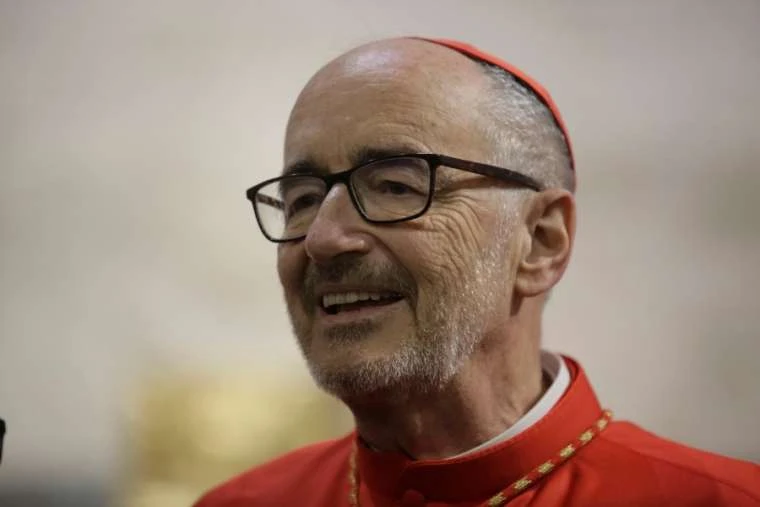
CNA Newsroom, Feb 10, 2025 / 09:30 am (CNA).
A prominent Vatican cardinal said on Monday that people are being “terrorized” by the U.S. government’s “crackdown” on immigration and freeze of Catholic-run aid programs.
Cardinal Michael Czerny, prefect of the Vatican’s Dicastery for Promoting Integral Human Development, told the Associated Press in an interview published Feb. 10 that U.S. measures affecting both migration policy and international aid programs are causing serious harm to vulnerable populations.
“A crackdown is a terrible way to administer affairs and much less to administer justice,” the Czech-born Canadian Jesuit said. “I’m very sorry that many people are being hurt and indeed terrorized by the measures.”
The cardinal’s comments coincided with a sharp rebuke from Caritas Internationalis, which on Monday strongly condemned what it called “the reckless decision by the U.S. administration to abruptly close USAID funded programs and offices worldwide.”
Caritas warned: “Stopping USAID will jeopardize essential services for hundreds of millions of people, undermine decades of progress in humanitarian and development assistance, destabilize regions that rely on this critical support, and condemn millions to dehumanizing poverty or even death.”
Catholic Relief Services — the U.S. Catholic Church’s primary aid agency and one of USAID’s recipients — has already raised concerns about the impact.
Czerny noted that smaller Catholic programs are also affected.
The Vatican official emphasized Pope Francis’ teaching that caring for migrants and vulnerable people is a fundamental Christian duty.
“What the Church teaches is very well summed up by Pope Francis, who says that our obligation, not only as Christians but as human beings, is to welcome people, to protect them, to promote them, and to integrate them,” Czerny said.
The Jesuit cardinal is the latest of several prelates to weigh in on U.S. immigration policy changes, which numerous Catholic leaders, including Pope Francis, have criticized as unjust.
On Feb. 7, Archbishop Joseph F. Naumann of Kansas City, Kansas, noted that “the Church does not have the authority or the responsibility to determine the legal status of those living in the United States” but does have “an obligation to care for every person with respect and love, no matter their citizenship status.”
At the same time, the Kansas archbishop offered a full-throated endorsement of prioritizing public safety threats in immigration enforcement.
If you value the news and views Catholic World Report provides, please consider donating to support our efforts. Your contribution will help us continue to make CWR available to all readers worldwide for free, without a subscription. Thank you for your generosity!
Click here for more information on donating to CWR. Click here to sign up for our newsletter.



Canadian Jesuit. Our Christian duty is, as Czerny says, to welcome, protect, promote, and integrate people. Why does Czerny preach only to the U.S.? Where are his judgmental words to Canada and the Vatican? They too do not advocate what Czerny preaches. Biden’s US government may have served as the world’s patsy-pocketbook, but
for the world to hope that all US presidents or citizens agree to serve at the world’s pleasure forever is a fool’s dream.
Dear cardinal, please mind your own business. A sovereign nation has the right, responsibility, and mandate to secure its borders. People who violate immigration law should feel afraid. That’s an appropriate response.
In truth of fact, it is this Vatican itself that has terrorized its own Catholic Church. The renoval of good, orthodox bishops like Strickland, kicking Cardinals like Burke out of their positions and apartments, suppressing Catholics’ access to the Extraordinary Form of the Mass, and promoting leftist/globalist ideology, etc are examples of the scorched-earth tactics of the Bergoglian Prince. Don’t dare tell us how to run the USA; our Church hierarchy has lost its moral highground a long, long time ago.
THIS IS NOT ABOUT MONEY!!
Right. Where was the outrage when Biden murdered worldwide with USAID money?
https://chrissmith.house.gov/news/documentsingle.aspx?DocumentID=411693
I don’t get why enforcing the law is now considered an act of terror. A jar can only hold so much before it either overflows or shatters, and the US is at that point. Illegal immigration into the US should have NEVER become an acceptable exception. I personally believe that even legal immigration through the port of entry should be limited.
Either way, legal or not, the United States should not be the dumping ground for all the world’s troubles, wars, and immigrants, and for any nation that criticizes the President Trump’s actions, have them open their own borders, and see how they like it after a couple years.